


Complex processes of soil formation describe major pedological pathways that create distinctive soil characteristics under particular environmental conditions. They differ from simple processes because several soil-forming actions operate together within one evolving soil profile.
These processes connect strongly with climate, rainfall, drainage, vegetation, parent materials, and landscape position. Their boundaries remain difficult to establish because one process can overlap another as environmental conditions change across the landscape.
Understanding these processes helps explain why soils formed in humid tropics differ from soils developed in cool forests or dry grasslands. It also clarifies patterns in soil horizons, colour, chemistry, and drainage.
The major forms considered in this article are lateritisation, podsolisation, calcification, and gleisation. Each process has recognizable conditions and characteristics, although they do not operate as completely separate systems within nature.
For farmers, students, planners, and environmental professionals, recognizing these processes provides a useful foundation for interpreting soil profiles. It also supports better decisions concerning land use, soil management, and conservation.
Complex Soil Formation Processes
Complex processes of soil formation usually reflect the combined influence of climate, water, vegetation, parent materials, relief, and time. Climate often provides the strongest basis for distinguishing these processes in different regions.
Water strongly affects weathering, leaching, mineral movement, and material deposition. Rainfall patterns therefore influence whether bases remain within the profile, move downward, or accumulate within particular horizons over time across the profile.
Vegetation contributes organic residues and controls biological activity at the soil surface. In humid regions, abundant plant growth can supply substantial litter, while rapid decomposition affects nutrient circulation and overall soil physical properties.
Topography influences drainage and groundwater conditions, especially in low-lying landscapes. Landscape position can therefore create environments where particular processes become dominant or where several processes operate simultaneously; soil properties and characteristics helps interpret these differences.
Complex processes should not be treated as mutually exclusive categories. A soil may show evidence of more than one process because environmental conditions vary through space, depth, season, and geological history.
Careful study of soil characteristics and their environmental setting helps distinguish these pathways. Physical properties, chemical reactions, profile development, moisture conditions, and drainage together reveal the dominant influences within local environmental media.
Read Also: The Six (6) Physical Properties of Soil
Lateritisation and Tropical Soil Development
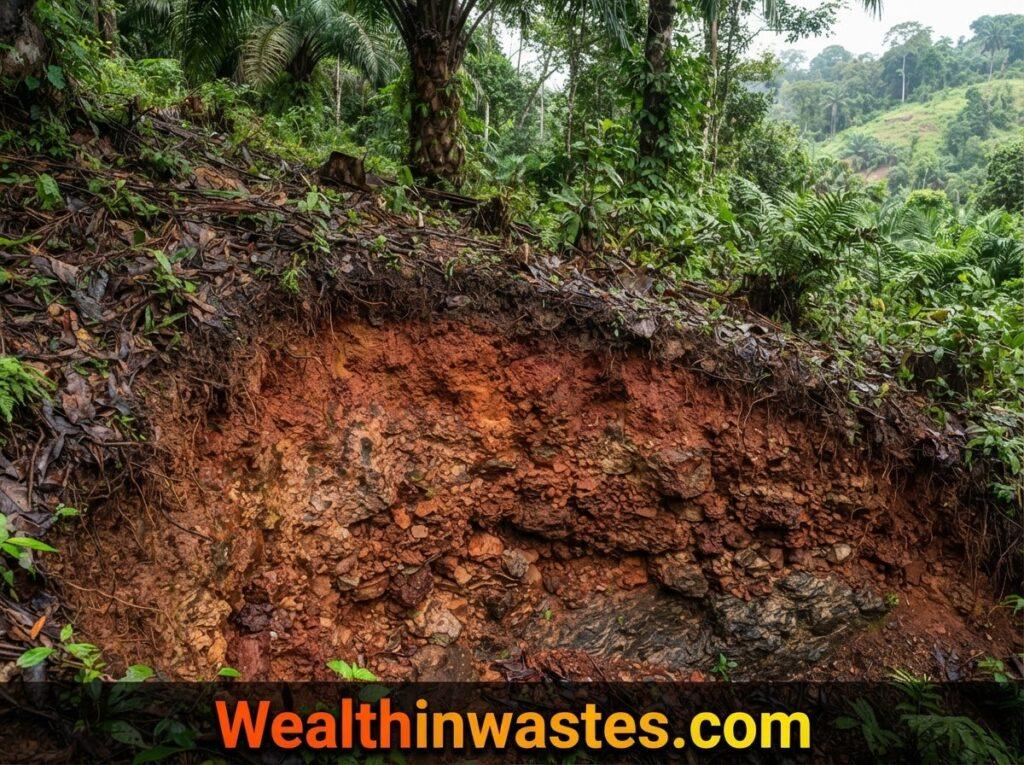
Lateritisation produces laterites and lateritic soils, also called latosols, oxisols, or ferruginous tropical soils. The process mainly develops under warm to hot humid conditions where weathering remains strong for long periods.
These environments commonly occur in equatorial, tropical, and monsoon climates. Luxuriant vegetation contributes abundant organic residues, while high temperatures and moisture encourage rapid biological and chemical activity within the soil constituents.
Topography also matters because landscape position influences groundwater conditions and the effective depth of the soil. Differences in drainage and soil depth can therefore modify the intensity of lateritic development.
1. Deep weathering: Long uninterrupted periods of rock weathering can produce deeply and intensely weathered parent material, leaving a thick soil mantle with strong evidence of prolonged chemical alteration over many years.
2. Rapid organic cycling: Leaf fall from luxuriant vegetation can decompose rapidly, helping maintain the circulation of bases and organic materials between vegetation and soil throughout the active surface layer under favourable climatic conditions.
3. Strong mineral alteration: Intense chemical weathering can release bases from remaining minerals while high-silicate clays such as montmorillonite and illite alter toward lower-silicate materials such as kaolinite during prolonged weathering.
4. Residual sesquioxides: Continued weathering can leave residues dominated by kaolin and iron and aluminium sesquioxides, with different degrees of hydration and mineral impurities that reflect prolonged tropical alteration within the remaining soil material.
5. Profile development: Lateritisation may produce either stratified or unstratified soil profiles, depending on parent material, weathering history, drainage conditions, and other environmental factors affecting soil resource management under tropical conditions.
Podsolisation and Cool Humid Conditions

Podsolisation contrasts with lateritisation because it commonly occurs in cool humid regions associated with Koppen’s C and D climates. The term derives from the Russian word podsol, meaning ash underneath.
The process produces podsols and podsolic soils with clearly differentiated profiles. Their horizons often show marked differences in appearance, physical properties, and chemical properties, especially where soil moisture conditions supports prolonged downward movement.
High soil acidity plays an important role in podsolisation. The source material associates the soil solution with a pH of about 3 to 4, promoting strong leaching of bases and colloids.
1. Base removal: Soluble bases, including metallic cations, can move away from colloidal surfaces and leave the solum through groundwater movement, producing strong depletion within upper soil layers from the surface horizon.
2. Sesquioxide movement: Aluminium and iron sesquioxides can become mobile and move downward, contributing to a lighter A2 horizon as materials are removed from upper layers through the upper profile.
3. Clay dispersion: Inorganic clays may become peptised, making them more susceptible to dispersion and downward movement when acidity, water flow, and surface chemistry favour continued translocation within the profile toward deeper horizons.
4. Illuvial B horizon: A deeper B horizon can develop through deposition of sesquioxides, bases, clay materials, and humus, especially as acidity declines during downward movement through the soil within the developing profile.
Clear horizon development makes podsolisation useful for understanding leaching and translocation. The process also demonstrates why soil chemical mobility and soil-water chemistry can strongly influence the appearance of cool humid soil profiles.
Calcification in Low-Rainfall Regions
Calcification is characteristic of low-rainfall environments, particularly continental interiors and grassland regions. It occurs prominently in temperate grasslands and other areas where evaporation can exceed precipitation over extended periods during long dry seasons.
The process involves downward movement of some soil solutions and materials, although strong leaching does not dominate. Instead, reduced rainfall and high evapotranspiration encourage carbonate accumulation within the soil profile.
Calcification commonly produces soils described as pedocals, reflecting the prevalence of lime. Calcium compounds can accumulate within the profile and form recognizable features that aid traditional soil classification interpretations within these drier landscapes.
1. Calcic horizon: A calcic horizon commonly develops within the B or C horizon, while a mollic surface horizon may contain abundant organic colloids saturated with calcium ions under suitable climatic conditions.
2. Lime accumulation: Lime becomes prominent within the soil, giving the resulting soils their pedocal character and distinguishing them from strongly leached soils formed under wetter conditions.
3. Water balance: Net soil-water loss occurs because evapotranspiration exceeds precipitation, limiting prolonged downward leaching and favouring retention or concentration of dissolved materials in the profile during much of the year.
4. Ion precipitation: Ions may precipitate in a sequence involving calcium and magnesium bicarbonates followed by calcium sulphates as soil-water conditions change and dissolved materials become concentrated within the soil solution.
5. Calcrete formation: Continued carbonate accumulation can produce a hardened crust known as calcrete, while broader integrative soil classification frameworks help explain diagnostic soil features in suitable grassland environments.
Gleisation and Poor Soil Drainage
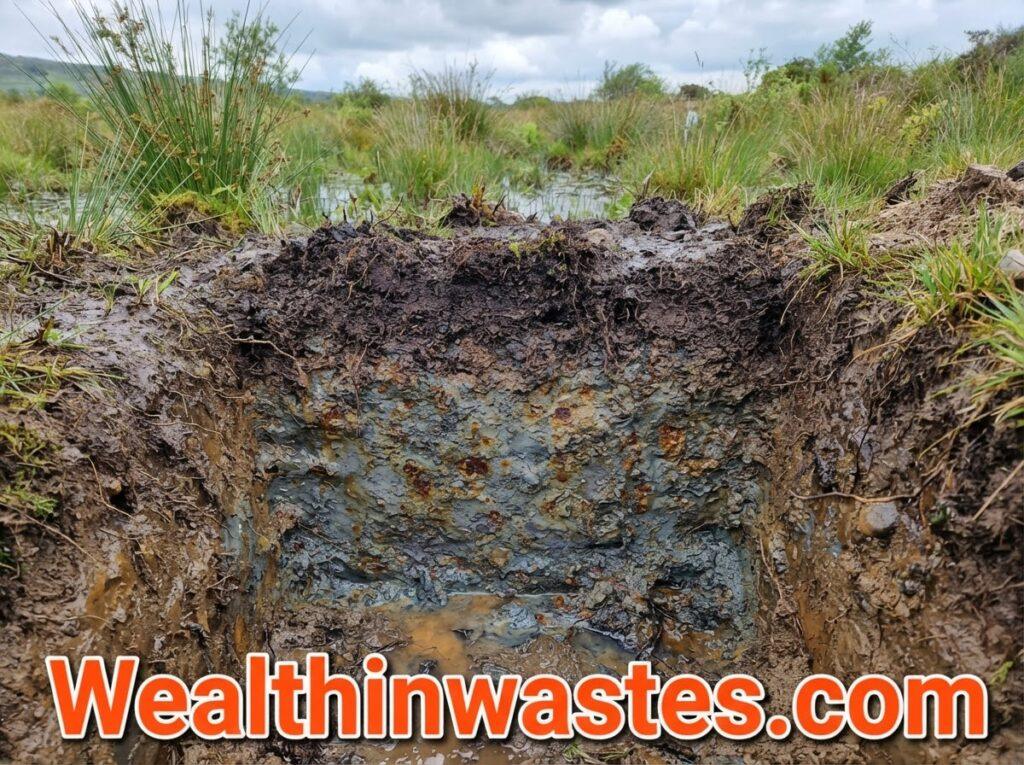
Gleisation occurs where drainage becomes impeded, allowing prolonged water saturation and reducing conditions to develop. Unlike the other processes discussed, it can occur under many climatic environments for extended periods.
Topographic position strongly affects gleisation. Valley bottoms, depressions, and swampy low-relief areas can retain water, creating conditions suitable for prolonged saturation within the soil profile and requiring careful soil drainage assessment.
Geology also influences the process where poorly drained clayey soils restrict water movement. Cold regions with permafrost can also develop drainage limitations that favour gleying conditions and persistent saturation in low-lying settings.
1. Soil mottling: Periodic drying can create mottled patterns within the soil because oxidation and reduction alternate as water levels rise and fall around individual soil particles within contrasting soil layers.
2. Surface-water gleying: An impervious horizon within the profile can restrict drainage and cause water to accumulate near the surface, producing surface-water gleying during prolonged wet conditions after repeated wetting and drying.
3. Groundwater gleying: An impervious layer beneath the active profile can maintain a high water table and produce groundwater gleying in deeper soil materials during prolonged saturation in deeper layers.
4. Grey soil colours: Prolonged saturation can create homogeneous grey or greyish-white soil colours as reducing conditions alter the forms and distribution of iron compounds within the upper soil during prolonged saturation.
5. Ferric mottles: Rust-coloured ferric oxide mottles commonly appear where drying allows oxidation, making mottling an important feature of many hydromorphic soils and related environmental effects of wastes where drainage remains restricted.
Climate Water and Soil Formation Controls
Climate provides a strong framework for distinguishing the major complex processes of soil formation. Temperature and rainfall affect chemical reactions, biological activity, weathering intensity, and water movement across rainfall-driven soil movement.
Warm humid conditions favour intense weathering and lateritisation, while cool humid conditions support strong leaching and podsolisation. Low rainfall promotes calcification through limited leaching and greater evapotranspiration within the profile.
Rainfall also influences soil water availability and movement. factors influencing soil moisture helps explain infiltration, percolation, saturation, evaporation, and the transfer of dissolved materials through different soil horizons over the growing season.
Drainage adds another important control. Well-drained slopes can develop differently from valley bottoms because water does not remain in the profile for equal periods, while soil properties affecting mobility show why pore conditions matter.
Vegetation modifies the soil environment through litter production, root activity, organic matter inputs, and biological cycling. These effects interact with climate and can influence acidity, decomposition, mineral alteration, and horizon development.
Time allows these interacting influences to produce recognizable profile characteristics. Long-term weathering, translocation, accumulation, and structural change therefore leave measurable evidence that helps identify dominant soil-forming processes and guide soil assessment.
Four Complex Soil Formation Processes Compared
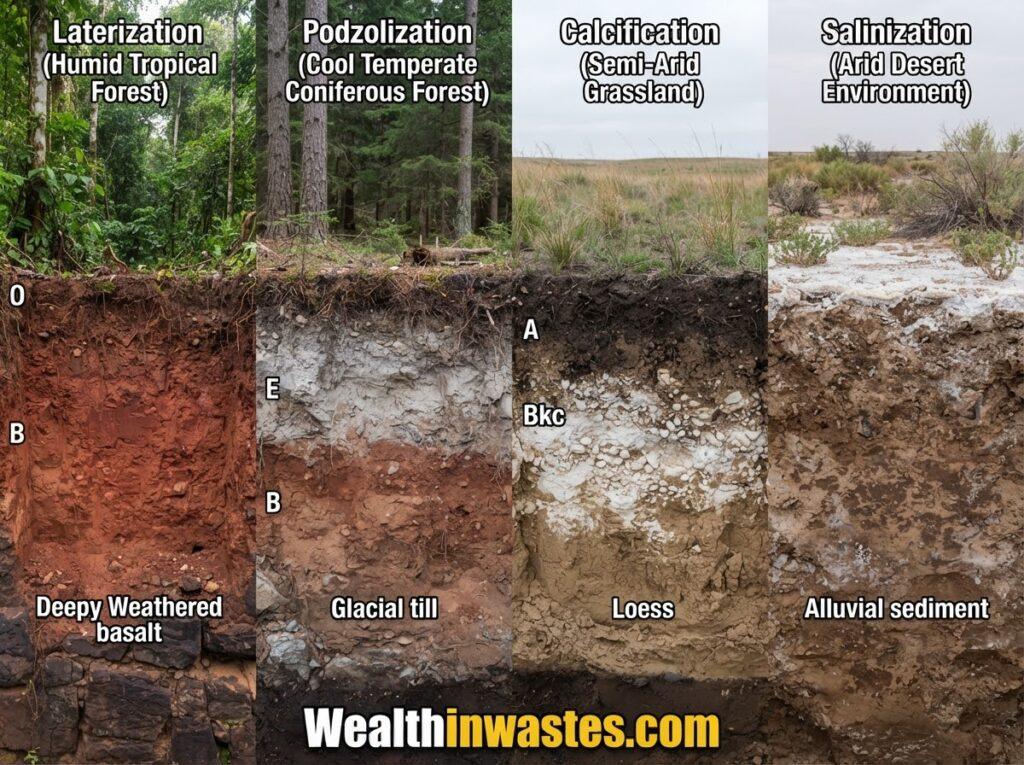
The four major processes can be compared by examining their dominant environmental settings, water conditions, and characteristic profile features. These comparisons make the differences easier to remember and apply during field interpretation.
Lateritisation is associated with warm, humid environments where intense weathering and vigorous vegetation promote deep alteration. Podsolisation occurs under cool humid conditions where strong acidity and leaching dominate, while water pollution pathways reveal profile contrasts.
Calcification develops where rainfall remains low and evapotranspiration exceeds precipitation. Gleisation develops wherever drainage remains impeded long enough for saturation, reduction, and distinctive mottling to affect the soil profile in contrasting landscapes.
The four processes also demonstrate different pathways for material movement. Lateritisation emphasizes residual weathering products, podsolisation emphasizes downward translocation, calcification emphasizes carbonate accumulation, and gleisation emphasizes waterlogged transformations reflected in pesticide movement through soil.
Although these processes have distinguishing characteristics, they can overlap within landscapes or through time. Environmental conditions can change, allowing one process to become less dominant while another becomes more important during long-term development.
Studying the contrasts alongside the three major soil types and their characteristics can strengthen understanding of how soil classification, formation, and environmental controls relate to one another, including wider hazardous substances in soil perspectives.
Why Complex Soil Formation Processes Matter
Knowledge of complex soil formation processes helps explain why soils differ across regions. It also provides a practical basis for interpreting soil profiles, assessing drainage, and understanding local soil behaviour within land resource dependence systems.
For agriculture, recognizing the dominant process can support more suitable land-use decisions. Soil depth, acidity, water movement, carbonate accumulation, and drainage conditions can influence crop selection, cultivation choices, and across farming landscapes.
Environmental professionals can also use soil-forming evidence to understand vulnerability. Strong leaching, waterlogging, carbonate accumulation, or intense weathering can affect nutrient movement and the stability of soil resources under changing land-use pressure.
Understanding formation processes also improves interpretation of soil properties. Texture, structure, colour, temperature, moisture, and profile development interact with pedological processes rather than operating independently within the soil environment over long periods.
Because soil develops gradually, management should protect the conditions that maintain its productive functions. Practical conservation must also consider agricultural land degradation risks, erosion, organic matter losses, and changing water conditions.
Finally, complex soil formation processes connect physical geography, soil science, agriculture, and environmental management. Their study reveals how climate, water, vegetation, and landscape interact over time, including pressures from oil exploration impacts and other disturbances.
Read Also: Soil Meaning and Soil Properties
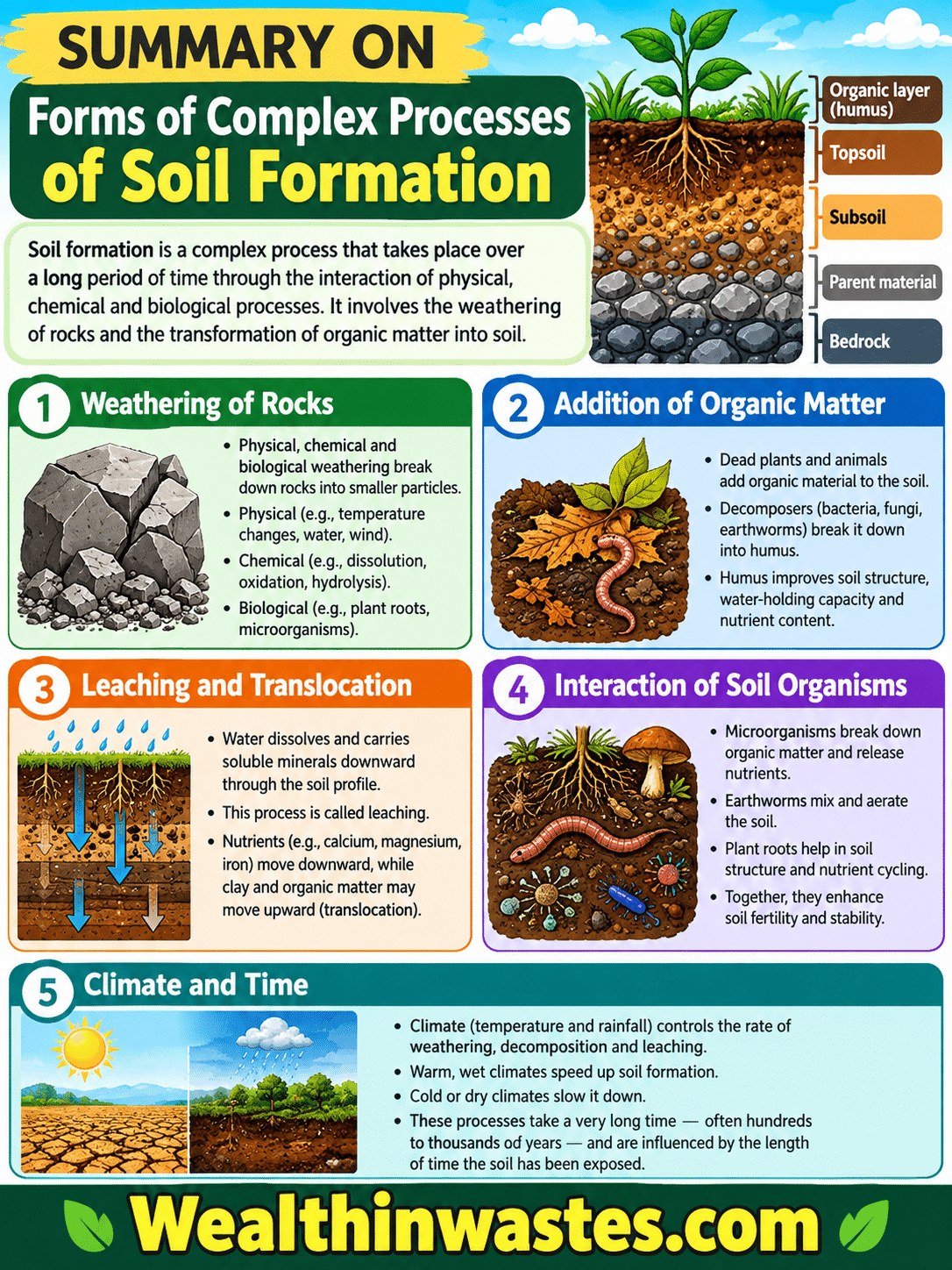
Summary on Forms of Complex Processes of Soil Formation Explained
| Process | Main Environment | Dominant Action | Key Features |
|---|---|---|---|
| Lateritisation | Warm to hot humid regions | Intense weathering and leaching | Deeply weathered material, kaolinite, iron and aluminium sesquioxides |
| Podsolisation | Cool humid regions | Strong leaching and downward translocation | Acidic conditions, lighter A2, developed illuvial B horizon |
| Calcification | Low-rainfall grasslands and continental interiors | Carbonate concentration and precipitation | Calcic horizon, pedocal character, calcrete |
| Gleisation | Impeded drainage environments | Prolonged saturation and reduction | Grey colours, mottles, hydromorphic features |
Frequently Asked Questions About Forms of Complex Processes of Soil Formation Explained
1. What are the four forms of complex processes of soil formation?
The four forms discussed are lateritisation, podsolisation, calcification, and gleisation. They develop under different combinations of climate, rainfall, vegetation, drainage, parent material, and landscape conditions.
2. Why are complex soil formation processes closely related to climate?
Climate controls temperature and rainfall, which strongly influence weathering, leaching, evapotranspiration, biological activity, and water movement through soil profiles over long periods and across contrasting geographic regions.
3. Where does lateritisation mainly occur and what does it produce?
Lateritisation mainly occurs in warm to hot humid tropical regions. It produces laterites and lateritic soils characterized by intense weathering and residual iron and aluminium compounds within deeply altered profiles.
4. What conditions favour podsolisation in natural soil environments?
Podsolisation favours cool humid environments where acidic soil solutions encourage strong leaching of bases, clay materials, aluminium, and iron compounds from upper horizons toward deeper parts of the soil profile.
5. What distinguishes calcification from the other complex soil processes?
Calcification develops mainly in low-rainfall regions where evapotranspiration exceeds precipitation, encouraging carbonate accumulation, calcic horizon development, and sometimes the formation of calcrete within suitable grassland and continental environments.
6. Why is gleisation associated with drainage rather than one specific climate?
Gleisation occurs where drainage remains impeded, causing prolonged saturation and reducing conditions. It can therefore develop in different climates wherever water remains within soil profiles for extended periods.
Do you have any questions, suggestions, or contributions? If so, please feel free to use the comment box below to share your thoughts. We also encourage you to kindly share this information with others who might benefit from it. Since we can’t reach everyone at once, we truly appreciate your help in spreading the word. Thank you very much for your support and for sharing!
Read Also: Soil Formation Processes in Agriculture