


Soil moisture describes the water held within soil pores and the unsaturated ground below the surface. It links rainfall, irrigation, plant growth, groundwater recharge, and the wider water cycle naturally.
Its level changes continuously as water enters through precipitation or irrigation and leaves through evaporation, plant transpiration, drainage, and surface runoff. These gains and losses determine how much moisture remains available for roots.
For farmers, gardeners, hydrologists, and environmental managers, soil moisture provides useful evidence about crop water needs, drought risk, drainage conditions, and how effectively rainfall replenishes the ground across different seasons.
A soil can look dry at the surface while retaining moisture deeper down; conversely, saturated topsoil can hide limited water deeper in the root zone where plants need it for healthy growth.
This article explains the meaning and importance of soil moisture, how soil stores water, what influences its level, and the main ways to measure and manage it responsibly in agricultural fields.
Definition and Importance of Soil Moisture
Soil moisture refers to water held within the soil profile and the unsaturated subsurface zone above the water table. In some places, this zone extends far below the main root area.
For most farming decisions, the upper soil layer matters most because plant roots absorb water and nutrients there, while organisms support decomposition and soil functions that sustain healthy growth throughout the growing season. These processes demonstrate the importance of soil in supporting plant life.
The amount present at any moment depends on the soil-water balance: rainfall, snowmelt, and irrigation add water, while evaporation, plant transpiration, drainage, and runoff remove or redistribute it within the broader water cycle.
Like other natural resources, soil moisture must be managed carefully because plants need water to photosynthesize, transport nutrients, regulate leaf temperature, and sustain growth during dry spells and hot weather.
Maintaining the right moisture level helps crops establish roots, supports soil organisms, and improves nutrient availability; however, either prolonged dryness or waterlogging can restrict healthy plant development and reduce yields.
Moisture conditions also affect land productivity, especially where rainfall is irregular or soils hold little water. Understanding the causes of moisture variation helps farmers plan crops and watering schedules efficiently.
Measuring soil moisture turns a visual guess into a useful estimate, allowing growers to compare field conditions, identify developing stress, and decide when irrigation or drainage action is necessary in time.
Read Also: Soil Conservation: Meaning, Categories and Soil Management Practices
Soil Moisture Storage and Plant Availability

Soil does not hold all its water in the same way. Some water clings tightly to soil particles, while other portions remain available to roots or drain under gravity.
1. Hygroscopic Water: Soil particles attract a very thin film of water that clings tightly to their surfaces. Plant roots cannot usually extract this water, even when soil feels damp to touch.
2. Capillary Water: Surface tension and attraction between water molecules and soil particles hold this water in small pores. It supplies much of the moisture that roots can absorb during plant growth.
3. Gravitational Water: After heavy rain or excessive irrigation, large pores may fill temporarily. Gravity then pulls surplus water downward, and good drainage prevents prolonged saturation around roots, which protects root function.
4. Field Capacity: This is the moisture remaining after excess gravitational water drains freely from the soil. It often represents a useful upper reference point for irrigation scheduling under many field conditions.
5. Permanent Wilting Point: At this low moisture level, plants cannot take up water quickly enough to recover from wilting. Some tightly held water remains, but roots cannot access it sufficiently.
6. Available Water: The difference between field capacity and the permanent wilting point approximates the water available to plants. Its amount depends on soil texture, structure, rooting depth, and crop type, which are important factors controlling soil moisture.
7. Soil-Water Storage: Water held within the root zone works like a reserve, increasing after rainfall or irrigation and declining as roots absorb water and surface evaporation removes moisture between irrigation events. Understanding this reserve also supports assessments of agricultural land suitability.
Factors That Affect Soil Moisture
1. Rainfall and Irrigation: Frequent, well-distributed rainfall generally replenishes soil moisture, while intense storms may create runoff before water enters the ground. Irrigation supplements rainfall when crop demand exceeds natural supply, while erosion processes can remove valuable soil and water.
2. Soil Texture: Sandy soils drain quickly, whereas clay-rich soils often retain more total water but may release it slowly. Soil texture therefore changes storage capacity and irrigation frequency for plants across different crop stages.
3. Soil Structure and Organic Matter: Well-aggregated soil often allows water to infiltrate while retaining moisture in smaller pores. Organic matter improves aggregation and storage, whereas compaction can restrict infiltration and root development.
4. Vegetation Cover: Leaves, roots, and plant residues shield the soil from direct sun and raindrop impact. Land-cover changes can alter infiltration, surface runoff, and how long moisture remains after rain.
5. Temperature and Wind: High temperatures, strong winds, and low humidity usually increase evaporation or plant water loss. Under these conditions, exposed soil dries faster, particularly when vegetation provides little shade or protection.
6. Slope and Drainage: Steep slopes can encourage rapid surface runoff, while poorly drained depressions may retain water for extended periods. Compacted layers and restrictive soil horizons also influence the movement of water downward.
7. Human Activities: Tree removal, intensive cultivation, construction, and sealed urban surfaces can reduce infiltration or increase rapid runoff. Deforestation and poorly managed urban development can therefore change moisture availability across landscapes.
Methods for Measuring Soil Moisture

1. Gravimetric Method: Collect a representative sample, weigh it wet, dry it at about 105°C until its mass becomes constant, and weigh again. Water mass divided by dry-soil mass, multiplied by 100, gives gravimetric moisture percentage.
2. Volumetric Water Content: This measurement expresses water volume relative to total soil volume, commonly as a percentage or cubic metres per cubic metre. Soil classification helps explain why different soil types retain different quantities of water.
3. Tensiometer Method: A tensiometer estimates how strongly the soil holds water by measuring soil-water tension. Farmers use the readings to guide irrigation, particularly in relatively wet soil conditions, although the instrument does not directly measure water content.
4. Electrical Resistance Blocks: These sensors estimate soil-water conditions through changes in electrical resistance. Their readings can also respond to temperature, salts, and soil contact, so users should calibrate them for reliable field interpretation.
5. Time-Domain Reflectometry: TDR instruments send electromagnetic signals through probes inserted into soil and estimate water content from the soil’s dielectric properties. This method supports repeatable measurements when suitable calibration and installation procedures are followed.
6. Capacitance and Frequency-Domain Sensors: These instruments estimate moisture by measuring electrical properties around inserted probes. They provide quick readings at selected depths, but soil texture, salinity, temperature, and calibration can influence their accuracy.
7. Neutron Probe Method: A neutron probe estimates soil moisture by detecting interactions associated with hydrogen in the soil. Because it uses a radioactive source, trained personnel must follow applicable radiation-safety requirements and regulations.
8. Remote Sensing: Satellites and other remote-sensing systems estimate moisture across large areas using measured signals. These estimates mainly represent near-surface conditions and often require ground measurements for local irrigation decisions.
For accurate interpretation, users should record sampling depth, soil type, location, date, and recent rainfall or irrigation. Consistent field records support meaningful comparisons and better soil resource assessment.
Soil Moisture Deficit and Excess Water
A soil moisture deficit occurs when water availability falls below plant requirements. Plants respond by closing their stomata, reducing water loss, but this response can also restrict photosynthesis and growth during prolonged drought.
Common signs of moisture stress include wilting leaves, slower growth, reduced leaf expansion, premature leaf shedding, and poor crop development. However, symptoms can resemble nutrient deficiencies, so field measurements help identify the underlying problem.
Excess soil moisture creates a different challenge because water fills pores that normally contain air. Prolonged saturation limits oxygen supply to roots and can contribute to waterlogging and soil salinization under unsuitable drainage conditions.
Excess water can also move fertilizers, pesticides, and sediments away from fields. This runoff may contribute to water pollution and increase erosion, flooding, and sediment movement downstream.
Soil moisture also influences how agricultural chemicals dissolve and travel through soil. Understanding the factors controlling pesticide movement and the soil properties that affect chemical mobility helps reduce contamination risks.
Farmers should distinguish drought stress from poor drainage before choosing corrective measures. Additional irrigation cannot solve waterlogging, while drainage improvements alone cannot replace water lost during prolonged dry weather.
Practical Ways to Improve Soil Moisture
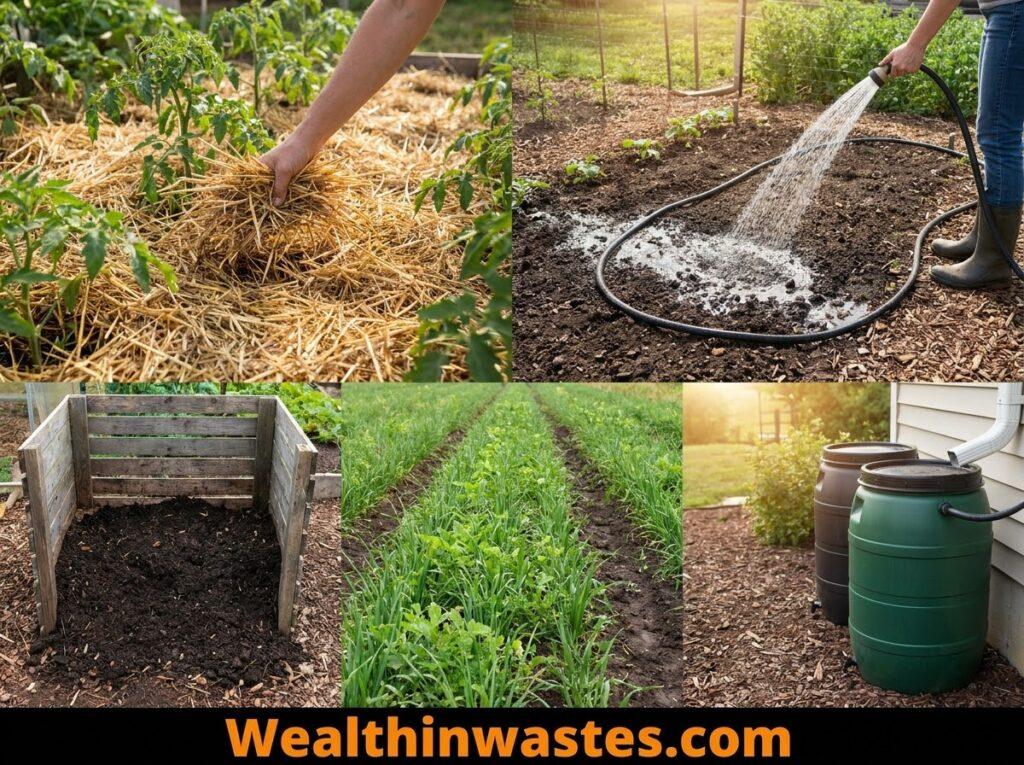
1. Monitor Soil Moisture Regularly: Check conditions at several points and depths within the root zone. Use suitable instruments or careful soil assessments to decide when crops need water rather than relying solely on appearance.
2. Add Organic Matter: Properly matured compost can improve soil aggregation, porosity, and water-holding capacity. Converting organic waste into compost provides a practical way to improve soil condition and moisture retention.
3. Apply Mulch: Cover exposed soil with suitable plant residues or other safe organic materials. Mulching reduces direct solar exposure, slows surface evaporation, limits weed competition, and helps maintain more stable moisture near roots.
4. Retain Crop Residues: Leaving suitable residues on the field protects the surface from raindrop impact and sunlight. Responsible management of agricultural residues can support moisture conservation and reduce unnecessary waste.
5. Improve Irrigation Practices: Apply water according to crop requirements, current soil moisture, rooting depth, and expected weather. Drip systems and well-managed sprinklers can reduce losses when properly installed, scheduled, and maintained.
6. Protect Vegetation Cover: Cover crops, suitable grasses, and other protective vegetation reduce direct exposure and slow runoff. Select species that complement the main crop and avoid excessive competition for limited soil water.
7. Maintain Good Drainage and Soil Structure: Prevent unnecessary compaction, manage field traffic, and maintain appropriate drainage channels. These actions help water enter the soil, reach roots, and drain when excess moisture threatens plant health.
Read Also: Practical Guide to Proper Water Resource Management
Soil Moisture in Agriculture and Ecosystems

Soil moisture influences agricultural productivity because crops need water throughout germination, vegetative growth, flowering, fruit development, and grain filling. The timing and quantity of water available can affect yield, quality, and harvest success.
Different crops have different water requirements, and their needs change with growth stage, root depth, temperature, and rainfall. Farmers can improve irrigation decisions by understanding crop water requirements and irrigation management.
Soil moisture also affects nutrient availability because roots generally absorb many nutrients through soil water. When moisture becomes inadequate, nutrient movement toward roots can decline, even where the soil contains sufficient nutrients.
Beyond agriculture, soil moisture supports soil organisms, decomposition, vegetation growth, and the exchange of water between land and atmosphere. Its influence on infiltration and evaporation also affects runoff patterns and local environmental conditions.
Moisture storage contributes to watershed functions by allowing some rainfall to enter the ground instead of immediately flowing across the surface. Good land management protects this process and supports the sustainable management of freshwater resources.
Monitoring soil moisture therefore benefits farmers, gardeners, researchers, and environmental managers. Reliable measurements support efficient irrigation, early identification of water stress, improved drainage, and responsible management of soil and water resources.
Summary on Definition, Measurement and Importance of Soil Moisture
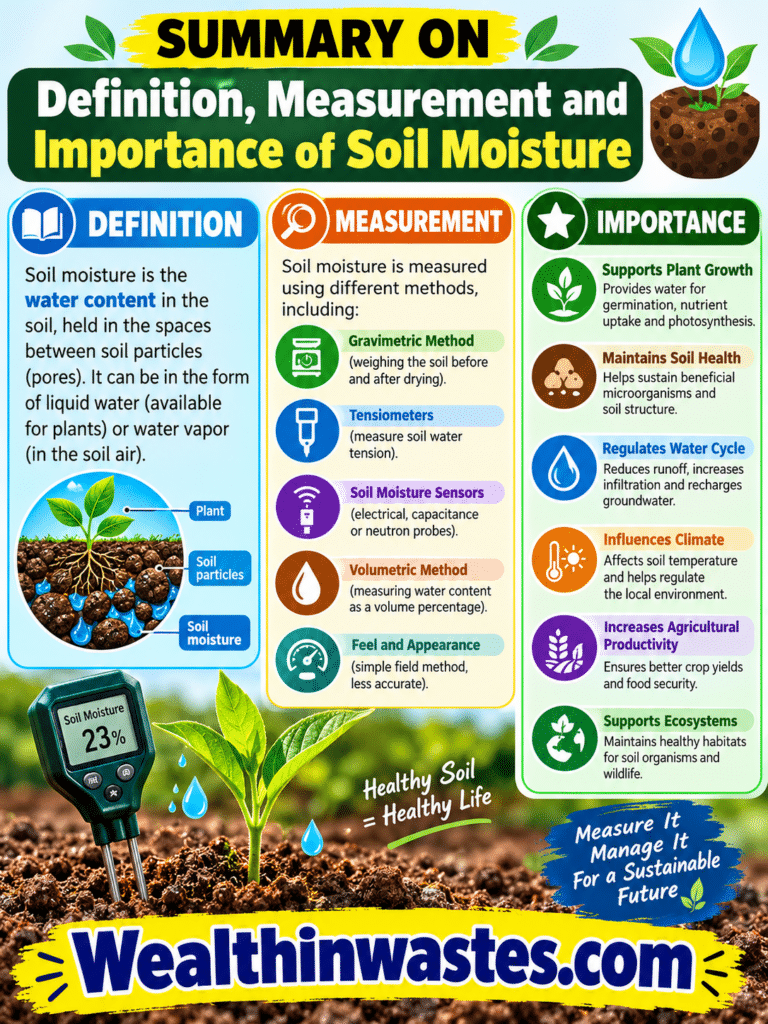
| Aspect | Summary |
|---|---|
| Definition | Water held within soil pores and the unsaturated zone below the ground surface. |
| Importance | Supports plant growth, nutrient uptake, soil organisms, and agricultural productivity. |
| Water Storage | Includes hygroscopic, capillary, and gravitational water, with different levels of availability to plants. |
| Field Capacity | The water remaining after excess gravitational water drains from the soil. |
| Permanent Wilting Point | A moisture level at which plants cannot extract enough water to recover from wilting. |
| Influencing Factors | Rainfall, irrigation, soil texture, organic matter, vegetation, temperature, wind, slope, and drainage. |
| Measurement Methods | Gravimetric testing, tensiometers, resistance blocks, TDR, capacitance probes, neutron probes, and remote sensing. |
| Moisture Deficit | Insufficient water for plant requirements, which can restrict growth and reduce yields. |
| Excess Moisture | May cause waterlogging, oxygen shortages around roots, runoff, and soil degradation. |
| Management | Monitoring, mulching, compost application, efficient irrigation, vegetation cover, and appropriate drainage. |
Frequently Asked Questions About Soil Moisture: Definition, Measurement and Importance
1. What Is Soil Moisture?
Soil moisture is the water held within soil pores and the unsaturated ground below the surface.
2. Why Is Soil Moisture Important?
It supports plant growth, nutrient uptake, soil organisms, crop productivity, and the movement of water through the environment.
3. What Is Field Capacity?
Field capacity is the moisture remaining after excess gravitational water drains freely from the soil.
4. What Is the Permanent Wilting Point?
It is the soil moisture level at which plants cannot extract enough water to recover from wilting.
5. What Is the Main Method of Measuring Soil Moisture?
The gravimetric method is a common reference method that estimates moisture from the loss in sample weight after oven drying.
6. Can Excess Soil Moisture Harm Plants?
Yes. Prolonged saturation restricts oxygen around roots and may cause waterlogging, poor growth, and root damage.
7. How Can Farmers Conserve Soil Moisture?
Farmers can use mulch, compost, cover crops, suitable irrigation schedules, regular moisture monitoring, and appropriate drainage.
8. How Often Should Soil Moisture Be Measured?
Measurement frequency depends on crop needs, weather, soil characteristics, irrigation practices, and the monitoring equipment available.
Do you have any questions, suggestions, or contributions? If so, please feel free to use the comment box below to share your thoughts. We also encourage you to kindly share this information with others who might benefit from it. Since we can’t reach everyone at once, we truly appreciate your help in spreading the word. Thank you very much for your support and for sharing!
Read Also: Principles and Methods of Soil and Water Conservation