


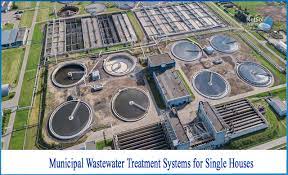
Many everyday activities, including bathing, doing laundry, flushing toilets, preparing meals, washing dishes, and cleaning household items, generate wastewater that eventually enters drainage or sewage systems.
Although wastewater disappears from homes through drains, its journey does not end there. It contains organic materials, nutrients, microorganisms, chemicals, and other substances requiring appropriate treatment before environmental discharge.
Domestic wastewater, commonly associated with sewage, can contain harmful bacteria, viruses, suspended solids, nutrients, and household chemicals. Without proper management, these contaminants can pollute soil and water resources.
Wastewater treatment protects public health by reducing harmful substances before treated effluent is discharged or reused. Proper treatment also protects rivers, lakes, groundwater, wetlands, and other valuable environmental resources.
The treatment method selected depends on wastewater characteristics, expected flow, available land, environmental requirements, financial resources, and the intended destination or reuse application of the treated water.
Understanding wastewater treatment objectives and operating principles is therefore important for households, communities, industries, agricultural enterprises, and authorities responsible for protecting water quality and maintaining sanitary conditions.
In areas with adequate infrastructure, centralized treatment facilities can receive wastewater continuously and process it through several treatment stages before discharge or beneficial reuse.
Where centralized sewerage is unavailable or unsuitable, properly designed onsite systems can provide wastewater treatment and disposal. Such systems require careful assessment of soil, groundwater, land, and wastewater flows.
Wastewater Treatment Objectives
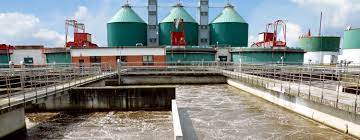
Wastewater treatment is designed to remove or reduce pollutants that could create health hazards, environmental degradation, unpleasant conditions, or unacceptable effects when wastewater enters receiving environments.
The specific treatment objectives depend on wastewater composition, discharge requirements, available treatment technology, environmental sensitivity, and whether the final water will be discharged, reused, or further treated.
1. Remove sediments:
Initial treatment removes large objects, grit, sand, and settleable materials that could obstruct pipes, damage mechanical equipment, reduce treatment efficiency, or accumulate unnecessarily inside later treatment units.
2. Remove organic matter:
Wastewater contains biodegradable organic substances that microorganisms can decompose. Treatment reduces biochemical oxygen demand, helping prevent excessive oxygen depletion in rivers, streams, lakes, and other receiving waters.
3. Remove nutrients:
Nitrogen and phosphorus can stimulate excessive plant and algae growth when discharged in large quantities. Nutrient removal helps reduce eutrophication and protects the ecological balance of receiving water bodies.
4. Remove or inactivate pathogens:
Pathogens such as disease-causing bacteria, viruses, protozoa, and other microorganisms must be reduced or inactivated to minimize risks associated with environmental exposure and inappropriate wastewater reuse.
Effective treatment begins with understanding wastewater composition and flow. Detailed wastewater characteristics and flow information helps engineers determine suitable treatment processes and system capacities.
Flow variations are also important because treatment units must accommodate changing wastewater quantities without losing efficiency. Proper hydraulic assessment helps prevent overloading, inadequate treatment, and operational instability.
Wastewater may be processed through several treatment levels, including preliminary or pretreatment, primary, secondary, tertiary, and disinfection stages, depending on the required quality of final effluent.
Preliminary treatment commonly removes large debris and grit, while primary treatment relies mainly on physical separation. Secondary treatment uses biological processes to reduce biodegradable organic matter.
Tertiary treatment provides additional polishing where necessary, particularly when nutrient removal, advanced solids removal, or other specific water-quality objectives are required for discharge or reuse.
Disinfection provides an additional barrier against microorganisms remaining after earlier treatment processes. Depending on the facility, methods may include chlorination, ultraviolet treatment, or other suitable technologies.
Table 13 summarizes common wastewater treatment levels and their principal objectives. The exact configuration varies among facilities because treatment systems are designed according to specific wastewater characteristics and requirements.
Table 13: Levels of Wastewater Treatment and Their Objectives
| Level | Objective |
|---|---|
| Pre-treatment | Remove large objects, sand, grit, and other materials that could interfere with subsequent treatment processes. |
| Primary | Remove settleable and suspended solids through physical processes, while reducing part of the organic load. |
| Secondary | Use biological processes to reduce biodegradable organic matter and associated pollutants remaining after primary treatment. |
| Tertiary | Provide additional treatment for nutrients, fine solids, specific organic compounds, or other pollutants requiring advanced removal. |
| Disinfection | Reduce or inactivate disease-causing microorganisms remaining after preceding treatment stages. |
Read Also: Wastewater Treatment Options
Operations of a Wastewater Treatment Plant
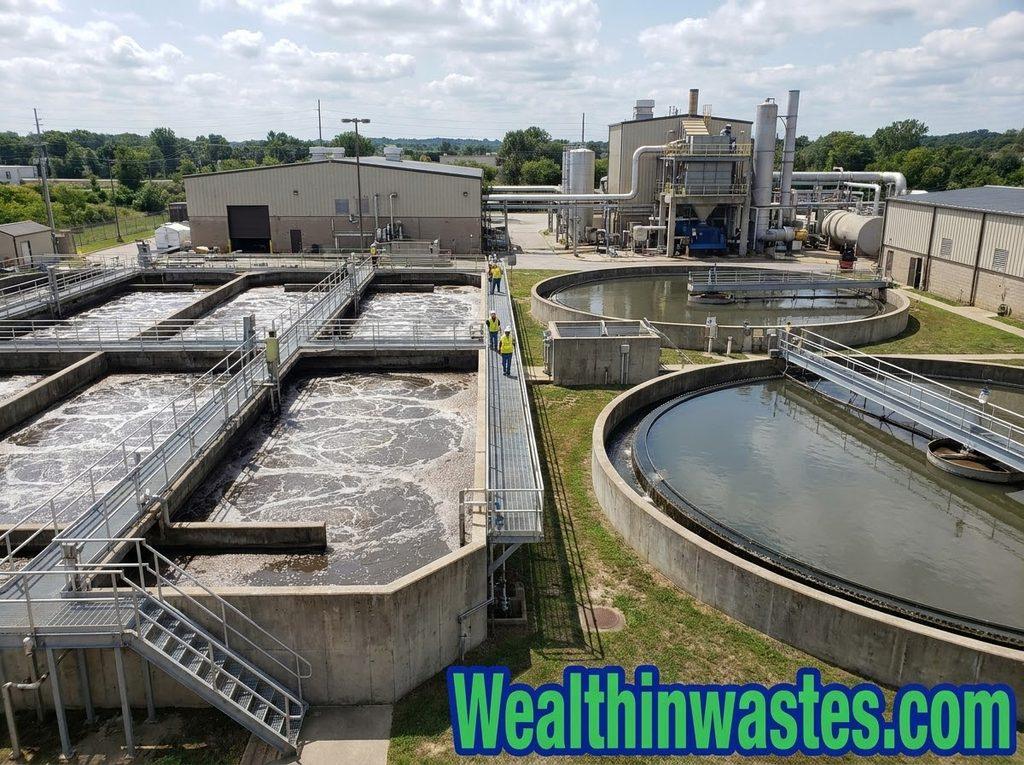
Wastewater treatment plants receive incoming wastewater, commonly called influent, and process it through controlled physical, biological, and sometimes chemical operations designed to produce an acceptable final effluent.
Domestic wastewater originates mainly from households and includes water discharged from toilets, bathrooms, kitchens, laundry activities, sinks, and other domestic uses within buildings.
Wastewater is predominantly water by weight, but the relatively small fraction of dissolved and suspended contaminants can create serious environmental and public health problems without appropriate treatment.
Treatment facilities normally operate continuously because wastewater generation occurs throughout the day. Continuous operation allows incoming flows to be received, treated, monitored, and discharged safely.
The first stages normally focus on protecting equipment and removing materials that could interfere with later treatment. Screening and grit removal are therefore important preliminary operations.
Screening removes larger materials such as plastics, rags, sticks, sanitary products, and other debris. Grit removal targets heavier inorganic particles such as sand and small stones.
Primary sedimentation then allows heavier suspended materials to settle while lighter floatable substances can be removed from the wastewater surface. These processes reduce the pollutant load entering biological treatment.
Detailed information about sedimentation in wastewater treatment is important because settling performance affects downstream treatment efficiency and the quantity of sludge generated.
Secondary treatment usually depends on microorganisms that consume biodegradable organic substances under controlled environmental conditions. Biological systems may use suspended-growth or attached-growth processes, depending on plant design.
The conventional sewage treatment process commonly combines physical and biological operations to reduce pollutants before effluent is released into a receiving environment.
Tertiary or advanced treatment can follow secondary treatment when stricter effluent standards apply. It may target nutrients, fine particles, dissolved substances, pathogens, or specific contaminants requiring additional removal.
Modern facilities may incorporate advanced membrane technologies for specialized applications. For example, ultrafiltration processes can support advanced separation and production of higher-quality treated water.
Disinfection provides final microbial control when required. Operators must monitor treatment performance carefully because inadequate treatment can result from hydraulic overloading, equipment failure, poor maintenance, or process instability.
Accurate flow information is important when designing and operating treatment systems. Wastewater flow estimation methods help determine hydraulic requirements and appropriate treatment capacity.
Sludge is another major output of wastewater treatment. Solids removed during treatment must be thickened, stabilized, dewatered, reused, or disposed of through methods appropriate to their characteristics.
Wastewater treatment plants therefore function as important components of water pollution control. Their performance depends on sound design, proper operation, regular maintenance, skilled personnel, monitoring, and reliable infrastructure.
On-Site Disposal and Treatment System
An onsite wastewater treatment and disposal system treats wastewater close to where it is generated rather than transporting the entire wastewater flow through a centralized municipal treatment network.
Onsite systems are especially useful in areas where centralized sewerage infrastructure is unavailable, impractical, too expensive, or unsuitable because of geographical or settlement conditions.
Each onsite system must be designed for the characteristics of its particular site and the volume of wastewater expected. Site conditions can differ significantly even between nearby properties.
A proper site investigation should consider soil properties, topography, available land area, expected wastewater generation, groundwater conditions, nearby surface waters, and existing infrastructure before system selection.
1. Soil conditions:
Soil texture, structure, permeability, depth, drainage properties, and restrictive layers influence how effectively wastewater can move through the ground and receive additional treatment during disposal.
2. Topography and lot size:
Land slope, available space, property boundaries, and site layout influence where treatment components can safely be installed while maintaining required separation distances from sensitive areas.
3. Groundwater conditions:
The depth of groundwater and seasonal groundwater fluctuations must be considered because insufficient separation can increase contamination risks and interfere with effective treatment and disposal.
4. Nearby water resources:
Wells, rivers, streams, springs, ponds, lakes, and drainage channels must be identified because poorly located systems can allow untreated or inadequately treated wastewater to reach sensitive water resources.
5. Wastewater quantity:
The expected wastewater flow must be estimated accurately because an undersized system may become overloaded, whereas unnecessary oversizing can increase construction and maintenance costs without proportional benefits.
Onsite systems commonly involve a septic tank followed by a subsurface soil absorption or disposal area. The tank provides preliminary treatment while the soil system provides additional treatment and dispersal.
The suitability of onsite treatment depends heavily on site conditions. Detailed wastewater reuse and onsite management considerations can help explain why treatment requirements differ among locations and applications.
Soil percolation testing or a suitable soil profile evaluation can provide information about how quickly water moves through the soil. This information helps determine whether a proposed disposal area is suitable.
Some sites may have severe limitations caused by shallow groundwater, impermeable soils, steep terrain, insufficient land area, flooding potential, or proximity to sensitive water resources.
Where conventional systems are unsuitable, alternative treatment or disposal technologies may be considered. The selected technology should provide adequate treatment while satisfying applicable environmental, public health, and planning requirements.
Proper operation is essential after installation. Household occupants should avoid practices that overload the system, introduce unsuitable materials, damage treatment components, or interfere with normal biological treatment processes.
Regular inspection and maintenance can extend system life and prevent avoidable failures. Septic tanks, pumps, filters, distribution components, and disposal areas should be monitored according to the system’s design requirements.
Effective onsite management is part of broader water and wastewater management, which aims to protect water resources while ensuring wastewater is safely collected, treated, reused, or disposed of.
In some circumstances, treated wastewater may be suitable for beneficial reuse after appropriate treatment and risk assessment. Reuse can reduce freshwater demand, but the required treatment level depends strongly on its intended application.
For agricultural applications, wastewater management should be handled carefully because untreated or inadequately treated wastewater can introduce pathogens, nutrients, salts, chemicals, and other contaminants into agricultural environments.
Agricultural enterprises can also learn from broader resource conservation approaches. Soil and water conservation practices support responsible management of valuable land and water resources.
Where adverse environmental or physical conditions make onsite disposal inappropriate, authorities may reject the proposed system or require an alternative design that provides better protection for public health and environmental resources.
Ultimately, effective wastewater treatment depends on matching treatment technology with wastewater characteristics, hydraulic conditions, site limitations, environmental objectives, available resources, and the intended final use or disposal method.
Read Also: Objectives of Water Treatment and Water Treatment Processes
Importance of Proper Wastewater Management
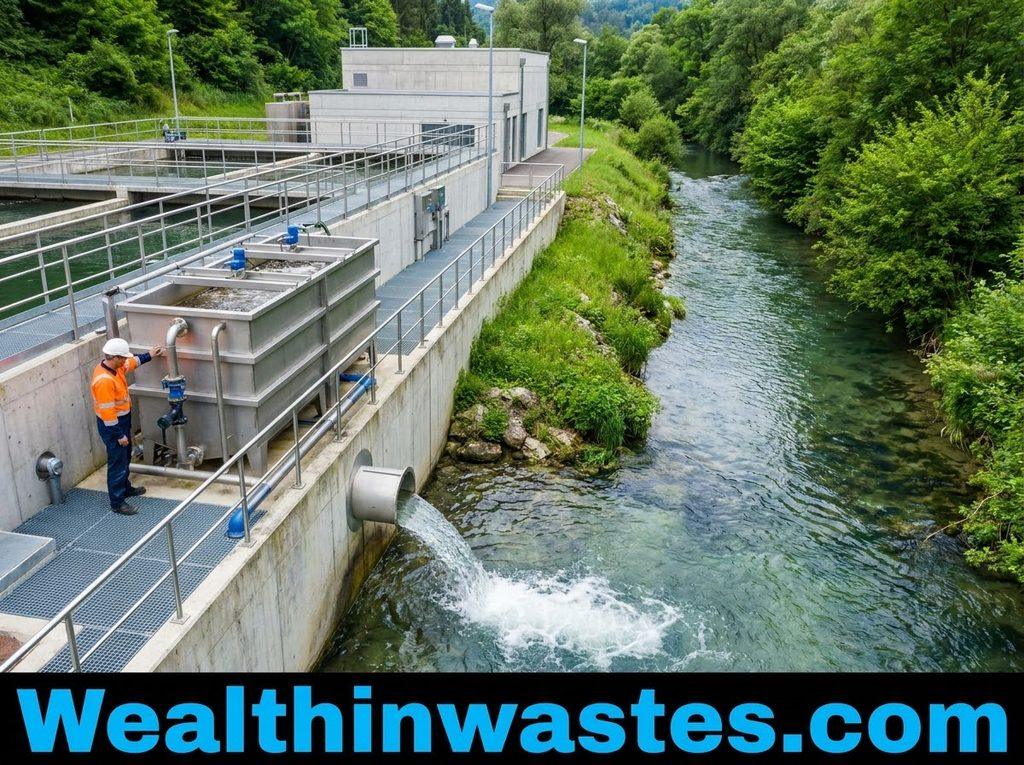
Proper wastewater management is essential because untreated wastewater can carry pollutants into environmental systems where they may create health risks, degrade ecosystems, and reduce the quality of available water resources.
Wastewater management begins with appropriate collection and continues through treatment, monitoring, discharge, reuse, and management of treatment residues. Each stage contributes to the overall effectiveness of pollution control.
One major benefit is protection of surface water. Rivers, streams, ponds, lakes, and reservoirs can suffer serious pollution when untreated sewage or inadequately treated effluent enters them.
Groundwater also requires protection because contamination can persist for long periods and may affect wells used for domestic, agricultural, and other purposes.
Proper wastewater treatment additionally reduces the spread of infectious diseases. Removing or inactivating pathogens lowers the likelihood that contaminated water will expose people through direct or indirect contact.
Nutrient control is another important objective because excessive nitrogen and phosphorus can contribute to eutrophication, algal growth, reduced oxygen conditions, and ecological disturbances in receiving waters.
Wastewater treatment can also support water reuse. Properly treated effluent may provide an alternative source for certain non-potable applications, reducing pressure on freshwater resources.
The potential for reuse is examined extensively in wastewater recycling and reuse systems, where treatment requirements are matched with the risks and intended applications.
Industrial facilities require special attention because their wastewater can contain distinctive contaminants, including oils, solvents, metals, nutrients, salts, and other substances that may require specialized treatment.
The industrial wastewater treatment process demonstrates why treatment systems must be selected according to the specific composition and pollutant characteristics of industrial effluents.
Sound wastewater management can provide economic benefits by reducing pollution-related costs, protecting productive water resources, supporting water reuse, and reducing damage associated with environmental degradation.
Communities also benefit when wastewater infrastructure is properly designed, maintained, and monitored. Reliable systems contribute to healthier settlements, cleaner surroundings, and improved confidence in available environmental resources.
Effective management requires suitable policies, technical expertise, financial investment, public awareness, regulatory enforcement, routine maintenance, and responsible behaviour from wastewater generators and system operators.
Modern treatment facilities may also create economic opportunities through resource recovery, wastewater reuse, sludge management, equipment supply, plant operation, maintenance, and other supporting services.
Some wastewater-related activities can even become specialized enterprises. Businesses involved in treatment services and recovery should, however, meet applicable technical, environmental, and public health requirements.
Overall, wastewater management should be considered an essential environmental service rather than merely a disposal activity. Its purpose is to protect people, conserve water, and reduce pollution.
Factors to Consider Before Selecting an On-Site Wastewater System
Choosing an onsite wastewater treatment system requires careful evaluation because no single technology is suitable for every property, wastewater type, soil condition, climate, groundwater situation, or settlement pattern.
The quantity of wastewater generated is one of the first considerations. System capacity should correspond with expected daily flows, peak flows, household occupancy, and potential future changes.
Wastewater characteristics also influence treatment requirements. Domestic sewage usually differs from industrial or agricultural wastewater, which may contain additional contaminants requiring specialized treatment or pretreatment.
Available land area affects system selection because some treatment and soil disposal technologies require substantial space. Small properties may need compact or advanced systems.
Soil permeability is particularly important where treated effluent will be dispersed through soil. Very slow or very rapid movement can create design and performance problems.
Groundwater depth should also be assessed carefully. A disposal system installed too close to groundwater may increase contamination risks and may fail to provide adequate treatment conditions.
Topography can influence gravity flow, excavation requirements, pumping needs, drainage patterns, and the location of treatment units relative to buildings and property boundaries.
Nearby wells and surface water bodies must be identified before installation. Appropriate separation distances help reduce the possibility of contaminating drinking-water sources and environmentally sensitive areas.
Local regulations and approval requirements should be considered before construction. Authorities may specify acceptable technologies, minimum distances, testing procedures, maintenance requirements, and discharge standards.
Available funding is another practical consideration. Installation costs, electricity requirements, maintenance expenses, replacement components, sludge removal, and long-term operating costs should be assessed before selecting a system.
Climate and seasonal conditions may also affect performance. Flooding, heavy rainfall, seasonal groundwater changes, temperature fluctuations, and prolonged dry conditions can influence system operation.
Water conservation can reduce wastewater generation and help smaller systems manage hydraulic loading. Efficient household water use can therefore complement appropriate wastewater treatment and disposal practices.
Wastewater flow assessment is particularly valuable during system planning. Reliable information about expected flow patterns supports appropriate sizing and reduces the likelihood of hydraulic overload.
Long-term maintenance should be considered from the beginning. A system may perform poorly when owners cannot obtain replacement components, technical assistance, electricity, or routine inspection services.
Ultimately, the best onsite wastewater system is one that provides adequate treatment, fits the available site, protects public health, satisfies environmental requirements, and can be operated sustainably over time.
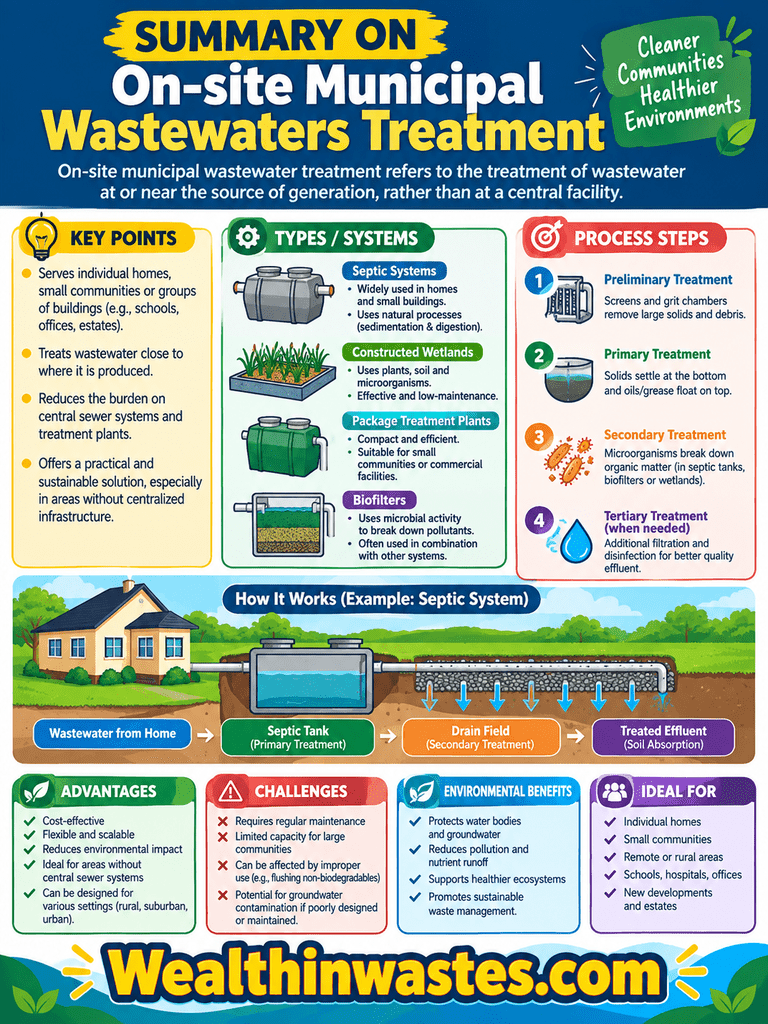
Summary on On-site Municipal Wastewaters Treatment
| Topic | Summary |
|---|---|
| Wastewater | Wastewater is water contaminated through domestic, commercial, industrial, agricultural, or other human activities and requires suitable management before discharge or reuse. |
| Treatment Objective | The main objectives are reducing solids, organic matter, nutrients, pathogens, and other pollutants that may harm people or the environment. |
| Pre-treatment | Removes large objects, grit, sand, and materials that can interfere with later treatment stages. |
| Primary Treatment | Uses physical processes, especially settling, to remove suspended and settleable solids and reduce part of the organic load. |
| Secondary Treatment | Uses biological processes to reduce biodegradable organic matter and associated pollutants remaining after primary treatment. |
| Tertiary Treatment | Provides additional treatment for nutrients, fine solids, specific contaminants, or applications requiring higher-quality effluent. |
| Disinfection | Reduces or inactivates disease-causing microorganisms remaining after other treatment stages. |
| Onsite Systems | Treat wastewater close to where it is generated and are useful where centralized sewerage is unavailable or impractical. |
| Site Assessment | Considers soil, groundwater, topography, lot size, wastewater flow, nearby water sources, regulations, and other site conditions. |
| Environmental Protection | Proper wastewater management protects public health, water resources, ecosystems, and communities while supporting safe water reuse. |
Frequently Asked Questions About Wastewater Treatment Objectives, Operations, and On-Site Disposal Systems
1. What is wastewater?
Wastewater is water contaminated through domestic, commercial, industrial, agricultural, or other activities and containing substances that require treatment before safe discharge or appropriate reuse.
2. Why does domestic wastewater require treatment?
Domestic wastewater can contain pathogens, organic matter, nutrients, suspended solids, and chemicals that may contaminate water resources and create risks to human and environmental health.
3. What are the main objectives of wastewater treatment?
The main objectives include removing sediments, reducing organic matter, controlling nutrients, reducing pollutants, and removing or inactivating disease-causing microorganisms.
4. What is primary wastewater treatment?
Primary treatment mainly uses physical processes such as sedimentation to remove settleable and suspended solids before wastewater proceeds to subsequent treatment stages.
5. What is secondary wastewater treatment?
Secondary treatment generally uses biological processes in which microorganisms break down biodegradable organic substances, thereby reducing the organic pollution remaining after primary treatment.
6. What is tertiary wastewater treatment?
Tertiary treatment provides additional pollutant removal after secondary treatment and may target nutrients, fine solids, specific chemicals, pathogens, or other contaminants.
7. What is an onsite wastewater treatment system?
An onsite system treats and disposes of wastewater close to its point of generation, commonly serving individual properties or small facilities without centralized sewer connections.
8. What factors affect onsite wastewater system selection?
Important factors include soil conditions, groundwater depth, topography, available land, wastewater quantity, wastewater quality, nearby water resources, local regulations, costs, and maintenance requirements.
9. Can treated wastewater be reused?
Yes, treated wastewater can sometimes be reused for suitable non-potable purposes, but the necessary treatment level depends on water quality, intended use, exposure risks, and applicable requirements.
10. Why is disinfection important?
Disinfection reduces or inactivates disease-causing microorganisms that may remain after previous treatment stages, thereby providing an additional safeguard before discharge or approved reuse.
Do you have any questions, suggestions, or contributions? If so, please feel free to use the comment box below to share your thoughts. We also encourage you to kindly share this information with others who might benefit from it. Since we can’t reach everyone at once, we truly appreciate your help in spreading the word. Thank you very much for your support and for sharing!
Read Also: Soil and Water Conservation Guide