


Soil is more than loose material under our feet; it is a living system that supports crops, trees, soil organisms, water movement, and many environmental processes essential to agriculture and everyday life.
When you examine a handful of soil, you find solid particles alongside tiny spaces that contain air or water. Their proportions change with texture, weather, drainage, and management over time.
Most mineral soils contain four main constituents: mineral matter, organic matter, soil air, and soil water. Each component performs distinct functions, but healthy soil depends on how they interact in the field.
A common teaching model assigns about 45% of soil volume to mineral matter, 5% to organic matter, and roughly 25% each to air and water under favorable conditions in many soils.
These figures are approximate, not permanent values: rainfall, irrigation, compaction, and drying change the air-water balance. Learning the constituents helps you judge soil condition and improve crop management more confidently.
Read Also: The Science of Pedology and Functions of Soil
What Are the Four Constituents of Soil?

Soil composition is the foundation for understanding the soil’s basic meaning and characteristics. Texture and profile also differ among soil groups found in different regions, while observable texture and pore characteristics help explain how spaces hold air and water.
1. Mineral Matter: Mineral matter consists of sand, silt, clay, and other mineral fragments released as rocks weather. It forms the solid framework, influences texture, and supplies or stores many plant nutrients over time.
2. Organic Matter: Organic matter includes decomposing plant and animal residues, roots, soil organisms, and stable humus. Although it often occupies a small volume, it improves aggregation, nutrient cycling, and moisture retention in many soils.
3. Soil Air: Soil air fills pores that water does not occupy. It supplies oxygen for roots and microorganisms, while allowing carbon dioxide and other gases to move out of the root zone.
4. Soil Water: Soil water occupies some pore spaces and carries dissolved nutrients towards plant roots. Its availability varies with rainfall, drainage, evaporation, texture, and how tightly soil particles hold moisture between rains.
Mineral Matter and Essential Soil Nutrients
Mineral matter comes mainly from weathered rock and minerals. Sand, silt, and clay represent different particle sizes; their proportions determine texture, drainage, aeration, and the soil’s ability to retain nutrients.
Clay particles have especially large surface areas and can hold water and nutrient ions. These properties influence nutrient chemistry, while methods for identifying soil groups also consider particles, parent material, and profile development.
Clay and other mineral surfaces influence how some farm chemicals attach to particles or move with water. Knowing these interactions helps farmers understand how farm chemicals move through soil and protect nearby water resources.
Plants obtain many essential nutrients from the soil solution, but mineral matter also serves as a long-term reserve. Weathering, biological activity, and chemical reactions gradually release certain elements into forms that roots can absorb.
Macro- and micronutrients differ in the amounts plants need. Plants require nitrogen, phosphorus, potassium, calcium, magnesium, and sulphur in relatively large amounts, while trace nutrients support specific processes in smaller quantities.
1. Sand: Sand has the largest particles and usually creates larger pores, allowing water to drain quickly. Sandy soils often warm rapidly, but may lose moisture and nutrients faster than finer soils.
2. Silt: Silt particles are smaller than sand but larger than clay. They often support good water storage and cultivation; however, poorly aggregated silt-rich soil can crust or erode when rain strikes bare ground.
3. Clay: Clay has the smallest mineral particles and a large surface area relative to its volume. It can retain substantial water and nutrient ions, although dense clay may drain slowly and restrict aeration.
Organic Matter and Soil Fertility

Organic matter includes fresh residues, partially decomposed materials, living organisms, and humus, a relatively stable product of decomposition. It stores carbon and helps maintain the biological activity required for healthy soil.
Plant residues and properly treated manure return carbon and nutrients to fields. Guides to putting farm by-products to productive use and recovering useful biodegradable materials show how suitable organic resources can improve soil over time.
Maintaining organic matter also supports long-term care of soil resources. Regular additions of suitable compost and crop residues can improve soil condition, although the results depend on the original soil and management practices.
Microorganisms gradually decompose residues, releasing some nutrients while converting the remainder into more stable organic compounds. Warmth, moisture, oxygen, and the material’s carbon-to-nitrogen ratio affect this process at different rates.
1. Soil Aggregation: Organic compounds bind mineral particles into stable aggregates. Better aggregation creates connected pores, supports root penetration, reduces surface crusting, and helps limit erosion when heavy rain strikes exposed farmland without cover.
2. Moisture Retention: Humus and fine residues absorb and hold moisture, particularly in sandy soils. This improves water storage between rain events, although organic matter cannot compensate for poor drainage or prolonged drought.
3. Nutrient Cycling: Soil organisms decompose residues and gradually release nitrogen, phosphorus, sulphur, and other nutrients. This recycling supports plant growth and can reduce the need for some purchased nutrient inputs when managed properly.
4. Microbial Energy: Organic compounds help retain some nutrient ions and provide energy for bacteria, fungi, and other organisms. Active soil biology supports decomposition, nutrient cycling, and the development of stable soil structure.
Soil Air and Root Respiration
Air in soil differs from outdoor air because roots and microbes consume oxygen and release carbon dioxide. Good pore structure lets gases move between soil and atmosphere at suitable rates.
Soil gas composition can shift where residues decompose rapidly or pollutants enter land. Understanding how contamination affects the environment helps explain why preventing pollution protects soil organisms, crop roots, and other living things.
Microbial waste treatment can turn suitable residues into useful resources when operators manage moisture and airflow. Microbial treatment technologies offer options, but poorly controlled waste can reduce soil and water quality.
Waterlogged soil contains less air because water occupies pores that gases would otherwise fill. Compaction creates a similar problem by reducing pore space, particularly when machinery repeatedly crosses wet farmland.
1. Oxygen Supply: Roots and beneficial microbes need oxygen for respiration. When compacted or saturated soil restricts air movement, roots may grow poorly and sensitive soil organisms can become less active.
2. Gas Exchange: Soil releases carbon dioxide produced by roots and microbes while receiving fresh oxygen from above. Organic residues from farm waste streams can increase microbial oxygen use during decomposition.
3. Air-Space Management: Avoid working wet soil with heavy machinery because compaction squeezes out pore space. Maintain suitable structure and drainage so gases can circulate around roots after rainfall and irrigation.
Soil Water and Its Main Forms

Rainfall is the main natural source of soil water, although irrigation, flooding, and rising groundwater also contribute. field practices that protect soil help retain useful moisture and limit runoff.
Water moves through soil at different speeds according to texture, structure, pore continuity, slope, and initial moisture. These conditions also influence the movement of dissolved nutrients and contaminants through soil profiles.
Contaminated irrigation water can introduce salts, pathogens, or toxic substances into fields. Safe water use and actions that prevent and reduce pollution protect soil quality, crops, and groundwater over repeated growing seasons.
1. Hygroscopic Water: Soil particles attract a thin film of water that clings tightly to their surfaces. This water moves very little, and plants generally cannot absorb it through their roots.
2. Gravitational Water: After rain or irrigation fills many pores, excess water moves downward under gravity. It usually drains beyond the main root zone quickly and may carry soluble nutrients away.
3. Capillary Water: Capillary water is held in smaller pores and thin films around soil particles. Roots can use much of this water, making it especially important between rainfall or irrigation events for crops.
How the Constituents of Soil Work Together
No constituent works alone: mineral particles form the framework, organic matter stabilizes aggregates, and pores store air and water. Their balance shapes roots, microbes, nutrient availability, and drainage throughout the year.
Composting suitable materials, as explained in guides to handling biodegradable materials safely, can add organic matter without overwhelming soil with fresh residues. Proper food scrap handling also keeps useful biomass out of dumps.
Good management considers the entire soil system rather than one property. Adding nutrients without addressing drainage, compaction, or organic matter may fail to resolve the underlying problem affecting plant growth.
1. Water-Air Balance: As water enters pore spaces, the volume available for soil air decreases. Well-drained soil usually restores oxygen more quickly after rain, supporting roots and aerobic microorganisms in active soil.
2. Nutrients and Humus: Mineral surfaces hold nutrient ions, while organic matter can retain nutrients and support microbial release. Together, they help match nutrient supply with crop demand throughout growth and reproduction.
3. Contamination and Roots: If pollutants enter soil, clay and organic matter may bind some substances or affect their movement. the impact of pollutants on soil life depends on chemistry and exposure.
How to Protect Soil Constituents on Farms

Healthy soil management preserves all four constituents rather than focusing only on fertilizers. Farmers can improve structure, water storage, and biology while also limiting contamination and unnecessary disturbance throughout the growing season.
1. Apply Suitable Organic Materials: Use mature compost and clean crop residues to build organic matter. Consider materials made from treated sludge only when regulations, treatment standards, and contaminant testing confirm safe agricultural use.
2. Maintain Surface Cover: Mulch and cover crops protect the soil surface from raindrop impact, reduce evaporation, and limit erosion. Their roots and residues also contribute organic matter and support soil organisms.
3. Manage Soil Moisture: Schedule irrigation according to crop needs, soil drainage, and weather conditions. Avoid prolonged waterlogging because saturated soil restricts oxygen supply and may increase nutrient losses through runoff or drainage.
4. Monitor Soil Quality: Test soil when crop symptoms, past land use, or nearby pollution raises concern. soil-condition monitoring systems can identify changes and guide timely corrective action before damage spreads.
Read Also: Heavy Metal Contamination in Soil
Summary on Components and Roles of 4 Constituents of Soil
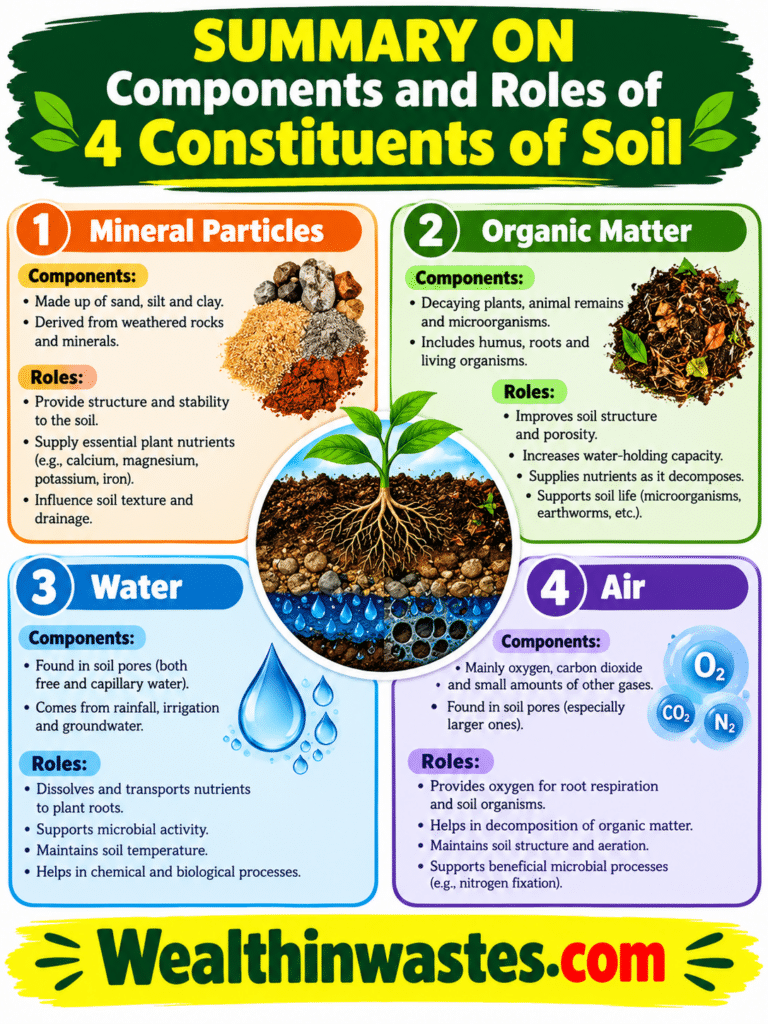
| Constituent | Approximate Share by Volume | Main Functions |
|---|---|---|
| Mineral Matter | 45% | Forms the soil framework, influences texture, and supplies or stores mineral nutrients. |
| Organic Matter | 5% | Improves aggregation, supports soil organisms, contributes nutrients, and helps retain moisture. |
| Soil Air | About 25% | Provides oxygen for roots and microbes and allows carbon dioxide and other gases to escape. |
| Soil Water | About 25% | Dissolves nutrients, transports them towards roots, and supplies plants with water. |
Mineral matter and organic matter form the solid portion of soil, while soil air and soil water occupy pore spaces. Their proportions change as soil becomes wetter, drier, compacted, or better structured.
Frequently Asked Questions About Constituents of Soil: Four Components and Their Roles
1. What Are the Four Constituents of Soil?
They are mineral matter, organic matter, soil air, and soil water.
2. What Is the Approximate Composition of Soil?
The conventional model gives 45% mineral matter, 5% organic matter, and about 25% each for air and water.
3. Which Constituent Forms the Largest Solid Portion?
Mineral matter generally forms the largest constituent by volume in the conventional soil-composition model.
4. Why Is Organic Matter Important?
It improves aggregation, water retention, nutrient cycling, and the energy supply for soil organisms.
5. Which Type of Soil Water Can Plants Use?
Capillary water usually provides the main plant-available water, depending on soil texture and pore characteristics.
6. Why Do Plant Roots Need Soil Air?
Roots need oxygen for respiration, while beneficial soil organisms require oxygen for many biological processes.
7. What Changes the Amount of Soil Air and Water?
Rainfall, irrigation, drainage, soil structure, texture, and compaction influence the space available for air and water.
8. How Can Farmers Improve Soil Constituents?
They can apply suitable compost, retain ground cover, manage irrigation, reduce compaction, and prevent contamination.
Do you have any questions, suggestions, or contributions? If so, please feel free to use the comment box below to share your thoughts. We also encourage you to kindly share this information with others who might benefit from it. Since we can’t reach everyone at once, we truly appreciate your help in spreading the word. Thank you very much for your support and for sharing!
Read Also: Management of Nigerian Soils in Agriculture