


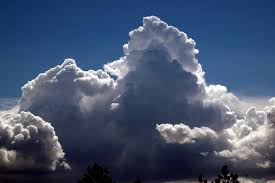
The atmosphere is the broad envelope of gases surrounding Earth and supporting conditions required for life. Although invisible, it influences temperature, weather, water movement, communication, and ecological processes.
Understanding the atmosphere requires more than looking above the ground or beneath clouds. Scientists divide it into distinct layers according to changes in temperature, composition, density, and the behaviour of gases.
These atmospheric layers interact continuously with land, water, living organisms, and incoming solar energy. Their interactions produce weather, regulate heat, transport moisture, and influence environmental conditions across Earth.
Atmospheric processes connect directly with agriculture, water resources, environmental management, and human activities. Evaporation, condensation, precipitation, radiation, winds, and circulation continuously move energy and matter throughout Earth’s environment.
Human activities can alter atmospheric conditions through emissions, deforestation, industrialization, transportation, waste disposal, and intensive resource use. Understanding these influences helps people manage environmental resources and reduce harmful effects.
Understanding the Atmosphere
The atmosphere contains gases that surround Earth and extend upward into increasingly thin regions. It does not have one sharp outer boundary, because atmospheric density gradually decreases with increasing altitude.
Major atmospheric gases include nitrogen, oxygen, argon, carbon dioxide, and variable amounts of water vapour. The proportions and physical behaviour of these gases differ with altitude, location, and conditions.
Atmospheric conditions also form part of Earth’s broader natural-resource system. Resources associated with the atmosphere support weather, climate, water availability, plant growth, transportation, communication, and several essential ecological functions.
The atmosphere works closely with the hydrosphere, lithosphere, biosphere, and cryosphere. This relationship means changes affecting one environmental sphere can produce consequences elsewhere through connected physical, chemical, and biological processes.
For example, forests influence atmospheric carbon exchange, moisture movement, temperature, and rainfall. A useful discussion of these connections appears in the classification of natural resources and their environmental importance, which shows why atmospheric resources matter.
Read Also: On-site Municipal Wastewaters Treatment
Troposphere and Everyday Weather

The troposphere forms the lowest atmospheric layer and contains most atmospheric mass and water vapour. Humans, animals, vegetation, aircraft, and most familiar weather phenomena exist within this region.
1. Temperature: Temperature generally decreases with increasing altitude within the troposphere because the atmosphere receives much of its heating indirectly from Earth’s warmed surface below rather than directly from sunlight.
2. Moisture: Water vapour enters the troposphere through evaporation and transpiration. It later condenses into clouds and contributes to precipitation, making the layer central to the continuous movement of water.
3. Weather: Clouds, rainfall, thunderstorms, winds, and many other weather events develop primarily within the troposphere. Agricultural activities therefore depend heavily on conditions produced by processes occurring in this atmospheric layer.
Evaporation and transpiration connect the atmosphere with soils, crops, forests, rivers, lakes, and oceans. Agricultural water movement is explained further through the hydrological cycle and plant water relationships.
Stratosphere and Ozone Protection
The stratosphere lies directly above the troposphere and extends to approximately fifty kilometres above Earth’s surface. Unlike the troposphere, temperature generally increases with altitude through much of this layer.
1. Ozone: Ozone becomes concentrated in an important region of the stratosphere.This ozone absorbs much harmful ultraviolet radiation from the Sun, helping protect living organisms from excessive ultraviolet exposure.
2. Temperature Pattern: Solar ultraviolet absorption by ozone contributes to warming within the upper stratosphere. Consequently, the layer displays a temperature structure that differs significantly from that found below.
3. Atmospheric Movement: Air movements within the stratosphere generally differ from the vigorous vertical mixing common in the troposphere. These differences make the stratosphere important for atmospheric circulation and stability.
Human activities can affect atmospheric composition through pollution and emissions. Waste management also matters because poorly handled waste can contribute gases and pollutants, as discussed in the environmental effects of solid waste.
Read Also: On-site Municipal Wastewaters Treatment
Mesosphere, Thermosphere and Exosphere

The mesosphere lies above the stratosphere and extends roughly from fifty to eighty-five kilometres. Temperatures decrease substantially with altitude, making the upper mesosphere one of Earth’s coldest atmospheric regions.
Meteoroids often burn and fragment within the mesosphere when they encounter atmospheric gases. This process creates many visible meteor trails and shows how the atmosphere interacts with objects entering from space.
The thermosphere occurs above the mesosphere and reaches several hundred kilometres upward. Temperatures can increase greatly because sparse atmospheric particles absorb energetic solar radiation, although the air remains extremely thin.
The ionosphere overlaps parts of the thermosphere and contains many electrically charged particles. These ions influence radio communication and respond strongly to solar radiation, solar storms, and other space-weather conditions.
The exosphere forms the extremely thin outer region of the atmosphere and gradually merges with space. Hydrogen and helium dominate its sparse gases, while atmospheric particles can travel extremely long distances.
Understanding all atmospheric layers becomes easier when viewed alongside broader environmental relationships. The discussion of forests and rangelands also demonstrates how surface ecosystems interact with atmospheric conditions and climate.
Key Atmospheric Processes
1. Evaporation: Evaporation changes liquid water into water vapour when molecules gain sufficient energy to escape surfaces. Warm temperatures, sunlight, wind, and dry air generally increase evaporation rates.
2. Transpiration: Plants release water vapour through microscopic openings in their leaves. Together, evaporation and transpiration form evapotranspiration, which strongly influences atmospheric moisture, crop water requirements, and local environmental conditions.
3. Condensation: Water vapour cools and changes into tiny liquid droplets or ice particles when air reaches suitable conditions. These particles gather to form clouds and support subsequent precipitation.
4. Precipitation: When cloud particles become sufficiently large, gravity causes water to fall toward Earth’s surface as rain, snow, sleet, or hail. Precipitation replenishes rivers, soils, reservoirs, and groundwater.
These processes operate continuously as part of the water cycle. Agricultural systems depend on this movement, while hydrologic cycle processes in agricultural water management explain how atmospheric water supports production.
Evapotranspiration also determines how much water crops require under different environmental conditions. Farmers can examine crop evapotranspiration and consumptive water use when planning irrigation and managing available water resources.
Radiation, Wind and Atmospheric Circulation

Solar radiation provides most energy driving atmospheric circulation and weather. Earth absorbs solar energy, converts much of it into heat, and releases energy upward as infrared radiation.
1.Solar Heating: Different surfaces absorb and release energy at different rates. Land and water therefore warm differently, creating temperature contrasts that influence winds, pressure differences, convection, and atmospheric circulation.
2. Wind Movement: Air moves from regions of relatively higher pressure toward regions of lower pressure. Earth’s rotation modifies this movement, producing circulation patterns that affect weather and climate.
3. Atmospheric Humidity: Humidity describes the amount of water vapour present in air. Temperature strongly influences how much moisture air can hold, affecting cloud development, evaporation, rainfall, and crop water loss.
Farmers rely on information about temperature, humidity, rainfall, wind, and solar conditions. The role of meteorological stations in agricultural decision-making shows how atmospheric measurements support farming activities.
Seasonal changes also influence evaporation and rainfall, creating different moisture conditions during agricultural periods. A practical discussion of seasonal evaporation and rainfall patterns explains these relationships clearly.
Atmosphere, Climate and Environmental Change
The atmosphere helps regulate Earth’s temperature by absorbing, redistributing, and re-emitting energy. Naturally occurring greenhouse gases retain some outgoing heat, making Earth’s surface considerably warmer than it otherwise would be.
Human activities can increase concentrations of greenhouse gases through fossil-fuel combustion, industrial production, land-use changes, agriculture, transportation, and waste management. These changes can influence long-term climate patterns.
Atmospheric pollution can also reduce air quality and affect ecosystems. Air transportation pollution demonstrates how combustion emissions can introduce pollutants into the atmosphere while contributing to broader environmental pressures.
Waste disposal can release methane, carbon dioxide, smoke, and other substances. The discussion of waste generation and its environmental effects explains how waste-related emissions can contribute to atmospheric and climatic problems.
Industrial activities may also release pollutants into the atmosphere through combustion, processing, transport, and accidental releases. The effects of industrial waste on environmental quality show why emission control remains important.
Deforestation further changes atmospheric processes because forests store carbon, release moisture, influence surface temperatures, and affect water movement. Vegetation degradation and deforestation can therefore disturb ecological and atmospheric relationships.
Read Also: On-site Municipal Wastewaters Treatment
Human Activities and Atmospheric Protection

1. Reduce Emissions: Cleaner energy, efficient transportation, improved industrial controls, and responsible fuel use can reduce atmospheric pollution. Communities should limit unnecessary burning and encourage technologies that use resources efficiently.
2. Protect Vegetation: Forests and other vegetation absorb carbon dioxide, release oxygen, moderate local climates, protect soil, and support water cycling. Preventing unnecessary forest destruction therefore benefits both atmosphere and ecosystems.
3. Manage Waste: Proper waste reduction, recycling, treatment, and disposal can limit harmful atmospheric emissions. Practical waste-reduction strategies can reduce the amount of material requiring disposal.
Recycling also reduces the need for some virgin materials and may lower environmental pressures associated with extraction and manufacturing. The benefits are discussed in recycling and environmental preservation.
People can also reduce pollution by following practical waste-management principles and avoiding open burning. The three Rs of waste management provide a simple framework for reducing unnecessary environmental impacts.
Protecting the atmosphere requires attention to pollution from homes, industries, farms, transport systems, and communities. Public responses to environmental pollution are important because collective action can reduce harmful atmospheric pressures.
Water and land management also contribute indirectly to atmospheric protection because environmental systems operate as interconnected units. Land pollution and its environmental consequences illustrate how surface degradation can affect wider ecological processes.
Soil conservation remains important because rainfall, runoff, vegetation, and atmospheric conditions interact closely. Measures discussed in soil erosion management and environmental conservation can help maintain healthy land and reduce damaging runoff.
Deforestation prevention should accompany atmospheric protection because forest destruction can disrupt carbon storage, rainfall, soil stability, and biodiversity. The causes and effects of deforestation explain these environmental connections.
Environmental protection also depends on sustainable resource use and responsible planning. The environmental impact of renewable natural resources demonstrates why resource conservation should accompany agricultural and economic development.
Forests can moderate climate, conserve soil, support biodiversity, and influence atmospheric moisture. Their importance becomes clearer through forest resources and their agricultural importance and related conservation practices.
Responsible water management completes this protection approach because water continuously moves through atmosphere, land, plants, and surface environments. Irrigation water resources and agricultural use show how atmospheric processes support productive land management.
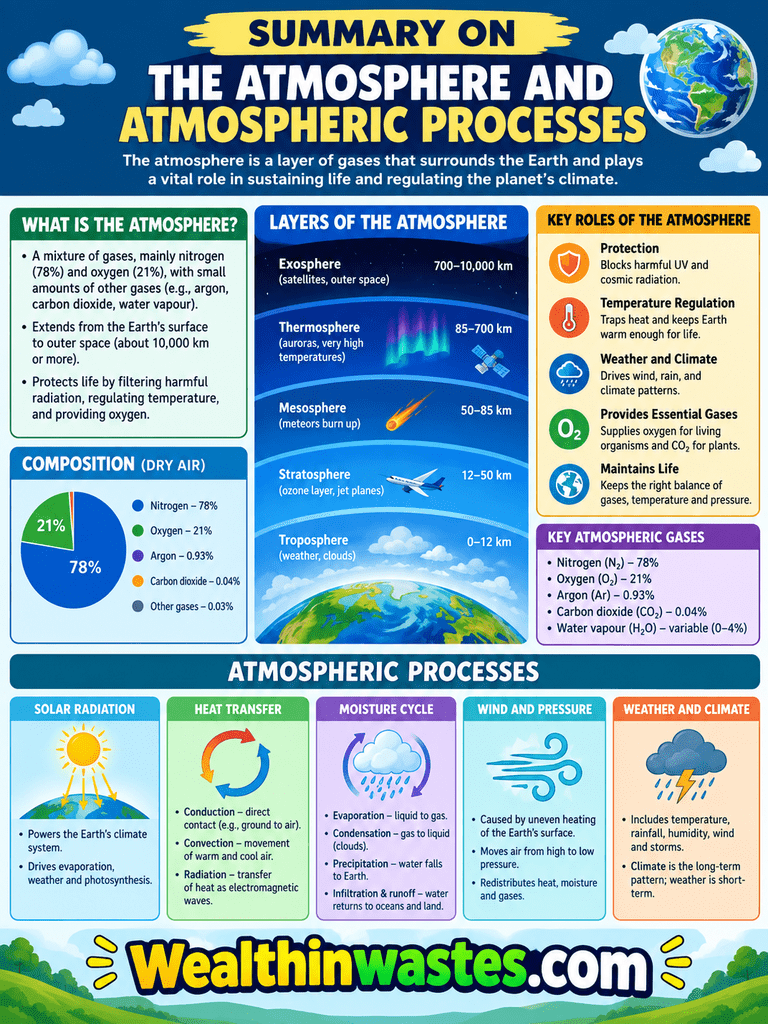
Summary on The Atmosphere and Atmospheric Processes
| Topic | Summary |
|---|---|
| Atmosphere | The gaseous envelope surrounding Earth, supporting life and influencing temperature, weather, moisture, radiation, and environmental conditions. |
| Troposphere | The lowest atmospheric layer where humans live and where most clouds, rainfall, and everyday weather occur. |
| Stratosphere | The layer above the troposphere containing the ozone-rich region that absorbs harmful ultraviolet radiation. |
| Mesosphere | An upper atmospheric layer where temperature decreases greatly with altitude and many meteoroids burn. |
| Thermosphere | A very thin, energetic layer where temperature rises strongly because atmospheric particles absorb high-energy solar radiation. |
| Exosphere | The extremely thin outermost atmospheric region that gradually merges into outer space. |
| Water Processes | Evaporation, transpiration, condensation, and precipitation move water continuously between Earth’s surface and atmosphere. |
| Atmospheric Protection | Emission control, forest protection, responsible waste management, recycling, and sustainable resource use can reduce atmospheric pressures. |
Frequently Asked Questions About Atmosphere: Layers, Functions and Atmospheric Processes
1. What is the atmosphere?
The atmosphere is the envelope of gases surrounding Earth. It supports life and influences temperature, weather, climate, water movement, radiation, and many environmental processes.
2. Which atmospheric layer contains most weather?
Most everyday weather occurs in the troposphere because it contains most atmospheric water vapour and experiences substantial vertical movement, cloud formation, rainfall, storms, and wind activity.
3. What is the importance of the stratosphere?
The stratosphere contains the ozone-rich region that absorbs much harmful ultraviolet radiation from sunlight, thereby helping protect living organisms and ecosystems from excessive ultraviolet exposure.
4. What happens in the mesosphere?
The mesosphere becomes colder with increasing altitude, and many meteoroids entering Earth’s atmosphere burn or fragment there because of interactions with atmospheric particles.
5. What is the ionosphere?
The ionosphere is a region containing many charged particles and overlapping mainly with the thermosphere. It interacts strongly with solar radiation and can influence radio communication.
6. What are the main atmospheric processes?
Important atmospheric processes include evaporation, transpiration, condensation, precipitation, radiation, wind movement, convection, and atmospheric circulation, which continuously redistribute energy and moisture.
7. How does deforestation affect the atmosphere?
Deforestation reduces vegetation cover and carbon storage while affecting moisture movement, surface temperature, rainfall patterns, soil stability, and broader ecological relationships involving the atmosphere.
8. How can people protect the atmosphere?
People can help protect the atmosphere by reducing emissions, avoiding open waste burning, conserving forests, improving energy efficiency, recycling materials, and supporting responsible environmental management.
Do you have any questions, suggestions, or contributions? If so, please feel free to use the comment box below to share your thoughts. We also encourage you to kindly share this information with others who might benefit from it. Since we can’t reach everyone at once, we truly appreciate your help in spreading the word. Thank you very much for your support and for sharing!
Read Also: Hydrology and the Water Cycle: Their Importance in Agriculture