


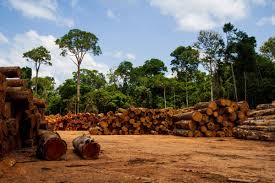
Land resources form the foundation of human settlement, agriculture, natural ecosystems, and many economic activities that support communities. Their quality, availability, ownership, and management strongly influence household welfare and national development.
Societies depend on land resources for crop production, livestock grazing, forestry, housing, infrastructure, mining, recreation, and ecosystem services. Consequently, changes in land quality or access can quickly affect incomes, employment, food security, and living standards.
In rural economies especially, land often represents both a productive asset and a source of social security. Families with secure access can invest, produce food, generate income, and improve their long-term economic resilience.
However, unequal access to productive land, unreliable water supplies, insecure tenure, declining soil fertility, and environmental degradation can deepen poverty. These pressures become more severe when communities depend heavily on agriculture and natural resources.
Understanding socio-economic dependency on land resources therefore requires attention to productivity, poverty, employment, ownership, environmental quality, and governance. Sustainable land management must balance present economic needs with future resource security.
Land Resources and Socio-Economic Development
Land resources support economic development by providing space and natural assets for farming, settlements, industries, transport networks, forestry, and mineral extraction. Their productivity directly affects the value communities derive from available resources.
Where productive land remains available and well managed, households can produce more food, sell surpluses, employ workers, and accumulate income. Higher productivity can also stimulate local businesses supplying seeds, tools, transport, processing, and marketing services.
Land also serves as a store of wealth, particularly where formal financial systems remain limited. Securely held land can support investment decisions, strengthen household assets, and provide a foundation for future economic opportunities.
The broader concept of land resources includes soil, terrain, water, vegetation, wildlife, climate-related features, and human modifications that influence how land functions. Understanding these relationships improves planning and resource allocation.
Communities also depend on forests, wetlands, grazing areas, and other landscapes for products and services beyond farming. These resources can provide fuel, food, fibre, medicinal materials, water regulation, habitats, and income.
Strong economic dependence on land can become risky when populations grow rapidly while productive areas decline. Without careful planning, competition intensifies, environmental pressures increase, and vulnerable households face shrinking opportunities for reliable livelihoods.
For this reason, natural resource management should connect economic objectives with environmental protection. Productive land resources must generate current benefits without undermining the ecological functions required for future prosperity.
Read Also: Types of Wastewater and Motivational Factors for Recycling/Reuse
Land Resources and Rural Poverty

1. Limited land access: Poor households often depend on small or marginal plots that provide insufficient production for food, savings, and investment. Limited access restricts their ability to escape persistent poverty.
2. Insecure tenure: Farmers who lack reliable rights may hesitate to invest in irrigation, soil improvement, tree planting, or long-term conservation. Uncertainty reduces incentives for practices that improve land productivity.
3. Low productivity: Poor soils, inadequate water, erosion, and limited inputs can reduce agricultural output. Land suitability and productivity therefore matter greatly for household income and food security.
4. Environmental vulnerability: Drought, flooding, erosion, declining fertility, and other stresses can quickly remove small household surpluses.Families with few alternative income sources usually feel these losses most severely.
5. Limited diversification: Poor households may depend heavily on one crop, one livestock enterprise, or one natural resource. Greater diversification can spread risk and improve their capacity to withstand economic or environmental shocks.
6. Weak market access: Remote communities often receive lower prices for products while paying higher costs for inputs and transportation. Better roads, storage, processing, and markets can increase the economic value of land-based production.
7. Resource degradation: Poverty can encourage short-term resource use when households need immediate income or food. Soil depletion, vegetation loss, and poor water management may then reduce future productivity and deepen poverty.
Land And Water Access For Rural Livelihoods
Land and water function together in most agricultural systems, so unequal access to either resource can limit production. Productive soils cannot deliver dependable yields when farmers lack sufficient, affordable, and timely water.
Rainfed agriculture remains highly exposed to rainfall variability because crop growth depends strongly on timing and quantity. In areas with unreliable rainfall, households may face frequent harvest losses that undermine income and household food supplies.
Irrigation can reduce some rainfall risks by improving water control and allowing farmers to produce more consistently. However, irrigation also requires investment, maintenance, appropriate technologies, reliable energy, and responsible management of water resources.
Communities therefore need integrated planning that considers soils, drainage, groundwater, rivers, wetlands, and farming systems together. The protection of water resources helps maintain agricultural productivity and public welfare.
Water quality also matters because contaminated irrigation supplies can introduce pollutants into soils, crops, livestock systems, and groundwater. Preventing contamination reduces health risks while protecting the productive capacity of land-based livelihoods.
Efficient water management can also lower production costs by reducing unnecessary pumping, runoff, evaporation, and nutrient losses. Farmers can improve resilience through water harvesting, efficient irrigation methods, drainage management, and conservation practices.
Protecting connections between land and water is especially important for poor households because they often lack financial reserves to absorb resource failures. Strong environmental management therefore becomes an important part of rural poverty reduction.
Agricultural Intensification And Income Growth
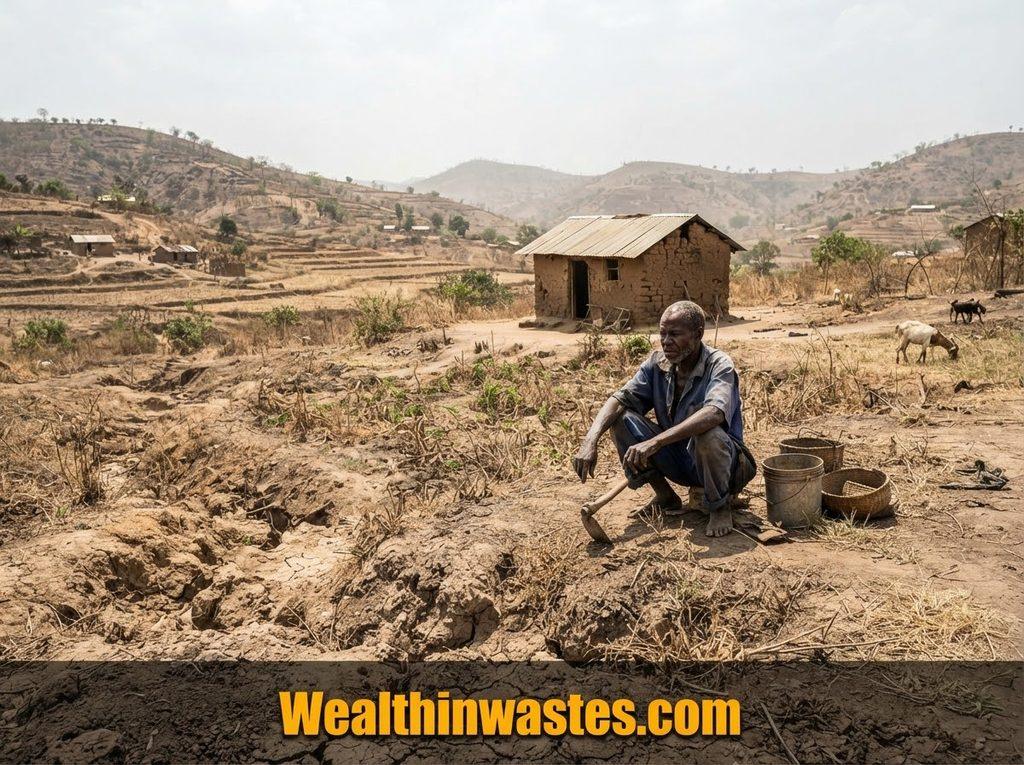
1. Higher output: Improved seeds, better soil management, irrigation, appropriate fertilizers, and effective pest control can increase production from existing land. Higher yields allow farmers to earn more without expanding cultivated areas excessively.
2. Greater food security: Higher farm productivity increases the quantity of food available for household consumption and local markets. Reliable production can reduce seasonal shortages and strengthen economic access to nutritious food.
3. More market activity: Agricultural intensification creates demand for machinery, transport, storage, processing, packaging, and other services. This can stimulate wider rural economies beyond the farm itself.
4. Employment opportunities: Intensification can create jobs when production expands through labour-intensive activities, processing, and marketing. However, mechanization may reduce certain farm tasks, so employment effects depend on the production system.
5. Better resource use: Producing more from existing land can reduce pressure to clear additional forests, wetlands, or grasslands. This becomes more beneficial when soil resources are managed sustainably.
6. Investment potential: Rising farm incomes can encourage households to invest in education, housing, equipment, livestock, processing, and other enterprises. Such investments can strengthen long-term economic resilience.
7. Equity challenges: Production growth does not automatically distribute benefits fairly. Wealthier operators may capture better land, technologies, water, and markets, leaving poorer producers with fewer opportunities and lower returns.
Land Tenure And Resource Allocation
Land tenure determines who can access, control, use, transfer, inherit, or benefit from land resources. Secure tenure can encourage productive investment because users gain greater confidence that they will enjoy future returns.
Traditional tenure systems can provide community protection and social legitimacy, especially where local institutions manage shared resources effectively. However, population growth, commercialization, urban expansion, and rising land values can create serious pressures.
Disputes may arise when customary rights, formal ownership, government allocations, and private transactions overlap. Transparent land allocation and suitability decisions can reduce uncertainty and support more efficient resource use.
Land markets can also influence inequality because households with greater financial capacity may acquire larger or better-located parcels. Effective governance should therefore protect legitimate rights while improving access for productive and vulnerable users.
Resource allocation should also recognize multiple land functions rather than treating every parcel as suitable for one economic purpose. Natural resource classification helps planners understand relationships among soil, water, forests, minerals, and other assets.
Fair tenure arrangements can strengthen conservation because farmers, communities, and investors become more willing to maintain soil fertility, protect vegetation, control erosion, and invest in long-term improvements.
When tenure remains insecure, land users may prioritize immediate extraction instead of sustainable management. Consequently, institutional reforms should combine legal clarity, accessible dispute resolution, inclusive participation, and practical support for responsible land use.
Land Degradation And Economic Vulnerability
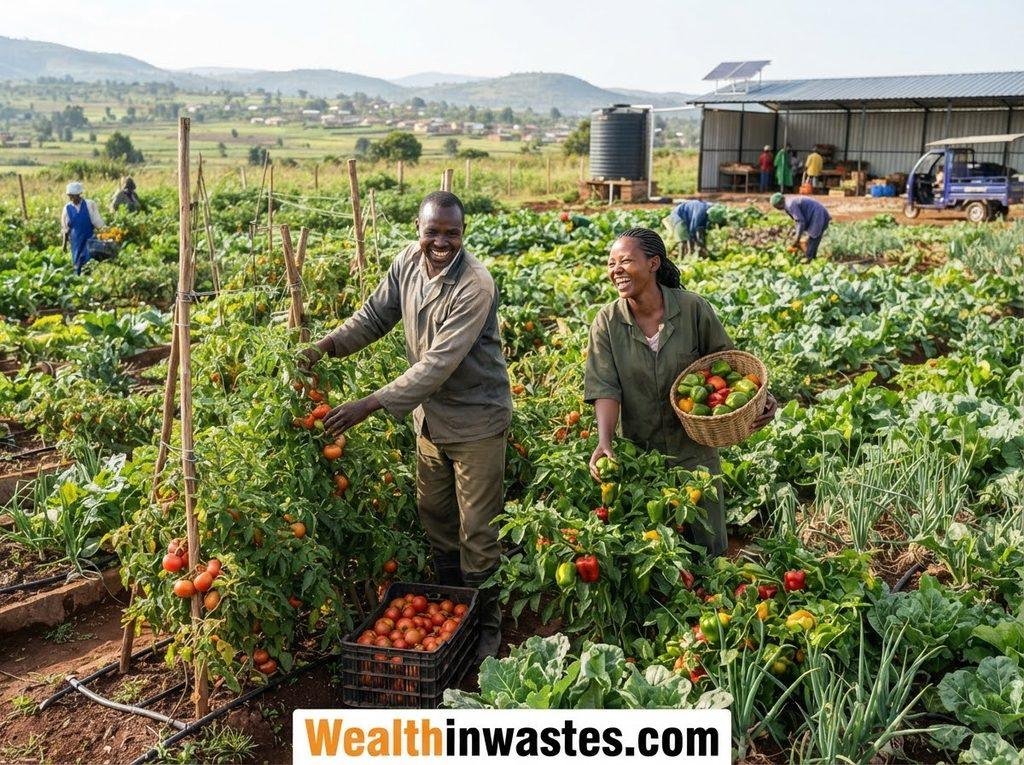
1. Soil erosion: Erosion removes fertile topsoil through water and wind, reducing rooting depth, nutrient availability, moisture retention, and crop productivity. Farmers may then spend more on fertilizers while receiving lower returns.
2. Nutrient depletion: Continuous cultivation without adequate nutrient replacement can reduce soil fertility. Declining fertility raises production costs, lowers yields, and may push households toward additional land clearing.
3. Vegetation loss: Clearing forests and grasslands can expose soil, disrupt habitats, increase runoff, and reduce ecosystem services. Forest resources also support income, food, fuel, medicines, and many rural enterprises.
4. Water degradation: Poor land management can increase sediment, nutrients, chemicals, and wastes entering rivers and groundwater. The resulting decline in water quality can affect farming, fisheries, household health, and local economies.
5. Climate pressure: Droughts, floods, temperature changes, and unpredictable seasons can intensify existing weaknesses. Climate-related pressure on land resources can reduce yields while increasing production and recovery costs.
6. Mining impacts: Mining can generate employment and government revenue, yet poorly managed extraction may disturb soils, vegetation, drainage, and nearby communities. Responsible resource management must balance economic benefits with environmental safeguards.
7. Waste accumulation: Improper disposal can introduce contaminants into farmland, soils, and water. Agricultural waste management therefore matters for protecting land productivity and reducing avoidable environmental costs.
Sustainable Land Management And Livelihoods
1. Soil conservation: Farmers can reduce erosion through mulching, cover crops, contour cultivation, terracing, reduced tillage, and appropriate vegetation management.These practices protect productive soil while improving moisture retention.
2. Water conservation: Efficient irrigation, rainwater harvesting, drainage improvement, and watershed protection can increase water-use efficiency. Water conservation practices also reduce pressure on freshwater ecosystems.
3. Diversified production: Combining crops, livestock, trees, processing, and other enterprises can spread risk. Diversification allows households to obtain income from several sources when one activity performs poorly.
4. Agroforestry: Trees integrated with crops or livestock can improve soil structure, provide fodder, fuel, fruit, timber, shade, and additional income. They can also reduce erosion and strengthen landscape resilience.
5. Responsible waste use: Composting and beneficial reuse can return organic matter and nutrients to soils while reducing disposal pressure. Waste reduction at source can further lower environmental and operational costs.
6. Ecosystem protection: Forests, wetlands, rivers, and grasslands provide services that support agriculture and communities. Ecosystem diversity strengthens ecological functions that underpin long-term human welfare.
7. Community participation: Sustainable land management becomes stronger when local users participate in planning, implementation, monitoring, and enforcement. Shared responsibility can improve compliance and make conservation measures more practical.
Read Also: Top Wastewater Management Companies in the World
Policy Priorities For Equitable Land Use
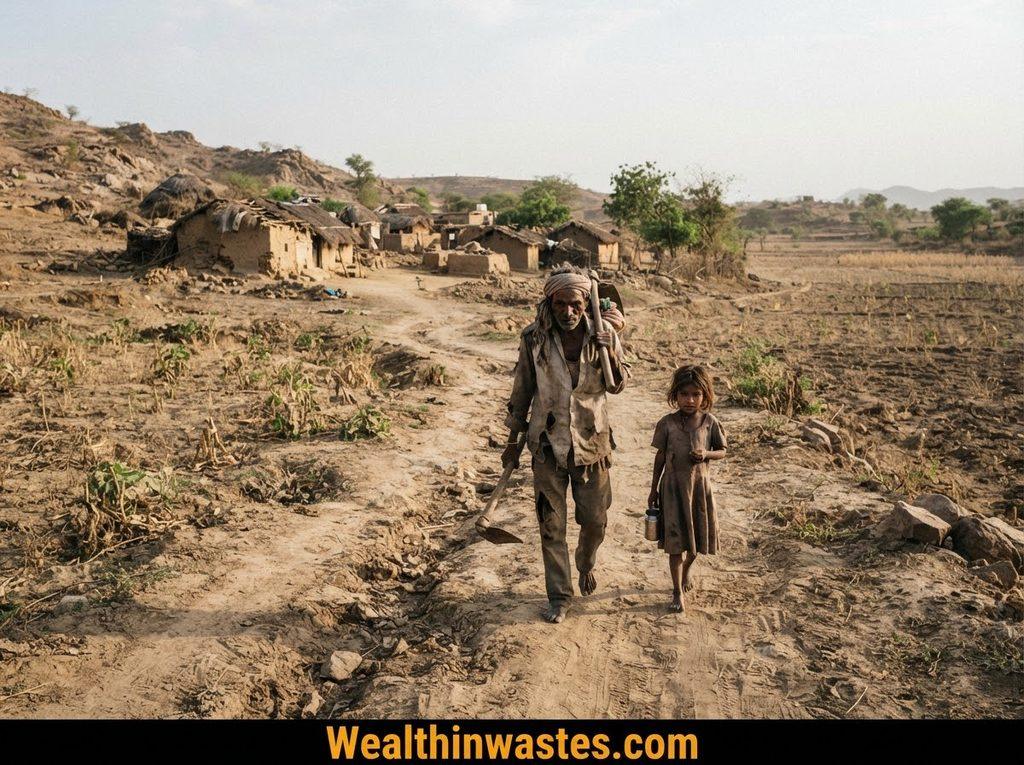
Governments can reduce socio-economic inequality by improving land governance, protecting legitimate tenure rights, expanding agricultural services, and supporting poor households with practical technologies. These actions should reflect local ecological and economic conditions.
Land-use planning should identify areas best suited for agriculture, conservation, settlements, infrastructure, forestry, and other activities. The process can reduce harmful conflicts while preventing high-value ecosystems from unnecessary conversion.
Environmental safeguards are equally important when development projects involve mining, construction, industry, or waste disposal. Proper site assessment can reduce contamination risks and protect surrounding land and water resources.
Policies should also support smallholders through affordable finance, extension services, improved infrastructure, market access, storage facilities, and processing opportunities. Productivity gains become more meaningful when farmers can retain a reasonable share of added value.
Watershed approaches can coordinate land and water management across farms and communities. Effective water resource protection helps reduce conflicts, protect supplies, and maintain the ecological functions supporting production.
Policies should also encourage efficient resource use and waste prevention. Responsible waste treatment and disposal can prevent land contamination while encouraging recovery, reuse, recycling, and other circular approaches.
Finally, equitable development requires continuous monitoring of land productivity, household welfare, environmental conditions, and resource access. Strong institutions can adapt policies when economic pressures, population changes, or environmental risks alter local priorities.
Economic Benefits Of Responsible Land Resources Management
Responsible management of land resources can improve farm productivity, preserve ecological functions, and support stable household incomes. It can also reduce costs created by erosion, pollution, declining fertility, flooding, and resource conflicts.
Healthy soils support crop production, while protected vegetation improves water regulation and habitat quality. Controlling soil erosion helps retain productive topsoil and reduces the long-term economic losses associated with land degradation.
Forest conservation offers additional economic opportunities through timber, non-timber products, tourism, ecosystem services, and small rural enterprises. Forests and rangelands can therefore support livelihoods while maintaining important ecological functions.
Communities can also improve resilience when they reduce unnecessary resource consumption and adopt efficient production systems. Good environmental management connects economic activities with practical measures for protecting soil, water, air, biodiversity, and public health.
Wastewater management deserves particular attention because poorly treated wastewater can affect farmland and groundwater. Proper planning, treatment, monitoring, and reuse can protect productive land while reducing pressure on freshwater supplies.
Likewise, cleaner agricultural production can reduce contamination from fertilizers, pesticides, manure, and discarded materials. Farmers can improve environmental performance by combining nutrient management, erosion control, safe storage, and responsible waste handling.
Ultimately, socio-economic dependency on land resources becomes an advantage when communities manage land as a long-term productive asset. Sustainable decisions allow present users to gain income without sacrificing future opportunities.
Socio-Economic Dependency On Land Resources
Land resources influence where people live, what they produce, how they earn income, and which environmental risks they face. Their importance extends beyond agriculture because land supports numerous social, economic, and ecological functions.
In many rural communities, land provides food, employment, housing space, livestock feed, forest products, and opportunities for trade. A decline in land quality can therefore affect several parts of household welfare simultaneously.
The relationship becomes especially strong where alternative employment remains limited. Households may continue cultivating degraded parcels because they have few realistic options, creating a cycle where poverty and resource pressure reinforce each other.
Breaking this cycle requires more than increasing production. Communities need secure access, appropriate technologies, functioning markets, environmental safeguards, education, infrastructure, and institutions that enable people to use land productively and responsibly.
Land resources should therefore be treated as economic assets and ecological foundations at the same time. Policies that focus only on short-term output may generate income today while creating larger environmental and social costs tomorrow.
Balanced land management can support food security, poverty reduction, employment creation, ecosystem protection, and rural transformation. It can also strengthen resilience by helping households withstand climate shocks and changing market conditions.
Summary on Land Resources and Socio-Economic Dependency
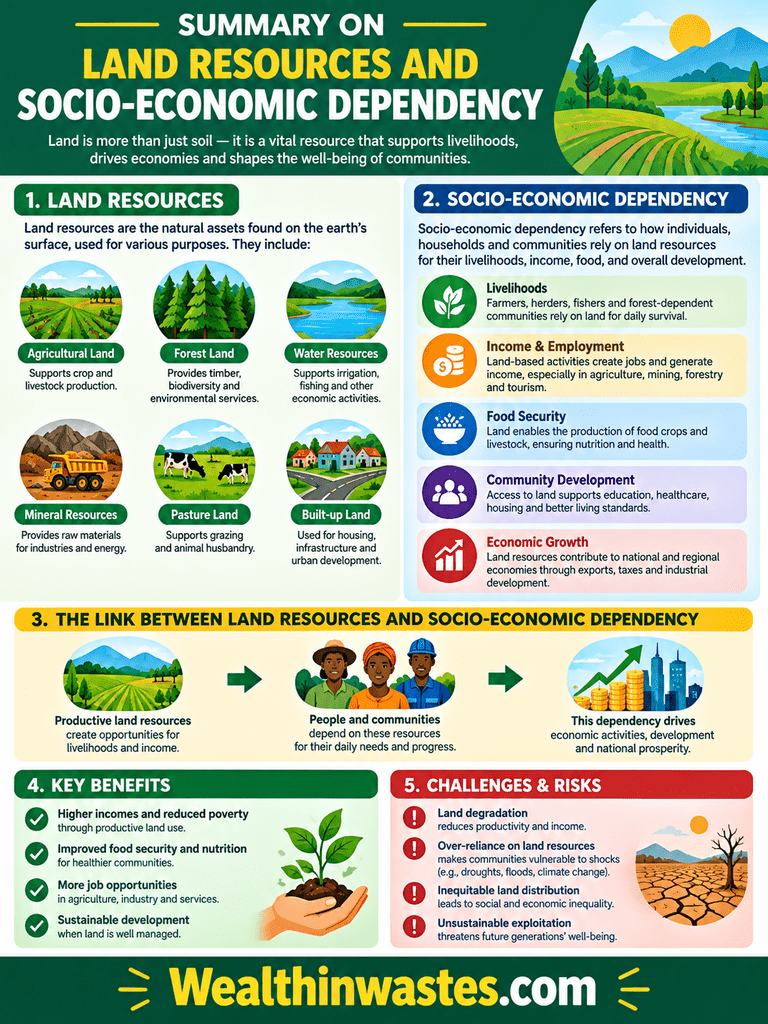
| Key Area | Main Point |
|---|---|
| Land Resources | Provide the physical and ecological foundation for agriculture, settlements, industry, forestry, and many livelihoods. |
| Poverty | Limited access, insecure tenure, low productivity, and resource degradation can reinforce rural poverty. |
| Land And Water | Reliable access to productive land and quality water improves agricultural productivity and livelihood security. |
| Agricultural Intensification | Higher productivity can improve food security, incomes, employment, and rural economic activity when benefits are fairly distributed. |
| Land Tenure | Secure and transparent tenure can encourage investment, conservation, and productive land use. |
| Land Degradation | Erosion, nutrient depletion, pollution, vegetation loss, climate stress, and poor waste management reduce economic productivity. |
| Sustainable Management | Conservation, diversification, agroforestry, water management, ecosystem protection, and community participation improve resilience. |
| Policy | Inclusive governance should combine economic development, environmental protection, tenure security, infrastructure, and equitable resource access. |
Frequently Asked Questions About Land Resources and Socio-Economic Dependency Explained
1. Why are land resources important to society?
Land resources support food production, housing, employment, industry, forests, minerals, biodiversity, water systems, and many economic activities essential for human welfare.
2. How do land resources influence poverty?
Access to productive land can support food production and income, while insecure or inadequate access can limit opportunities and increase vulnerability among poor households.
3. How does land degradation affect livelihoods?
Degradation can reduce soil fertility, crop yields, water quality, grazing capacity, and household income while increasing production costs and environmental risks.
4. Why is land tenure important?
Secure tenure gives users greater confidence to invest in land improvement, conservation, irrigation, tree planting, infrastructure, and other long-term productive activities.
5. Can agricultural intensification reduce poverty?
Yes, higher productivity can improve food security and incomes, but benefits may remain unequal when poor farmers lack access to land, technology, finance, water, or markets.
6. Why are land and water managed together?
Crop production depends on both soil and water, while poor management of one resource can damage the other through erosion, contamination, runoff, or excessive extraction.
7. What practices support sustainable land resources?
Important practices include soil conservation, agroforestry, diversified production, efficient irrigation, watershed protection, responsible waste management, ecosystem conservation, and community participation.
8. How can governments improve land resource management?
Governments can strengthen tenure systems, land-use planning, environmental regulation, agricultural services, infrastructure, market access, conservation programs, and inclusive local resource governance.
Do you have any questions, suggestions, or contributions? If so, please feel free to use the comment box below to share your thoughts. We also encourage you to kindly share this information with others who might benefit from it. Since we can’t reach everyone at once, we truly appreciate your help in spreading the word. Thank you very much for your support and for sharing!
Read Also: Land Resource and Sustainability in Agriculture