



Pesticide residues in cereals and pulses require careful regulation because these foods form important parts of diets and may retain small amounts of chemicals after approved crop protection treatments and storage activities.
Regulatory agencies assess pesticide uses before approval and establish limits intended to keep dietary exposure within acceptable safety boundaries for consumers, including vulnerable groups such as children and pregnant women.
A Maximum Residue Limit, commonly called an MRL, defines the highest permitted pesticide residue concentration in or on a food commodity when the pesticide receives authorized use according to approved agricultural practices.
For cereals and pulses, residue levels can reflect field applications, post-harvest treatments, storage protection, environmental movement, application rates, crop characteristics, and the time between treatment and harvest under particular conditions.
Effective regulation therefore depends on farmers, food businesses, laboratories, regulators, and consumers understanding how pesticide residues arise, how authorities assess them, and how compliance supports food safety throughout the food supply chain.
Good production practices reduce unnecessary chemical exposure by matching pesticide choice and application to pest problems while respecting label directions and required intervals. Environmental management best practices and food contamination sources provide related context.
Read Also: Pesticide Residues in Cereals and Pulses
Understanding Pesticide Residues in Cereals

A pesticide residue is a pesticide substance, metabolite, conversion product, reaction product, or related impurity that remains in food after authorized agricultural or post-harvest pesticide use and handling activities in the food supply chain.
Residues do not automatically mean that food is unsafe. Regulatory assessment considers toxicological information, expected dietary exposure, agricultural use patterns, and whether residues remain within established legal limits for consumers.
Cereal grains such as maize, rice, wheat, sorghum, millet, oats, and barley can receive treatments against insects, diseases, weeds, or storage pests at different production stages and locations within farming systems.
Pulses such as beans, peas, lentils, and other edible legumes may also receive crop protection treatments, while stored grains and pulses can require additional protection from insects during storage periods.
Residues may decline after application through degradation and other processes, but the rate varies with pesticide chemistry, environmental conditions, crop characteristics, processing, and the interval before consumption or further handling.
Understanding pesticide movement helps explain why residue levels differ between commodities and environments; soil characteristics, moisture, weather, application timing, and chemical properties influence pesticide behavior. The site conditions affecting pesticide mobility article explains these interactions.
For deeper environmental context, pesticide movement and absorption in soil explains how chemicals can attach to soil particles, dissolve, move, or undergo transformation throughout regulated food production systems and surrounding environments.
Likewise, factors influencing pesticide degradation show why persistence can differ among soils because temperature, moisture, pH, organic matter, microbes, and pesticide chemistry interact continuously under appropriate regulatory oversight and field conditions.
How MRLs Protect Cereal Consumers
MRLs provide measurable compliance points for pesticide residues in food, allowing regulators and food businesses to determine whether a commodity meets the residue requirements established for a specific pesticide in practical food safety management.
Codex defines MRLs as maximum pesticide residue concentrations legally permitted or recognized in food and feed, expressed in milligrams per kilogram and based on authorized agricultural practices throughout international food trade.
MRLs do not represent a target residue concentration for farmers. Instead, they support enforcement and trade decisions by indicating the residue level associated with compliant, properly authorized pesticide use in practical food safety management.
Health assessment also considers dietary exposure and toxicological reference values, including the acceptable daily intake used by experts when evaluating long-term consumer exposure to pesticide residues within established food safety systems today.
1. Legal Compliance: MRLs create clear residue limits that producers, processors, importers, laboratories, and regulators can use when checking whether cereal and pulse consignments satisfy applicable food safety requirements across markets.
2. Consumer Protection: Residue standards help keep dietary exposure within assessed safety boundaries when pesticides are used according to authorized conditions, supporting protection of consumers across ages. The residue management guidance reinforces this principle.
3. Trade Control: MRLs help authorities assess imported and exported cereals because international markets may apply Codex or destination-country requirements to pesticide residues found in food consignments entering regulated trade channels.
4. Consistent Testing: Defined residue limits allow laboratories to compare measured concentrations against recognized standards, making surveillance, compliance testing, enforcement decisions, and corrective actions more consistent across food supply chains.
5. Responsible Pesticide Use: MRL systems encourage farmers to respect approved crops, application rates, treatment intervals, and label directions supporting effective pest control without unnecessary residue accumulation. The producer responsibility discussion adds context.
Sources of Pesticide Residues in Cereals

Pesticide residues can enter cereals and pulses during field production when farmers apply insecticides, fungicides, herbicides, or other crop protection products directly to plants, soil, or surrounding production areas within farms.
Post-harvest treatment can create another pathway. Stored grains may receive approved protectants or fumigation to control insects, meaning storage practices can influence the final residue profile of commodities before sale.
Spray drift can transfer pesticide droplets from one field to another, while runoff can move chemicals from treated land into nearby water, soil, drainage channels, or other surrounding areas. These pathways can increase unintended exposure.
Incorrect dosage, repeated applications, unsuitable products, or treatment too close to harvest can increase residue levels above those expected from compliant agricultural practices and approved use patterns across production cycles.
Environmental persistence can also matter where older chemicals remain in soil or where contaminated materials, storage structures, equipment, or agricultural wastes contribute to unintended exposure and residue concerns for food production.
The article on sources of hazardous substances explains how agricultural chemicals, discarded containers, spills, and poor handling can introduce hazardous substances into farms and surrounding ecosystems under appropriate regulatory oversight.
Similarly, analysis of hazardous and toxic substances highlights pesticide residues as one pathway requiring controlled use, monitoring, and appropriate environmental management within established food safety requirements and routine regulatory monitoring.
Storage sanitation and pest control also influence chemical dependence. Where good storage design and preventive practices work effectively, operators may reduce unnecessary treatment frequency and minimize avoidable residue concerns across the food supply chain.
Factors That Affect Residue Levels
1.Pesticide Selection: Different pesticide ingredients behave differently in crops and environments, so residue persistence depends partly on chemical properties, approved uses, formulation characteristics, and degradation pathways under local conditions and management practices.
2. Application Rate: Applying more product than the label permits can increase residue levels and create avoidable food safety problems, especially when excessive treatment occurs repeatedly during production. The pesticide mobility guidance stresses careful application.
3. Timing And Interval: The time between the final application and harvest strongly influences residues because degradation continues after treatment, allowing concentrations to decline before the crop enters the food chain.
4. Weather Conditions: Rainfall, temperature, sunlight, wind, and humidity can influence pesticide deposition, wash-off, degradation, movement, and plant interactions, causing residue patterns to vary between locations and seasons during production.
5. Crop And Storage Conditions: Grain type, commodity moisture, processing, storage temperature, exposure duration, and post-harvest treatment can affect how residues persist or decline. Pollution management responses show why prevention matters.
Pesticide Residue Regulation In Nigeria
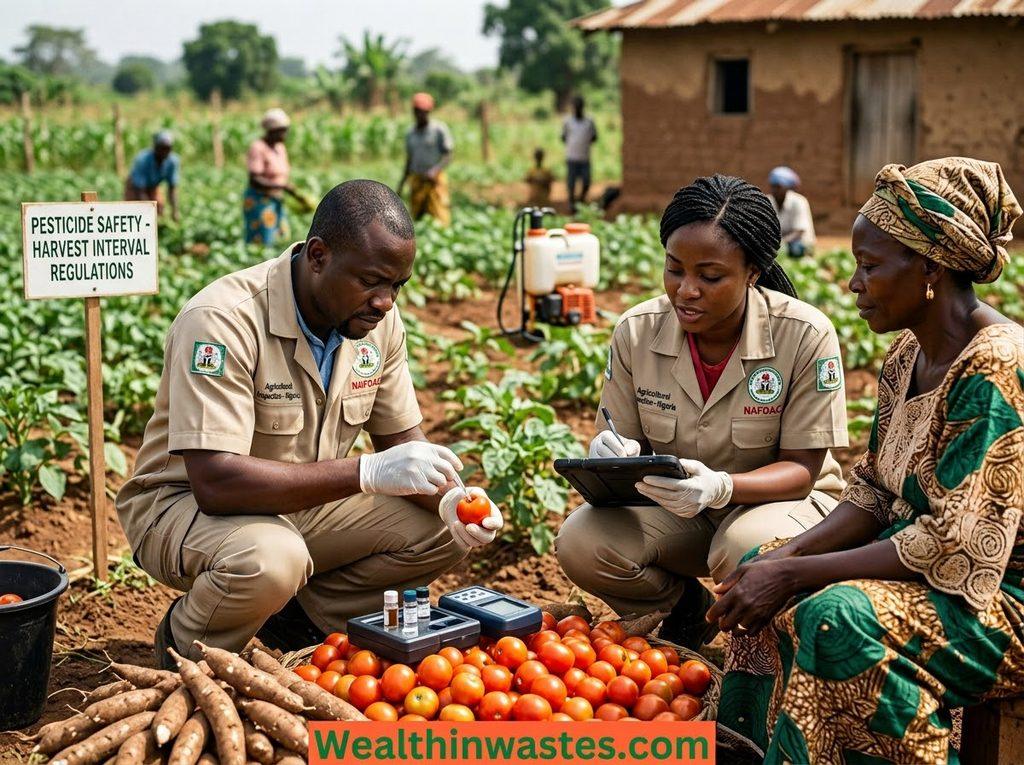
In Nigeria, pesticide regulation involves NAFDAC requirements covering pesticide registration, residue considerations, approved uses, labelling, and other controls intended to support safe pesticide use and consumer protection throughout the regulated food supply chain.
National rules operate alongside international food safety frameworks. Codex develops international MRL recommendations for pesticide and commodity combinations, while countries may establish or enforce national requirements according to local legislation.
Imported cereals and pulses may therefore face residue checks at points where authorities verify compliance with applicable standards before products enter commercial distribution or regulated trade channels under applicable food safety requirements.
Codex maintains a searchable pesticide residue database containing MRLs and extraneous MRLs for pesticide and commodity combinations, supporting transparent access to international residue standards for consumers and food businesses under regulatory oversight.
OECD methods and tools also support residue chemistry work, including statistical approaches that help authorities and experts derive or compare pesticide residue limits from supervised residue datasets under established food safety systems today.
Regulatory systems depend on reliable laboratory analysis because a legal residue limit has meaning only when samples are collected properly, analytical methods perform adequately, and results are interpreted against the correct commodity standard.
Food safety authorities rely on producer cooperation, documented pesticide use, inspection, surveillance, enforcement, and corrective action when residue findings indicate possible non-compliance or misuse across the food supply chain. Hazard classification guidance supports controlled handling.
The environmental management best-practice guide provides a broader framework for reducing pollution through responsible resource use, pollution prevention, compliance, and practical management procedures throughout agricultural operations and surrounding communities on and around farms.
Regulation works best when pesticide management connects farm decisions with environmental protection. Broader pollution prevention experience also shows why contaminant controls should protect soil and water throughout agricultural operations and food production systems.
Safe Pesticide Use On Cereals
1. Read The Label: Farmers should use only products approved for the intended crop and pest, following every label requirement concerning dose, application method, timing, protective measures, and harvest intervals.
2.Apply Only When Needed: Treatment should address genuine pest problems rather than routine or unnecessary spraying, reducing chemical use while supporting effective pest management and lowering residue risks across cereal farms.
3. Respect Pre-Harvest Intervals: The required interval between pesticide application and harvest gives residues time to decline and helps ensure harvested cereals remain within applicable regulatory residue requirements before marketing and consumption.
4. Prevent Storage Contamination: Storage facilities should remain clean, dry, well managed, and appropriately protected so chemical treatments occur only when necessary and according to approved product directions. Fumigant storage guidance supports safer handling.
5. Keep Proper Records: Recording products, rates, dates, target pests, treated fields, operators, and harvest dates supports traceability and helps farmers investigate residue problems. Farmers should review fumigation advantages and disadvantages before storage treatment decisions.
Read Also: Impact of Industrial Effluents on Human and Environment
Residue Testing and Food Compliance

Residue testing normally begins with representative sampling because laboratory results are meaningful only when the collected sample accurately reflects the lot or consignment being evaluated for regulatory purposes and food safety decisions.
Laboratories analyze samples using validated methods designed to detect specified pesticide residues at concentrations relevant to regulatory requirements and consumer protection decisions across food testing programmes and surveillance activities for compliance.
Testing may examine individual active substances or residue definitions that include relevant metabolites, conversion products, reaction products, or other compounds specified by the applicable regulatory standard for each commodity and pesticide.
Results must then be compared with the MRL applicable to the correct pesticide and commodity combination, because residue limits can differ between crops, commodities, and regulatory jurisdictions according to established standards.
Where results exceed an applicable limit, authorities may investigate the cause, review pesticide records, inspect production or storage practices, and determine corrective actions. Where water contamination contributes, wastewater treatment practices provide relevant environmental controls.
Food businesses can reduce compliance uncertainty by buying from traceable suppliers, maintaining lot identification, and supporting testing programs when needed for residue verification. The wider impacts of wastes also deserve attention.
Good compliance systems also require accurate standards, correct calculations, regulatory control, and clear records demonstrating adherence to approved pesticide use requirements across food production operations, inspection programmes, and enforcement systems.
Food safety extends beyond laboratory testing. The general impact of wastes on the environment explains how poorly managed agricultural chemical wastes can create wider contamination concerns affecting soil, water, crops, and communities.
Where contaminated water or effluent threatens agricultural land, wastewater treatment options provide useful background on treatment selection, pollutant reduction, and protection of receiving environments within established food safety systems today.
Reducing Residues In Cereals And Pulses
1. Use Integrated Pest Management: Combine monitoring, resistant varieties, sanitation, biological controls, cultural practices, and carefully selected pesticides so chemicals remain one tool within a broader pest management strategy for cereals and pulses.
2. Improve Field Application: Calibrate equipment, avoid unnecessary overlaps, use correct application conditions, maintain suitable spray coverage, and prevent drift or runoff that can create unintended residue pathways. Prevention should guide field decisions.
3.Strengthen Grain Storage: Proper drying, clean facilities, suitable storage structures, routine inspection, and targeted pest control can reduce storage infestations while limiting unnecessary post-harvest pesticide treatments. Fumigation guidance explains controlled storage treatment.
4. Manage Chemical Waste: Empty containers, contaminated materials, spills, and unused pesticide products should receive appropriate handling and disposal so environmental contamination does not create additional crop residue pathways. The waste impacts discussion provides context.
5. Build Traceability: Farm records, supplier information, treatment histories, storage records, sampling results, and lot identification make it easier to locate problems and demonstrate compliance throughout the cereal and pulse supply chain.
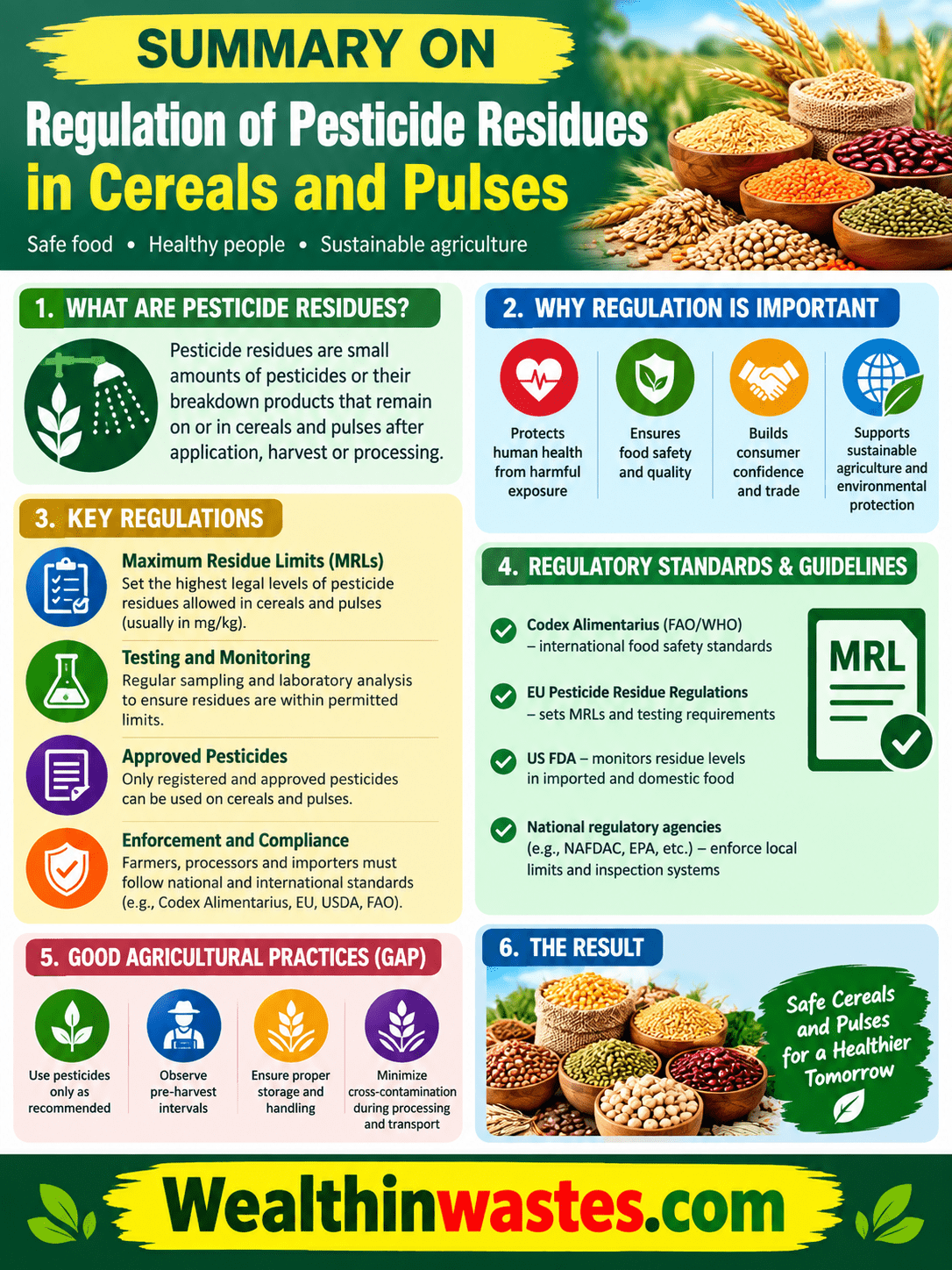
Summary on Regulation of Pesticide Residues in Cereals and Pulses
| Aspect | Summary |
|---|---|
| Pesticide residues | Small amounts of pesticide substances or related products may remain in cereals and pulses after authorized treatment. |
| MRLs | Maximum Residue Limits define legally tolerated residue concentrations for particular pesticide and commodity combinations. |
| Main sources | Field applications, post-harvest treatments, storage protection, drift, runoff, and environmental contamination can contribute residues. |
| Regulation | National regulators and international systems such as Codex establish or support residue standards and compliance procedures. |
| Testing | Representative sampling and reliable laboratory methods help compare measured residues with applicable limits. |
| Prevention | Correct product selection, application rates, timing, records, storage practices, and integrated pest management reduce residue risks. |
Frequently Asked Questions About Regulation of Pesticide Residues in Cereals and Pulses
1. What are pesticide residues?
Pesticide residues are substances or related compounds that remain in food after pesticide use during crop production, storage, transport, or processing. They may include metabolites and transformation products recognized by the applicable residue definition.
2. What does MRL mean?
MRL means Maximum Residue Limit, the legally permitted concentration of a specified pesticide residue in or on a particular food commodity under an established regulatory standard for that pesticide and commodity combination.
3. Are pesticide residues always dangerous?
A detected residue does not automatically mean unsafe food; risk depends on the pesticide, concentration, exposure, toxicology, dietary intake, and the applicable safety assessment established by regulatory authorities for consumers.
4. How can farmers reduce residues?
Farmers can reduce residues by following labels, using correct rates, respecting harvest intervals, applying only when needed, and keeping accurate treatment records that support traceability, compliance, and corrective action when necessary.
5. Do stored cereals contain pesticide residues?
They can contain residues when approved post-harvest pesticides or fumigants are used, especially when treatments are poorly selected, misapplied, or used contrary to label requirements and approved storage conditions for cereals.
6. Who sets pesticide residue limits?
National authorities establish or enforce national requirements, while Codex develops international MRL recommendations for pesticide and commodity combinations used in food trade and supports international harmonization of residue standards across markets.
7. How are residues detected?
Authorized laboratories analyze representative food samples with suitable analytical methods and compare measured concentrations with the applicable pesticide and commodity residue standard, helping authorities identify compliant or potentially non-compliant consignments.
Do you have any questions, suggestions, or contributions? If so, please feel free to use the comment box below to share your thoughts.We also encourage you to kindly share this information with others who might benefit from it. Since we can’t reach everyone at once, we truly appreciate your help in spreading the word. Thank you very much for your support and for sharing!
Read Also: Principles of Pesticide Application for Stored Agricultural Produce Protection