


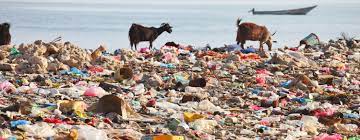
Environmental pollution is the unfavourable alteration of our surroundings, wholly or largely resulting from human actions through direct or indirect changes in energy patterns, radiation levels, chemical conditions, physical conditions, and organisms.
Environmental pollution is a global problem that affects developed and developing countries, attracting attention because continued exposure can produce serious consequences for human health, ecosystems, agriculture, communities, and economic activities.
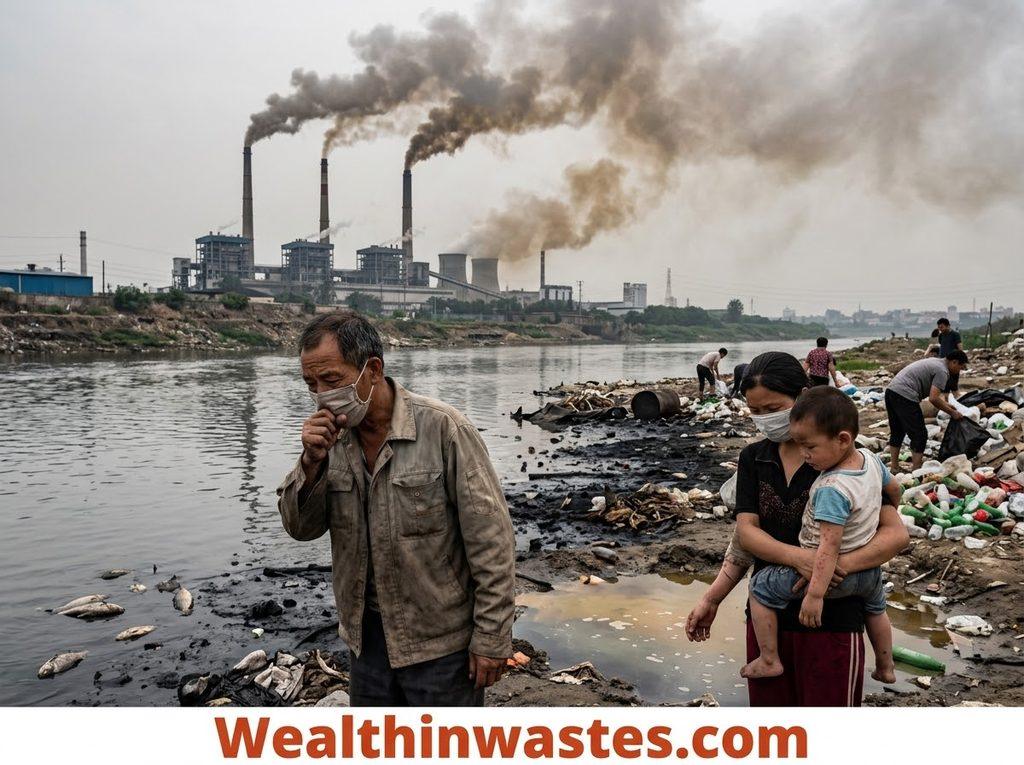
Environmental pollution is associated with adverse health effects that may appear shortly after exposure or develop gradually over time, depending on the pollutant, concentration, exposure route, and duration involved.
Acute effects commonly follow sudden and severe exposure with rapid absorption, while chronic effects develop gradually after prolonged or repeated exposure over relatively long periods, sometimes remaining unnoticed until damage becomes substantial.
Types of Environmental Pollution
Environmental pollution can be classified according to the nature of pollutants and the environmental components they affect. The major categories include air, water, land, noise, radioactive, and thermal pollution.
1. Air Pollution: Air pollution occurs when harmful gases, smoke, particles, vapours, or biological materials enter the atmosphere at concentrations capable of affecting human health, ecosystems, visibility, climate, or agricultural productivity.
2. Water Pollution: Water pollution occurs when harmful substances enter rivers, lakes, groundwater, wetlands, seas, or other water bodies, changing their physical, chemical, or biological characteristics beyond acceptable conditions.
3. Soil or Land Pollution: Soil and land pollution develops when waste materials, toxic chemicals, petroleum products, pesticides, salts, radioactive substances, or other contaminants accumulate and reduce environmental quality.
4. Noise Pollution: Noise pollution results from excessive or unwanted sound produced by transportation, industries, machines, construction, entertainment activities, and other sources, potentially affecting communication, sleep, concentration, behaviour, and wellbeing.
5. Radioactive Pollution: Radioactive pollution occurs when radioactive materials enter the environment through accidents, industrial activities, medical applications, mining, research, improper disposal, or other processes that expose organisms to ionising radiation.
6. Thermal Pollution: Thermal pollution occurs when human activities release excessive heat into water or surrounding environments, changing natural temperatures and potentially reducing dissolved oxygen while disturbing aquatic organisms and ecosystems.
Different societies perceive environmental problems differently because culture, religion, economic conditions, education, governance, and technological exposure influence how communities understand environmental risks and choose appropriate responses.
Read Also: Methods of Dissemination of Environmental Information
Social Response to Environmental Pollution
Social response to environmental pollution refers to how individuals, communities, institutions, industries, and governments recognize pollution, express concern, change behaviour, demand accountability, and participate in measures that reduce environmental risks.
Public understanding strongly influences environmental behaviour because people who recognize pollution sources and consequences are more likely to support responsible disposal, conservation, reporting systems, environmental education, and pollution-control measures.
Socioeconomic conditions also influence public perceptions because communities facing poverty, unemployment, weak infrastructure, or limited services may prioritize immediate livelihood needs before addressing longer-term environmental concerns and health risks.
Effective [public environmental education and information sharing](https://wealthinwastes.com/environmental-and-health-effects-of-wastes/) can help communities understand pollution pathways, recognize harmful practices, adopt safer habits, and communicate environmental concerns more effectively to responsible authorities.
Community participation becomes stronger when people receive reliable information, trust institutions, understand their responsibilities, and believe that reporting pollution will produce meaningful action rather than continued environmental neglect.
Where social institutions respond promptly, communities can contribute through monitoring, clean-up activities, responsible waste handling, environmental advocacy, and cooperation with authorities to prevent pollution before it causes severe damage.
Causes and Sources of Environmental Pollution
Environmental pollution comes from several human activities, and the seriousness of pollution depends on pollutant quantity, toxicity, persistence, exposure pathways, environmental conditions, population density, and effectiveness of control measures.
1. Improper Waste Disposal: Uncontrolled dumping, open burning, poorly managed landfills, and indiscriminate disposal allow waste materials and hazardous substances to contaminate land, water, and air while creating unpleasant community conditions.
2. Industrial Activities: Factories may release wastewater, gases, smoke, chemicals, heavy metals, oils, heat, and solid residues into surrounding environments when production processes lack effective treatment and pollution-control systems.
3. Agricultural Practices: Excessive fertilizers, pesticides, herbicides, livestock wastes, erosion, residue burning, and poor irrigation practices can introduce nutrients, chemicals, sediments, and other pollutants into soil, air, and water.
4. Oil Exploration and Spills: Petroleum exploration, transportation, storage, refining, pipeline failures, and deliberate sabotage can release crude oil and related substances that damage soil, vegetation, wetlands, water bodies, wildlife, and livelihoods.
5. Transportation and Energy Use: Vehicles, power plants, generators, and fuel-burning equipment emit gases and particles that contribute to air pollution, while transport activities may also produce noise, waste, spills, and environmental disturbances.
6. Population Growth and Urbanization: Rapid population growth increases demand for housing, transportation, food, water, energy, and consumer goods, thereby increasing waste generation and placing greater pressure on already stressed environmental systems.
Health and Ecological Effects of Pollution

Environmental pollution can affect people through contaminated air, water, food, and soil, while ecosystems may experience habitat degradation, biodiversity decline, disrupted food chains, reduced productivity, and weakened ecological resilience.
Air pollutants may irritate the respiratory system, worsen existing breathing problems, reduce quality of life, and create wider environmental effects when pollutants accumulate or participate in atmospheric chemical reactions.
Contaminated water can expose communities to pathogens, toxic chemicals, heavy metals, petroleum residues, and other harmful substances, especially where treatment systems remain inadequate or contaminated sources support domestic and agricultural activities.
Land pollution can reduce soil quality and productivity when toxic substances accumulate, while poorly managed wastes may also attract disease vectors, obstruct drainage, produce odours, and create unsafe living conditions.
Pollution can impose economic burdens through medical expenses, lost productivity, damaged infrastructure, reduced agricultural output, fisheries losses, environmental restoration costs, and declining value of affected natural resources.
Pollutants can also move through food chains, meaning environmental contamination may affect organisms indirectly when plants, fish, livestock, wildlife, or people consume contaminated materials from affected ecosystems.
Community Perceptions of Environmental Pollution
Community perceptions influence how societies identify environmental pollution, assign responsibility, tolerate harmful activities, and support corrective actions. These perceptions may vary significantly between regions, occupational groups, and socioeconomic classes.
1. Awareness and Education: Environmental awareness helps residents recognize pollution sources, understand exposure pathways, identify warning signs, and make informed decisions about waste handling, resource use, reporting, and community participation.
2. Cultural and Social Values: Cultural beliefs, traditions, religious interpretations, community expectations, and social relationships can influence how people define environmental responsibility and whether pollution-control practices receive broad public support.
3. Economic Circumstances: Low-income households may depend directly on polluted land, forests, rivers, or informal economic activities for survival, making pollution responses more complicated where environmental protection threatens immediate income.
4. Trust in Institutions: Public participation improves when environmental agencies communicate clearly, enforce rules fairly, investigate complaints, and demonstrate visible results instead of allowing repeated pollution incidents to continue without accountability.
5. Community Participation: Local groups can support environmental protection through neighbourhood clean-ups, waste separation, tree planting, public reporting, educational campaigns, monitoring activities, and collective pressure for responsible corporate and governmental behaviour.
6. Social Advocacy: Environmental organizations, researchers, journalists, community leaders, and concerned citizens can draw public attention to pollution problems, demand transparency, encourage policy reforms, and support affected communities seeking corrective action.
Pollution Control and Community Action
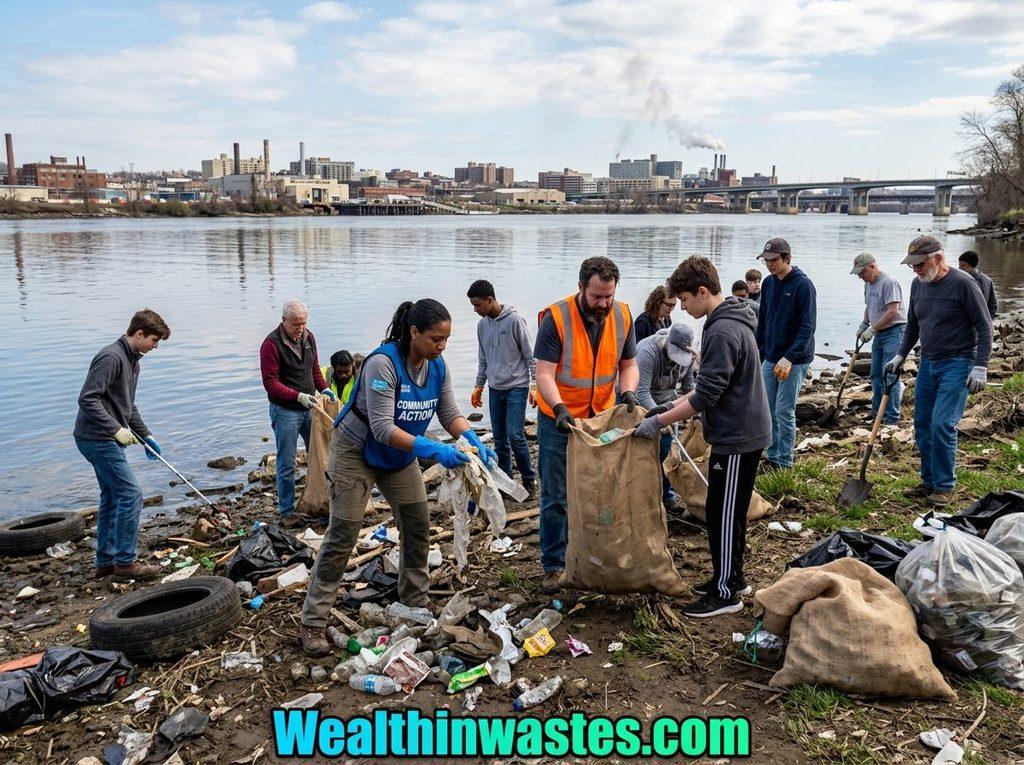
Pollution control works best when prevention begins at the source rather than waiting until contaminants spread widely. Communities, industries, households, and authorities all have practical responsibilities within this process.
1. Reduce Pollution at Source: Organizations can prevent pollution by using cleaner materials, improving production efficiency, reducing waste generation, maintaining equipment, preventing leaks, and replacing hazardous processes with safer alternatives.
2. Improve Waste Management: Proper collection, separation, reuse, recycling, treatment, and disposal reduce the quantity of waste entering the environment and limit opportunities for pollutants to contaminate air, soil, or water.
3. Strengthen Water Protection: Communities and authorities can protect water bodies by controlling effluent discharges, reducing runoff pollution, treating wastewater, protecting drainage systems, and preventing direct dumping into rivers, streams, and lakes.
4. Support Environmental Enforcement: Effective laws require monitoring, consistent enforcement, appropriate penalties, transparent investigations, and institutional capacity capable of identifying pollution sources and ensuring that responsible parties meet environmental obligations.
5. Encourage Public Participation: Residents should have accessible channels for reporting pollution incidents, receiving environmental information, joining local programmes, and communicating concerns with authorities, businesses, researchers, and community organizations.
6. Promote Sustainable Practices: Sustainable transport, responsible farming, cleaner energy use, resource conservation, recycling, pollution prevention, and careful consumption can reduce pressure on environmental systems while supporting healthier and more resilient communities.
Economic and Regional Consequences of Pollution
Environmental pollution creates economic consequences that may extend far beyond the immediate location of contamination. Governments, households, businesses, farmers, fishers, and communities can all experience direct or indirect financial losses.
Polluted environments can reduce agricultural productivity, damage fisheries, increase water-treatment expenses, raise healthcare costs, weaken tourism, reduce workplace productivity, and require costly restoration projects after contamination becomes widespread.
Research on pollution-related economic losses shows why environmental damage should receive serious attention during policy decisions, because the cost of prevention can differ greatly from the cost of restoring damaged systems.
Oil-producing communities may face especially severe consequences because spills and related activities can contaminate agricultural land, surface water, wetlands, vegetation, fisheries, and community infrastructure while disturbing established livelihoods.
The scale of damage often depends on the pollutant involved, the size and location of the affected area, exposure duration, ecosystem sensitivity, population dependence on local resources, and speed of response.
Regional differences also matter because developed areas may possess stronger infrastructure and enforcement capacity, whereas developing communities may struggle with inadequate treatment facilities, limited monitoring resources, and weak institutional coordination.
For this reason, the wider environmental impacts of waste should be considered when governments design policies, allocate resources, approve industrial projects, and evaluate long-term development priorities.
Reducing pollution can protect economic resources by lowering treatment costs, preventing health expenses, preserving productive land and water, improving working conditions, and maintaining environmental assets that support livelihoods over time.
Read Also: Environmental Psychology and Ecological Theory
Information, Policy and Pollution Monitoring
Reliable environmental information supports better decisions because policymakers, communities, researchers, industries, and environmental agencies need accurate evidence to identify pollution sources, assess risks, evaluate trends, and measure control efforts.
Environmental monitoring can measure pollutants in air, water, soil, sediments, workplaces, and biological systems, helping authorities understand where contamination occurs and whether pollution levels change after interventions are introduced.
Methods used to monitor pollutants can provide information needed for exposure assessment, environmental planning, regulatory enforcement, emergency response, and long-term management of contaminated areas and resources.
Water-quality protection also requires preventive thinking because pollution control becomes more effective when communities reduce contamination before pollutants reach rivers, groundwater, lakes, and other sensitive receiving environments.
Governments can strengthen pollution management by establishing clear standards, supporting environmental education, investing in monitoring equipment, improving laboratory capacity, coordinating agencies, and making pollution information accessible to affected communities.
Water-quality management principles emphasize prevention and appropriate control measures, particularly where pollution originates from diffuse sources that require improved agricultural, industrial, domestic, and community practices.
Environmental policy should also recognize that pollution often crosses administrative boundaries, meaning effective solutions require cooperation among neighbouring communities, local authorities, industries, regulators, researchers, and national institutions.
Finally, strong environmental governance depends on continuous learning. Communities and institutions should review pollution data, identify recurring problems, improve response systems, and adapt policies as environmental conditions and technologies change.
Responsible environmental action becomes more effective when accurate information, public participation, scientific evidence, institutional capacity, and practical pollution-control measures operate together rather than functioning as separate activities.
Summary on Social Response to Environmental Pollution and Types of Environmental Pollution
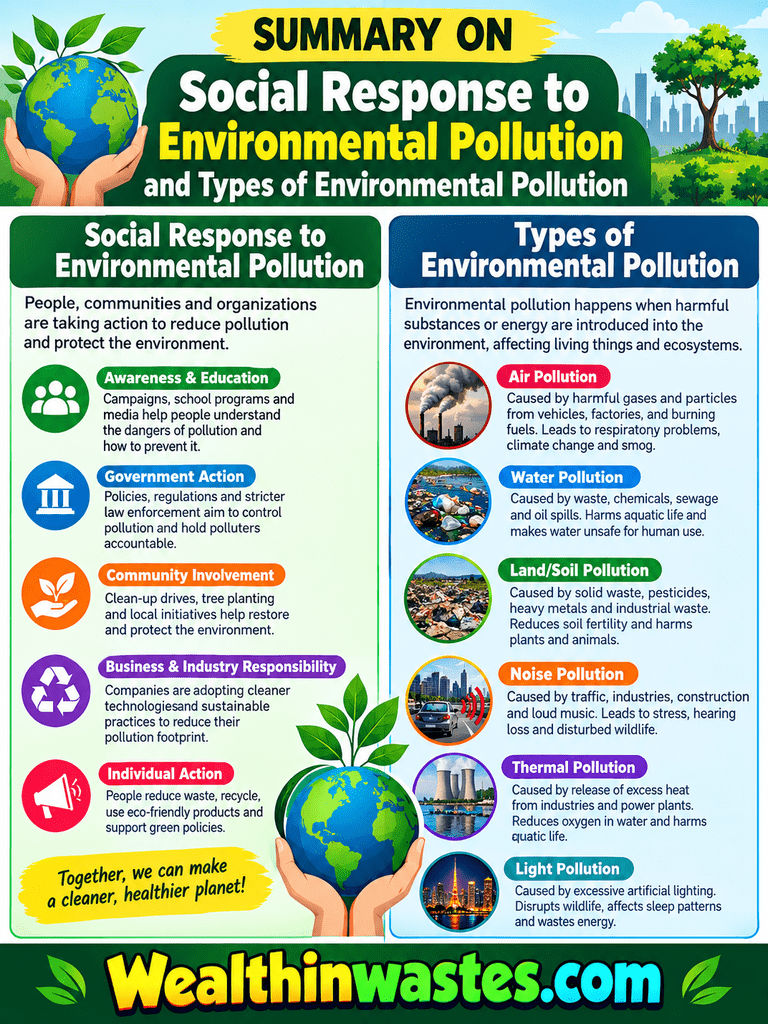
| Aspect | Summary |
|---|---|
| Meaning | Environmental pollution is an undesirable change in environmental conditions caused largely by human activities. |
| Main Types | Air, water, soil or land, noise, radioactive, and thermal pollution are major categories. |
| Main Sources | Waste disposal, industries, agriculture, oil activities, transportation, energy use, and population growth contribute significantly. |
| Health Effects | Pollution can cause acute and chronic health problems through contaminated air, water, food, and soil. |
| Social Response | Awareness, education, public participation, advocacy, institutional trust, and community action influence pollution responses. |
| Economic Effects | Pollution can increase healthcare, treatment, restoration, agricultural, fisheries, and productivity costs. |
| Control | Source reduction, proper waste management, enforcement, monitoring, public education, and sustainable practices can reduce pollution. |
Frequently Asked Questions About Environmental Pollution: Social Response and Its Main Types
1. What is environmental pollution?
Environmental pollution is the harmful alteration of air, water, soil, or other environmental conditions through pollutants released by human or natural activities.
2. What are the main types of environmental pollution?
The major types include air, water, soil or land, noise, radioactive, and thermal pollution.
3. How does society respond to environmental pollution?
Society responds through education, advocacy, public participation, reporting, environmental laws, community programmes, cleaner practices, monitoring, and pollution-control activities.
4. What are common causes of environmental pollution?
Common causes include improper waste disposal, industrial activities, agricultural chemicals, oil spills, transportation, fuel combustion, and rapid urbanization.
5. Why does environmental pollution differ between regions?
Pollution patterns differ because regions have different industries, population levels, infrastructure, environmental policies, cultures, technologies, economic conditions, and natural resources.
6. Can communities help reduce environmental pollution?
Yes. Communities can reduce pollution through proper waste handling, environmental education, clean-up activities, responsible resource use, pollution reporting, recycling, and support for effective environmental regulations.
7. Why is pollution monitoring important?
Monitoring provides evidence about pollutant levels, exposure risks, pollution sources, environmental trends, and the effectiveness of measures designed to control contamination.
8. How can environmental pollution be prevented?
Prevention requires reducing pollution at source, improving waste management, treating wastewater, enforcing standards, promoting cleaner technologies, monitoring pollutants, educating communities, and encouraging sustainable practices.
Do you have any questions, suggestions, or contributions? If so, please feel free to use the comment box below to share your thoughts. We also encourage you to kindly share this information with others who might benefit from it. Since we can’t reach everyone at once, we truly appreciate your help in spreading the word. Thank you very much for your support and for sharing!
Read Also: Air Pollution and Its Impact on Agriculture