


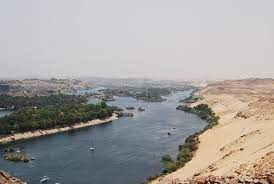
Waterlogging in irrigation occurs when repeated water application raises soil moisture beyond the level crops can safely use. Poor drainage then keeps the root zone saturated for prolonged periods.
Irrigation supports reliable crop production where rainfall cannot meet plant demand, but excessive application can create serious soil problems. Two major concerns are salinity buildup and persistent waterlogging in fields.
When irrigation water evaporates or leaves through plant transpiration, dissolved salts remain behind in the soil. Continued accumulation can reduce water availability to roots and restrict normal crop development over time.
Waterlogging develops when irrigation, seepage, rainfall, or groundwater recharge adds water faster than the soil can remove it. The rising water table can eventually reach the active root zone and remain there.
Both problems can occur together because saturated soils often have poor natural drainage, while repeated irrigation adds dissolved salts. Effective irrigation therefore requires careful water scheduling, drainage, and soil monitoring.
Causes of Waterlogging in Irrigation
Waterlogging can develop even on productive farms when irrigation quantity, field drainage, soil properties, and groundwater conditions are not managed together. Several interacting factors commonly create excessive saturation in many irrigation projects.
1. Excess Irrigation: Applying more water than crops can use leaves surplus moisture in the root zone. Repeated applications may push water downward and gradually raise the groundwater level beneath fields.
2. Canal Seepage: Unlined canals and damaged irrigation channels can lose substantial water into surrounding soil. Persistent seepage increases groundwater recharge and may create wet conditions near irrigation infrastructure and fields.
3. Poor Natural Drainage: Heavy clay soils, shallow restrictive layers, and flat terrain can slow downward water movement. Fields with limited drainage capacity therefore remain saturated longer after irrigation or rainfall.
4. Rising Groundwater: Shallow groundwater creates another pathway to waterlogging because irrigation losses can recharge the water table. Farmers should monitor groundwater management where saturation repeatedly develops beneath the crop root zone today.
5. Uneven Field Application: Poorly designed systems may overwater some areas while leaving others dry. Using suitable land suitability information and accurate field layout can improve distribution and reduce wet patches.
6. Soil Compaction: Machinery traffic and repeated cultivation can compress soil pores and restrict drainage. Better soil degradation practices can preserve soil structure and allow excess water to move more freely.
Read Also: Hurts Wastewater Management Complete Guide
Water Runoff and Soil Erosion Effects
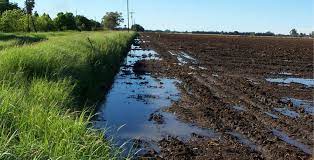
Because productive farmland depends on healthy soil, runoff and erosion can reduce the amount of water that remains available for crops. Irrigation management must therefore protect soil structure and fertility.
Water moving rapidly across exposed ground can detach and transport valuable topsoil, nutrients, organic matter, and soil organisms. The resulting losses weaken the field’s capacity to support consistent crop production.
Severely eroded soil may absorb less water because surface structure and infiltration pathways change. Protecting land with vegetation and careful cultivation can reduce runoff while preserving moisture for crops.
Tree canopies, crop residues, grasses, and cover crops slow rainfall before it reaches the soil surface. These measures can reduce the speed of runoff and lower the energy available to detach soil particles.
Farmers should also understand soil erosion because repeated soil loss can expose less fertile layers and reduce rooting depth. Erosion control therefore supports both water conservation and long-term field productivity.
Runoff can carry fertilizers, pesticides, sediments, and other materials into waterways.Well-managed fields reduce this transfer by maintaining ground cover, improving infiltration, and controlling excessive irrigation or stormwater flow, protecting nearby watershed pollution systems.
Effective runoff management should complement irrigation planning rather than operate separately. Keeping soil covered, maintaining drainage routes, and limiting unnecessary water application can protect fields from both erosion and saturation.
Soil Salinization in Irrigated Fields
Irrigation water contains dissolved minerals and soil moisture that remain in soil after water evaporates or plants absorb moisture. When salts accumulate faster than they leave, the soil gradually develops harmful salinity conditions.
Salt concentration becomes more damaging when evaporation exceeds rainfall or when drainage cannot carry dissolved salts below the root zone. Arid and semi-arid farming areas face particularly strong evaporation pressure.
Salinity reduces the ability of plant roots to absorb water because dissolved salts increase osmotic pressure in the soil solution. Crops may therefore experience water stress even when soil appears moist.
Some salts can also damage plant tissues directly or disturb nutrient balance. Sensitive crops may show poor emergence, leaf scorching, stunted growth, uneven development, and lower yields under persistent saline conditions.
Farmers can manage the risk by testing irrigation water and soil regularly, choosing suitable crops, improving drainage, and following appropriate water quality improvement principles to protect the root zone effectively.
Salinity can worsen when evaporation draws water upward toward the surface, leaving dissolved salts behind. Repeated cycles concentrate salts within upper soil layers, while pesticide movement may behave differently in altered soils.
Chemical and physical changes may accompany salt accumulation, reducing soil structure and infiltration in severe cases. The resulting decline in soil condition can make future irrigation less effective and increasingly costly.
Salt buildup can also increase the cost of restoring damaged fields because farmers may need improved drainage, better-quality water, tolerant crops, amendments, and careful management over several growing seasons.
Waterlogging and Crop Root Damage

Waterlogging limits the air available within soil pores, leaving crop roots with insufficient oxygen for respiration. Root activity declines when saturation persists, weakening the plant’s ability to absorb water over time.
Saturated conditions can damage root systems and reduce nutrient uptake, even when nutrients remain present in soil. Plants may develop yellow leaves, slow growth, shallow roots, or poor flowering around underground water and aquifers.
Waterlogging can increase disease pressure because wet conditions favour several soilborne pathogens and weaken plant tissues. Crops that require well-aerated soil often suffer the greatest productivity losses under persistent saturation.
Waterlogging also delays field operations because saturated soils cannot support machinery safely. Cultivation, planting, harvesting, and weed control may become difficult, increasing labour requirements and production costs for farmers during peak wet periods.
When waterlogging persists across large areas, productive farmland can become economically unviable. This is why effective drainage remains essential wherever irrigation adds substantial quantities of water to agricultural soils without timely intervention.
Persistent saturation can also reduce root exploration and limit the soil volume and soil conservation available for nutrient acquisition. Plants may become less stable physically, especially where wet soil loses strength and collapses.
Waterlogging may interact with salinity because shallow groundwater pollution can carry dissolved salts upward. As water evaporates near the surface, those salts can accumulate while poor drainage continues to restrict their removal.
Warning Signs of Salinity and Waterlogging
Early diagnosis helps farmers correct irrigation and drainage problems before serious production losses occur. Salinity and waterlogging have different signs, but both can become difficult to distinguish without monitoring before widespread crop injury occurs.
1. Salt Crusts: White or pale deposits on the soil surface may indicate salt accumulation near the root zone. However, serious salinity can develop before visible crusting becomes obvious during routine field inspection.
2. Crop Stress: Poor germination, uneven stands, leaf tip burn, and stunted plants may signal salt injury. These symptoms can resemble drought, so field testing improves diagnostic accuracy and management during routine field inspection.
3. Wet Patches: Waterlogging often produces persistent wet areas, muddy surfaces, weak roots, and slow crop growth. Severe cases may leave standing water long after irrigation has stopped in affected fields during routine field inspection.
4. Root Damage: Saturated soils limit oxygen and can cause shallow, weakened roots. Comparing affected plants with healthier plants nearby can reveal changes in the root environment during routine field inspection.
5. Changing Field Patterns: Crop colour, plant height, moisture, and drainage behaviour may differ across one field. Monitoring seasonal weather under climate sustainability conditions can reveal spreading problem zones throughout the growing season.
6. Soil Test Results: Electrical conductivity can indicate salinity, while moisture measurements show saturation patterns. Farmers should understand wastewater sources before deciding whether poor water quality contributes to field problems.
Prevention of Soil Salinization
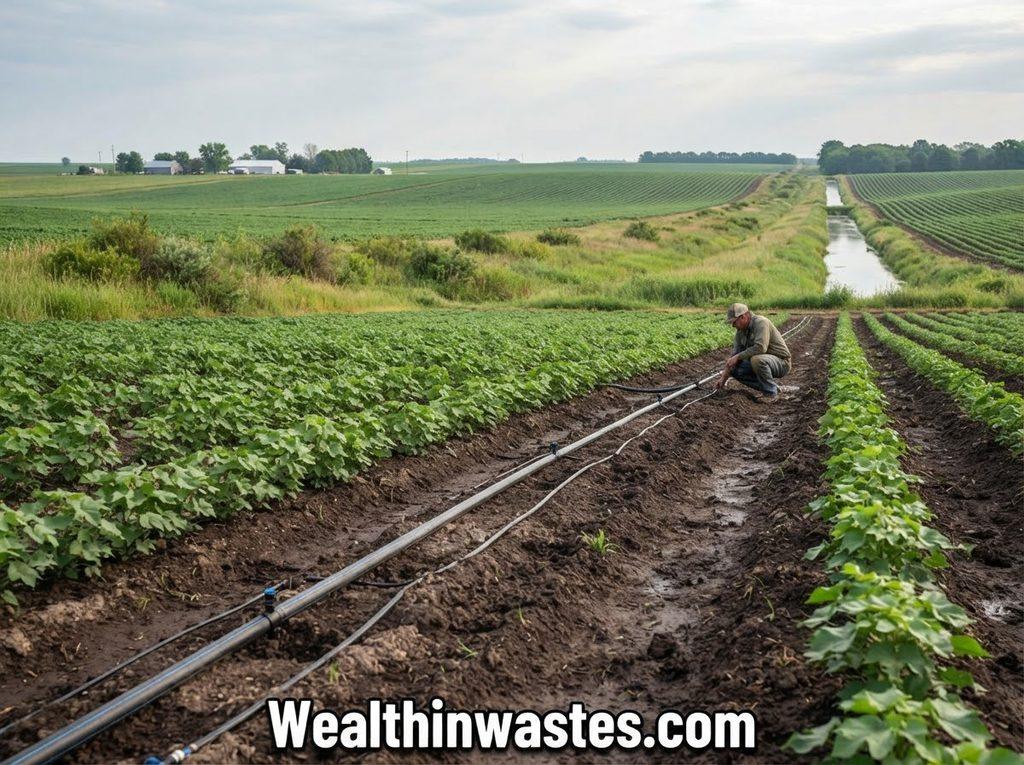
Successful salinity control combines water quality testing with careful scheduling and drainage. Farmers should keep records of irrigation volumes and soil measurements so they can recognize gradual changes before crop losses become substantial.
1. Test Irrigation Water: Check salinity indicators before regular use, because water quality determines how many dissolved salts enter the field. Testing helps farmers select suitable sources and management practices.
2. Match Water Application To Demand: Apply only the amount crops need at the appropriate growth stage. water conservation and accurate scheduling reduce excessive evaporation, deep losses, and the unnecessary concentration of salts in soil.
3. Improve Salt Leaching: Where drainage is adequate, apply good-quality water and wastewater reuse deliberately to move accumulated salts below the root zone. Leaching works best when excess water can leave the field safely.
4. Select Tolerant Crops: Crops differ in their ability to withstand saline conditions. Choosing varieties suited to the field’s salt level can protect yields while longer-term soil improvements continue under local growing conditions.
5. Maintain Soil Structure: Organic matter, careful cultivation, and erosion control can improve infiltration and root-zone conditions. Better soil structure helps water move downward and supports more effective salt management.
6. Monitor Field Conditions: Record soil salinity, moisture, crop response, and irrigation amounts throughout the season. Regular records reveal trends that can guide timely adjustments before damage becomes severe throughout the growing season.
Control of Waterlogging With Effective Drainage
Drainage planning should begin before large irrigation schemes operate because removing excess water becomes harder and more expensive after the water table has risen. Regular maintenance keeps drainage systems functional.
1. Build Adequate Drains: protecting water resources and surface drains or subsurface systems can remove excess water from fields. Their design should match soil characteristics, rainfall, groundwater conditions, and irrigation volumes.
2.Maintain Irrigation Channels: Repair leaks, cracks, and damaged control structures promptly. Reducing canal seepage prevents unnecessary groundwater recharge and limits waterlogging around fields near irrigation infrastructure and field drains.
3. Schedule Irrigation Carefully: Monitor soil moisture and crop demand before each application. Avoid fixed schedules that continue irrigating during wet periods or after enough water has already entered the root zone.
4. Level The Field: Proper land leveling improves water distribution and reduces areas that receive excessive irrigation. Uniform application makes it easier to deliver adequate moisture without creating persistent wet spots.
5. Monitor Groundwater Levels: Track economic impact and water table depth where waterlogging remains a recurring problem. Early rises can trigger drainage adjustments before groundwater reaches the principal root zone and damages crops.
6. Manage Compaction: Reduce unnecessary machinery traffic when soil is wet and use appropriate tillage practices. Less compaction creates more connected pores, allowing water and air to move through the root zone.
Read Also: Water and Wastewater Management Complete Guide
Sustainable Soil and Water Management
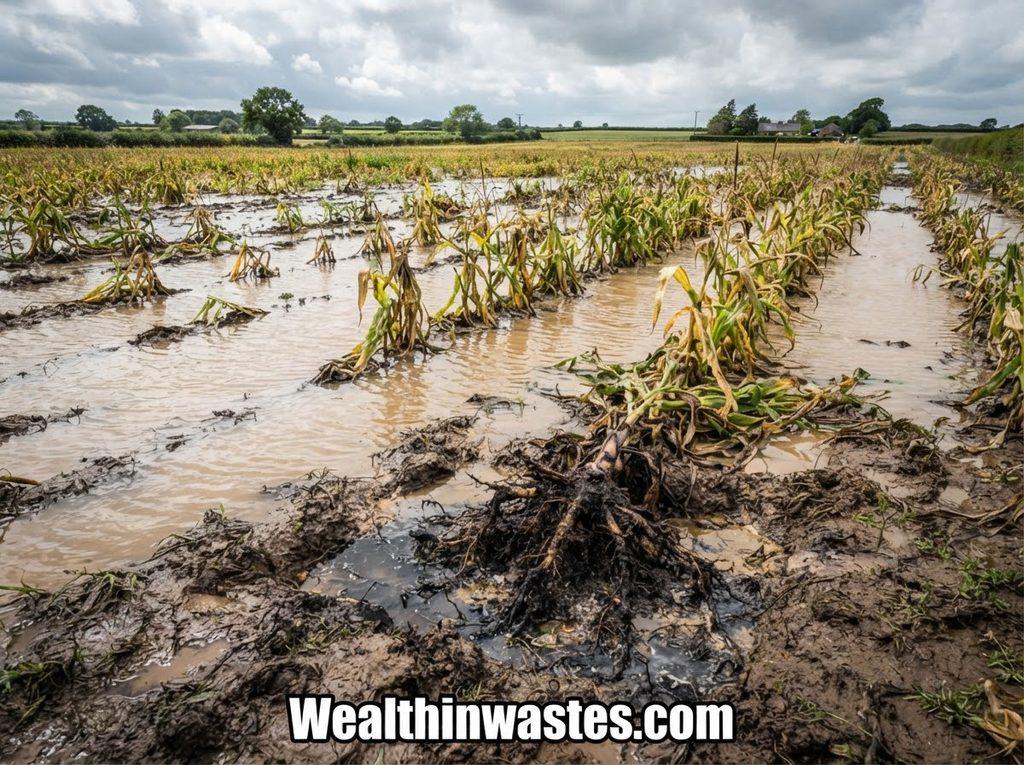
Good irrigation management begins with understanding how soil texture, structure, slope, crop demand, rainfall, and groundwater interact. Farmers should treat water application and drainage as parts of one connected system.
Soil organic matter can improve aggregation, infiltration, and water retention, helping fields use rainfall and irrigation more effectively. It can also reduce runoff and protect soil against erosion during storms.
Vegetative cover helps intercept rainfall, reduce the speed of surface flow, and protect soil particles from being detached. Trees, cover crops, grasses, and crop residues can therefore support water conservation.
Efficient irrigation methods can reduce avoidable water losses, but technology alone cannot solve poor drainage. Systems still require correct design, maintenance, suitable application rates, and regular field observation by farmers.
Integrated management protects productive soil while reducing wasted water, nutrient losses, erosion, and drainage problems. The goal is not simply to add water, but to maintain healthy roots and prevent industrial effluent entering irrigation sources.
Farmers should also consider the quality of drainage water because salt, nutrients, and sediments may leave irrigated fields. Responsible disposal and biological sustainability practices prevent these materials from creating wider environmental problems.
Long-term planning should connect irrigation efficiency with composting and soil conservation, groundwater protection, runoff control, and suitable crop selection. This approach keeps agricultural land productive while reducing repeated costs over time.
Summary on Soil Salinization and Waterlogging in Irrigation
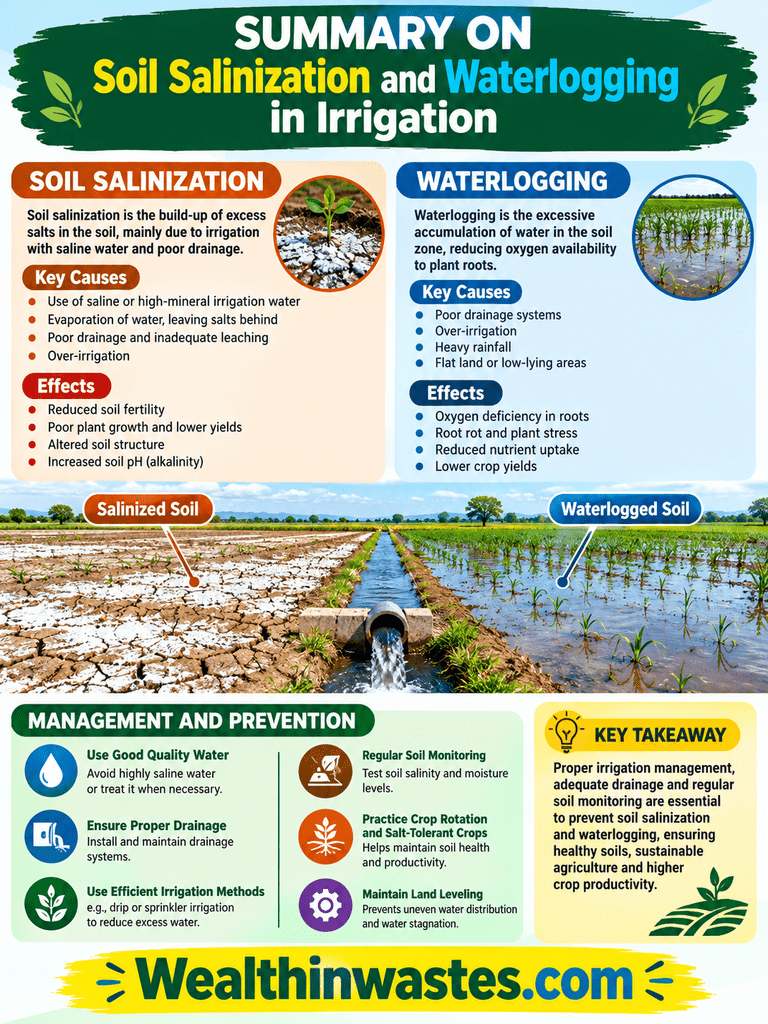
| Topic | Key Point |
|---|---|
| Waterlogging | Excess water remains in the root zone when irrigation exceeds crop demand or drainage capacity. |
| Soil Salinization | Dissolved salts accumulate when evaporation and plant uptake remove water faster than salts leave the soil. |
| Main Causes | Over-irrigation, canal seepage, poor drainage, shallow groundwater, uneven application, and compaction can increase risk. |
| Crop Effects | Root oxygen shortage, nutrient imbalance, salt stress, disease pressure, weak growth, and lower yields may result. |
| Prevention | Test water and soil, schedule irrigation carefully, improve drainage, select tolerant crops, and protect soil structure. |
| Long-Term Management | Combine efficient irrigation with soil conservation, groundwater protection, runoff control, monitoring, and responsible water quality management. |
Frequently Asked Questions About Soil Salinization and Waterlogging in Irrigation
1. What is waterlogging in irrigation?
Waterlogging occurs when excess water saturates the root zone for too long, reducing soil aeration and restricting normal crop growth.
2. How does irrigation cause soil salinization?
Irrigation water can contain dissolved salts that remain after evaporation or plant uptake, causing salts to accumulate when drainage is inadequate.
3. What are common signs of waterlogged soil?
Persistent wet patches, standing water, weak roots, poor growth, muddy surfaces, and delayed field operations can indicate waterlogging.
4. What are common signs of salinity?
Salt crusts, poor germination, leaf tip burn, uneven stands, stunted growth, and reduced crop performance may indicate soil salinity.
5. Can waterlogging and salinity occur together?
Yes. Rising groundwater can bring salts upward, while poor drainage prevents both excess water and dissolved salts from leaving the root zone.
6. How can farmers prevent irrigation waterlogging?
Farmers can improve drainage, repair canals, level fields, monitor soil moisture, reduce unnecessary irrigation, and track groundwater depth.
7. How can saline soils be managed?
Test soil and irrigation water, improve drainage, use suitable leaching where appropriate, maintain soil structure, and choose salt-tolerant crops.
8. Why is drainage important in irrigated agriculture?
Drainage removes excess water and helps carry dissolved salts away, keeping the root zone better aerated and more suitable for productive crop growth.
Do you have any questions, suggestions, or contributions? If so, please feel free to use the comment box below to share your thoughts. We also encourage you to kindly share this information with others who might benefit from it. Since we can’t reach everyone at once, we truly appreciate your help in spreading the word. Thank you very much for your support and for sharing!
Read Also: Understanding Irrigation in Agriculture