


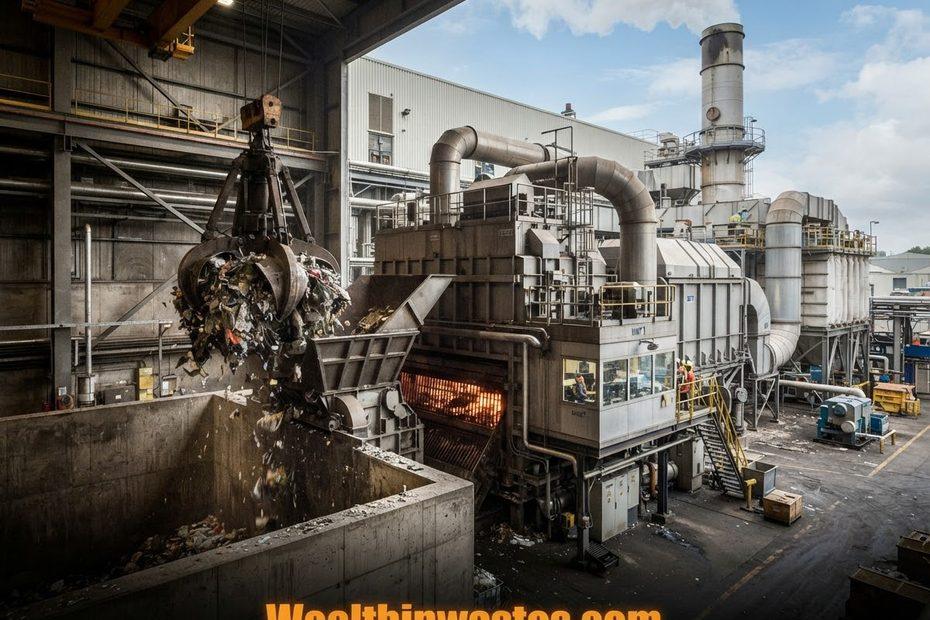
Incineration is a controlled thermal treatment method that burns combustible waste at high temperatures, changing much of its organic content into gases, heat, and residual ash requiring proper management.
Unlike uncontrolled open burning, incineration takes place inside purpose-built equipment where operators can monitor combustion conditions. Proper operation depends on suitable temperature, oxygen, residence time, and effective mixing throughout treatment.
The process can substantially reduce the volume of combustible municipal, industrial, and selected healthcare wastes requiring final disposal. However, volume reduction does not remove the need for responsible residue management.
Modern facilities can recover energy from combustion by producing steam that drives turbines or supplies useful heat. Incineration can therefore combine controlled waste treatment with energy recovery when properly designed.
Incineration can treat selected hazardous or infectious wastes because controlled high-temperature conditions can destroy many organic contaminants and pathogens. However, unsuitable materials require segregation, specialized handling, or alternative treatment methods.
Understanding Incineration and Its Purpose
Incineration does more than burn rubbish because controlled combustion seeks to convert combustible materials efficiently while limiting harmful emissions and maintaining safe conditions for workers, equipment, and surrounding communities.
The process converts combustible components mainly into gases and heat, while non-combustible minerals remain as ash. Waste composition, moisture, heating value, and operating conditions strongly influence the resulting residues.
Waste characteristics determine treatment suitability, making proper waste classification important before combustion. Classification helps identify combustible, recyclable, hazardous, infectious, inert, and otherwise unsuitable materials.
Before treatment begins, facilities must handle incoming waste carefully to prevent scattering, contamination, and unnecessary worker exposure. Good storage arrangements support safer feeding and help maintain organized waste movement.
Good waste storage practices keep refuse contained before collection and treatment. Suitable containers, sanitary surroundings, convenient access, and adequate capacity reduce avoidable handling problems during the preparation stage.
Waste composition also affects combustion performance because dry combustible material generally ignites more readily than wet material. High moisture consumes energy during evaporation and can lower thermal efficiency during combustion.
Facilities should therefore understand the physical composition of incoming materials before choosing equipment or operating conditions. Waste characterization and analysis can reveal important differences within a waste stream.
Incineration reduces the amount of combustible material requiring final disposal, but it does not eliminate all physical residues. Bottom ash and fly ash remain and require controlled handling after combustion.
Read Also: Traditional Solid Waste Disposal Methods
Incineration Process Steps and Treatment Stages
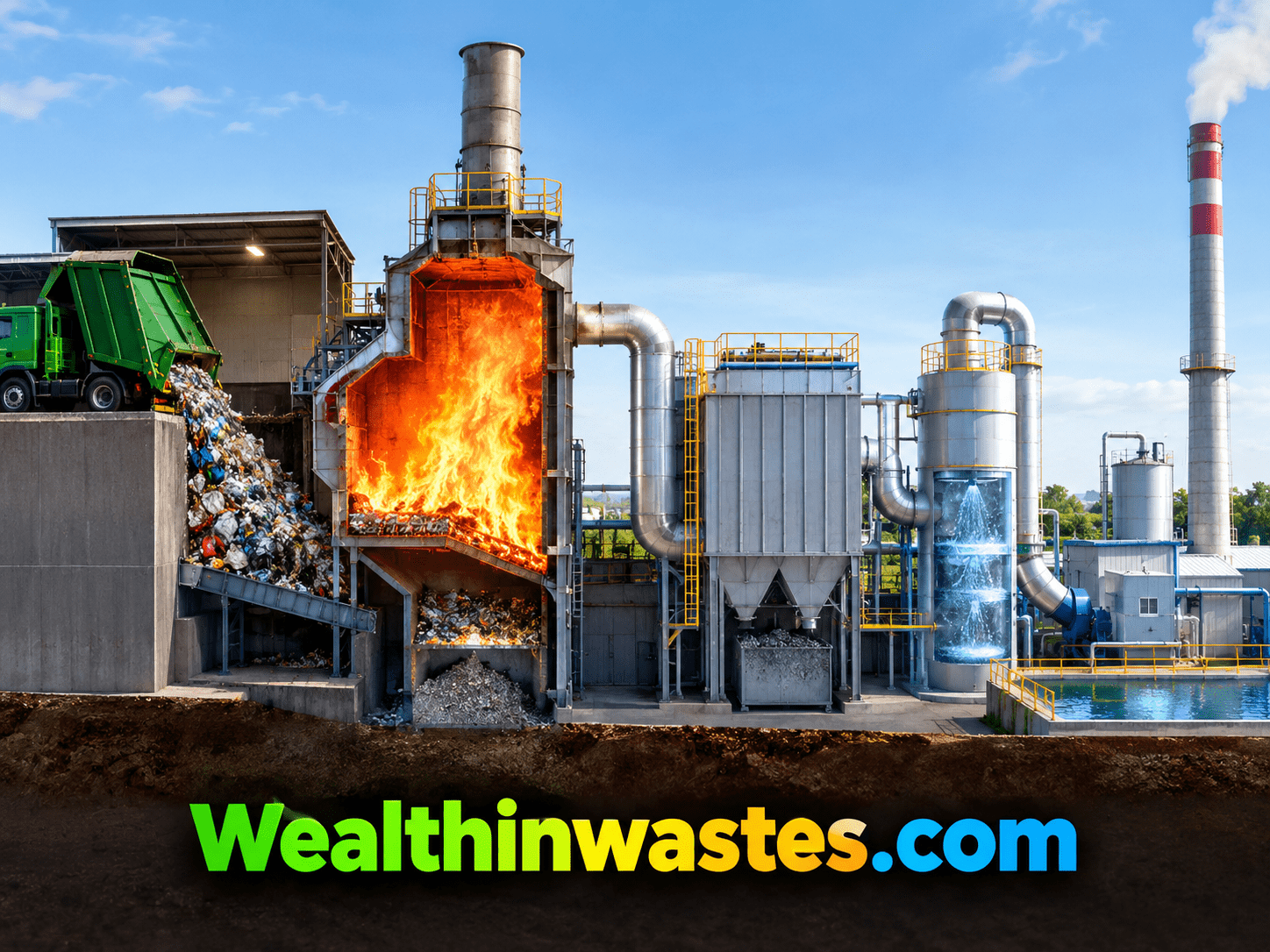
1. Waste Reception and Preparation: Incoming materials should undergo safe reception, inspection, weighing where necessary, and preparation. Operators should remove recyclable, inert, and unsuitable materials before controlled combustion begins.
2. Furnace Startup: Operators should inspect burners, chambers, air systems, monitoring equipment, and emission controls before starting. The furnace should reach suitable operating conditions before substantial waste enters the chamber.
3. Controlled Combustion: Prepared waste enters the combustion chamber where heat, oxygen, turbulence, and adequate residence time support burning. Operators regulate feed rates and airflow to maintain stable combustion conditions.
4. Secondary Combustion: Combustible gases leaving the primary zone can receive additional oxygen and heat in a secondary chamber.This promotes further oxidation and helps reduce incompletely burned gaseous compounds.
5. Ash Collection: Combustion leaves bottom ash and finer fly ash within the system. Operators should collect these residues safely, assess their characteristics, and direct them toward appropriate management pathways.
6. Flue-Gas Treatment: Exhaust gases pass through suitable pollution-control equipment that captures particles and reduces selected contaminants. Monitoring and maintenance help keep these systems effective throughout normal facility operation.
7. Energy Recovery: Where facilities include boilers and recovery systems, combustion heat produces steam that can generate electricity or provide useful thermal energy. Recovery increases the resource value of treatment.
8. Residue Management: Operators should transport, treat, recover, store, or dispose of remaining residues through approved procedures. Responsible management prevents ash and other by-products from creating secondary environmental problems.
Waste treatment begins before combustion because proper reduction, segregation, collection, and transport influence the quality of material entering the furnace. Source waste reduction can decrease unnecessary treatment loads.
Effective facilities also depend on coordinated collection and handling because waste cannot enter treatment safely without organized movement. The wider waste management process connects these activities.
Collection systems should deliver suitable waste consistently while avoiding uncontrolled mixing of incompatible materials. Proper planning also considers transport distances, treatment capacity, storage requirements, and final residue destinations.
An organized waste removal system supports reliable delivery and reduces delays between generation, collection, treatment, and final disposal. Each stage should operate as part of one coordinated system.
Major Incinerator Types and Their Applications
1. Moving-Grate Incinerator: This system moves waste mechanically across different combustion zones, supporting drying, ignition, burning, and ash removal. It commonly handles heterogeneous municipal waste during continuous thermal treatment operations.
2. Fixed-Grate Incinerator: This design keeps waste relatively stationary on a grate during combustion. Its simpler mechanical arrangement suits certain smaller operations, although operators must manage loading, airflow, and ash removal carefully.
3. Rotary-Kiln Incinerator: A slowly rotating cylindrical chamber tumbles waste during combustion, encouraging mixing and heat exposure. This design offers flexibility for selected industrial, hazardous, and mixed waste streams.
4. Fluidized-Bed Incinerator: Air flowing upward through granular material creates vigorous mixing, allowing waste, oxygen, and heat to interact efficiently. Operators usually need prepared feed material with controlled particle characteristics.
Industrial facilities often produce waste streams with very different physical and chemical properties. Understanding industrial waste characteristics helps managers choose thermal equipment that matches the material requiring treatment.
Rotary kilns often provide useful flexibility for selected difficult materials, but equipment selection still depends on moisture, heating value, composition, loading rate, contamination, and available operating expertise.
Healthcare waste presents additional concerns because infectious materials, sharps, pharmaceuticals, and contaminated items require careful segregation. Biomedical waste characteristics should guide treatment selection.
Facilities handling healthcare materials should prevent improper mixing before thermal treatment begins. Improper biomedical disposal practices can create hazards that controlled treatment systems must avoid.
Incinerator Operating Requirements for Efficient Treatment
1.Adequate Oxygen Supply: Combustion requires sufficient oxygen to support oxidation, while excessive airflow can remove heat unnecessarily. Operators should regulate air according to waste composition, moisture, feed rate, and furnace conditions.
2. Suitable Temperature: The combustion chamber must maintain conditions that support effective thermal breakdown and oxidation. Stable temperature depends on waste heating value, moisture, feed rate, airflow, and equipment design.
3. Sufficient Residence Time: Hot gases need enough time inside suitable combustion conditions to promote effective oxidation. Chamber design, gas movement, temperature, and operating controls all influence required residence time.
4. Effective Turbulence: Strong mixing helps oxygen, gases, and heat interact throughout the combustion zone. Better turbulence reduces poorly burned pockets and improves the consistency of thermal treatment.
5. Durable Refractory Lining: Furnace walls need heat-resistant materials that protect structural components from intense temperatures and chemical attack. Operators should inspect refractory surfaces regularly and repair damaged areas promptly.
6. Emission Control: Pollution-control equipment should capture particulate matter and reduce relevant gaseous contaminants before exhaust reaches the atmosphere. Regular maintenance and monitoring help sustain effective environmental performance.
7. Continuous Monitoring: Operators should monitor temperature, airflow, feed rate, combustion indicators, and equipment condition. Reliable records help identify abnormal operation early and support consistent performance during routine treatment activities.
These requirements fit within the wider principles of responsible waste management. The waste management hierarchy encourages managers to select suitable technologies according to environmental and practical conditions.
Integrated planning prevents incineration from operating as an isolated solution. Integrated waste management principles connect reduction, reuse, recovery, treatment, transportation, and final disposal.
Operators should also understand how the complete waste system functions because thermal treatment depends on dependable collection, storage, feeding, emission control, residue handling, maintenance, and trained personnel throughout facility operations.
A broader waste management framework helps authorities assess costs, responsibilities, treatment options, environmental safeguards, and resource recovery opportunities before investing in incineration facilities.
Waste Types Suitable for Incineration
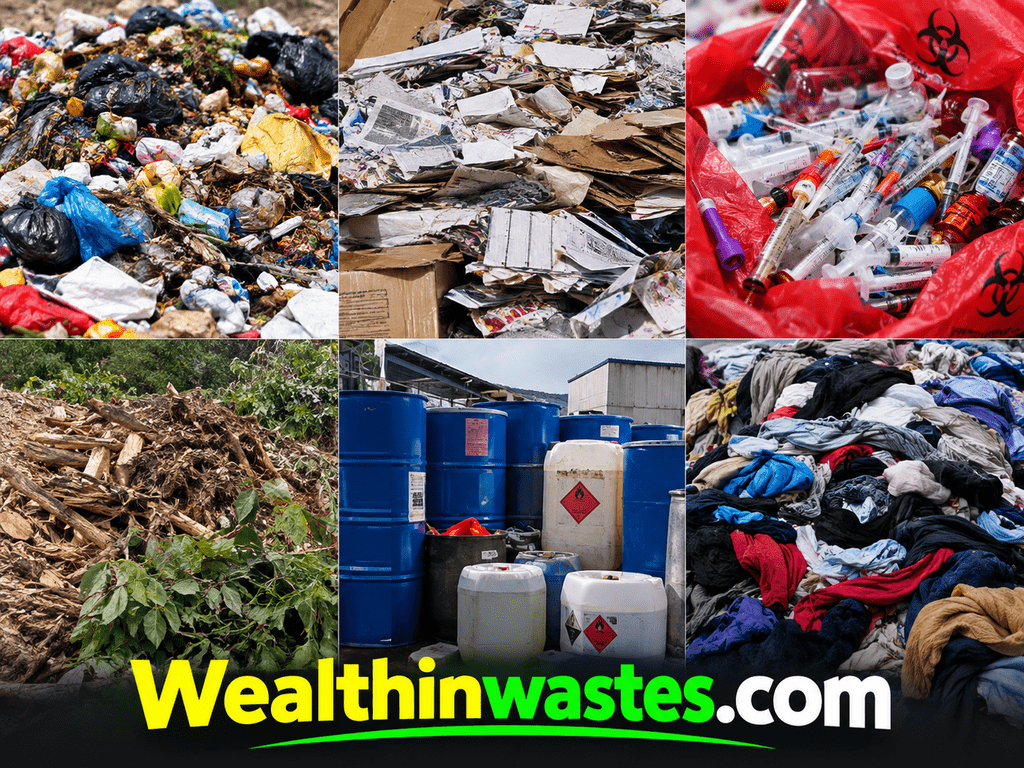
Incineration works best with combustible materials that can sustain thermal treatment under controlled conditions. Waste managers should assess moisture, composition, heating value, contaminant content, and physical form before treatment.
Municipal waste can contain paper, plastics, textiles, food residues, metals, glass, and other materials. Understanding waste sources helps identify which fractions deserve combustion.
High-moisture organic waste may not provide efficient combustion because much of the available heat supports water evaporation. Suitable biological treatment can offer better results for many biodegradable materials.
Composting provides an alternative for suitable organic fractions because microorganisms convert biodegradable matter into useful products under controlled conditions. Composting options can therefore complement thermal treatment.
Communities with suitable organic waste streams may also consider localized biological treatment. Community composting approaches can divert appropriate biodegradable materials before they reach centralized thermal facilities.
Selected healthcare wastes can require controlled thermal treatment because infectious materials present particular risks. However, facilities should segregate sharps, pharmaceuticals, radioactive materials, and other unsuitable items according to applicable procedures.
Managers should also compare incineration with alternatives such as recycling, composting, anaerobic digestion, gasification, and pyrolysis. Other waste treatment technologies may provide better options for certain materials.
Waste preparation can include inspection, sorting, size adjustment, controlled storage, and removal of unsuitable materials. These activities improve feed consistency and reduce problems caused by incompatible materials entering the furnace.
Benefits of the Incineration Process
One major benefit of incineration is significant volume reduction because combustion converts much of the combustible fraction into gases while leaving a smaller quantity of solid residual material.
Thermal treatment can also provide rapid processing, making it useful where waste quantities are high or disposal land is limited. Treatment capacity depends on facility design, feed characteristics, and operational controls.
Energy recovery adds another potential benefit because combustion heat can produce steam for electricity generation or useful heating. Properly designed facilities can therefore recover value while treating appropriate residual waste.
Incineration can also complement material recovery when operators remove valuable recyclables before treatment. Recycling benefits include resource conservation, reduced disposal volumes, and lower demand for virgin materials.
Source separation protects recyclable materials from unnecessary combustion and keeps valuable resources within productive economic systems. Proper recycling practices should therefore operate alongside thermal treatment.
Recycling can recover paper, plastics, metals, glass, and other materials that may retain economic value. Recycling guidance helps managers divert suitable materials before incineration.
Controlled high-temperature treatment may also reduce biological risks in selected infectious waste streams. However, the equipment, combustion conditions, emission controls, and residue management must match the type of waste handled.
Another advantage involves reduced landfill demand because smaller residual quantities require final disposal after combustion. This benefit becomes more meaningful when facilities integrate recovery, recycling, and responsible residue management.
Read Also: Criteria for Hygienic Storage of Solid Waste
Incineration Limitations and Environmental Risks
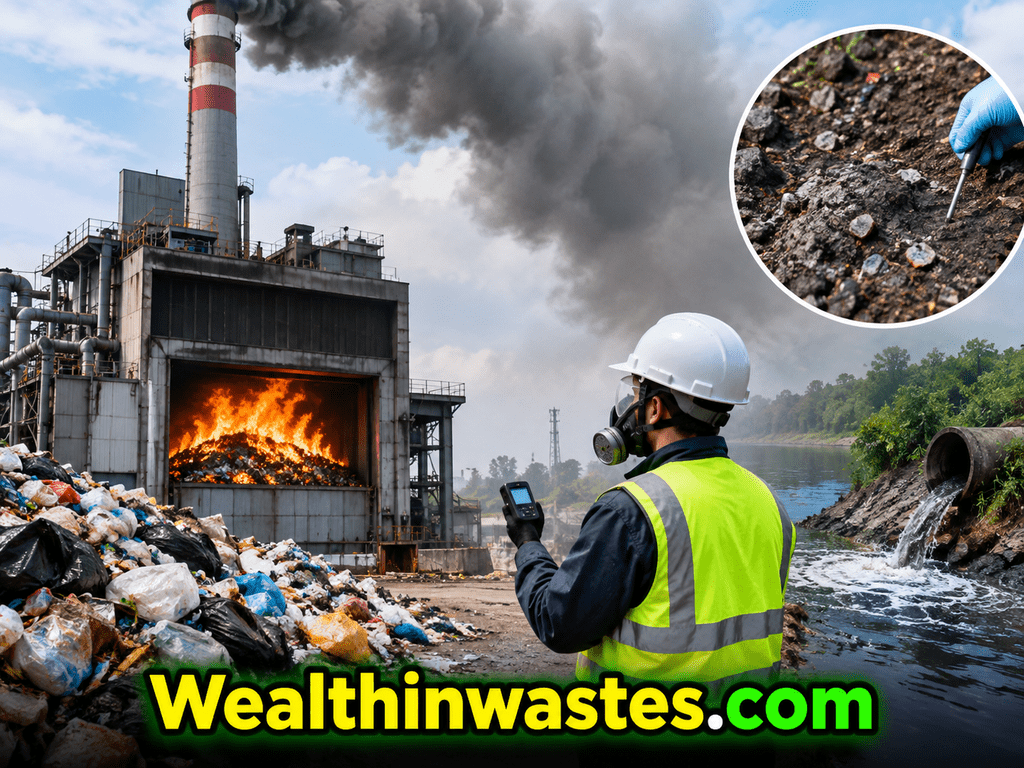
Incineration requires substantial investment in furnaces, feeding systems, emission controls, monitoring equipment, maintenance, skilled workers, energy systems, and residue handling infrastructure throughout its operational lifetime.
Poor combustion control can create smoke, carbon monoxide, particulate matter, acidic gases, metals, and other pollutants. Effective equipment and skilled operation therefore remain essential for reducing environmental risks.
Landfills also create environmental concerns, particularly when facilities lack suitable controls for liquids, gases, and waste placement. Landfill emission concerns demonstrate why final disposal requires careful management.
Incineration does not remove the need for final disposal because ash remains after combustion. Landfill management considerations remain relevant for residues that require controlled disposal.
Fly ash deserves particular care because fine particles can concentrate contaminants captured during combustion. Facilities should contain, characterize, transport, and dispose of these materials through appropriate procedures.
Improper waste handling can also affect air, water, and soil quality. Environmental effects of waste show why treatment systems must operate within a wider pollution-prevention strategy.
Another limitation involves resource loss when recyclable materials enter the furnace unnecessarily. Facilities should prioritize recovery opportunities before combustion so valuable materials remain available for reuse or recycling.
Incineration also requires community trust because nearby residents may raise concerns about emissions, traffic, odour, noise, ash handling, and facility safety. Transparent monitoring and strong environmental management can address legitimate concerns.
Incineration Within Integrated Waste Management
Incineration should form part of an integrated waste-management system rather than operate as the only treatment option. Different materials require different pathways according to their value, risks, and characteristics.
The waste hierarchy encourages prevention, reuse, recycling, recovery, treatment, and final disposal in an order that supports resource conservation. Thermal treatment therefore fits most appropriately within carefully planned residual-waste management.
The reduce, reuse, and recycle approach can lower the amount of material reaching incinerators. Source reduction remains preferable because avoiding waste also reduces collection, transportation, treatment, and disposal requirements.
Integrated systems can improve economic and environmental performance by keeping valuable materials within productive use. Integrated management benefits extend beyond disposal because recovery opportunities can support resource conservation.
Households, businesses, industries, and public institutions can strengthen this approach by separating waste at its source. Proper waste management practices improve handling before materials reach treatment facilities.
Waste minimization remains another important priority because reducing waste generation decreases the quantity requiring treatment. Waste minimization strategies can therefore reduce pressure on incineration and disposal infrastructure.
Authorities should evaluate waste composition, treatment capacity, financing, land availability, environmental standards, operator skills, energy demand, recovery opportunities, and community expectations before selecting incineration technology.
A successful system balances thermal treatment with recycling, composting, source reduction, energy recovery, and safe final disposal. This approach allows incineration to manage suitable residual waste without unnecessarily destroying recoverable resources.
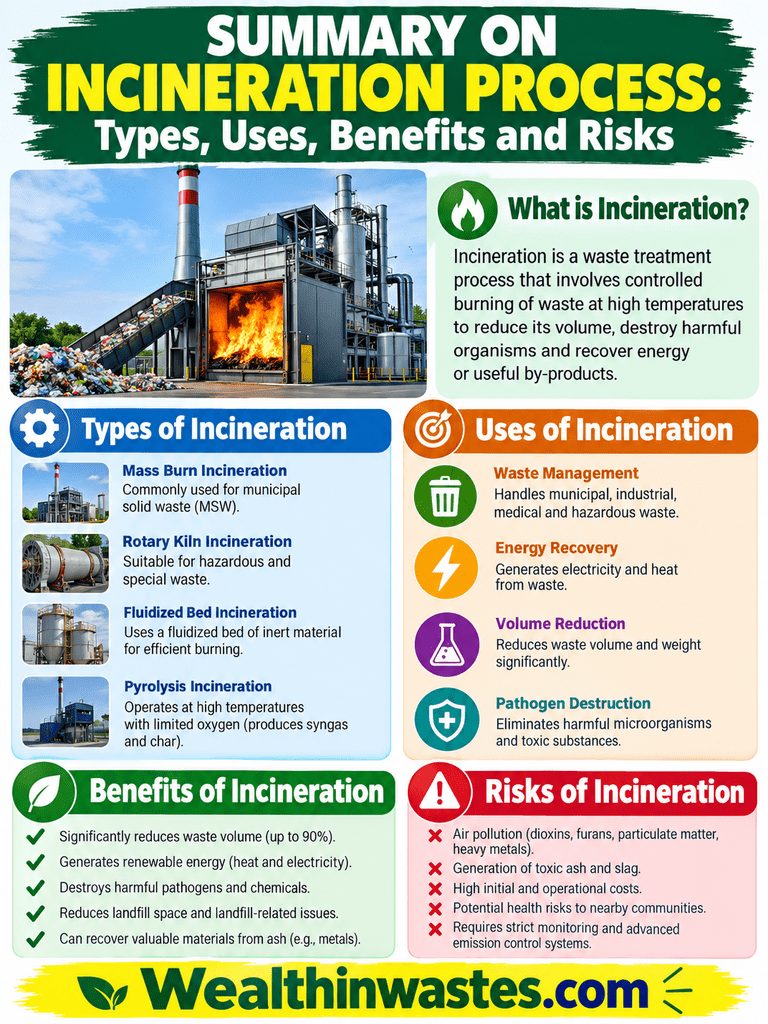
Summary on Incineration Process: Types, Uses, Benefits and Risks
| Aspect | Summary |
|---|---|
| Definition | Incineration is controlled thermal treatment that burns combustible waste and produces gases, heat, and residual ash. |
| Main purpose | It reduces waste volume, treats selected difficult materials, and may recover useful energy from combustion. |
| Process | The process includes reception, preparation, startup, combustion, flue-gas treatment, ash collection, energy recovery, and residue management. |
| Main types | Moving-grate, fixed-grate, rotary-kiln, and fluidized-bed incinerators serve different waste streams and operating conditions. |
| Key requirements | Effective treatment depends on oxygen, temperature, turbulence, residence time, monitoring, maintenance, and emission controls. |
| Suitable wastes | Selected combustible municipal, industrial, hazardous, and healthcare wastes may receive thermal treatment after suitable preparation. |
| Benefits | Major benefits include volume reduction, rapid treatment, possible pathogen destruction, and potential energy recovery. |
| Limitations | Costs, emissions, ash generation, operational demands, and resource losses can limit the suitability of incineration. |
| Best approach | Incineration works best as one component of an integrated system involving reduction, reuse, recycling, biological treatment, recovery, and disposal. |
Frequently Asked Questions About Incineration Process: Types, Uses, Benefits and Risks
1. What is the incineration process?
It is a controlled thermal treatment method that burns combustible waste under managed temperature, oxygen, mixing, and residence-time conditions, producing gases, heat, and residual ash.
2.What are the main types of incinerators?
The major types include moving-grate, fixed-grate, rotary-kiln, and fluidized-bed incinerators. Each design suits different waste characteristics, preparation requirements, treatment capacities, and operational conditions.
3. Can incineration generate electricity?
Yes. Facilities can recover combustion heat through boilers that produce steam for electricity generation or useful heating, provided suitable energy-recovery equipment forms part of the system.
4. Does incineration completely eliminate waste?
No. Combustion greatly reduces combustible material, but bottom ash and fly ash remain. Facilities must characterize, handle, treat, recover, transport, or dispose of these residues appropriately.
5. Why is waste segregation important before incineration?
Segregation removes recyclable, inert, hazardous, and unsuitable materials while improving feed consistency. It protects resources, supports safety, prevents operational problems, and improves overall treatment control.
6. What environmental risks can incineration create?
Poor operation can release smoke, particulates, carbon monoxide, acidic gases, metals, and other pollutants. Strong combustion control, emission treatment, monitoring, maintenance, and residue management reduce these risks.
7. Is incineration better than recycling?
They serve different purposes. Recycling preserves recoverable materials, while incineration treats suitable residual waste. Waste managers should prioritize recovery opportunities before sending appropriate materials for thermal treatment.
8. Is incineration suitable for all waste materials?
No. Suitability depends on material composition, moisture, heating value, hazardous characteristics, physical form, equipment capability, regulatory requirements, and the availability of safer or more valuable alternatives.
9. What makes incineration different from open burning?
Incineration uses engineered equipment with controlled combustion, air supply, temperature monitoring, emission controls, and residue management. Open burning lacks these reliable controls and can release pollutants directly.
10. What is the best role for incineration in waste management?
Incineration should manage suitable residual waste after reduction, reuse, recycling, composting, and other recovery opportunities receive consideration. This integrated approach supports resource conservation and environmental protection.
Do you have any questions, suggestions, or contributions? If so, please feel free to use the comment box below to share your thoughts. We also encourage you to kindly share this information with others who might benefit from it. Since we can’t reach everyone at once, we truly appreciate your help in spreading the word. Thank you very much for your support and for sharing!
Read Also: All You Need To Know About Sustainable Practices In Agriculture