



Sound forms a normal part of daily life, supporting communication, entertainment, awareness, and safety among humans and other animals. However, excessive or unwanted sound can become disturbing noise.
Noise pollution has existed for centuries, although modern communities experience it on a much larger scale. Growing cities, transportation systems, industries, construction activities, and leisure facilities continually increase environmental sound.
Historical records show that ancient societies recognized the problems caused by excessive sound. Restrictions once controlled noisy wagons, horse carriages, and nighttime movement because residents needed peaceful surroundings for sleep.
Today, roads carry numerous cars and heavy trucks, while aircraft, trains, factories, machinery, entertainment centres, and recreational vehicles create additional sources of unwanted sound across communities and residential areas.
Understanding noise pollution requires more than recognizing loud sounds. It also requires identifying where the noise originates, how communities experience it, and why different sound sources create different environmental concerns.
What Is Noise Pollution?
Noise pollution refers to unwanted or unpleasant sound that interferes with normal activities, comfort, communication, relaxation, or sleep. The definition depends strongly on how people perceive and respond to sound.
A low or pleasant sound can support communication or entertainment, whereas excessively loud sound can become irritating and disruptive. Therefore, context matters when deciding whether particular sound constitutes noise pollution.
The health effects of excessive noise demonstrate why communities should treat unwanted sound as an environmental concern rather than merely an inconvenience.
Noise pollution can affect residential environments, workplaces, educational spaces, transportation corridors, commercial areas, and recreational locations. Its effects may become more noticeable when exposure continues for long periods.
Noise also creates social and economic concerns because persistent disturbance can reduce environmental comfort and interfere with learning, communication, relaxation, and other activities that support community wellbeing.
The economic dimension also matters because pollution generally creates costs for individuals, institutions, governments, and communities. Research discussed by WealthInWastes shows that pollution can produce significant economic losses across society.
Consequently, noise pollution deserves attention during environmental planning because prevention at the source can reduce disturbance before it spreads widely through populated environments and surrounding communities.
Read Also: Negative Health Effects of Noise
Sound And Noise: What Is The Difference?
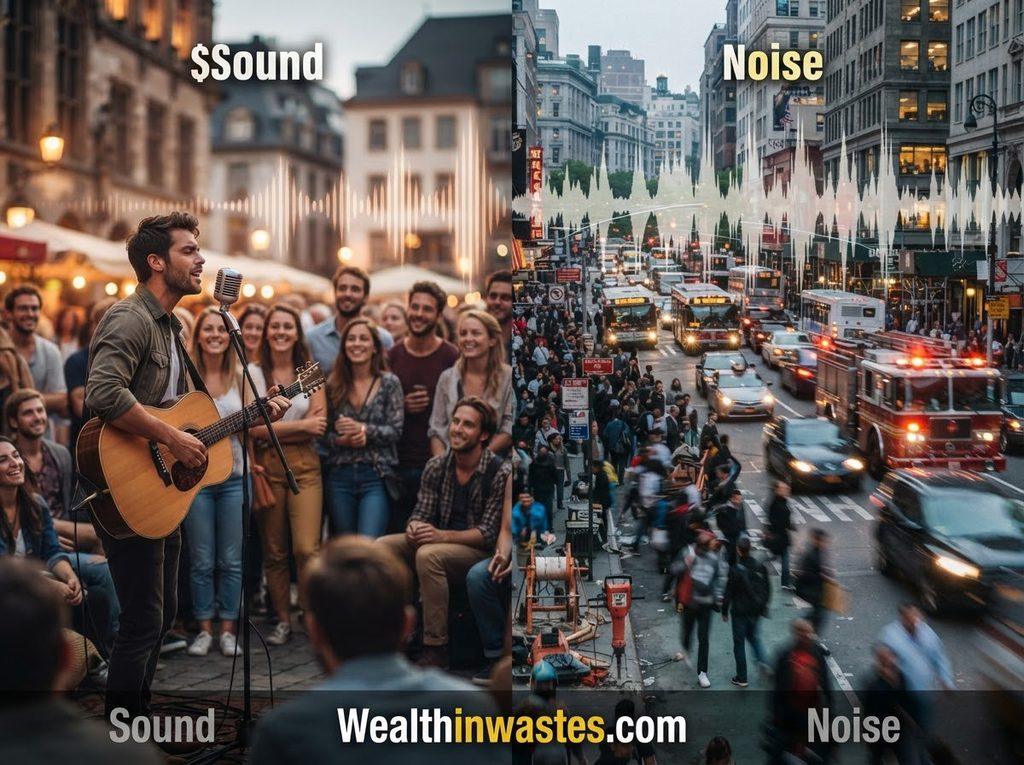
Physically, sound and noise involve sound waves that reach the auditory system. The important distinction comes from perception because people classify similar sounds differently as music, speech, alarms, or unwanted noise.
For this reason, scientists cannot define noise only through physical measurements. The term usually describes unwanted sound, although sound energy can also create adverse health effects at sufficiently high levels.
Environmental conditions can influence how sound travels and how people experience it. Buildings, roads, terrain, weather, background sound, and distance can change the character of noise reaching a listener.
The broader topic of pollution includes several environmental forms, and understanding those categories helps readers place noise pollution alongside other types of environmental pollution.
Airborne contaminants represent another major environmental concern, and readers can compare these different pollution pathways through the discussion of air pollution and air quality.
Noise measurements commonly use decibel-based indicators, including A-weighted sound levels. These measurements help describe sound exposure, although equal measured levels from different sources may produce different perceived effects.
The source explains LAeq as the A-weighted equivalent continuous sound level measured over a stated period. This measure provides a useful way to describe average sound exposure within environmental assessments.
Therefore, understanding noise pollution requires both objective measurements and attention to human perception. Neither measurement alone completely explains how particular sounds affect communities, homes, workplaces, or recreational spaces.
Community Noise Pollution Sources
Community noise includes sound from many sources outside industrial workplaces. Major contributors include roads, railways, aircraft, industries, construction activities, public works, commercial premises, neighbourhood activities, and household equipment.
Urbanization, population growth, and technological development can increase the amount of environmental noise within communities. Expanding highways, airports, railway systems, and urban infrastructure can further increase exposure.
Effective waste management contributes to cleaner and more organized communities, and the broader principles explained in proper waste management support healthier environmental conditions overall.
Similarly, communities need coordinated environmental practices because environmental and health effects of wastes can combine with other environmental pressures and reduce the quality of urban living.
Neighbourhood noise may come from restaurants, cafeterias, discotheques, music, sports events, playgrounds, car parks, domestic animals, household appliances, ventilation systems, and activities carried out by nearby residents.
Indoor noise can also originate from office machines, home appliances, ventilation systems, lifts, plumbing equipment, and neighbouring activities. These sounds may disturb occupants even when outdoor conditions remain relatively quiet.
Weak monitoring and enforcement can make neighbourhood noise especially difficult to manage because authorities may struggle to define, measure, investigate, and control individual disturbances occurring within closely connected residential areas.
Waste disposal practices can also influence neighbourhood environmental quality, which makes responsible waste disposal important when communities seek broader environmental improvements beyond noise control.
Major Sources Of Noise Pollution
Noise pollution comes from several major environmental sources. These sources differ in intensity, frequency, duration, location, and timing, so each requires appropriate attention when communities assess unwanted sound.
1. Industrial Noise: Factories, machinery, fans, steam pressure equipment, stamping operations, riveting, and road breaking can create intense sounds inside workplaces and across nearby communities.
Industrial noise may contain low or high frequencies, tonal components, impulsive sounds, or disruptive temporal patterns. Rotating machinery and air-moving equipment can generate distinctive sounds across broad frequency ranges.
2. Transportation Noise: Roads, railways, and aircraft represent major environmental noise sources. Heavy vehicles often create more sound, while engine operation, tyre contact, train movement, stations, airports, takeoffs, and landings contribute additional noise.
3. Construction Noise: Building projects and excavation can produce considerable sound through cranes, cement mixers, welding, hammering, boring, and similar operations. Poor maintenance can make construction equipment unnecessarily noisy.
4. Domestic And Leisure Noise: Homes and entertainment areas may generate noise through household equipment, voices, music, parties, sporting events, motor racing, motorboats, festivals, concerts, fireworks, and recreational machinery.
These sources illustrate why noise pollution cannot be controlled through one solution. Each source requires attention to equipment, location, operating times, transportation patterns, community planning, and the behaviour of noise producers.
Other environmental pollutants also originate from human activity, and readers studying broader pollution patterns can review water pollution sources and classifications for comparison.
Land degradation creates another environmental challenge, particularly where wastes accumulate or contaminate soil. The causes and consequences discussed under land pollution and its solutions provide useful wider environmental context.
Industrial Noise Pollution And Its Causes
Industrial noise presents serious challenges because mechanized production often requires powerful machinery that generates substantial sound. Exposure may occur inside factories and outside workplaces where surrounding communities experience the noise.
Machines can create different sound patterns depending on their operating mechanisms. Rotating and reciprocating equipment commonly generates tonal components, while air-moving equipment can produce noise across wide frequency ranges.
High sound pressure levels can arise when components or gases move rapidly. Fans, steam pressure relief valves, stamping machines, riveting equipment, and road-breaking activities can therefore create intense industrial sounds.
1. Source Control: Machinery should preferably receive noise-control measures at its source. Quieter equipment, suitable maintenance, and appropriate operating practices can reduce unnecessary sound before it reaches surrounding areas.
2. Land-Use Planning: Separating industrial and residential zones can reduce direct exposure. Proper zoning prevents factories and homes from developing too closely together where high workplace noise could disturb residents.
3. Sound Insulation: Passive measures such as sound-insulating enclosures can limit the movement of industrial sound. Active noise-control systems may also reduce unwanted emissions from suitable industrial installations.
4. Operational Restrictions: Limiting the operating time of particularly noisy equipment can reduce disturbance during sensitive periods. This approach may prove useful where complete source replacement or relocation remains difficult.
Industrial pollution control requires organized planning, and the wider discussion of institutional arrangements for pollution control highlights the importance of authorities, monitoring, standards, and enforcement.
Industries also generate other forms of waste, making environmental management important beyond sound control. Proper disposal methods described under recommended waste disposal practices can support broader pollution prevention efforts.
Transportation Noise Pollution Sources

Transportation noise represents a major source of environmental noise and includes road traffic, railway operations, and aircraft activity. The volume and character of sound vary according to vehicles, speeds, routes, surfaces, and operating conditions.
Road traffic noise comes mainly from vehicle engines and friction between tyres, roads, and surrounding air. At higher speeds, contact between tyres and road surfaces can become especially important.
Traffic sound levels depend on traffic flow, vehicle speed, the proportion of heavy vehicles, and road-surface characteristics. Traffic lights, hills, intersections, and unfavourable terrain can create particularly difficult noise conditions.
Railway noise depends mainly on train speed, although engines, wagons, rails, foundations, and wheel or rail roughness also influence sound levels. Tight curves may produce high-frequency wheel squeal.
Stations can create additional railway noise through engines, whistles, loudspeakers, and passenger activity. Marshalling yards may become noisy because trains repeatedly carry out shunting operations.
High-speed trains introduce special challenges because their rapidly moving bodies create sudden increases in environmental sound. At very high speeds, greater high-frequency energy can make railway noise resemble aircraft sounds.
Aircraft generate substantial noise near commercial and military airports.Takeoffs can create intense sound, vibration, and rattling, while landings produce substantial noise along extended low-altitude flight corridors.
Broader transport systems also interact with urban environmental pressures. The principles of reducing unnecessary environmental burdens demonstrate how prevention strategies can support more sustainable communities.
Environmental improvement also depends on responsible material use and recovery, and information about recycling and its environmental advantages provides useful background for broader pollution reduction.
Construction, Domestic And Leisure Noise
Construction projects can produce considerable noise through excavation, drilling, hammering, welding, cement mixing, cranes, and other operations. Poorly maintained equipment can increase sound emissions and community disturbance.
Construction impacts become more serious when activities occur near homes, schools, hospitals, workplaces, or other sensitive locations. Scheduling noisy activities carefully can reduce disturbance during periods requiring greater environmental quiet.
Street services can also create temporary environmental noise. Garbage collection and street cleaning may disturb residents when workers perform these activities during sensitive periods of the day or night.
Building services create another category of indoor and neighbourhood noise. Ventilation systems, air-conditioning plants, heat pumps, plumbing systems, ducts, and lifts can disturb residents when they operate continuously or at high levels.
1. Household Activities: Vacuum cleaners, lawn mowers, music systems, conversations, parties, and other domestic activities can disturb neighbours, particularly within closely occupied residential buildings.
2. Entertainment Activities: Concerts, discotheques, festivals, sporting events, fireworks, and other entertainment activities can produce intense sound. Customers travelling to and from these venues may also increase surrounding traffic noise.
3. Powered Recreation: Motor racing, off-road vehicles, motorboats, water skiing, snowmobiles, and similar activities can introduce loud sounds into locations that previously remained relatively quiet.
Plastic waste creates another environmental challenge, and understanding plastic waste pollution helps illustrate why communities need coordinated approaches to multiple forms of environmental degradation.
Municipal environments contain many sources of human-generated waste and activity. The discussion of municipal solid waste sources provides additional context about the varied activities occurring within modern communities.
Read Also: Casella Waste Services Complete Guide
Managing And Reducing Noise Pollution

Noise pollution control works best when communities identify major sources and address them before excessive sound reaches homes, workplaces, schools, and other sensitive environments.
1. Control Noise At Source: Quieter machinery, proper maintenance, sound insulation, and active control technologies can reduce noise at the point where it originates.
2. Improve Land-Use Planning: Separating industrial facilities, major transport routes, entertainment venues, and residential areas can reduce direct exposure and protect people from persistent environmental sound.
3. Regulate Operating Times: Restricting particularly noisy activities during sensitive periods can reduce disturbance. This approach can help protect sleep, relaxation, learning, and other activities that require quieter surroundings.
4. Strengthen Monitoring: Effective authorities need suitable methods for defining, measuring, monitoring, and enforcing noise requirements. Consistent monitoring helps identify persistent problems and supports practical environmental decision-making.
5.Promote Responsible Behaviour: Residents, businesses, industries, transport operators, and entertainment providers can reduce unnecessary noise by controlling equipment, respecting operating limits, and considering nearby communities.
Environmental management becomes more effective when communities reduce waste and other pressures alongside noise. Practical guidance on reducing environmental waste supports this wider prevention approach.
Prevention also remains central to sustainable environmental management. The principles explained through waste minimization and reduction illustrate the broader value of addressing environmental problems at their source.
Recycling and material recovery can further support environmental protection, particularly when communities integrate prevention with efficient resource use. The proper recycling process provides useful guidance for reducing wider environmental pressures.
Organic waste management also contributes to sustainable communities, and composting organic materials provides one example of transforming waste into a useful resource instead of increasing environmental burdens.
Managing noise pollution therefore requires cooperation among households, industries, transport operators, businesses, authorities, and planners. Combining source control, careful land use, monitoring, and responsible behaviour offers a practical approach.
Summary on Meaning and Sources of Noise Pollution
| Topic | Summary |
|---|---|
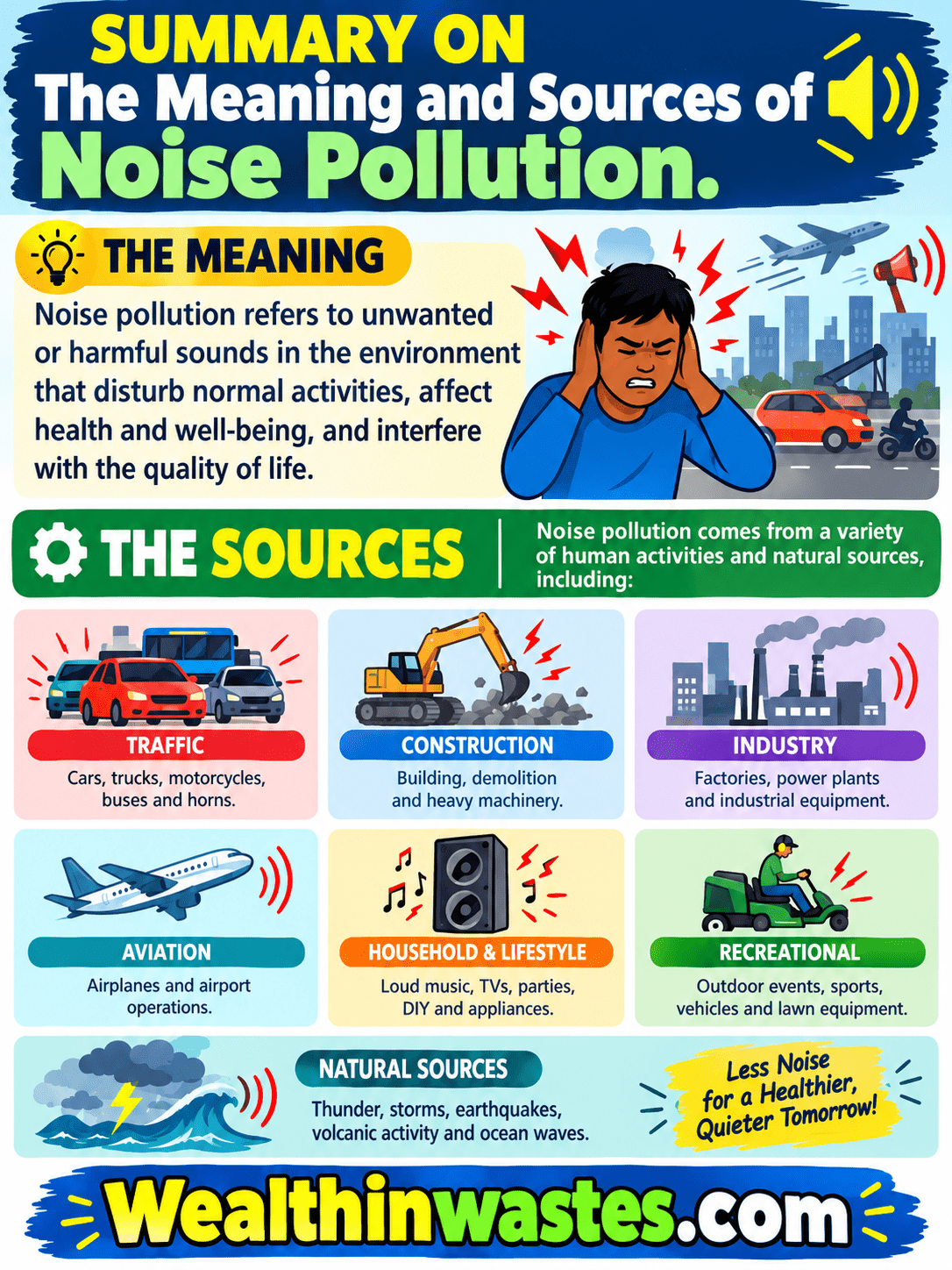
| Meaning | Noise pollution refers to unwanted or unpleasant sound that interferes with normal activities, comfort, communication, relaxation, or sleep. |
| Sound And Noise | Sound and noise involve the same physical sound waves, but people classify sounds differently according to perception and context. |
| Community Sources | Community noise comes from transportation, industries, construction, commercial premises, neighbourhood activities, households, and leisure facilities. |
| Industrial Sources | Factories and machinery can generate intense tonal, low-frequency, high-frequency, impulsive, and disruptive sounds. |
| Transportation Sources | Road vehicles, trains, stations, aircraft, takeoffs, landings, and related operations generate substantial environmental noise. |
| Construction Sources | Excavation, drilling, hammering, welding, cement mixing, cranes, and other construction activities can disturb communities. |
| Domestic And Leisure Sources | Household equipment, music, parties, sporting events, concerts, festivals, fireworks, and powered recreation can produce excessive sound. |
| Control Measures | Noise reduction requires source control, suitable zoning, sound insulation, operating restrictions, monitoring, enforcement, and responsible behaviour. |
Frequently Asked Questions About Meaning and Major Sources of Noise Pollution Explained
1. What is noise pollution?
Noise pollution is unwanted or unpleasant sound that disturbs comfort, communication, relaxation, sleep, or normal activities within an environment.
2. What are the major sources of noise pollution?
Major sources include road traffic, railways, aircraft, industries, construction activities, household equipment, entertainment venues, sports events, and powered recreational activities.
3. Is every loud sound noise pollution?
No. Noise depends on perception and context. A sound may be useful or enjoyable in one situation but unwanted and disturbing in another environment.
4. Why is transportation a major source of environmental noise?
Road vehicles, trains, stations, aircraft, takeoffs, landings, engines, wheels, tyres, and traffic movements create substantial sound across populated areas.
5. How does industrial activity create noise pollution?
Industrial machines, fans, steam equipment, stamping, riveting, road breaking, rotating equipment, and air-moving machinery can generate intense and disruptive sound.
6. What causes domestic noise pollution?
Domestic sources include conversations, music, parties, vacuum cleaners, lawn equipment, ventilation systems, home appliances, lifts, plumbing systems, and nearby activities.
7. Can construction activities cause noise pollution?
Yes. Excavation, drilling, hammering, welding, cranes, cement mixers, and other construction operations can create considerable environmental noise.
8. How can noise pollution be reduced?
Noise can be reduced through quieter equipment, source control, sound insulation, suitable zoning, operating-time restrictions, monitoring, enforcement, and responsible community behaviour.
Do you have any questions, suggestions, or contributions? If so, please feel free to use the comment box below to share your thoughts. We also encourage you to kindly share this information with others who might benefit from it. Since we can’t reach everyone at once, we truly appreciate your help in spreading the word. Thank you very much for your support and for sharing!
Read Also: Proper Farm Waste Management Guide