


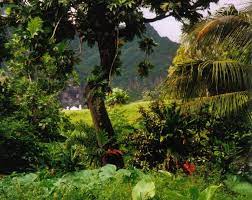
Natural resources form the foundation of human survival, production, settlement, and economic activity. Air, water, soil, sunlight, forests, wildlife, minerals, and energy supplies support daily life in countless ways around the world.
Although nature provides these resources, human demand determines how quickly societies extract, transform, consume, and replace them. Population growth, technology, industrialization, agriculture, and urban expansion can increase pressure on environmental resources.
A natural resource becomes useful when people recognize its value and possess ways to access or apply it. Therefore, resource importance changes across places, cultures, technologies, economies, and historical periods.
The distinction between renewable and non-renewable resources helps explain resource availability and depletion. However, renewability does not mean unlimited supply because excessive harvesting, pollution, habitat loss, and poor management can reduce regeneration.
Understanding the concept and types of natural resources supports better planning, conservation, and sustainable development. It also helps communities recognize environmental limits while meeting present needs without destroying future opportunities.
Definition and Concept of Natural Resources
A resource is any material, condition, substance, or environmental feature that people can use to satisfy needs, achieve objectives, support production, or improve wellbeing within particular social and economic circumstances.
Natural resources differ from manufactured resources because natural processes provide their original forms. People may extract, process, transport, combine, or transform them, but the underlying materials still originate within nature.
The concept also depends on human knowledge and technology. A substance can remain unused until people discover a practical purpose, develop suitable technology, or create demand for products derived from it.
Resource value can therefore change over time and between locations. Advances in science may make previously ignored materials useful, while scarcity, regulation, or changing preferences can increase the value of existing resources.
Land illustrates this concept clearly because people value different combinations of fertility, slope, accessibility, scenery, minerals, water availability, and location. Its usefulness depends strongly upon the purpose and conditions involved.
Natural resources also carry ecological value beyond direct market uses. Forests can store carbon, wetlands can regulate water, soils can support vegetation, and biodiversity can maintain ecological relationships essential for productive landscapes.
Consequently, responsible use of resources requires society to consider immediate benefits alongside environmental functions, social needs, economic opportunities, and the interests of future generations and communities across different landscapes today.
Read Also: How to Reduce the Amount of Wastes Produced
Characteristics of Natural Resources
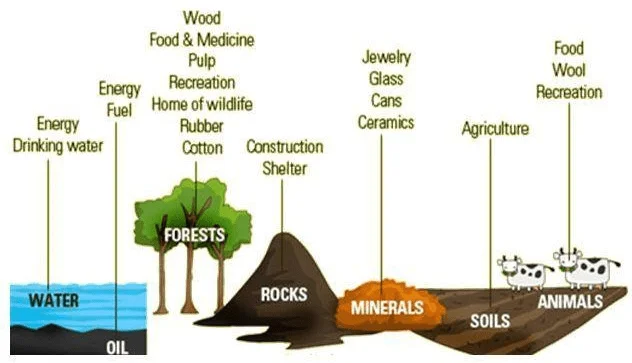
Natural resources have several characteristics that explain why their management can become difficult. Their distribution, availability, quality, accessibility, usefulness, and capacity for regeneration differ across environments and geographical regions worldwide.
Some resources occur in large quantities, while others exist only in particular places. Extraction costs, infrastructure, technology, ownership systems, environmental conditions, and market demand also influence how accessible resources become.
The following characteristics help explain how societies identify, value, and manage natural resources while recognizing that resource conditions can change through human activities and natural processes over time and across regions.
1. Uneven Distribution: Natural resources are not distributed equally across the earth. Climate, geology, topography, soils, and biological conditions create major differences in where water, forests, minerals, productive land, and fuels occur.
2.Variable Availability: Resource availability can change through extraction, consumption, regeneration, pollution, climate variability, and land-use change. Therefore, an apparently abundant resource may become scarce when demand rises faster than replenishment.
3. Economic Value: A resource gains economic importance when people can use it productively. Prices, technology, infrastructure, scarcity, quality, and resource characteristics and demand influence its market value and contribution to livelihoods and development.
4. Ecological Importance: Many natural resources perform ecological functions beyond direct human use. Wetlands regulate water, forests provide habitat, soils support vegetation, and biodiversity strengthens ecosystem processes that sustain human societies.
Major Types of Natural Resources
Natural resources can be classified in several ways depending on origin, availability, renewability, and physical characteristics. These classifications make it easier to understand resource behavior, environmental importance, and management requirements.
One broad system separates resources according to whether they come from living organisms or non-living components. Another considers whether natural processes can replace supplies within periods relevant to human use.
Understanding these categories prevents confusion because renewable resources can still suffer depletion, while some non-renewable resources may remain available for long periods when consumption stays controlled, efficient, and carefully monitored.
1. Biotic Resources: Biotic resources originate from living organisms or once-living biological materials. Forests, wildlife, fish, livestock, crops, and other biological resources fall into this category and support food, materials, medicine, and livelihoods.
2. Abiotic Resources: Abiotic resources come from non-living components of nature. Air, water, sunlight, soil minerals, rocks, metals, and geological materials provide important foundations for agriculture, construction, energy production, and industry.
3. Renewable Resources: Renewable resources can recover through natural reproduction, growth, circulation, or replenishment. Forests, fisheries, vegetation, freshwater, and solar energy belong here when people manage use within ecological limits through careful conservation practices.
4. Non-Renewable Resources: Non-renewable resources exist in finite geological stocks and generally require extremely long periods to form. Fossil fuels and many mineral deposits therefore need careful extraction and conservation, efficient use, recycling, and substitution.
Renewable Natural Resources

Renewable natural resources can replenish through ecological, hydrological, atmospheric, or biological processes. Their continued availability depends on rates of regeneration, environmental quality, and whether human use stays within sustainable limits.
Renewability therefore describes a resource’s capacity to recover, not permission for unlimited consumption. Overfishing, excessive logging, groundwater pumping, soil degradation, or habitat destruction can reduce replenishment and undermine future availability.
Effective management protects the systems that regenerate these resources, including forests, watersheds, soils, fisheries, grasslands, and ecosystems that support biological production and provide essential environmental services for society over time.
1. Forest Resources: Forest systems can regenerate through natural succession, assisted regeneration, or reforestation when harvesting remains controlled. They provide timber, fuel, food, medicines, habitat, soil protection, and other valuable ecological services.
2. Water Resources: Freshwater continually moves through the hydrological cycle, but accessible supplies remain limited by pollution, drought, overuse, infrastructure, and uneven distribution. Protecting water quality through pollution control is therefore essential.
3.Biological Resources: Fisheries, wildlife, vegetation, and agricultural biodiversity can reproduce naturally when habitats remain suitable. Sustainable harvesting, protected areas, breeding management, and habitat restoration help maintain their populations and productive capacity.
4. Solar And Wind Resources: Sunlight and wind are renewed by natural processes. Their use can provide energy without consuming finite fuel stocks, although equipment, transmission systems, and environmental considerations require careful planning and oversight.
Read Also: Methods of Disposal of Waste Pesticide Containers
Non-Renewable Natural Resources
Non-renewable natural resources occur in finite stocks that natural geological processes cannot replace within timeframes relevant to ordinary human use. Their depletion becomes a major concern when extraction continuously exceeds available reserves.
Fossil fuels and mineral deposits illustrate this category. Although new deposits can form naturally, geological formation generally takes extremely long periods, so current consumption can reduce supplies available to later generations.
Non-renewable classification does not mean immediate disappearance. Resource availability depends on known reserves, technology, extraction costs, market conditions, recycling, discoveries, and substitution, which can change practical supplies significantly over time.
1. Fossil Fuels: Coal, crude oil, and natural gas provide energy and feedstocks for transportation, industry, electricity, heating, and manufacturing. Their combustion also produces emissions, while extraction can disturb land and water systems.
2. Metallic Minerals: Iron, copper, gold, tin, aluminum-bearing ores, and other metallic minerals supply materials for construction, machinery, electronics, transportation, and manufacturing. Mining requires careful planning to limit habitat damage and pollution.
3. Non-Metallic Minerals: Limestone, gypsum, clay, sand, salt, and related materials support cement production, construction, agriculture, chemicals, and manufacturing. Their extraction can alter landscapes, generate dust, and affect drainage systems.
4. Resource Recovery And Recycling: Recycling cannot recreate a geological deposit quickly, but it can extend material availability by recovering metals and reducing demand for newly extracted resources. Resource conservation therefore supports longer-term efficiency.
Economic And Social Value of Natural Resources
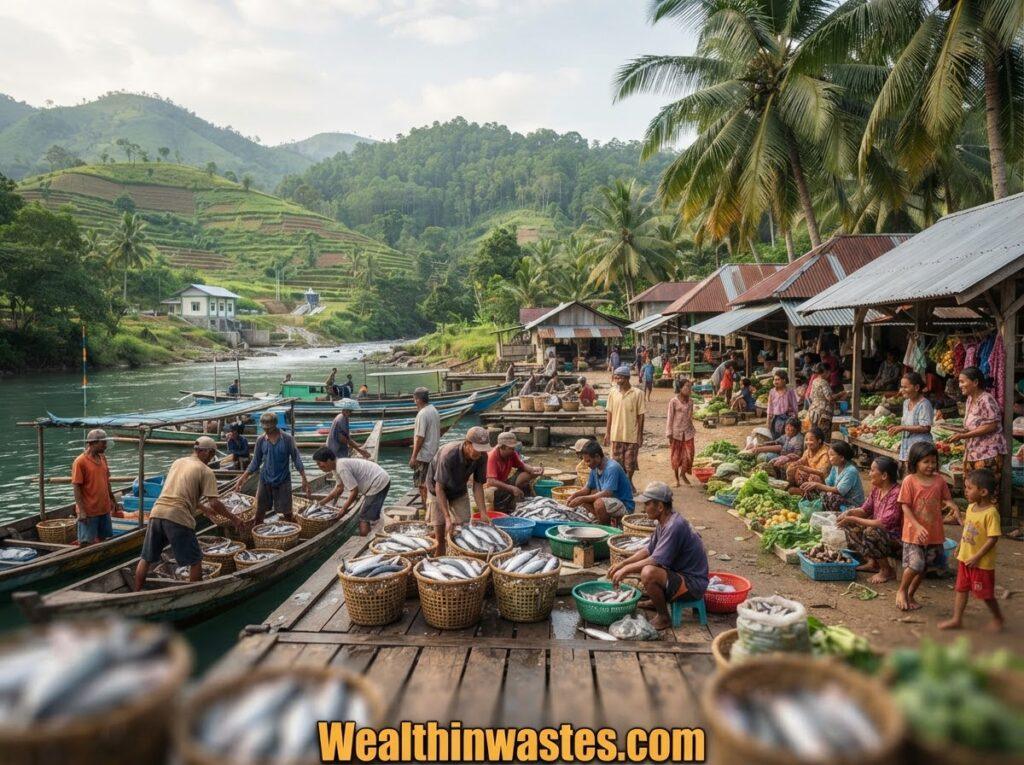
Natural resources create economic and social value by supporting production, employment, trade, food systems, infrastructure, energy supply, cultural practices, and household livelihoods worldwide. Their importance extends beyond direct market prices.
Agriculture depends heavily on fertile soil, water, sunlight, biological diversity, and suitable climates. Fisheries depend on productive aquatic ecosystems, while forestry supplies materials, food, medicines, energy sources, and income opportunities.
Natural resources also provide ecosystem services that markets may undervalue. Water regulation, pollination, carbon storage, soil formation, habitat provision, and climate moderation can support economies without appearing directly in national accounts.
1. Food And Nutrition: Crops, livestock, fisheries, wild foods, freshwater, soils, and plant biodiversity contribute directly to food production. Their condition influences nutritional security, farm productivity, household incomes, and resilience.
2. Energy And Industry: Fossil fuels, water, sunlight, wind, biomass, and minerals support energy production and industrial activity. Efficient resource use can reduce operating costs while protecting supplies needed for continued economic development.
3. Livelihoods And Employment: Millions of households depend directly or indirectly on farming, fishing, forestry, mining, tourism, and other resource-based activities. Forest-based livelihoods illustrate how natural assets support income and subsistence.
4.Ecosystem Services: Natural systems provide services that help societies function. Biodiversity values, watershed protection, pollination, soil formation, recreation, and climate regulation can strengthen community wellbeing and long-term economic stability.
Threats to Natural Resources
Natural resources face pressure when human demand, extraction, pollution, and land conversion exceed the capacity of ecosystems to recover naturally. These pressures can reduce quality, availability, biodiversity, productivity, and resilience.
Population growth can increase demand for food, water, housing, energy, transport, and materials. Urbanization and industrial development may intensify resource consumption while generating wastes that enter surrounding ecosystems and communities.
Poor governance can worsen resource degradation when regulations remain weak, access is uncontrolled, or environmental costs receive little attention. Effective institutions, monitoring, enforcement, and community participation can improve resource stewardship.
Deforestation removes vegetation that protects soils, stores carbon, supports wildlife, and regulates water. It can also fragment habitats and reduce ecological functions. Changes in land cover can therefore produce wider environmental consequences.
Pollution can damage air, water, and soil resources by introducing harmful substances or excessive waste. Environmental pollution may reduce resource quality, restrict beneficial uses, and create additional treatment or restoration costs.
Climate change can alter rainfall, temperature, drought frequency, flooding, ecosystems, and agricultural conditions. Climate-related pressures can interact with habitat loss and overuse, making already stressed resources harder to manage sustainably.
Unsustainable extraction can also create social conflicts when competing users depend on the same land, water, forest, fisheries, or mineral deposits. Fair access, transparent decisions, and long-term planning can help reduce these pressures.
Read Also: Methods of Disposal of Waste Pesticide Containers
Sustainable Natural Resource Management
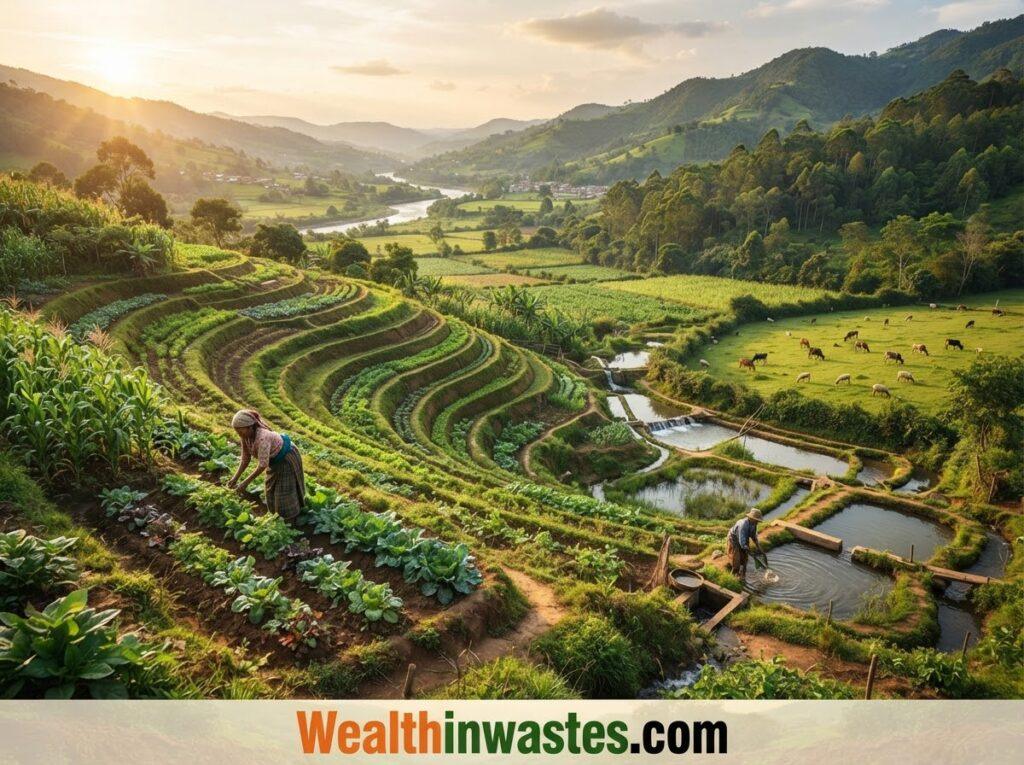
Sustainable natural resource management seeks to maintain resource functions while allowing people to obtain benefits from nature. It combines conservation, efficient use, restoration, monitoring, planning, regulation, technology, and public participation.
A practical approach begins with understanding resource conditions, users, demands, risks, and ecological limits. Good information helps decision-makers establish priorities, identify sensitive areas, and design management measures suited to local conditions and local resource needs.
Resource management should also consider the connections among land, water, forests, soils, biodiversity, climate, and human activities. Changes in one component can create effects elsewhere, so isolated decisions may produce unintended consequences.
Environmental management provides a broader framework for controlling human activities that affect natural systems. Wetland protection complements this framework, while resource conservation connects social needs, economic development, pollution control, and ecosystem stability.
Soil conservation protects a fundamental productive resource by reducing erosion, maintaining fertility, improving structure, and supporting sustainable land use. Healthy soils improve agricultural productivity and strengthen ecological resilience over time.
Sustainable development connects environmental protection with economic and social goals. It encourages decisions that satisfy current needs while maintaining ecological and resource foundations required by future generations and resilient communities.
Effective management also depends on reducing waste and pollution, restoring degraded areas, and improving resource efficiency. Reducing environmental impacts from waste helps protect natural resources and lowers pressure on already stressed ecosystems.
Summary on Definitions, Concept and Types of Natural Resources
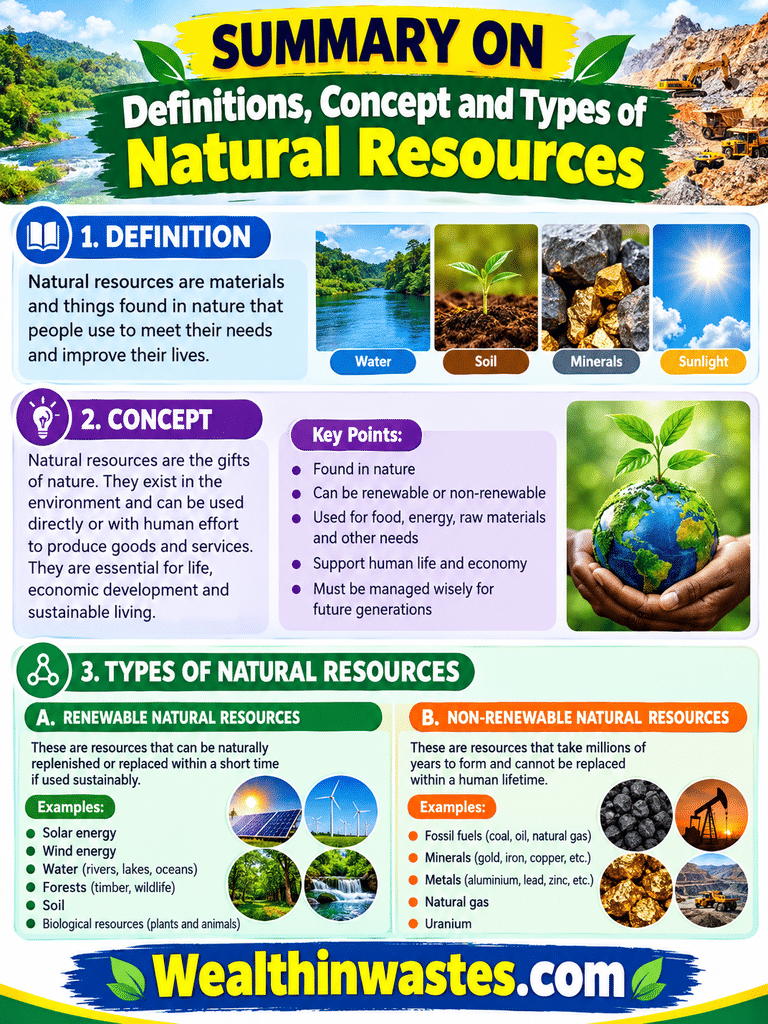
| Section | Main Idea | Why It Matters |
|---|---|---|
| Definition and Concept | Explains how natural materials become resources through human needs, knowledge, technology, and value. | Shows why resource importance changes across time, places, and societies. |
| Characteristics | Describes distribution, availability, economic value, and ecological importance. | Helps explain why resources require careful planning and management. |
| Major Types | Classifies resources as biotic, abiotic, renewable, or non-renewable. | Provides a clear framework for understanding resource behavior and use. |
| Renewable Resources | Covers forests, water, biological resources, sunlight, and wind. | Highlights regeneration and the need to avoid excessive use. |
| Non-Renewable Resources | Covers fossil fuels and metallic and non-metallic minerals. | Explains finite supplies and the importance of conservation and recovery. |
| Economic And Social Value | Shows how resources support food, energy, livelihoods, industry, and ecosystem services. | Connects environmental resources with human wellbeing and development. |
| Threats | Examines pollution, deforestation, overuse, population growth, and climate pressures. | Identifies factors that can reduce resource quality and availability. |
| Sustainable Management | Focuses on conservation, restoration, monitoring, efficiency, and participation. | Supports long-term resource security and environmental sustainability. |
Frequently Asked Questions About Concept and Types of Natural Resources: A Complete Guide
1. What are natural resources?
Natural resources are materials, substances, energy sources, and environmental features supplied by nature that people use for survival, production, settlement, livelihoods, and other human needs.
2. Why is the concept of a resource changing?
Resource importance changes with technology, knowledge, scarcity, culture, demand, and economic conditions. A material can become valuable when people develop practical uses or technologies for it.
3. What are the main types of natural resources?
Natural resources can be classified as biotic or abiotic and as renewable or non-renewable. These categories describe origin, regeneration capacity, and the nature of available resource stocks.
4. Are renewable resources unlimited?
No. Renewable resources can regenerate, but overuse, pollution, habitat destruction, drought, and poor management can reduce their availability and push consumption beyond natural replenishment rates.
5. What are examples of non-renewable resources?
Common examples include coal, petroleum, natural gas, iron ore, gold, tin, limestone, clay, gypsum, sand, and other minerals formed through long geological processes.
6. Why is natural resource management important?
Natural resource management helps conserve supplies, protect ecosystems, reduce degradation, support livelihoods, maintain productivity, and ensure that present resource use does not undermine future opportunities.
Do you have any questions, suggestions, or contributions? If so, please feel free to use the comment box below to share your thoughts. We also encourage you to kindly share this information with others who might benefit from it. Since we can’t reach everyone at once, we truly appreciate your help in spreading the word. Thank you very much for your support and for sharing!
Read Also: Forest Resources in Agriculture