


The perception of sound plays an important role in everyday human life because speech, music, natural sounds, and ordinary social interactions contribute to communication, comfort, awareness, and general well-being.
Noise becomes harmful when unwanted or excessive sound interferes with normal human activities, disturbs rest, or places repeated stress on the body, especially when exposure continues for long periods.
The negative health effects of noise can involve hearing, sleep, cardiovascular function, mental well-being, communication, attention, memory, learning, and performance, with severity depending partly on exposure conditions.
According to the source material, an adverse effect of noise involves changes in body function that impair capacity, reduce the ability to cope with additional stress, or increase susceptibility.
Understanding these effects helps individuals, communities, employers, schools, and environmental authorities recognize noise as an important environmental health concern rather than treating it simply as an annoyance.
Understanding Noise And Its Health Effects
Noise is a physical environmental pollutant that can arise from transportation, machinery, industrial activities, construction, entertainment, crowded spaces, and other sources that produce sounds beyond comfortable background levels.
1. Physical Effects: Excessive sound can interfere directly with the auditory system while also provoking body responses such as increased arousal, altered circulation, and other physiological reactions.
2. Psychological Effects: Persistent unwanted sound may contribute to irritation, emotional stress, reduced well-being, anxiety symptoms, headaches, mood changes, and greater difficulty coping with demanding situations.
3. Social Effects: Noise can interfere with conversation, relationships, concentration, and ordinary activities, creating misunderstandings and reducing the quality of communication between people in homes, workplaces, schools, and communities.
4. Environmental Context: Noise belongs among physical pollutants, alongside other environmental pressures, and its harmful effects can become more significant when people experience frequent, prolonged, or poorly controlled exposure.
The broader relationship between pollution and human well-being is discussed through the environmental conditions that allow pollution to produce adverse change, showing why noise deserves attention within environmental health management.
WealthInWastes also identifies noise as a physical pollutant alongside heat and radiation in its discussion of the major classifications of pollutants affecting environmental quality and human surroundings.
Sources vary widely between communities, but traffic, aircraft, industrial machinery, construction activities, loud music, and crowded urban areas can all create repeated exposure that gradually affects health.
The relationship between ordinary human activities and environmental pollution becomes clearer when examining the common sources and types of environmental pollution described by WealthInWastes.
Read Also : Noise Control Measures
Hearing Impairment and Tinnitus From Noise

Hearing impairment generally means an increase in the threshold required to hear sounds, and specialists commonly assess this change through threshold audiometry to determine the degree of hearing difficulty.
Noise-induced hearing impairment remains one of the most important irreversible occupational hazards because repeated exposure can damage hearing capacity and make normal speech increasingly difficult to understand.
1. High-Frequency Damage: The source material explains that noise-induced impairment occurs predominantly within higher frequencies, particularly between 3,000 and 6,000 Hz, with the strongest effect around 4,000 Hz.
2. Exposure Duration: The risk of hearing impairment depends strongly on sound exposure levels and the number of years a person remains exposed to occupational or environmental noise.
3.Individual Susceptibility: At higher exposure levels, individual differences can influence how quickly hearing impairment progresses, meaning people exposed to similar conditions may experience different outcomes.
4. Tinnitus: Noise exposure can produce tinnitus, commonly experienced as ringing or other internally perceived sounds, and it may remain temporarily after exposure or persist more permanently.
The source notes that prolonged occupational exposure can produce lasting tinnitus, while temporary symptoms may continue for several hours after loud entertainment, concerts, or similar high-noise experiences.
Research presented in the source also indicates that men and women can face noise-induced hearing impairment, emphasizing that vulnerability does not depend simply on biological sex.
Noise exposure can occur alongside other environmental pressures, making broader understanding of environmental and health effects useful when evaluating community conditions that affect quality of life.
People working around industrial machinery may face combined occupational risks, particularly where other hazards exist, which makes exposure-related environmental health concerns relevant to workplace planning.
Noise Effects On Speech Communication
One of the most immediate negative health effects of noise occurs when unwanted sound masks speech and prevents listeners from clearly understanding spoken words during ordinary conversations.
Speech interference can create misunderstandings, uncertainty, irritation, reduced confidence, fatigue, lower working capacity, strained relationships, and other behavioral reactions when people repeatedly struggle to communicate effectively.
1. Background Masking: Interfering noise can cover important speech sounds, making words or parts of conversations difficult to distinguish, particularly when the background sound is loud.
2. Vulnerable Listeners: Hearing-impaired people, older adults, children learning language and reading skills, and people unfamiliar with the spoken language may experience greater communication difficulties.
3. Distance Effects: Outdoor speech levels decrease as the distance between speakers increases, making communication even more difficult when environmental noise already competes strongly with the speaker’s voice.
4. Room Conditions: Reverberation can reduce speech discrimination, especially when room reverberation combines with high background noise and creates a more complex listening environment.
The wider environmental health context is important because communities experience several forms of nuisance simultaneously, including unwanted sound, waste, odors, and other factors described in environmental sanitation and nuisance management.
Noise from roads and vehicles can occur alongside emissions and other pollution pressures, reinforcing the importance of understanding how communities respond to environmental pollution and its effects.
When communication repeatedly fails, people may withdraw from conversations, misunderstand instructions, or experience increased frustration, especially in workplaces, classrooms, hospitals, homes, and other shared environments.
Reducing excessive background noise therefore protects more than hearing because clear communication supports safety, learning, social interaction, emotional stability, and efficient completion of everyday responsibilities.
Sleep Disturbance And Nighttime Noise

Uninterrupted sleep supports normal physiological and mental functioning, while environmental noise can disturb sleep by making it harder to fall asleep, increasing awakenings, or changing normal sleep patterns.
1. Delayed Sleep: Noise may increase sleep latency, meaning a person needs more time to fall asleep after going to bed, particularly when sound remains noticeable.
2. Night Awakenings: Repeated sounds can wake sleeping individuals or interrupt otherwise continuous rest, reducing the restorative quality of sleep and producing greater tiredness the following day.
3. Altered Sleep Stages: Nighttime noise may alter sleep depth and reduce the proportion of rapid eye movement sleep, potentially contributing to reduced perceived sleep quality.
4. Daytime After-Effects: The source associates nighttime noise exposure with fatigue, poorer mood, reduced well-being, decreased performance, and increased annoyance that can continue into the following day.
Noise during sleep may also trigger temporary physiological changes, including increased blood pressure, elevated heart rate, altered breathing, body movement, and other signs of autonomic activation.
Nighttime conditions can become more difficult in environments already affected by poor planning, waste, traffic, and other disturbances, making effective environmental management practices important for healthier communities.
Residential areas near major roads, transport routes, industrial operations, or other persistent sources may require stronger environmental planning to prevent repeated disturbance from becoming a normal part of daily life.
Older people, shift workers, people with sleeping difficulties, and individuals already vulnerable to physical or mental disorders may experience greater consequences when nighttime noise repeatedly disrupts their rest.
Understanding sleep disturbance also supports broader environmental decision-making, especially when noise is identified as an environmental aspect that organizations should assess and manage.
Cardiovascular And Physiological Noise Effects
Noise can act as an environmental stressor, especially when exposure is sudden, unfamiliar, intense, or prolonged, causing the body to activate systems that prepare it to respond to perceived threats.
1. Increased Blood Pressure: Acute noise exposure may produce temporary increases in blood pressure as the autonomic and hormonal systems respond to stressful sound conditions.
2. Increased Heart Rate: Loud or unexpected sounds can stimulate physiological arousal and increase heart rate, particularly when the sound produces a strong startle response.
3. Vasoconstriction: Noise-related stress responses may narrow blood vessels temporarily, reflecting the body’s automatic reaction to environmental stimulation and perceived threat.
4. Longer-Term Risks: The source reports associations between prolonged high sound-pressure exposure and permanent conditions such as hypertension and ischaemic heart disease among susceptible people.
The magnitude and duration of physiological responses can vary according to individual characteristics, lifestyle factors, environmental conditions, and the nature of the sound encountered.
Noise exposure should therefore be considered within wider environmental risk management, particularly where pollution pressures from industry and infrastructure may already affect residents.
Industrial areas can combine several environmental pressures, and the broader impact of industrial activities on people and the environment shows why careful management remains necessary.
Environmental planning can also use formal assessment procedures when projects may increase noise near sensitive locations, as explained through environmental protection and impact assessment measures.
Authorities and organizations can reduce avoidable exposure by controlling noisy activities, considering location, monitoring conditions, and applying suitable standards where repeated noise could affect surrounding communities.
Mental Health Effects Of Persistent Noise

Environmental noise is not generally regarded as a direct cause of mental illness, but persistent exposure may increase stress and intensify difficulties among people already vulnerable to mental disorders.
The source associates environmental noise with anxiety, emotional stress, nervous complaints, headaches, mood changes, instability, irritability, arguments, reduced well-being, and greater social conflict.
1.Emotional Stress: Persistent unwanted sound can keep people in a state of heightened alertness, making ordinary tasks feel more demanding and reducing their sense of comfort.
2. Irritability: Repeated disturbance may increase annoyance and frustration, especially when individuals feel they cannot control the sound source or escape from its presence.
3. Mood Changes: Sleep disruption and constant annoyance can contribute to poorer mood and reduced well-being, particularly when exposure occurs repeatedly across nights and days.
4. Social Conflict: Noise may increase arguments and tension between neighbors, households, workers, and other community members when the disturbance continues without effective resolution.
Large population studies have examined associations between noise exposure and indicators such as perceived well-being, psychological symptoms, and use of tranquilizers or sleeping medicines.
These relationships should be interpreted carefully because mental health has many causes, but persistent environmental stress remains an important factor when assessing community quality of life.
Broader environmental health discussions also show that exposure risks often depend on how hazards are generated and managed, as illustrated by the health impacts associated with poorly managed environmental hazards.
Effective institutions also matter because pollution control requires monitoring, standards, enforcement, and coordinated responsibilities, topics explored in institutional arrangements for environmental pollution control.
Noise Effects On Learning And Performance
Noise can interfere with cognitive performance in laboratories and workplaces because it distracts attention, increases arousal, and makes complex mental tasks harder to complete accurately.
1. Reduced Attention: Competing sounds can interrupt sustained concentration, especially during tasks that require people to monitor details continuously or respond to multiple cues.
2. Memory Difficulties: Complex activities that depend on working memory may become more difficult when persistent background sound consumes attention and interferes with information processing.
3. Weaker Problem Solving: Noise may reduce performance on analytical tasks requiring sustained mental effort, careful reasoning, and the ability to coordinate several pieces of information.
4. Lower Persistence: Noise-related cognitive strain can affect motivation, particularly when people must persist with difficult tasks for extended periods in distracting environments.
The source highlights children as an important vulnerable group because chronic aircraft noise during early childhood has been associated with poorer reading acquisition and reduced motivational capacity.
Schools, daycare centers, and similar learning environments therefore require careful attention to noise sources, especially where highways, airports, industrial operations, or other major sources are nearby.
Workplace safety also depends on healthy environmental conditions, and broader discussions of environmental health risks affecting workers and communities help place noise exposure within a wider safety perspective.
Organizations can reduce distractions by separating noisy equipment from quiet work areas, improving building design, maintaining machinery, and limiting unnecessary sound during tasks that demand high concentration.
The economic consequences of environmental problems also matter because lost productivity, reduced performance, health costs, and disruption can contribute to broader economic losses resulting from pollution.
Read Also: Issues in Wastewater Reuse and Recycling, and the Future of Water Reuse
People More Vulnerable To Noise Exposure

Noise does not affect every person in exactly the same way because age, hearing ability, health status, exposure duration, work conditions, and sensitivity can influence the severity of experienced effects.
1.Children: Children developing language, reading, attention, and memory skills may experience greater difficulty when persistent environmental noise interferes with communication and classroom concentration.
2. Older Adults: Older people may face greater communication difficulties when hearing ability has already declined, particularly in environments where background noise masks speech.
3. Hearing-Impaired People: Individuals with existing hearing difficulties may find speech and environmental information harder to understand when unwanted sound competes with important signals.
4. Shift Workers: People sleeping during daytime hours may experience challenges when traffic, construction, commercial activity, and neighborhood noise interfere with their preferred sleeping periods.
5. Sensitive Individuals: People especially vulnerable to physical or mental disorders, stress, or sleeping difficulties may experience stronger reactions to repeated environmental noise exposure.
Community planning can reduce exposure by keeping major noise sources away from particularly sensitive locations and by considering sound impacts during environmental decision-making and development planning.
Sanitary and environmental planning should also address other community nuisances because healthier surroundings require coordinated action, as shown by the broader principles of responsible environmental management.
Well-designed facilities, controlled operations, and responsible waste and pollution practices can reduce combined environmental pressures, helping communities create cleaner and healthier spaces for living, learning, and working.
Environmental management is most effective when organizations identify harmful environmental aspects, evaluate their significance, and apply practical control measures before exposure becomes a persistent community problem.
Preventing The Negative Health Effects Of Noise
Reducing noise exposure begins with controlling unnecessary sound at its source, limiting exposure time, improving separation between noisy and quiet areas, and protecting especially sensitive environments.
1. Control Noise Sources: Maintain machinery, reduce unnecessary vehicle noise, schedule loud activities carefully, and apply practical engineering measures that lower sound levels where noise originates.
2. Improve Planning: Consider noise during site selection and environmental assessment, especially for schools, hospitals, residential areas, workplaces, and other locations where people need quiet conditions.
3. Reduce Exposure Time: Where high noise cannot be eliminated immediately, limiting the duration of exposure can reduce the total burden placed on the hearing system and body.
4. Protect Workers: People working in noisy environments should use suitable hearing protection and follow workplace procedures designed to reduce harmful exposure and support safer working conditions.
5. Protect Sleep: Reduce avoidable nighttime noise, improve bedroom sound isolation where practical, and manage nearby traffic, entertainment, construction, or machinery that repeatedly interrupts rest.
Public authorities also need effective regulations, monitoring, enforcement, and community education because individual efforts cannot fully solve persistent noise created by roads, industries, airports, or poorly planned developments.
Environmental protection works best through coordinated policies and clear institutional responsibilities, including approaches described in the principles used to guide environmental management decisions.
Proper collection and organized environmental services also support healthier surroundings, while effective community waste collection systems demonstrate how organized services can reduce wider environmental pressures.
Finally, environmental protection should consider ecosystems and surrounding communities, because sustainable development depends on reducing harmful pressures while maintaining healthy environments for present and future generations.
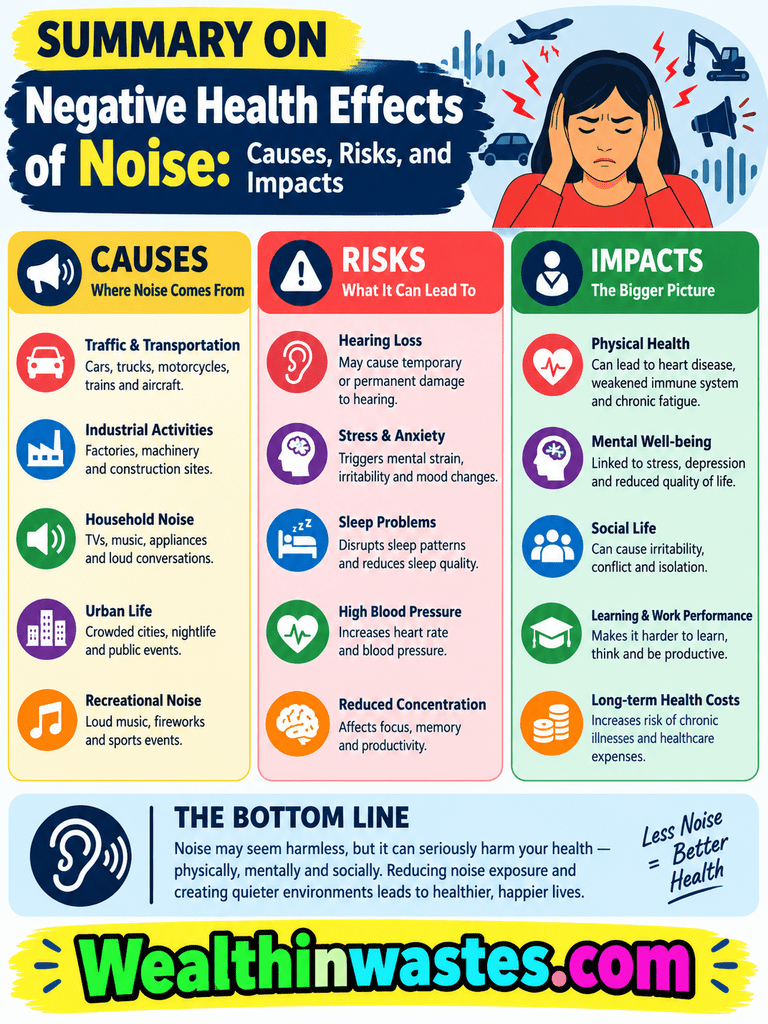
Summary on Negative Health Effects of Noise: Causes, Risks, and Impacts
| Health Area | Major Negative Effect |
|---|---|
| Hearing | Hearing impairment and tinnitus |
| Communication | Speech masking, misunderstanding, and reduced confidence |
| Sleep | Delayed sleep, awakenings, altered sleep quality, and fatigue |
| Cardiovascular | Raised blood pressure, increased heart rate, and physiological stress responses |
| Mental Health | Irritability, anxiety symptoms, emotional stress, and mood changes |
| Cognition | Reduced attention, memory, problem solving, and task performance |
| Learning | Interference with language, reading, motivation, and classroom concentration |
| Vulnerable Groups | Children, older adults, hearing-impaired people, shift workers, and sensitive individuals |
Noise is an environmental pollutant that can affect several dimensions of human health, particularly when exposure remains loud, frequent, prolonged, or difficult to escape within homes, workplaces, schools, and communities.
Protecting public health requires source control, better planning, exposure reduction, worker protection, and environmental regulation so that people can communicate clearly, sleep adequately, concentrate effectively, and maintain healthier surroundings.
Frequently Asked Questions About Negative Health Effects of Noise
1. What is the most serious negative health effect of noise?
Noise-induced hearing impairment is one of the most serious effects because prolonged exposure can damage hearing permanently, while repeated loud sound may also produce temporary or persistent tinnitus in affected individuals.
2. Can noise disturb sleep?
Yes. Noise can delay sleep, cause awakenings, alter sleep stages, reduce perceived sleep quality, and contribute to daytime fatigue, poor mood, reduced well-being, and lower performance.
3. Can excessive noise increase blood pressure?
Yes. Acute noise exposure can activate autonomic and hormonal responses that temporarily increase blood pressure and heart rate, while prolonged high-level exposure has been associated with hypertension.
4. How does noise affect communication?
Noise masks important speech sounds, making conversations harder to understand and increasing misunderstandings, uncertainty, irritation, fatigue, and reduced confidence, particularly among vulnerable listeners.
5. Can noise affect mental health?
Persistent environmental noise can increase stress, annoyance, irritability, mood changes, headaches, and reduced well-being, while potentially worsening difficulties among people already vulnerable to mental disorders.
6. Can noise affect students?
Yes. Noise can interfere with attention, reading, memory, language development, problem solving, and motivation, especially when children experience chronic exposure during important periods of learning and development.
7. Who is more vulnerable to harmful noise?
Children, older adults, hearing-impaired people, shift workers, and individuals with sleeping difficulties or other physical and mental vulnerabilities may experience stronger consequences.
8. How can the negative health effects of noise be reduced?
Reduce noise at its source, limit exposure time, improve environmental planning, separate noisy activities from sensitive areas, protect workers, manage nighttime disturbance, and enforce appropriate environmental controls.
Do you have any questions, suggestions, or contributions? If so, please feel free to use the comment box below to share your thoughts. We also encourage you to kindly share this information with others who might benefit from it. Since we can’t reach everyone at once, we truly appreciate your help in spreading the word. Thank you very much for your support and for sharing!
Read Also: Basic Concepts and Contents for Agricultural Projects