


Petroleum migration describes the movement of generated hydrocarbons from a source rock toward porous and permeable rocks where they can accumulate beneath a sealing layer. It links petroleum generation, accumulation, and discovery.
Crude oil does not usually remain where organic matter first transforms into hydrocarbons. Geological pressure, buoyancy, pore-fluid movement, fractures, faults, and changes in rock properties can drive hydrocarbons through subsurface pathways.
The process may involve primary migration from mature source rocks and secondary migration through carrier beds, fractures, faults, and other conduits. Understanding each stage helps explain why petroleum occurs within particular underground structures.
Petroleum migration can occur over considerable geological distances and does not always follow a simple vertical route. Direction and rate depend on pressure conditions, fluid density, rock properties, geological structures, and available pathways.
Petroleum exploration therefore examines more than hydrocarbon presence. Geologists also study source rocks, reservoir rocks, seals, traps, migration pathways, and the timing of these elements to determine whether accumulations can form and remain preserved.
The relationship between generation and accumulation also explains why neighbouring wells can produce different crude oils. Variations in source material, migration history, reservoir conditions, and alteration influence petroleum characteristics underground.
Petroleum Migration: Basic Process
Petroleum migration begins after organic-rich sediments experience burial, heating, and chemical transformation. The resulting hydrocarbons occupy the pore system within source rocks before pressure and other forces help move them toward suitable accumulation areas.
A mature source rock must generate enough hydrocarbons for migration to become significant. During maturation, kerogen changes into petroleum, while increasing temperature and pressure alter the composition, volume, and mobility of the generated fluids.
Once hydrocarbons leave the source rock, they may enter nearby carrier rocks that provide connected pore spaces. These pathways can transport petroleum toward structures capable of storing hydrocarbons for prolonged geological periods.
Some petroleum accumulations form close to their source rocks, making migration relatively short. Other accumulations require movement across considerable distances because the source and reservoir rocks developed separately during geological history.
The movement of petroleum remains closely related to the transformation of organic matter into hydrocarbons, because migration begins only after sufficient petroleum generation occurs within a mature source system.
The physical properties of the rocks also determine whether hydrocarbons can move efficiently. Connected pores, fractures, permeability contrasts, fluid pressure, and rock wettability all influence the direction and ease of petroleum movement.
Primary Petroleum Migration
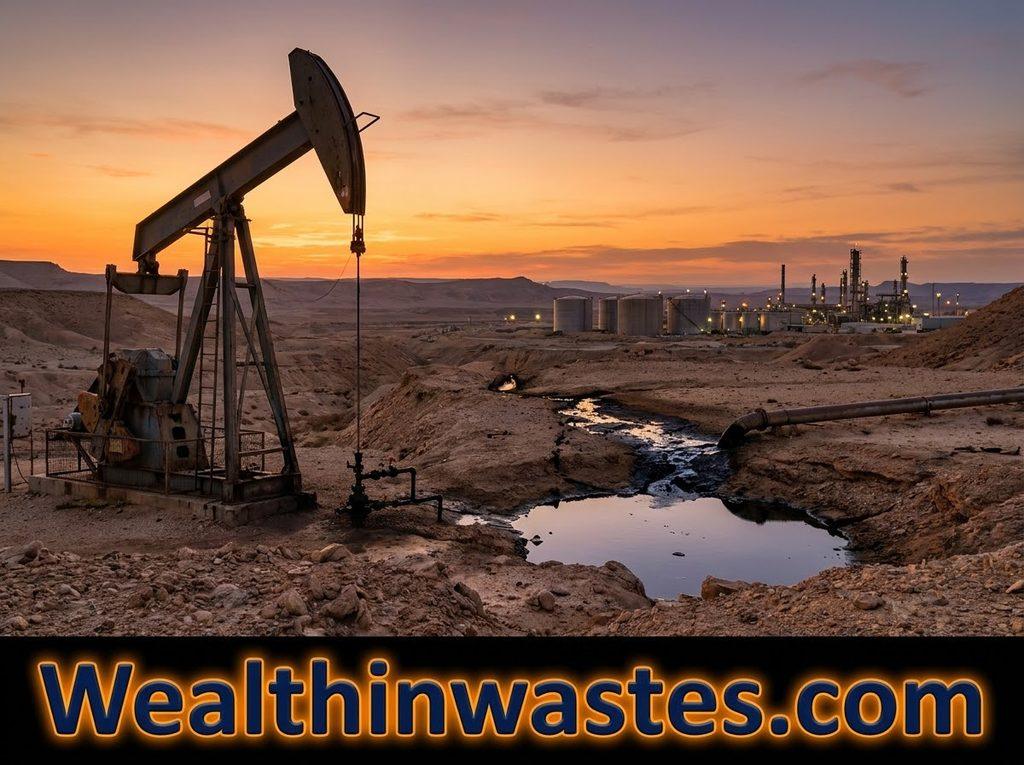
1. Hydrocarbon Expulsion: Primary migration begins when generated petroleum leaves the fine-grained source rock where it formed. Compaction, pressure buildup, chemical changes, and fluid saturation can encourage hydrocarbons to escape from the source.
2. Movement Through Tight Rocks: Source rocks commonly possess very small pores and low permeability. Hydrocarbons therefore require sufficient driving pressure to move through or out of the compact rock matrix into connected carrier pathways.
3. Hydrocarbon Phase Changes: Petroleum may move as dissolved components, dispersed droplets, or a more continuous hydrocarbon phase. Changes in temperature, pressure, composition, and saturation influence the form and mobility of migrating fluids.
4. Entry Into Carrier Beds: Successful primary migration transfers hydrocarbons from the source rock into adjacent permeable beds, fractures, or other openings. These pathways provide the connection required for later movement toward reservoir structures.
Secondary Petroleum Migration
1.Buoyancy-Driven Movement: Once hydrocarbons enter porous carrier rocks, their lower density compared with formation water can encourage upward movement. Buoyancy becomes especially important where connected pore networks permit continuous fluid movement.
2. Hydrodynamic Transport: Formation-water movement can influence petroleum migration by changing pressure relationships and fluid directions. Strong groundwater flow may redirect hydrocarbons laterally, upward, or along dipping geological layers.
3. Fault And Fracture Migration: Faults and fractures can act as efficient conduits when they remain open and connected. They may allow hydrocarbons to cross otherwise restrictive layers and reach reservoirs located at greater distances.
4. Accumulation In Traps: Secondary migration continues until hydrocarbons encounter a suitable trap and seal. The seal prevents further escape, allowing oil and gas to accumulate within the available reservoir pore space.
The movement of hydrocarbons through geological pathways resembles the broader mobility of contaminants described in the study of oil movement through environmental compartments, although petroleum migration occurs within natural subsurface systems.
Forces And Pathways Of Petroleum Migration

1. Buoyancy Force: Buoyancy is one of the most important driving forces because petroleum generally has lower density than formation water. This density contrast encourages hydrocarbons to rise through connected subsurface pore systems.
2. Pressure Differences: Variations in pressure can move fluids from higher-pressure zones toward lower-pressure areas. Compaction, burial, fluid generation, and tectonic changes can create pressure gradients that influence migration.
3. Hydrodynamic Force: Flowing formation water can carry or redirect hydrocarbons along permeable pathways. Its effect depends on groundwater direction, hydraulic gradients, permeability, fluid viscosity, and the geometry of surrounding geological formations.
4. Geological Pathways: Carrier beds, sandstone layers, fractures, faults, unconformities, and interconnected pore spaces can provide routes for petroleum movement. Their continuity determines how far hydrocarbons can travel before accumulation or leakage.
Understanding subsurface pathways also benefits from knowledge of underground water movement through connected geological formations, because groundwater flow can strongly affect petroleum direction and distribution.
Petroleum migration may occur vertically, laterally, or diagonally depending on geological structure and fluid forces. A tilted reservoir, fault zone, or permeable bed can redirect hydrocarbons toward a distant trapping structure.
Reservoir Rocks And Petroleum Traps
A reservoir rock must provide enough pore space to store hydrocarbons and sufficient permeability to permit fluid movement. Sandstones and carbonates commonly serve this purpose because their pore systems can hold and transmit petroleum.
Porosity determines the amount of fluid a rock can contain, while permeability measures how easily fluids move through connected pores. A reservoir may have high porosity but poor permeability when its pores lack effective connections.
Reservoir quality can change because of compaction, cementation, dissolution, fracturing, and mineral alteration. These geological processes can improve or reduce the pore connectivity that petroleum requires during migration and accumulation.
Petroleum traps form when geological structures or stratigraphic arrangements stop migrating hydrocarbons. Anticlines, faults, salt structures, pinch-outs, and unconformities can all create conditions that retain accumulated petroleum underground.
A competent seal remains essential because even a high-quality reservoir cannot retain petroleum without an effective barrier. Shale, evaporite, and other low-permeability rocks can act as seals when they maintain sufficient continuity and integrity.
The relationship between reservoir storage and petroleum accumulation also connects with the characteristics of source rocks and petroleum-generating materials, since source quality influences the quantity and composition of migrating hydrocarbons.
Natural-resource discussions also recognize petroleum as a finite geological resource, as explained in the classification of natural resources by development and availability, which reinforces the importance of understanding underground accumulation.
Read Also: Petroleum Transformation Process
Petroleum Occurrence And Accumulation
Petroleum occurs in many sedimentary basins where geological conditions allowed hydrocarbons to generate, migrate, accumulate, and remain preserved. The concentration of oil fields varies greatly because source, reservoir, seal, and trap conditions differ.
Oil fields contain one or more wells drilled into subsurface reservoirs. Petroleum may occur with natural gas and formation water, while different reservoir zones can contain fluids with different physical and chemical characteristics.
Surface seepages provide visible evidence of natural petroleum leakage from underground systems. Such seepages have historically attracted attention because they demonstrate that hydrocarbons can travel naturally from deeper formations toward the surface.
Large petroleum accumulations often occur where geological structures successfully collected hydrocarbons over long periods. The size of a field depends on source productivity, migration efficiency, reservoir capacity, trapping geometry, and preservation conditions.
The chemical nature of crude oil can vary between fields because source material, thermal maturity, migration history, reservoir conditions, and alteration processes differ. This explains the diversity described in the chemical composition of crude oil from different sources.
Crude oil also exists alongside petroleum fractions that become useful commercial products after processing. The distribution of these materials is discussed in the different petroleum fractions and their components.
Petroleum occurrence therefore depends on a complete geological system rather than one isolated factor. Exploration succeeds more readily where generation, migration, reservoir development, trapping, sealing, and preservation occurred in the correct sequence.
Theories Of Petroleum Origin
1. Biogenic Theory: The biogenic theory explains petroleum as a product of ancient biological material buried in sediments. Heat, pressure, and geological time transformed organic matter through stages that ultimately generated hydrocarbons.
2. Source Rock Formation: Organic-rich sediments became source rocks after burial and compaction. Their organic content later produced kerogen, which changed under increasing temperature and pressure during geological maturation and petroleum generation.
3. Abiogenic Theory: The abiogenic theory proposes that petroleum can originate from inorganic carbon-bearing materials through deep geological and chemical processes. It has historically attracted debate but receives less scientific acceptance than the biogenic explanation.
4. Geological Migration: Both origin discussions recognize the importance of hydrocarbons occupying geological spaces and moving through the Earth. Migration pathways, reservoir rocks, and trapping structures remain central to explaining petroleum occurrence.
The transformation sequence associated with biological origin is described further through the stages that convert buried organic matter into petroleum, including diagenesis, catagenesis, and later thermal alteration.
The concept of finite geological supplies also appears in the explanation of petroleum as a natural resource, highlighting why petroleum development depends on accumulated geological stocks rather than rapid natural replacement.
Read Also: Social Response to Environmental Pollution and Types of Environmental Pollution
Why Petroleum Migration Matters

Petroleum migration matters because successful exploration depends on identifying places where generated hydrocarbons could move and accumulate. Without an effective migration pathway, even an excellent source rock may fail to create a commercial petroleum field.
Migration studies help geologists reconstruct petroleum systems by identifying possible source-to-reservoir pathways. These reconstructions improve exploration decisions by showing where hydrocarbons probably travelled, accumulated, leaked, or became trapped during geological history.
Understanding migration also supports environmental interpretation because petroleum can escape through fractures and natural seepage zones. Human activities may further release oil during drilling, transport, production, refining, and storage operations.
The environmental consequences of petroleum activities are discussed in the assessment of oil drilling impacts on ecosystems, particularly where extraction activities disturb habitats, water bodies, and surrounding ecological systems.
Oil contamination can also affect water quality, making knowledge from the classification of petroleum products as water pollutants useful when assessing spills and other releases into aquatic environments.
Pollution pathways can involve both direct and indirect releases, as explained through the different sources and classifications of water pollution. This connection is important where petroleum enters rivers, wetlands, groundwater, or coastal systems.
Effective responses require appropriate environmental controls because oil pollution can affect ecosystems, livelihoods, and economic activities. These concerns are examined through practical approaches for controlling water pollution and limiting contaminant movement.
In petroleum-producing regions, environmental management also relates to broader resource issues discussed in soil and mineral resource management, especially where extraction activities influence land quality, aquatic systems, and community livelihoods.
Industrial operations generate additional environmental concerns, making the impacts associated with industrial waste generation relevant to petroleum processing, manufacturing, maintenance, and related activities.
Broader pollution consequences can also be understood through the general effects of waste on environmental systems, including impacts on water, soil, air quality, ecosystems, and human communities.
Oil-spill events demonstrate the potential consequences when hydrocarbon containment fails. A major example is discussed in the environmental and economic consequences of a major oil spill.
Petroleum-related environmental risks can also involve broader pollution processes discussed in the explanation of natural and diffuse pollution sources, particularly where contaminants move through water and other environmental pathways.
Economic consequences deserve attention because environmental damage can reduce productivity and impose recovery costs. These issues connect with the assessment of economic losses associated with pollution across affected sectors and communities.
Pollution control also depends on effective institutions, regulations, monitoring, and enforcement. The role of governance is examined in the institutional arrangements used for pollution control within environmental management systems.
Petroleum production connects with wider energy systems because hydrocarbon resources support fuels, transportation, industry, electricity generation, and chemical manufacturing. Natural gas applications are examined in the overview of gaseous fuels and their major uses.
Petroleum remains a non-renewable geological resource, so careful management matters.Related resource principles are discussed in the classification and development of natural resources within environmental management.
Industrial petroleum activities also generate wastes requiring appropriate handling, making the broader discussion of industrial waste and environmental impacts useful for understanding associated environmental management challenges.
Water-related risks from petroleum activities become especially important where extraction overlaps sensitive watersheds. Relevant considerations appear in the discussion of watershed pollution and management.
Finally, petroleum migration should be viewed as one stage within a complete petroleum system. Generation, expulsion, migration, accumulation, sealing, preservation, exploration, production, and environmental management remain closely connected throughout the resource cycle.
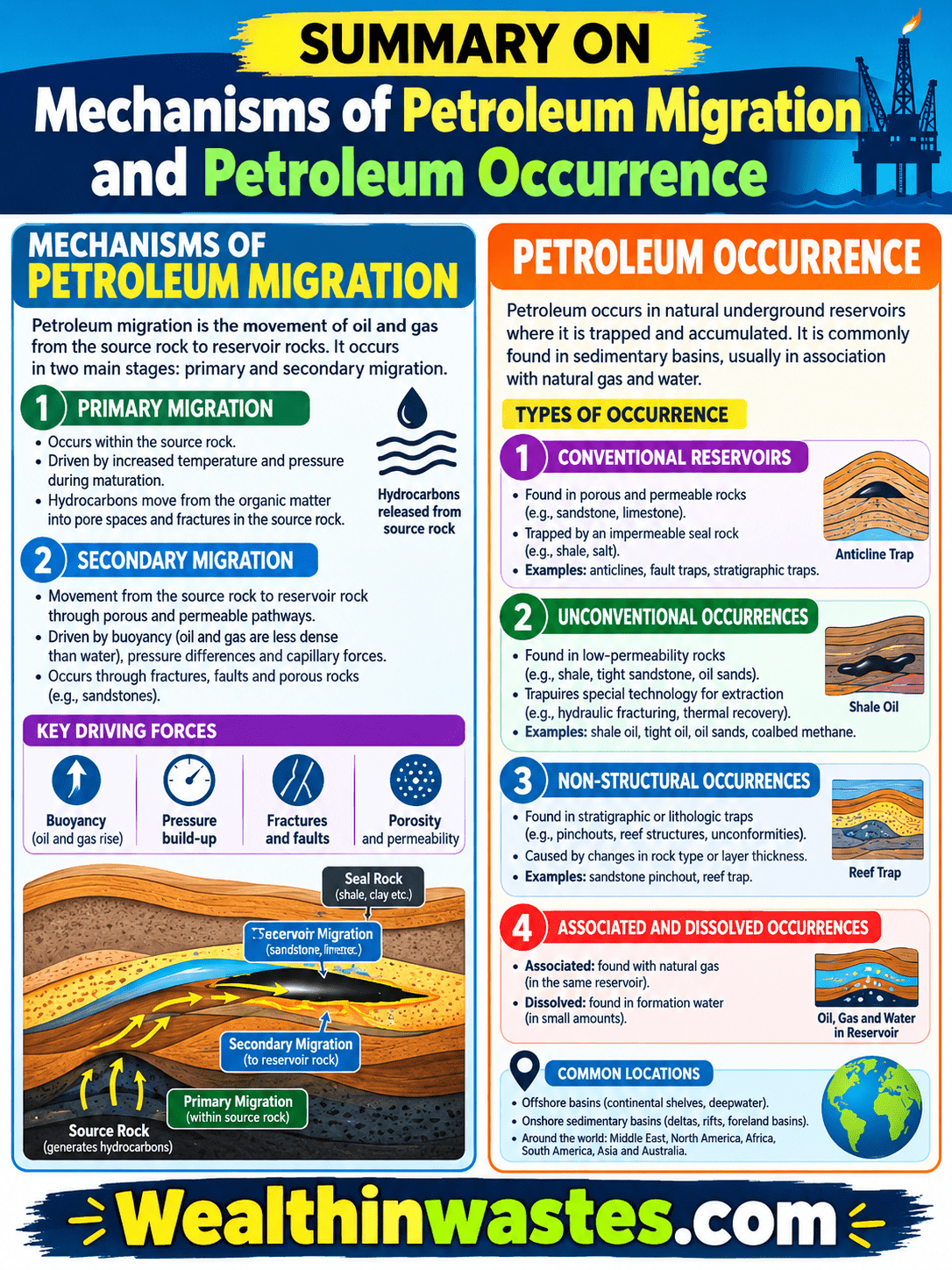
Summary on Mechanisms of Petroleum Migration and Petroleum Occurrence
| Aspect | Summary |
|---|---|
| Petroleum Migration | The movement of hydrocarbons from source rocks toward reservoirs and traps. |
| Primary Migration | Moves generated hydrocarbons out of mature source rocks into nearby carrier pathways. |
| Secondary Migration | Transports hydrocarbons through porous rocks, fractures, faults, and conduits. |
| Main Forces | Buoyancy, pressure differences, hydrodynamic flow, and geological structure influence movement. |
| Migration Pathways | Carrier beds, connected pores, faults, fractures, and permeable geological layers can conduct petroleum. |
| Reservoir Rocks | Reservoirs require adequate porosity and permeability to store and transmit hydrocarbons. |
| Traps And Seals | Geological traps collect petroleum while seals prevent continued upward or lateral escape. |
| Petroleum Occurrence | Oil fields develop where source, migration, reservoir, trap, seal, and preservation conditions align. |
| Origin Theory | The biogenic theory remains the generally accepted explanation for petroleum formation. |
Frequently Asked Questions About Petroleum Migration: Mechanisms and Petroleum Occurrence
1. What Is Petroleum Migration?
Petroleum migration is the geological movement of generated hydrocarbons from source rocks through pores, fractures, faults, carrier beds, and other pathways toward reservoirs where accumulation can occur.
2. What Are The Main Types Of Petroleum Migration?
The two main types are primary migration and secondary migration. Primary migration moves hydrocarbons from mature source rocks, while secondary migration transports them through carrier rocks toward suitable traps.
3. What Causes Petroleum To Migrate?
Important driving forces include buoyancy, pressure differences, hydrodynamic flow, geological deformation, fluid generation, and the physical properties of rocks through which hydrocarbons move.
4. What Is Primary Petroleum Migration?
Primary petroleum migration occurs when hydrocarbons leave the mature source rock where they formed and enter adjacent carrier beds, fractures, or connected geological pathways.
5. What Is Secondary Petroleum Migration?
Secondary migration occurs after hydrocarbons leave the source rock. Petroleum then travels through permeable carrier rocks, fractures, faults, and other conduits until it reaches a trapping structure.
6. What Is A Petroleum Reservoir?
A petroleum reservoir is a subsurface rock formation with enough connected pore space to store hydrocarbons and sufficient permeability to allow fluids to move through the rock.
7. Why Are Petroleum Traps Important?
Petroleum traps stop migrating hydrocarbons from continuing through geological pathways. When an effective seal lies above or around a reservoir, oil and gas can accumulate for long periods.
8. Where Does Petroleum Commonly Occur?
Petroleum commonly occurs in sedimentary basins containing mature source rocks, permeable reservoir rocks, effective seals, migration pathways, suitable traps, and geological conditions that preserve accumulated hydrocarbons.
9. Which Theory Best Explains Petroleum Origin?
The biogenic theory is the generally accepted explanation, proposing that petroleum formed from ancient organic matter buried in sediments and transformed through geological heat, pressure, and chemical processes.
10. Why Is Petroleum Migration Important In Exploration?
Petroleum migration helps explorers identify whether generated hydrocarbons could have travelled from source rocks into reservoirs. Understanding pathways, traps, seals, and timing improves evaluation of potential petroleum accumulations.
Do you have any questions, suggestions, or contributions? If so, please feel free to use the comment box below to share your thoughts. We also encourage you to kindly share this information with others who might benefit from it. Since we can’t reach everyone at once, we truly appreciate your help in spreading the word. Thank you very much for your support and for sharing!
Read Also: Meaning and Components of Environment for Agricultural Projects