



Crude oil exists as a complex natural mixture of hydrocarbons, and its composition varies according to the source, reservoir conditions, and proportions of different compounds found within the underground deposit.
The classification of crude oil helps explain these differences by grouping petroleum according to chemical composition, density, API gravity, viscosity, carbon distribution, correlation index, and other measurable physical and chemical characteristics used by industry.
Understanding crude oil classification is important because crude types behave differently during transportation, storage, refining, and processing, while their properties influence product yields, treatment requirements, operating costs, and economic value.
Petroleum and natural gas occur naturally as mixtures of hydrocarbons that can be separated into constituents that existed within the reservoir before refining or other applied processing methods were introduced.
This article explains the major crude oil classes, the meaning of API gravity, and important properties including density, salt content, sulphur content, pour point, ash content, viscosity, and trace metals.
Crude Oil Classification
Crude oil classification uses several factors because petroleum from different fields does not contain identical proportions of hydrocarbons, impurities, or physical characteristics. These differences affect handling, storage, transportation, refining, and processing requirements.
Petroleum may be classified from its physical state alongside other fossil fuels, but chemical composition provides a more detailed basis for distinguishing crude oil types and predicting their behaviour during processing and refining.
The major compositional groups described for petroleum include paraffinic, naphthenic, and aromatic crude oils. Some crude oils also show mixed characteristics, combining significant proportions of more than one hydrocarbon group within one deposit.
Crude oils can also receive market descriptions such as light or heavy according to density and API gravity, while sweet or sour descriptions commonly reflect differences in sulphur content during commercial evaluation.
These classification approaches are complementary rather than competing systems. A single crude oil can belong to a chemical composition class while also receiving a density category and a sulphur-based market description.
Because classification relies on measurable characteristics, analysts can compare crude oils from different wells using consistent terminology. This approach supports more effective communication among producers, traders, transporters, and refinery operators.
Chemical classification focuses on hydrocarbon families, whereas density and API gravity emphasize physical heaviness. Sulphur content adds another practical dimension, allowing crude oils to receive broader commercial descriptions in petroleum markets.
Read Also: Mechanisms of Petroleum Migration and Petroleum Occurrence
Hydrocarbon Composition Classes

1. Paraffinic: Paraffinic crude oils contain large quantities of saturated straight-chain or branched-chain hydrocarbons and comparatively smaller quantities of ring structures within their overall composition and molecular distribution in the reservoir.
2. Naphthenic: Naphthenic crude oils contain high proportions of saturated cyclic hydrocarbons with one or more rings, sometimes carrying paraffin side chains on those ring structures and molecular frameworks within the crude.
3. Aromatic: Aromatic crude oils contain relatively large quantities of hydrocarbons with aromatic nuclei, including structures based on benzene, naphthalene, and phenanthrene ring systems within their complex molecular composition and distribution.
4. Mixed Classes: Crude oils may combine paraffinic, naphthenic, and aromatic characteristics, producing mixed categories whose percentages vary substantially. These combinations explain why crude oils from different fields show distinct properties.
5.Paraffinic-Naphthenic: This mixed crude class contains substantial paraffin and naphthene components, creating intermediate chemical characteristics that differ from strongly paraffinic or strongly naphthenic petroleum classes found in many reservoirs.
6. Paraffinic-Naphthenic-Aromatic: This mixed class contains meaningful proportions of all three hydrocarbon families, demonstrating that crude oil composition can combine several structural characteristics within one petroleum mixture from particular producing fields.
| Crude Oil | Paraffin | Naphthene | Aromatic | Wax | Asphalt | |
| Classification | (% | (%) | (%) | (%) | (%) | |
| Paraffinic | 46 – 61 | 22 – 32 | 12 – 25 | <10 | <6 | |
| Paraffinic– Naphthenic | 42 – 45 | 38 — 39 | 16 – 20 | <6 | <6 | |
| Naphthenic | 15 – 26 | 61 – 76 | 8 – 13 | 0 | <6 | |
| Aromatic | <8 | 57 – 78 | 20 – 25 | <0.5 | <20 | |
| Paraffinic– Naphthenic- Aromatic | 27 – 35 | 36 — 47 | 26 — 33 | <1 | <10 |
API Gravity And Density Classification

Density provides another widely accepted basis for crude oil classification. It represents mass per unit volume, while specific gravity compares the density of oil with the density of a reference substance.
API gravity provides a petroleum industry scale derived from specific gravity. Higher API gravity generally indicates lighter crude, whereas lower API gravity indicates heavier crude with greater density and different handling characteristics.
Specific gravity values for crude oils can range from roughly 0.82 for lighter crudes to above 1.0 for heavier materials. Refiners use these differences when evaluating crude feedstocks and expected processing behaviour.
According to the source classification, crude oil with API gravity above 30.0 falls within the paraffin-based category, while values from 20.1 to 29.9 indicate intermediate characteristics between paraffin and naphthene types.
API gravity below 20 indicates naphthene-based heavy crude under the source classification. Specific gravity values provide the corresponding density perspective, helping users interpret whether crude is comparatively light or heavy during commercial evaluation.
The API system does not describe every crude characteristic by itself. Refiners still examine sulphur, salt, viscosity, pour point, metals, and composition before selecting suitable processing conditions and equipment for a refinery.
Specific gravity and API gravity therefore work as practical indicators rather than complete descriptions of crude quality. Detailed laboratory testing remains necessary when refiners compare feedstocks or plan processing operations.
The relationship between density and product yield makes these measurements valuable during crude purchasing and refinery planning. However, operators must interpret the values together with composition and contaminant levels.
Key Crude Oil Properties
Crude oil properties differ according to origin and the ratio of components in each mixture. These measurable characteristics provide first-hand information about crude quality, processing demands, handling difficulty, and economic value.
1. Viscosity: Viscosity describes resistance to flow and strongly affects pumping, transportation, storage, and processing. More viscous crude generally requires greater pumping effort and more careful handling through pipelines and equipment.
2. Carbon Distribution: Carbon distribution describes how carbon atoms occur across hydrocarbon molecules and fractions. The distribution helps distinguish crude characteristics and indicates how different hydrocarbon structures contribute to processing behaviour.
3. Correlation Index: Correlation index provides a comparative measure used with other crude characteristics. It helps petroleum specialists relate chemical composition and hydrocarbon structure when assessing and comparing different crude oils.
4. Hydrocarbon Composition: Hydrocarbon composition identifies the relative presence of paraffinic, naphthenic, and aromatic compounds.Those proportions help classify crude and provide clues about expected product fractions after petroleum refining.
5. Crude Assay: A crude assay brings several individual measurements together to describe a feedstock comprehensively. Consistent testing improves comparison, supports process planning, and helps identify changes in crude quality.
Salt and Sulphur Content

1. Salt Content: Salt content is expressed in milligrams of sodium chloride per litre of oil or, alternatively, in pounds per barrel. It indicates salt dissolved in water emulsified with crude oil during production.
2. Refinery Corrosion: High salt content presents serious corrosion risks during refining and can contribute to plugging heat exchangers and heater pipes. The source recommends desalting when salt exceeds ten pounds per 1,000 barrels.
3. Sulphur Content: Sulphur compounds influence the treatment required during refining, so refiners measure sulphur before selecting suitable processing and treating strategies. Higher sulphur levels can increase treatment requirements and operating costs.
4. Sulphur Testing: The source describes burning a measured crude sample in an air stream to oxidize sulphur compounds, followed by dissolving sulphur trioxide in water and titrating the resulting acid.
Pour Point And Flow Behaviour
Pour point is the lowest temperature at which crude oil or one of its products is observed to flow under specified test conditions. It indicates important low-temperature flow behaviour in petroleum handling.
Pour point provides an indication of petroleum wax, particularly long-chain hydrocarbons, present in crude oil. Paraffinic crude generally contains more wax than other crude types described in this classification system.
High wax content can create handling challenges because long-chain hydrocarbons may crystallize or precipitate as temperatures approach ambient conditions. This behaviour can restrict flow through storage systems, pumps, and pipelines.
Transportation becomes more difficult when crude temperature falls below its pour point. Operators may therefore need suitable heating practices or chemical pour point depressants to maintain acceptable flow conditions during movement.
The source identifies long-chain n-paraffins containing roughly 16 to 60 carbon atoms as contributors to near-ambient precipitation that can reduce fluidity and eventually stop crude oil flow altogether under certain conditions.
Low-temperature behaviour should receive particular attention when crude travels over long distances or remains in storage for extended periods. Appropriate handling conditions help operators maintain movement through pipelines and related equipment.
Wax-related flow problems can also influence operating efficiency because restricted movement may increase pumping demands and complicate routine handling. Testing the pour point helps identify these potential difficulties beforehand.
Read Also: Roles of Producers and Corporations in Waste Management
Ash Content and Trace Metals

Ash content helps determine the quantity of metallic constituents present in crude oil. Ash consists largely of inorganic material that remains after combustible components burn away at high temperature during analysis.
During the ashing process, carbon, hydrogen, nitrogen, oxygen, and sulphur-containing components undergo oxidation as the crude burns completely. The remaining material forms stable metallic salts, metal oxides, and silicon oxide residues.
The residual ash can undergo further elemental analysis using atomic absorption spectroscopic techniques. This additional analysis helps identify individual metallic constituents that occur within the crude oil sample after complete combustion.
Nickel and vanadium measurements can complement other laboratory results when specialists investigate crude variation.Their relative levels may reveal differences in source materials, reservoir conditions, petroleum-forming environments, and geological history.
Crude oils generally contain similar classes of compounds, but their percentages vary from well to well and field to field. Those variations explain why different crudes require different processing approaches.
Although ash represents the inorganic residue remaining after combustion, the result also helps indicate the presence of troublesome metallic material. Such information becomes valuable when evaluating complex or heavy crude feedstocks.
Why Crude Oil Properties Matter
Crude oil properties have direct effects on refinery economics because they influence the kinds of products a refinery can obtain, the treatment required, and the difficulty of processing each feedstock.
1. Product Yield: Lighter crude oils can provide greater proportions of light and middle distillates such as gasoline, which may command higher values and improve the economic attractiveness of the crude.
2. Processing Cost: Crude containing substantial sulphur, nitrogen, salts, or metals may require additional treatment. These impurities can affect catalysts, equipment, pipelines, and overall refinery operating expenses during petroleum processing.
3. Transportation: Density, viscosity, wax content, and pour point influence movement through pipelines and storage systems. Understanding these properties helps operators select suitable handling conditions for safe and efficient transportation.
4. Crude Valuation: Buyers and refiners use measured properties to compare crude feedstocks. Quality, composition, impurity levels, and expected product yield collectively influence demand, processing decisions, and commercial value in the marketplace.
5. Overall Assessment: Together these properties explain why crude oils can have commercial values, while product yield, impurity treatment, transportation behaviour, equipment demands, environmental risks and responses, and processing choices influence value.
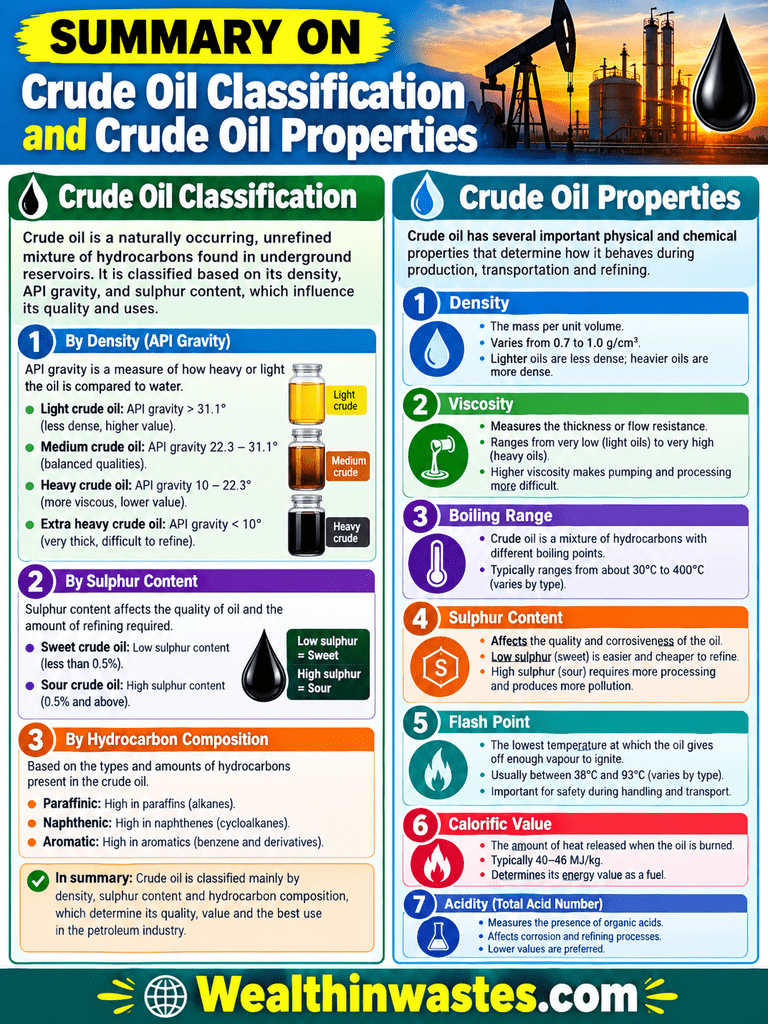
Summary on Crude Oil Classification and Crude Oil Properties
| Aspect | Summary |
|---|---|
| Classification Basis | Chemical composition, density, API gravity, viscosity, carbon distribution, and correlation index. |
| Paraffinic Crude | Rich in straight-chain or branched saturated hydrocarbons with relatively fewer ring structures. |
| Naphthenic Crude | Rich in saturated cyclic hydrocarbons containing one or more rings. |
| Aromatic Crude | Contains larger proportions of aromatic hydrocarbon nuclei such as benzene and related ring systems. |
| API Gravity | Higher values indicate lighter crude, while lower values indicate heavier crude. |
| Important Properties | Density, salt content, sulphur content, pour point, ash content, viscosity, and trace metals. |
| Economic Importance | Properties influence product yield, treatment needs, transportation, processing cost, and crude value. |
Frequently Asked Questions About Crude Oil Classification and Key Properties Explained
1. What is crude oil classification?
Crude oil classification groups petroleum according to chemical composition, density, API gravity, and other measurable characteristics.
2. What are the main chemical classes of crude oil?
The main classes are paraffinic, naphthenic, aromatic, and mixed crude types containing combinations of these hydrocarbon families.
3. What does API gravity show?
API gravity indicates crude density on a petroleum scale; higher API values generally represent lighter crude, while lower values indicate heavier crude.
4. Why is salt content important in crude oil?
High salt content can promote corrosion and plugging in refinery equipment, so crude may require desalting before further processing.
5. Why does sulphur content matter?
Sulphur content affects the treatment required during refining and can increase processing demands and operating costs.
6. What is pour point?
Pour point is the lowest temperature at which crude oil or a product is observed to flow under specified test conditions.
7. What does ash content measure?
Ash content indicates inorganic and metallic residues that remain after crude oil undergoes complete combustion at high temperature.
8. Why do crude oil properties matter economically?
They influence product yields, treatment requirements, transportation difficulty, refinery costs, and the commercial value of crude feedstocks.
Do you have any questions, suggestions, or contributions? If so, please feel free to use the comment box below to share your thoughts. We also encourage you to kindly share this information with others who might benefit from it. Since we can’t reach everyone at once, we truly appreciate your help in spreading the word. Thank you very much for your support and for sharing!
Read Also: Cultivation, Production, and Processing of Oil Palm