


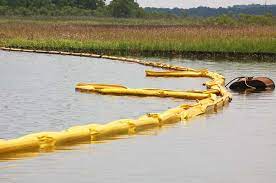
Several environmental parameters can reveal the extent of contamination at sites affected by oil spillage, helping investigators understand pollution levels and evaluate changes occurring within polluted water, soil, and sediment.
Oil pollution monitoring therefore involves collecting environmental samples and measuring physical, chemical, and biological indicators that reveal the presence and concentration of petroleum-derived contaminants.
These measurements provide useful evidence for determining pollution severity, identifying environmental changes, supporting regulatory decisions, and evaluating whether clean-up activities are actually reducing contamination across affected areas.
The principles of environmental management emphasize prevention and responsible control because pollution prevention generally reduces the environmental and financial burden associated with extensive treatment and later restoration.
This article explains important oil pollution monitoring parameters, their analytical significance, major testing approaches, and practical methods for preventing, containing, recovering, and remediating petroleum contamination.
Key Parameters For Oil Pollution Monitoring
Oil pollution monitoring can examine gross organic constituents, individual petroleum compounds, oxygen-demanding substances, extractable materials, petroleum hydrocarbons, ultraviolet-active constituents, metals, and radioactive compounds within affected environmental media.
1. Total Organic Carbon and Oxygen Demand: Total organic carbon, chemical oxygen demand, biochemical oxygen demand, and related measures estimate the quantity or oxygen requirements of organic materials present within polluted water, soil, or sediment.
2. Oil and Grease: This parameter measures substances extracted by suitable nonpolar organic solvents, providing a useful indication of petroleum-related materials and other solvent-soluble compounds present within environmental samples.
3. Total Petroleum Hydrocarbons: TPH provides a broader petroleum contamination measure by estimating mixtures of hydrocarbon compounds within impacted soil, sediment, and water, supporting clean-up planning and remediation decisions.
4. Ultraviolet Absorbing Constituents: Aromatic compounds in crude oil absorb ultraviolet radiation, making UV absorbance useful as a surrogate indicator of aggregate organic contamination where petroleum pollution affects environmental samples.
5. Metals and Radioactive Compounds: Crude oil and petroleum wastes can contain trace metals and radioactive constituents associated with geological materials, making their determination important during comprehensive environmental monitoring programmes.
These indicators complement broader environmental monitoring programmes because effective investigations depend on selecting measurements that match the environmental medium and purpose.
Read Also: Oil Pollution in the Environment: Extent, Effects, Sources and Fate
Oil Pollution Monitoring Through Oxygen Demand

Biochemical oxygen demand is an empirical test that estimates oxygen consumption caused by microorganisms while they degrade biodegradable organic matter in wastewater, polluted water, and related environmental samples.
BOD can help investigators understand the biodegradable fraction of organic pollution, although petroleum mixtures vary considerably in composition and biodegradability, so results require interpretation alongside other monitoring parameters.
During BOD testing, diluted samples are prepared with suitable dilution water and may receive microbial seed where naturally occurring organisms cannot adequately support degradation during the incubation period.
The prepared samples remain in airtight bottles under controlled incubation conditions for five days, while dissolved oxygen measurements taken before and after incubation provide the basis for calculating oxygen demand.
Where pollution creates oxygen demand greater than available dissolved oxygen, investigators dilute the sample with aerated water and may add seed organisms to improve degradation and measurement reliability.
Environmental investigators can compare BOD with established water quality analysis procedures to place oxygen-demand results within a broader assessment of chemical and biological conditions.
Chemical oxygen demand differs because it estimates oxygen equivalent consumed by a specified chemical oxidant, commonly potassium dichromate, under controlled strongly acidic conditions rather than relying primarily on microbial activity.
COD therefore offers a rapid gross measurement of oxidisable pollutants and can be compared with BOD, TOC, and total oxygen demand to develop a broader understanding of organic pollution characteristics.
Oil Pollution Monitoring With Organic Measures
Total organic carbon provides a direct measurement of carbon associated with organic matter and can be determined in water, soil, and sediment samples collected from areas affected by petroleum contamination.
1. Total Organic Carbon: TOC measures organic carbon regardless of its oxidation state, making it a convenient indicator of overall organic loading; however, it does not measure every element associated with organic compounds.
2. Chemical Oxygen Demand: COD estimates the oxygen equivalent of oxidisable matter using a chemical oxidant, providing a broad measurement that complements BOD and TOC when assessing contaminated environmental samples.
3. Oil and Grease: Oil and grease analysis measures solvent-extractable material rather than one specific substance, meaning the result may include petroleum hydrocarbons together with biological lipids and other extractable compounds.
4. Organic Carbon Interpretation: TOC results should not replace BOD or COD because each parameter provides different information about organic matter, oxidation characteristics, oxygen demand, and contaminant behaviour within polluted systems.
TOC analysis commonly uses catalytic oxidation to convert carbon into carbon dioxide, after which the resulting carbon dioxide can be quantified instrumentally using methods such as nondispersive infrared detection.
Reliable TOC analysis requires representative samples, appropriate blanks, calibration standards, stable instrument conditions, and replicate measurements capable of producing reproducible analytical results across the expected concentration range.
Readers examining broader water-treatment relationships can also review water quality management principles to understand why monitoring data should guide prevention, treatment, and environmental protection decisions.
Oil Pollution Monitoring Through Petroleum Tracing
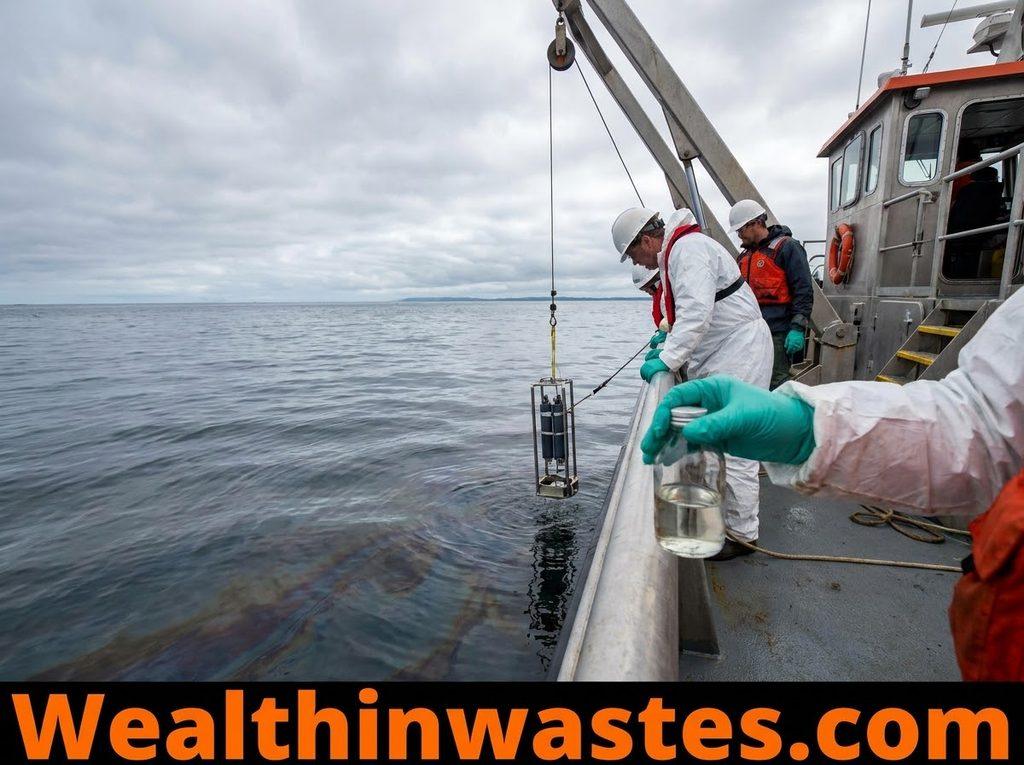
Oil and grease analysis provides another important monitoring approach because petroleum contamination often produces solvent-extractable materials that can accumulate in water, soil, sediment, treatment systems, and receiving environments.
For liquid samples, investigators commonly transfer measured volumes into separating funnels and extract the target material with an appropriate solvent before recovering the extract for gravimetric determination.
Solid samples can undergo solvent extraction using techniques such as ultrasonic extraction or Soxhlet extraction, depending on the sample characteristics, analytical objective, and available laboratory equipment.
After extraction, the solvent passes through a drying material to remove water, while controlled evaporation leaves the extractable residue that investigators weigh and use for concentration calculations.
Total petroleum hydrocarbons extend the monitoring approach by targeting mixtures of aliphatic and aromatic petroleum-derived hydrocarbons found across contaminated water, soil, and sediment environments.
Analytical approaches include infrared spectroscopy, Raman spectroscopy, fluorescence methods, gravimetric techniques, immunoassay, gas chromatography with flame ionisation detection, and gas chromatography coupled with mass spectrometry.
For chromatographic determination, laboratories extract hydrocarbons from environmental media, clean the resulting extract, concentrate it when necessary, and introduce it into the analytical instrument for quantification.
Infrared techniques can provide a comparatively quick approach because hydrocarbon functional groups display characteristic absorption bands that investigators can compare with calibration standards prepared from petroleum hydrocarbons.
Readers interested in treatment systems can compare petroleum monitoring with industrial wastewater treatment processes, particularly where industrial effluents contain oil, grease, hazardous compounds, and other organic pollutants.
Other Indicators In Oil Pollution Monitoring
Oil pollution monitoring should not rely on petroleum hydrocarbons alone because crude oil can influence several chemical indicators and may introduce additional contaminants into surrounding environmental systems.
1. Ultraviolet Absorption: Aromatic compounds in crude oil can absorb ultraviolet radiation, so measured UV absorbance can indicate aggregate concentrations of UV-active organic constituents within polluted water samples.
2. Metals: Petroleum-associated wastes may contain trace metals, whose concentrations require laboratory determination using techniques such as atomic absorption spectrometry, inductively coupled plasma methods, flame photometry, or related analytical procedures.
3. Radioactive Compounds: Environmental investigations may assess radioactive constituents where geological materials associated with crude oil activities create potential concerns, using suitable counting instruments or instrumental analytical methods.
4. Sample Condition And Quality: Correct sample collection, preservation, preparation, calibration, blank analysis, replication, and documentation remain essential because poor sampling practices can undermine otherwise accurate laboratory measurements.
UV measurement commonly uses a spectrophotometer fitted with quartz cuvettes, while samples require suitable preparation, blank correction, controlled pH conditions, and replicate absorbance measurements.
Monitoring metals generally requires digestion before instrumental determination because organic matter and particulate materials can interfere with analysis or retain metals that investigators need to bring into solution.
Such comprehensive assessment aligns with established water quality monitoring practices, where chemical, biological, and physical information supports environmental interpretation and management decisions.
Control Measures For Oil Pollution
Monitoring demonstrates pollution conditions, but effective environmental protection requires prevention and corrective action that reduce the probability of spills while limiting contamination when incidents occur.
Preventive measures usually provide stronger environmental and economic benefits because avoiding a spill eliminates many subsequent expenses associated with containment, recovery, treatment, restoration, compensation, and long-term monitoring.
Organizations can combine cleaner production, routine equipment maintenance, worker training, emergency preparedness, environmental regulations, and strong institutional oversight to reduce opportunities for accidental petroleum releases.
Risk assessments should identify vulnerable equipment, pipelines, tanks, loading points, and operational activities, while previous incidents can help managers identify recurring weaknesses and strengthen emergency preparedness programmes.
Remote sensing and other surveillance technologies can support inspection of petroleum installations and pipeline corridors, helping responsible agencies detect unusual changes and respond before small problems become major releases.
Double-hulled vessels and double-layer containment systems can provide additional protection because petroleum must breach more than one protective barrier before entering the surrounding environment.
Organizations should also maintain equipment routinely, test emergency response plans, conduct drills, provide adequate spill-response resources, and continuously improve worker knowledge through appropriate health, safety, and environmental training.
These measures support wider institutional arrangements for pollution control, especially where effective enforcement and coordinated government action are necessary to prevent environmental degradation.
Good water protection practices also emphasize preventing contamination rather than relying entirely on later treatment, a principle reflected in water pollution control strategies used for contaminated aquatic systems.
Read Also: Roles of Producers and Corporations in Waste Management
Remediation Options After Oil Pollution
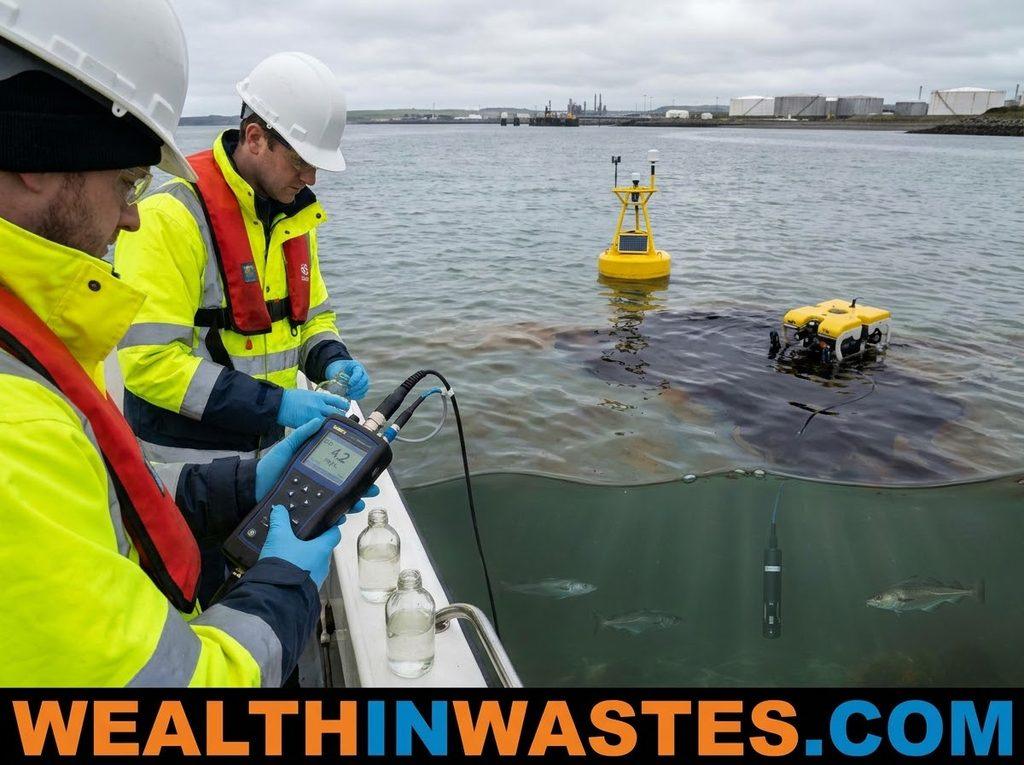
When prevention fails and an oil spill occurs, remediation should match the type, volume, location, weather conditions, environmental sensitivity, and physical characteristics of the released petroleum material.
1. Chemical Dispersants: Surfactants contain hydrophilic and lipophilic components that help break surface slicks into smaller droplets, allowing currents and wave action to disperse them through the water column.
2. Mechanical Skimmers: Skimmers mechanically recover floating oil from water surfaces and come in different designs, capacities, and applications suited to offshore waters, shallow areas, rivers, and coastal environments.
3. Sorbent Materials: Sorbents recover oil through absorption or adsorption and may include agricultural residues, wood products, peat, seaweed, activated carbon, clays, zeolites, and manufactured materials.
4. Microbial Degradation: Certain microorganisms can degrade petroleum hydrocarbons naturally or through assisted bioremediation, although the process may proceed slowly and depends strongly on environmental conditions and microbial activity.
5. Controlled In-Situ Burning: In-situ burning removes large quantities of oil rapidly through controlled combustion, but it destroys recoverable petroleum and can create combustion products, requiring careful site-specific assessment and authorization.
Dispersant use requires particular caution because dispersing oil does not destroy the contaminant; it changes its physical distribution and can expose water-column organisms to petroleum constituents.
Therefore, authorities should assess environmental risks before approving chemical treatment, particularly in sensitive freshwater or ecological settings where additional chemical exposure may create unacceptable impacts.
Skimmer performance can decline with strong waves, high currents, debris, ice, very viscous oils, tar balls, and oiled materials that obstruct intake systems or recovery equipment.
Response teams can improve skimmer performance by concentrating floating oil with containment booms before positioning recovery equipment where the slick reaches sufficient thickness for efficient collection.
Sorbents work particularly well for residual contamination or smaller spills, and responders can deploy them as pads, rolls, blankets, pillows, socks, bags, granules, powders, cubes, or other practical forms.
A broader review of specific pollutant clean-up methods also illustrates why remediation techniques must match the contaminant, site conditions, and desired environmental outcome.
Microbial remediation can involve petroleum-degrading organisms such as members of the genera Alcanivorax, Marinobacter, Pseudomonas, and Acinetobacter, although degradation rates can remain relatively slow.
Successful remediation therefore requires follow-up monitoring because visible disappearance of an oil slick does not necessarily demonstrate complete contaminant removal from soil, sediment, groundwater, or biological systems.
Where contaminated land requires additional management, principles discussed in soil properties and soil management can help explain how pollutants interact with soil surfaces and move through affected sites.
How Monitoring Supports Better Control
Oil pollution monitoring creates the evidence needed to understand contamination patterns, determine the effectiveness of control actions, and support decisions about continued treatment, restoration, and environmental protection.
Samples from water, soil, and sediment should represent the affected area adequately, while monitoring programmes should consider pollution sources, movement pathways, seasonal changes, environmental sensitivity, and available analytical resources.
Monitoring results become more useful when investigators establish baseline conditions, collect repeated measurements, document sampling locations, maintain laboratory quality control, and compare results across consistent time intervals.
Pollution control decisions should connect analytical evidence with practical response measures so that monitoring does more than describe contamination and instead guides prevention, containment, treatment, restoration, and compliance.
This approach fits the broader principles described in wastewater treatment and guideline standards, where measured environmental conditions help determine whether treatment and discharge practices meet required objectives.
Industrial facilities handling petroleum products should integrate oil pollution monitoring with broader industrial waste management practices to reduce risks from multiple contaminants released during production and processing activities.
Where industrial wastewater carries petroleum constituents, treatment systems may require physical, chemical, and biological processes selected according to influent characteristics, discharge requirements, and environmental conditions.
Facilities can review industrial wastewater treatment procedures when integrating pollutant monitoring with treatment operations that address oil, grease, suspended solids, hazardous contaminants, and other industrial wastewater constituents.
Advanced systems can also combine improved treatment processes with digital monitoring technologies, supporting more efficient control where conventional approaches cannot provide adequate protection against persistent organic contaminants.
Modern wastewater technologies discussed in advanced wastewater treatment developments demonstrate how monitoring and treatment can increasingly operate together to improve environmental performance and resource protection.
Pollution prevention should remain the primary objective because remediation can become technically difficult and financially demanding once petroleum spreads through soils, sediments, groundwater, wetlands, agricultural lands, or aquatic habitats.
Soil contamination deserves careful attention because petroleum hydrocarbons can interact with organic matter, mineral surfaces, and soil pores, influencing contaminant retention, migration, biological activity, and future land use.
The wider discussion of land pollution and soil contamination provides useful context for understanding how pollutants can degrade land resources and complicate environmental restoration.
Effective oil pollution control also depends on understanding hazardous materials, especially where petroleum waste contains toxic chemicals, metals, or other substances requiring special handling during treatment and disposal.
Readers can therefore examine hazardous waste control measures alongside petroleum monitoring to appreciate the broader responsibilities involved in safe storage, transportation, treatment, and environmental protection.
Recent environmental management guidance also highlights the importance of identifying hazardous waste sources and classifications, which supports stronger risk assessment when petroleum operations generate complex contaminated materials.
Information from hazardous waste source classifications can complement oil pollution monitoring where petroleum-related residues contain substances requiring controlled management because of their potential environmental hazards.
Finally, monitoring evidence can support economic and policy decisions by showing whether preventive investments, response programmes, and remediation activities reduce environmental damage and associated social or financial losses.
The economic consequences of pollution are discussed further in pollution-related economic loss assessments, which demonstrate why reliable environmental data remain important for policy and management decisions.
Additional water-quality treatment knowledge can strengthen monitoring programmes because polluted sites often require coordinated sampling, treatment, disposal, and follow-up verification before responsible authorities consider restoration activities complete.
Proper treatment selection depends on contaminant characteristics, environmental conditions, regulatory requirements, treatment capacity, available technology, and the intended final condition of the affected environment.
In practice, successful oil pollution management combines early detection, accurate measurement, strong prevention, rapid response, appropriate remediation, institutional oversight, and continued monitoring after clean-up activities finish.
Summary Methods and Measures of Oil pollution Monitoring and Control
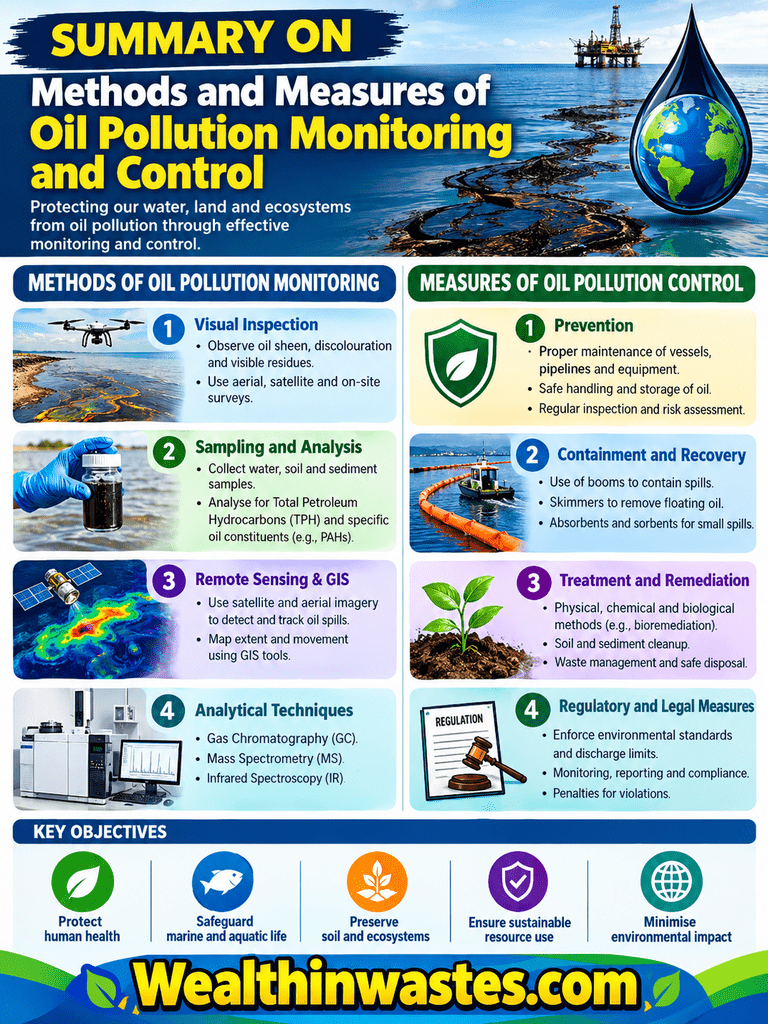
| Area | Key Points |
|---|---|
| Monitoring | Oil pollution monitoring uses measurements from water, soil, sediment, and other environmental media. |
| Organic Indicators | BOD, COD, TOC, oil and grease, and UV absorption provide different measures of organic contamination. |
| Petroleum Indicators | Total petroleum hydrocarbons help estimate petroleum contamination and guide remediation planning. |
| Additional Indicators | Metals and radioactive compounds may require investigation where petroleum-related wastes create additional contamination concerns. |
| Prevention | Maintenance, training, cleaner technology, risk assessment, regulation, surveillance, and emergency planning help prevent spills. |
| Remediation | Dispersants, skimmers, sorbents, microbial degradation, and controlled burning can assist oil spill response under suitable conditions. |
| Management | Continuous monitoring verifies pollution extent, supports treatment decisions, and evaluates remediation effectiveness. |
Frequently Asked Questions About Oil pollution Monitoring and Control: Methods and Measures
1. What is oil pollution monitoring?
Oil pollution monitoring is the systematic measurement of environmental indicators used to determine the presence, extent, concentration, movement, and effects of petroleum contamination.
2. Which parameters are commonly used for oil pollution monitoring?
Common parameters include BOD, COD, TOC, oil and grease, total petroleum hydrocarbons, ultraviolet absorption, metals, and radioactive compounds.
3. What does BOD measure in polluted water?
BOD estimates the oxygen consumed by microorganisms while degrading biodegradable organic material in a sample under specified testing conditions.
4. Why is total petroleum hydrocarbons important?
TPH provides a broad measure of petroleum-derived hydrocarbons in water, soil, and sediment, helping investigators understand contamination and plan appropriate remediation.
5. How can oil pollution be prevented?
Prevention involves routine maintenance, worker training, risk assessment, cleaner production, emergency planning, surveillance, strong regulations, and reliable spill-response systems.
6. Are chemical dispersants always suitable for oil spills?
No. Their suitability depends on spill conditions and environmental sensitivity because dispersants redistribute oil rather than destroy it completely.
7. What are oil skimmers?
Oil skimmers are mechanical devices that recover floating oil from water surfaces. Their effectiveness depends on oil thickness, weather, waves, currents, debris, and equipment design.
8. Can microorganisms remove oil pollution?
Yes. Certain microorganisms can degrade petroleum hydrocarbons, although microbial remediation may proceed slowly and depends on suitable environmental conditions and microbial activity.
9. Why should monitoring continue after remediation?
Follow-up monitoring confirms whether contamination levels have declined and helps identify residual pollution that may remain in soil, sediment, water, or biological systems after visible oil disappears.
10. Why is oil pollution monitoring important?
It provides evidence for understanding pollution severity, selecting control measures, evaluating remediation, supporting environmental regulation, and protecting ecosystems and human activities from continuing petroleum contamination.
Do you have any questions, suggestions, or contributions? If so, please feel free to use the comment box below to share your thoughts. We also encourage you to kindly share this information with others who might benefit from it. Since we can’t reach everyone at once, we truly appreciate your help in spreading the word. Thank you very much for your support and for sharing!
Read Also: Water and Land Pollution in Agriculture