


Air pollution remains a serious environmental challenge because gases, particles, fumes, and other contaminants can accumulate in the atmosphere and affect human health, ecosystems, visibility, and climate conditions.
Effective measures to control air pollution must address pollutants before they enter the atmosphere, capture emissions released during operations, and encourage cleaner energy, transport, production, and household practices.
Industries, transport systems, households, agriculture, and waste activities all influence air quality. Therefore, successful control requires coordinated actions from individuals, businesses, communities, and governments working toward cleaner environments.
This article explains practical methods used to control particulate matter and gaseous pollutants, including cyclones, scrubbers, electrostatic precipitators, bag-house filters, absorption, adsorption, combustion, and carbon sequestration.
Good waste management also supports cleaner air because uncontrolled burning, poor disposal, and inefficient treatment can release smoke, particles, toxic gases, and other pollutants into surrounding communities.
Control Air Pollution: Meaning And Importance
Air pollution control refers to methods and processes that reduce or eliminate emissions of substances capable of harming human health, natural resources, ecosystems, buildings, and the general atmospheric environment.
Meaningful and lasting efforts to control air pollution expanded during the twentieth century as governments developed measures for limiting emissions from stationary sources, mobile sources, industrial activities, and communities.
Natural events such as volcanic eruptions and forest fires can release pollutants, but human activities remain important targets because their emissions can often be reduced through improved technology, management, and cleaner practices.
Businesses can strengthen pollution prevention by adopting source-reduction practices that minimize waste, improve housekeeping, reduce material losses, and prevent pollutants from being created unnecessarily during production and handling activities.
Households and communities also contribute by reducing unnecessary burning, managing waste properly, improving ventilation, selecting cleaner products, and supporting practices that decrease smoke and harmful airborne contaminants around living areas.
Read Also: On-site Municipal Wastewaters Treatment
Control Air Pollution At The Source
1. Cleaner Fuels: Replacing highly polluting fuels with cleaner alternatives can reduce emissions generated during combustion. Cleaner energy choices can also complement responsible environmental control practices across households and industries.
2. Process Improvement: Industries can redesign production processes, improve equipment efficiency, prevent leaks, and minimize unnecessary combustion. These changes reduce the amount of pollution generated during normal operations.
3. Material Substitution: Replacing hazardous or highly polluting materials with safer alternatives can reduce emissions at their origin. Waste minimization planning can support this approach by identifying avoidable losses.
4. Better Waste Practices: Preventing open burning and improving collection, reuse, recycling, and treatment can reduce smoke and toxic emissions. Proper solid waste management is therefore closely connected with cleaner air.
5. Equipment Maintenance: Regular maintenance keeps engines, burners, filters, and industrial systems operating efficiently. Well-maintained equipment generally reduces incomplete combustion, leaks, excessive fuel use, and unnecessary pollutant emissions.
Control Particulate Matter Effectively
Particulate matter can be removed from polluted airstreams through physical collection processes. Common control technologies include cyclones, wet scrubbers, electrostatic precipitators, and fabric-filter bag houses.
These devices differ in operating principles, pollutant characteristics, efficiency, cost, maintenance requirements, and suitability for particular industrial processes. Equipment selection therefore depends strongly on particle size and emission conditions.
Proper waste separation can indirectly reduce particulate pollution by preventing unnecessary burning and encouraging recovery of useful materials. Recycling practices therefore form an important supporting measure for cleaner communities.
Industrial facilities should also consider the composition, density, shape, corrosivity, reactivity, and size distribution of emitted particles before selecting collection equipment. Different pollutants require different control strategies.
Collected particles require appropriate handling after removal. Suitable waste treatment and transformation methods can prevent captured materials from becoming secondary environmental hazards through careless storage, transport, or disposal.
Use Cyclones And Scrubbers
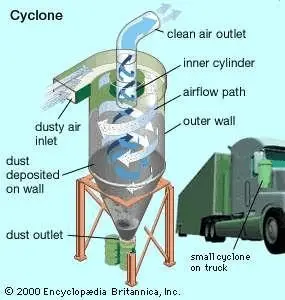
1. Cyclones: A cyclone forces contaminated air into a spiral movement inside a cylindrical chamber. Larger particles possess greater inertia, move toward the walls, and slide downward into a collection hopper.
Cyclones work especially well for relatively coarse particles and often serve as pre-cleaners before other collection devices. Their simple construction also makes them useful for controlling industrial dust emissions.
Figure 1: Cyclone Source: Encyclopaedia Britannica, 2000.
2. Wet Scrubbers: Wet scrubbers bring polluted air into direct contact with water or another liquid. Particles collide with droplets and become trapped, allowing the contaminated material to leave the airstream.
Spray towers wash upward-moving air with downward water sprays. Venturi scrubbers increase contact between particles and liquid through high gas velocity, producing stronger collection performance for finer suspended materials.
3. Scrubber Applications: Wet scrubbers are useful for hot airstreams, sticky particles, flammable dusts, explosive mists, chemical-processing emissions, and hazardous-waste combustion streams requiring effective particulate control.
Good waste treatment complements particulate control because uncontrolled disposal can create additional smoke and dust. Recommended disposal methods help reduce these secondary pollution pathways.
Apply Electrostatic And Bag-House Filters
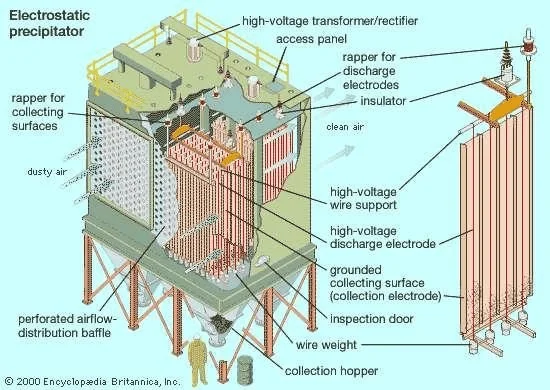
Electrostatic precipitators remove fine particles by electrically charging suspended materials before attracting them toward oppositely charged collection surfaces. The collected dust then undergoes periodic removal from the collecting plates.
High-voltage direct current charges particles as polluted air passes through the precipitator. Electrical forces then move charged particles toward collection electrodes, where they accumulate until mechanical cleaning removes them.
Figure 2: Electrostatic precipitator Source: Encyclopedia Britannica, 2000.
Fabric-filter bag houses provide another highly effective method for controlling suspended particles. Dust-laden air passes through fabric bags, while particles remain trapped and cleaner air leaves through the filtering material.
1. Fabric Filtration: Bag-house systems can capture very small particles efficiently when properly designed and maintained. Regular cleaning prevents excessive pressure loss and preserves effective airflow through the filter media.
2. Dust Handling: Collected material requires safe storage, transport, and disposal. Facilities should prevent captured dust from escaping again through spills, poor containment, careless handling, or unsuitable disposal.
3. Supporting Recovery: Reusing materials where appropriate can reduce the amount of waste requiring final disposal. Recycling for pollution control can therefore support broader emission-reduction objectives.
Control Gaseous Air Pollutants
Gaseous pollutants, volatile organic compounds, and other airborne contaminants require treatment methods suited to their chemical properties. Three major techniques include absorption, adsorption, and incineration or combustion.
1. Absorption: Absorption transfers gaseous pollutants from air into a contacting liquid capable of dissolving or chemically reacting with the contaminant. Wet scrubbers and packed towers commonly support this process.
Countercurrent absorption towers move polluted air upward while liquid absorbent flows downward across packing materials. This arrangement increases contact between the gas and liquid, improving pollutant transfer and removal.
Sulfur dioxide from fossil-fuel combustion can undergo flue-gas desulfurization through wet or dry systems. These systems use absorbent materials that capture sulfur compounds before treated gases leave the facility.
2. Adsorption: Adsorption holds gas molecules on the surface of a solid material. Activated carbon is widely used because its highly porous structure provides a large surface area for capturing pollutants.
Activated carbon systems can control volatile organic compounds, odours, and solvent vapours. Their effectiveness depends on pollutant characteristics, carbon properties, operating conditions, and suitable system design and maintenance.
Reducing waste at the source can also reduce the quantity of gaseous pollutants generated during processing. Waste reduction strategies therefore support cleaner production and lower pollution-control demands.
3. Incineration: Combustion can oxidize volatile organic compounds and hydrocarbon pollutants into simpler products such as carbon dioxide and water when adequate temperature, time, and turbulence support complete oxidation.
Catalysts can assist combustion by enabling oxidation at lower temperatures. Properly designed afterburners can help control odours, toxic compounds, and photochemically reactive pollutants from several industrial operations.
Industries should still manage combustion residues carefully because emission control does not eliminate the need for responsible waste handling. Environmental waste impacts remain important after treatment processes operate.
Read Also: Proper Waste Control Complete Guide
Use Carbon Sequestration and Cleaner Energy
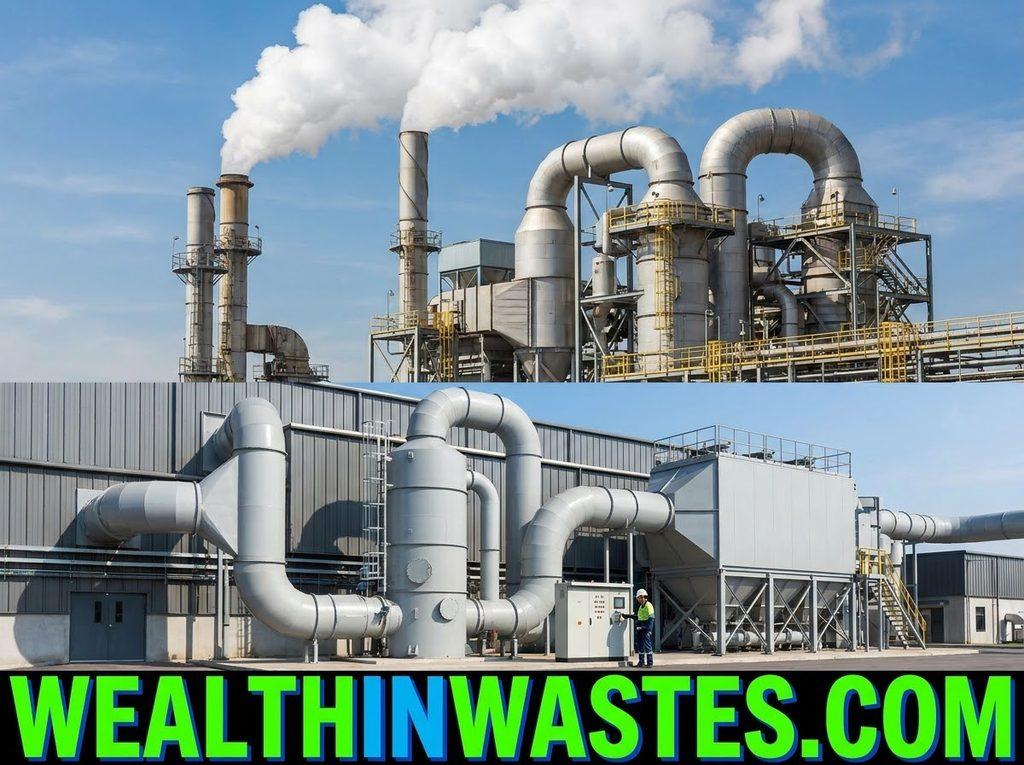
Reducing carbon dioxide emissions requires greater energy efficiency and lower dependence on fossil-fuel combustion. Cleaner energy sources can reduce pollution while supporting broader efforts to protect atmospheric quality.
1. Renewable Energy: Solar, wind, and other lower-emission energy sources can reduce pollution associated with fossil-fuel combustion. Their wider adoption can support cleaner electricity generation and long-term environmental management.
2. Efficient Energy Use: Improving efficiency reduces fuel consumption and the amount of pollutants produced for each unit of useful energy. Efficient systems can therefore deliver both environmental and economic advantages.
3. Carbon Sequestration: Carbon sequestration involves long-term storage of carbon dioxide underground or through natural systems such as forests and oceans. Protecting these systems strengthens their role in carbon storage.
Deforestation weakens natural carbon storage because forests remove carbon dioxide through growth. Protecting vegetation and improving land management can therefore support atmospheric carbon reduction alongside technological measures.
Integrated environmental management can help communities combine resource recovery, pollution prevention, and efficient waste handling. Integrated waste management approaches support these broader environmental objectives.
4. Cleaner Transport: Replacing highly polluting vehicles, maintaining engines, improving public transportation, and encouraging cleaner vehicle technologies can reduce emissions from mobile sources across urban and industrial areas.
Rural communities can also benefit from decentralized resource recovery and efficient waste systems. Community-based environmental practices can reduce transport-related emissions and improve local resource use.
Monitor Air Quality With AQI
The Air Quality Index, commonly called AQI, provides a standardized way to communicate daily ambient air-quality conditions and associated health concerns related to particulate and gaseous pollution.
AQI values help people understand whether air conditions are relatively clean or polluted. Higher values indicate greater pollution levels and generally greater concern about potential health effects.
The source draft identifies major pollutants used in AQI reporting as ground-level ozone, particle pollution, carbon monoxide, sulfur dioxide, and nitrogen dioxide under the United States regulatory framework.
1. Good: AQI values from 0 to 50 indicate satisfactory air quality, with pollution posing little or no risk under the stated index classification.
2. Moderate: Values from 51 to 100 indicate acceptable air quality, although unusually sensitive individuals may experience health concerns from particular pollutants.
3. Unhealthy For Sensitive Groups: Values from 101 to 150 indicate increased concern for sensitive populations, including children, older adults, and people with certain respiratory or heart conditions.
4. Unhealthy: Values from 151 to 200 indicate that the health risk extends beyond unusually sensitive groups and may affect a wider portion of the population.
5. Very Unhealthy: Values from 201 to 300 indicate a greater health concern and require increased attention to exposure, particularly during episodes involving elevated particulate or gaseous pollution.
6. Hazardous: Values from 301 to 500 represent the highest category in the index and indicate hazardous air conditions requiring serious attention to exposure reduction and public protection.
| AQI Value | AQI Category |
|---|---|
| 0-50 | Good |
| 51-100 | Moderate |
| 101-150 | Unhealthy for Sensitive Groups |
| 151-200 | Unhealthy |
| 201-300 | Very Unhealthy |
| 301-500 | Hazardous |
Monitoring should work alongside prevention and treatment rather than replace them. Understanding environmental effects helps communities connect pollution sources with practical actions that protect air quality.
Improving air quality also requires coordination across waste, water, land, transportation, and industrial systems. Industrial waste management remains especially important where production activities generate multiple environmental pollution pathways.
Summary on List of Effective Measures to Control Air Pollution
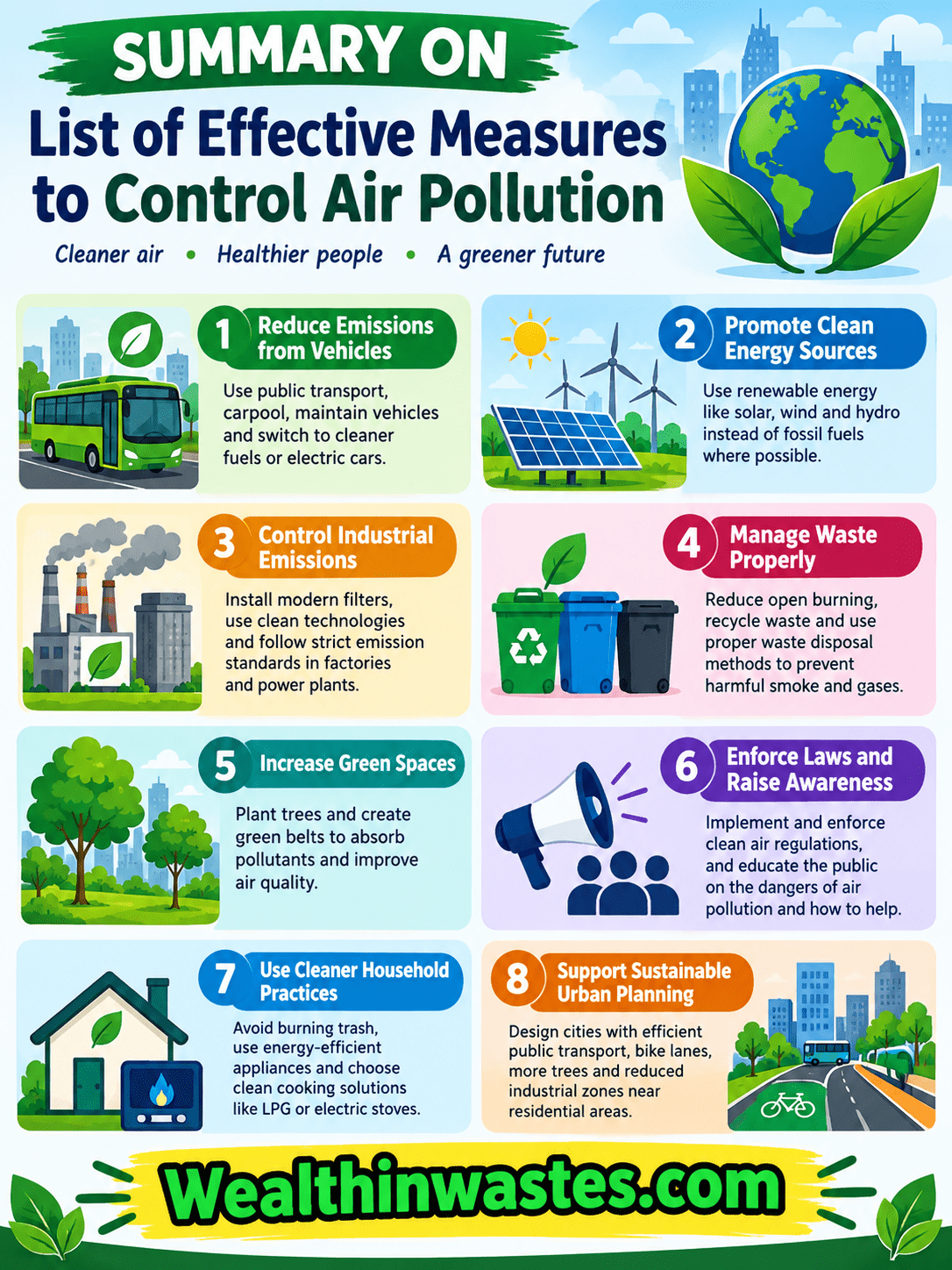
| Measure | Purpose | Main Benefit |
|---|---|---|
| Source Control | Prevents pollution before release | Reduces emissions and treatment demand |
| Cleaner Fuels | Reduces combustion pollutants | Cleaner energy use |
| Cyclones | Collects coarse particulates | Effective industrial dust control |
| Wet Scrubbers | Captures particles and some gases | Useful for difficult industrial streams |
| Electrostatic Precipitators | Removes fine particles | High particulate collection efficiency |
| Bag-House Filters | Filters suspended particles | Effective fine-particle control |
| Absorption And Adsorption | Removes gaseous pollutants | Controls gases, VOCs, and odours |
| Combustion | Oxidizes combustible gaseous pollutants | Reduces VOC and hydrocarbon emissions |
| Carbon Sequestration | Stores carbon dioxide | Supports long-term climate protection |
| AQI Monitoring | Communicates pollution conditions | Supports informed exposure decisions |
Frequently Asked Questions About Control Air Pollution: 8 Effective Measures for Clean Air
1.What does it mean to control air pollution?
Control Air Pollution means reducing, preventing, capturing, treating, or eliminating harmful substances before they enter the atmosphere or while emissions are being generated.
2. What is the best way to control air pollution?
Preventing pollution at its source is generally the strongest approach because cleaner fuels, efficient processes, reduced waste generation, and better maintenance reduce emissions before treatment becomes necessary.
3. How do cyclones control air pollution?
Cyclones use centrifugal action to force larger airborne particles toward chamber walls, where the particles lose momentum, slide downward, and collect inside a hopper.
4. What does a wet scrubber remove?
Wet scrubbers remove suspended particles by contacting polluted air with liquid droplets. Depending on their design, they can also help capture selected gaseous pollutants through absorption.
5. How do electrostatic precipitators work?
Electrostatic precipitators electrically charge particles in polluted air and attract those particles toward oppositely charged collection electrodes, where accumulated dust is periodically removed.
6. Why are bag-house filters important?
Bag-house filters provide highly effective particulate collection because contaminated air passes through fabric media that retain dust while allowing cleaner air to continue through the system.
7. What are the main methods for controlling gaseous pollutants?
Major methods include absorption, adsorption, and combustion. These techniques can target gaseous pollutants, volatile organic compounds, odours, hydrocarbon vapours, and selected industrial chemical emissions.
8. Why is the Air Quality Index important?
The AQI translates air-pollution measurements into understandable categories, helping people recognize pollution levels and potential health concerns associated with poor ambient air conditions.
Do you have any questions, suggestions, or contributions? If so, please feel free to use the comment box below to share your thoughts. We also encourage you to kindly share this information with others who might benefit from it.
Since we can’t reach everyone at once, we truly appreciate your help in spreading the word. Thank you very much for your support and for sharing!
Read Also: Agriculture and the Natural Environment