



Hazardous substances require careful identification because their physical and chemical properties can create serious risks for people, animals, property, and the environment when handled, stored, transported, or discarded improperly.
The classification of hazardous substances helps workers, businesses, regulators, and households understand the dangers associated with different materials and select suitable precautions before exposure, movement, treatment, or final disposal occurs.
Some hazardous substances create immediate dangers through fire, explosion, violent reactions, or toxic exposure, while others produce serious effects after repeated or prolonged contact with comparatively small quantities.
Hazardous materials may occur as solids, liquids, gases, vapours, biological materials, radioactive substances, or mixtures containing dangerous constituents that require specialized controls during handling and waste management operations.
Understanding the classification of hazardous substances therefore provides a practical foundation for recognizing warning signs, interpreting hazard information, choosing protective measures, and preventing avoidable contamination, injuries, fires, and environmental damage.
Understanding Hazardous Substance Classification
Hazardous substances receive classification according to characteristics that create health hazards, physical hazards, environmental hazards, or combinations of these risks under specific conditions of exposure and use.
Health-related hazards describe effects on living organisms, including poisoning, irritation, sensitization, organ damage, cancer, genetic changes, reproductive problems, infectious disease, and other harmful biological consequences.
Physical hazards describe properties that can cause fires, explosions, dangerous reactions, pressure-related incidents, or destructive chemical changes when substances encounter heat, ignition sources, water, or incompatible materials.
Classification also supports waste determination because authorities and organizations need to establish whether discarded materials require hazardous-waste controls, specialized containers, controlled transportation, treatment, or restricted disposal.
Useful guidance on this process is available in this waste determination process, which explains why accurate identification should occur before treatment or disposal decisions.
For additional background, readers can review the nature, origin, and identification of hazardous substances before examining the different classification systems discussed throughout this article.
Read Also : The Nature, Origin, and Identification of Hazardous Substances
Health And Physical Hazard Categories
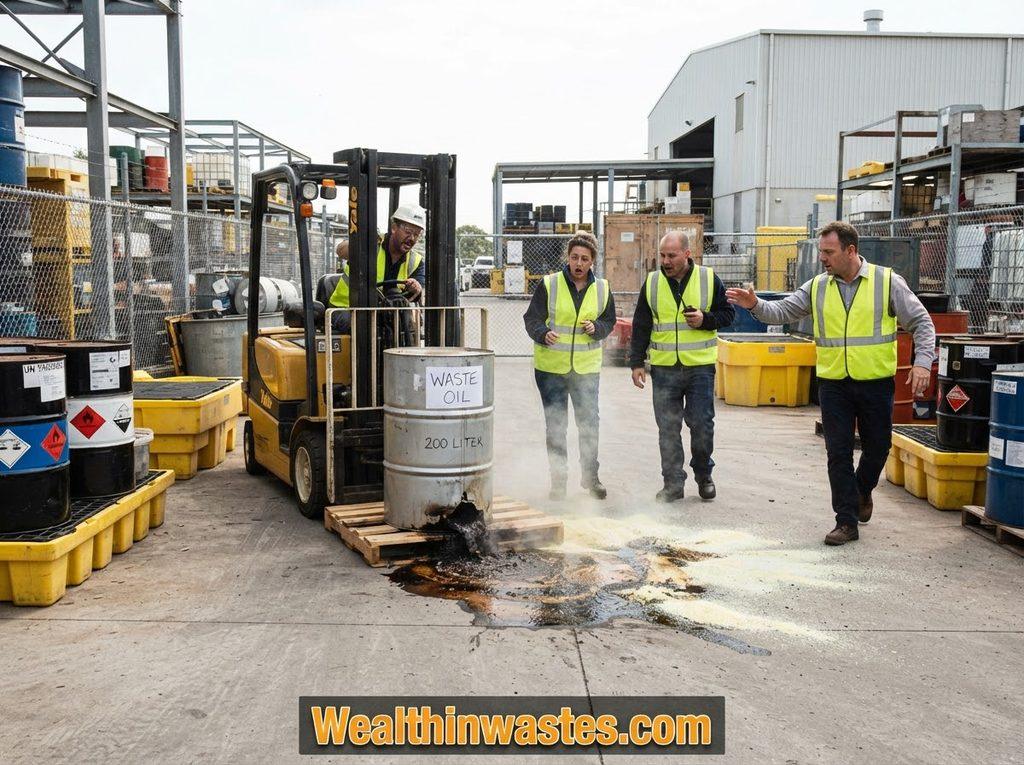
Health hazards describe how substances affect the body after exposure, while physical hazards describe dangerous properties that can create fires, explosions, pressure events, or unstable reactions during normal handling conditions.
Acute health hazards develop rapidly after short-term exposure and may produce poisoning, burns, breathing problems, unconsciousness, or other serious effects requiring immediate attention from trained personnel.
Chronic health hazards develop gradually after repeated or prolonged exposure and may contribute to organ damage, cancer, reproductive problems, genetic changes, or other long-term health effects.
Workers can better recognize these risks by studying established characteristics of hazardous wastes, particularly ignitability, corrosivity, reactivity, and toxicity, which commonly guide hazardous-waste identification.
Understanding major hazardous waste sources, effects, and control measures also helps explain how exposure occurs across industrial, household, medical, agricultural, and environmental settings.
Physical hazards remain important because a substance may create danger even before toxic exposure occurs, especially where ignition, heat, pressure, impact, friction, or chemical incompatibility can trigger dangerous events.
Major Hazard Properties And Their Effects
1.Corrosivity: Corrosive substances can destroy metals, living tissues, or other materials through chemical action, often causing severe burns, structural damage, equipment failure, and dangerous reactions with incompatible substances.
2. Explosivity: Explosive materials can release energy extremely rapidly, producing pressure, heat, fragments, or shock waves that may cause serious injuries, fires, structural destruction, or fatalities.
3. Flammability: Flammable substances can ignite readily when exposed to suitable heat, sparks, flames, or other ignition sources, allowing fires to spread quickly through workplaces and storage areas.
4. Ignitability: Ignitable materials have properties that make burning possible under specified conditions, so they require careful storage, controlled handling, suitable containers, and strict separation from ignition sources.
5. Reactivity: Reactive substances may undergo spontaneous or violent chemical changes when exposed to water, heat, pressure, shock, or incompatible materials, potentially generating toxic gases or explosive conditions.
6. Carcinogenicity: Carcinogenic substances can initiate cancer development or increase cancer incidence following sufficient exposure, making effective exposure control especially important during production, handling, storage, and waste disposal.
7. Infectivity: Infectious materials contain viable microorganisms or biological agents capable of causing disease when susceptible people or animals encounter sufficient quantities through appropriate exposure pathways.
8. Irritancy: Irritant substances can inflame or damage the skin, eyes, respiratory system, or other tissues, with severity depending on concentration, duration, route of exposure, and individual susceptibility.
9. Mutagenicity: Mutagenic substances can cause genetic changes by damaging or altering genetic material, creating concerns for affected cells and potentially producing lasting biological consequences after exposure.
10. Toxicity: Toxic substances can poison living organisms after exposure through inhalation, ingestion, skin contact, injection, or other routes, with effects ranging from temporary illness to death.
11. Radioactivity: Radioactive materials emit ionizing radiation, which can damage living tissues and cells, requiring controlled handling, shielding, monitoring, secure storage, and regulated transportation.
12. Teratogenicity: Teratogenic substances can interfere with normal development during pregnancy and may increase the risk of congenital abnormalities, particularly when exposure occurs during sensitive developmental periods.
13. Sensitization: Sensitizing substances can trigger heightened immune responses after previous exposure, causing allergic reactions such as skin inflammation, respiratory symptoms, or other repeated sensitivity responses.
These properties demonstrate why classification requires more than simply identifying whether a substance is liquid, solid, or gaseous because dangerous behaviour often depends on its composition.
Nine Major Hazard Classes
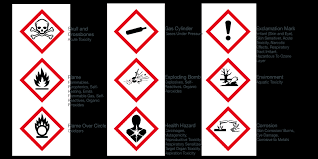
1. Class 1 – Explosives: This class covers substances and articles capable of producing explosions, dangerous projections, intense fires, or combinations of these effects when exposed to suitable initiating conditions.
2. Class 2 – Gases: Gases include compressed, liquefied, refrigerated, and dissolved gases that may create pressure, flammability, toxicity, oxidizing, or asphyxiation hazards during storage and transportation.
3. Class 3 – Flammable Liquids: These liquids can produce ignitable vapours and catch fire when exposed to suitable ignition sources, making ventilation, temperature control, and ignition prevention essential.
4. Class 4 – Flammable Solids: This class includes flammable solids, substances liable to spontaneous combustion, and materials that become dangerous when they contact water or release flammable gases.
5.Class 5 – Oxidizers And Organic Peroxides: Oxidizing substances can intensify combustion, while organic peroxides may undergo dangerous decomposition, requiring separation from incompatible fuels, heat sources, and reactive materials.
6. Class 6 – Toxic And Infectious Substances: These materials can cause poisoning, disease, or biological contamination through inhalation, ingestion, injection, or contact, depending on their toxicological or infectious characteristics.
7. Class 7 – Radioactive Materials: Radioactive substances emit radiation and require specialized controls based on activity, radiation type, exposure pathways, packaging requirements, storage conditions, and regulatory limits.
8. Class 8 – Corrosives: Corrosive materials can severely damage living tissue and attack metals or other materials, creating burns, leaks, equipment deterioration, and dangerous secondary reactions.
9. Class 9 – Miscellaneous Hazardous Materials: This class contains dangerous substances and articles that present significant hazards but do not fit neatly within the other major hazard classes.
Some hazardous wastes also appear in broader categories according to their sources and composition, as explained in this classification of solid waste resource.
Similarly, an overview of waste management types and classifications shows how hazard potential can complement classifications based on origin, physical state, recyclability, and handling requirements.
Explosive Gas And Liquid Classifications
Class 1 explosive materials receive further divisions because not every explosive creates the same level or type of danger. Their behaviour determines the controls required during handling and transportation.
1. Division 1.1: These explosives present a mass explosion hazard, meaning an explosion can affect almost the entire quantity of material involved in the incident.
2. Division 1.2: These explosives create a projection hazard without a mass explosion hazard, meaning fragments or pieces can travel significant distances during an incident.
3. Division 1.3: These materials present a fire hazard together with either a minor blast hazard, minor projection hazard, or both, without a mass explosion effect.
4. Division 1.4: These explosives present only a minor explosion hazard, with effects generally confined to the immediate package or surrounding area during normal transport conditions.
5. Division 1.5: These are very insensitive explosive substances that still present a mass explosion hazard, although initiation under normal conditions remains comparatively difficult.
6. Division 1.6: These extremely insensitive articles contain predominantly insensitive substances and do not present a mass explosion hazard under recognized transport classification conditions.
Gas hazards also vary considerably because compressed gases, flammable gases, toxic gases, and oxidizing gases can require different separation, ventilation, pressure control, and emergency response measures.
Flammable liquids similarly require strict ignition control because their vapours can accumulate, travel away from the original container, and ignite unexpectedly when they encounter a suitable ignition source.
Readers can explore radioactive waste management for a related example of why hazard classification should guide storage, transport, treatment, and disposal decisions.
Likewise, specialized pesticide waste disposal practices show how hazardous liquids require controlled handling to reduce exposure, spills, contamination, and unintended environmental releases.
Solid Oxidizing Toxic And Infectious Classes
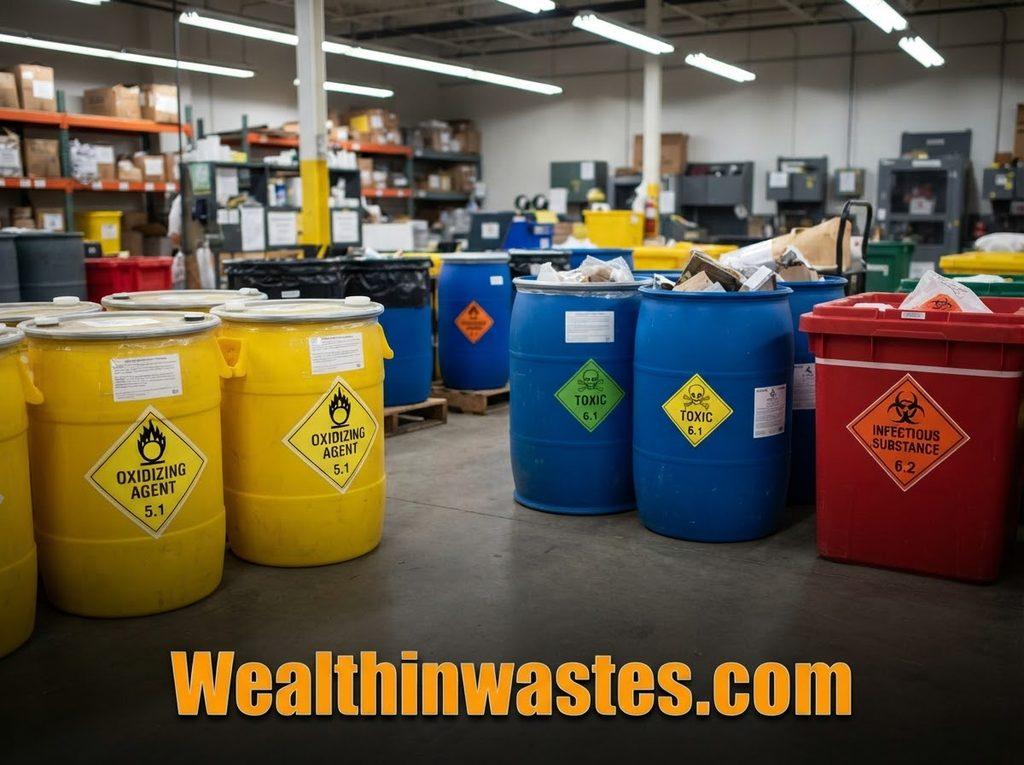
Class 4 materials demonstrate that solids can remain highly hazardous even without producing obvious vapours because some ignite easily, react spontaneously, or release dangerous gases after contacting water.
Class 5 oxidizing substances deserve special attention because they may intensify fires involving combustible materials, while organic peroxides may decompose under heat, contamination, friction, or incompatible storage conditions.
1. Oxidizing Substances: These materials support or accelerate combustion by supplying oxygen or promoting oxidation, so they should remain separated from fuels, organic materials, reducing agents, and other incompatible substances.
2. Organic Peroxides: Organic peroxides contain thermally unstable structures that can decompose rapidly, sometimes producing heat, pressure, fire, or explosive effects when storage conditions become unsuitable.
3. Toxic Substances: Toxic materials can cause harmful biological effects after exposure, with severity depending on concentration, route, duration, individual susceptibility, and the substance’s specific toxicological properties.
4. Infectious Substances: Infectious materials contain pathogens capable of causing disease, requiring appropriate containment, hygiene, segregation, treatment, transportation, and disposal to protect workers and surrounding communities.
Healthcare environments generate several materials within these risk categories, including infectious, chemical, pharmaceutical, pathological, cytotoxic, and radioactive wastes that require separate management approaches.
This guide to different types of hospital wastes explains how medical waste categories differ according to source, composition, and potential hazard.
Information about medical waste types and recovery opportunities also demonstrates why correct segregation matters before treatment, recycling, recovery, or disposal begins.
For broader biomedical context, readers can examine the definitions and sources of biomedical special waste to understand how healthcare facilities generate specialized hazardous materials.
Radioactive Corrosive And Miscellaneous Materials
Class 7 radioactive materials require special controls because their danger comes from ionizing radiation rather than ordinary toxicity, flammability, or corrosivity alone, although several hazards can occur simultaneously.
Radioactive materials may originate from nuclear activities, medical applications, research laboratories, industrial equipment, or other specialized operations where radioactive sources receive controlled use and disposal.
Class 8 corrosive materials include strong acids and bases capable of damaging skin, eyes, metals, containers, infrastructure, and environmental receptors when uncontrolled releases occur.
1. Radioactive Materials: These substances require exposure monitoring, controlled packaging, secure storage, appropriate labelling, trained personnel, and regulated transportation because radiation cannot always be detected through ordinary senses.
2. Corrosive Materials: These substances can attack tissue and materials through chemical reactions, requiring compatible containers, protective equipment, spill controls, and careful separation from incompatible chemicals.
3. Miscellaneous Hazardous Materials: Class 9 includes dangerous materials that create recognized hazards outside the principal categories, such as environmentally hazardous substances and certain battery-related materials.
Some corrosive conditions also arise during water and wastewater processes, where chemical reactions can gradually damage pipes, tanks, treatment structures, and other infrastructure.
This discussion of water pollution sources and classifications helps explain how hazardous contaminants can move through aquatic systems after improper handling or accidental release.
The wider environmental implications appear in this overview of waste impacts on the environment, particularly where hazardous materials contaminate air, soil, surface water, or groundwater.
Read Also: Water and Wastewater Management Complete Guide
Why Proper Hazard Classification Matters
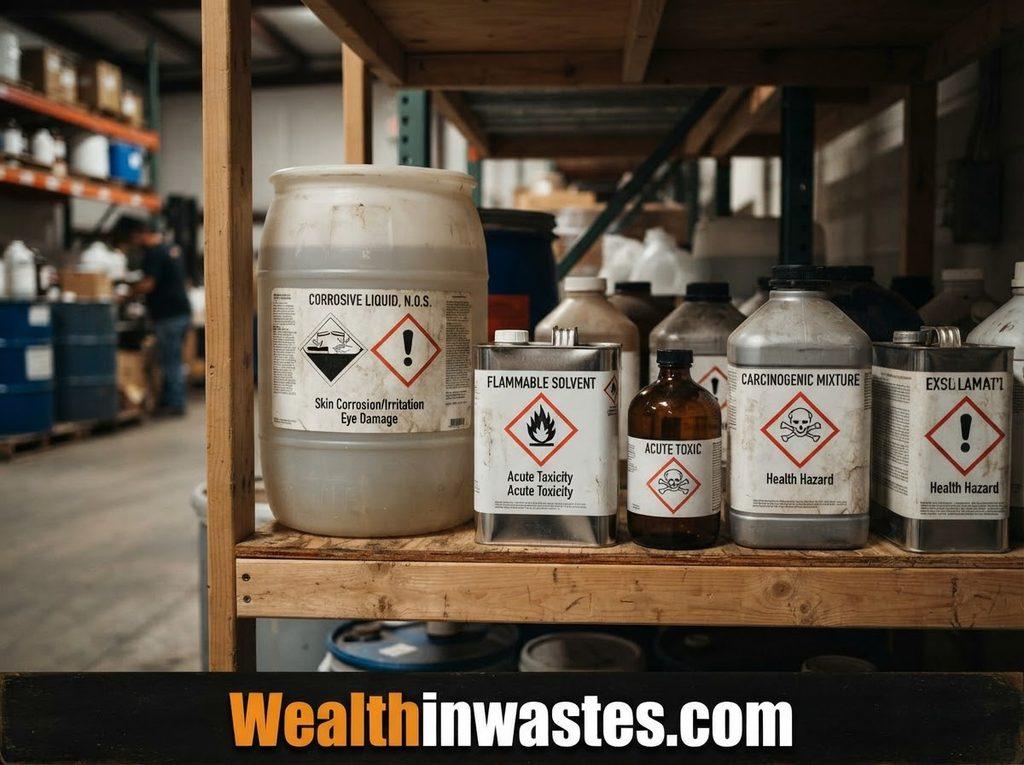
Correct classification determines how hazardous substances should be labelled, packaged, stored, transported, treated, and disposed of, helping organizations prevent incompatible materials from creating avoidable accidents.
Classification also improves emergency preparedness because workers can identify likely hazards quickly and select appropriate protective equipment, containment procedures, evacuation measures, firefighting methods, and response strategies.
Households also need awareness because paints, pesticides, solvents, batteries, cleaning products, medicines, and other products may become hazardous wastes when discarded without suitable controls.
The household hazardous waste guide provides useful examples of common domestic materials that require separate handling rather than disposal with ordinary household waste.
Chemical products deserve special attention because their hazard properties may persist after use, particularly when residues remain inside containers, equipment, laboratories, industrial systems, or wastewater streams.
Readers can learn more about chemical waste disposal and the precautions required to protect human health and environmental quality during disposal activities.
A complementary resource on chemical waste management explains why identification, labels, safety information, segregation, storage, and responsible disposal should form part of an integrated management system.
Industrial operations generate particularly diverse hazardous materials, including solvents, acids, alkalis, petroleum residues, metals, chemical by-products, contaminated packaging, and other process wastes.
The discussion of industrial waste sources demonstrates how different production activities generate different waste streams, while industrial waste impacts show why effective control remains essential.
Electronic equipment can also contain hazardous constituents, so proper e-waste management matters when discarded devices contain metals and components capable of contaminating soil, water, or air.
Good classification therefore supports the wider hierarchy of prevention, reuse, recovery, treatment, and final disposal while reducing unnecessary exposure throughout the entire life cycle of hazardous materials.
This guidance on waste treatment and disposal methods explains why prevention and controlled management should take priority over uncontrolled disposal or simple transfer of risks elsewhere.
Proper management also depends on reducing hazardous waste generation at source, which makes waste minimization and reduction an important companion strategy alongside classification and disposal.
Non-biodegradable materials can create additional management challenges when they contain hazardous components, making this non-biodegradable waste management guide useful for understanding longer-term disposal concerns.
In agriculture, hazardous materials can include pesticides, veterinary medicines, disinfectants, oils, treated containers, and other chemicals requiring careful segregation, storage, use, and disposal practices.
Farm operators can complement hazardous-substance knowledge with this Agric4Profits resource on proper farm waste management to strengthen environmental protection and responsible waste handling.
Hazardous substances can occur in many forms, including gases, explosives, flammable liquids, combustible solids, radioactive materials, corrosive chemicals, toxic products, infectious materials, and miscellaneous dangerous substances.
They may appear in homes, farms, hospitals, laboratories, roads, industrial facilities, commercial premises, workshops, construction sites, and disposal locations, making accurate classification relevant across many everyday environments.
Careful observation of labels, containers, hazard symbols, product information, safety documentation, and storage conditions can provide valuable clues before personnel handle or move potentially dangerous substances.
The classification of hazardous substances ultimately provides a practical language for identifying dangers, communicating risks, selecting controls, protecting workers, preventing pollution, and supporting safer treatment, transportation, and disposal decisions.
Summary on Classification of Hazardous Substances
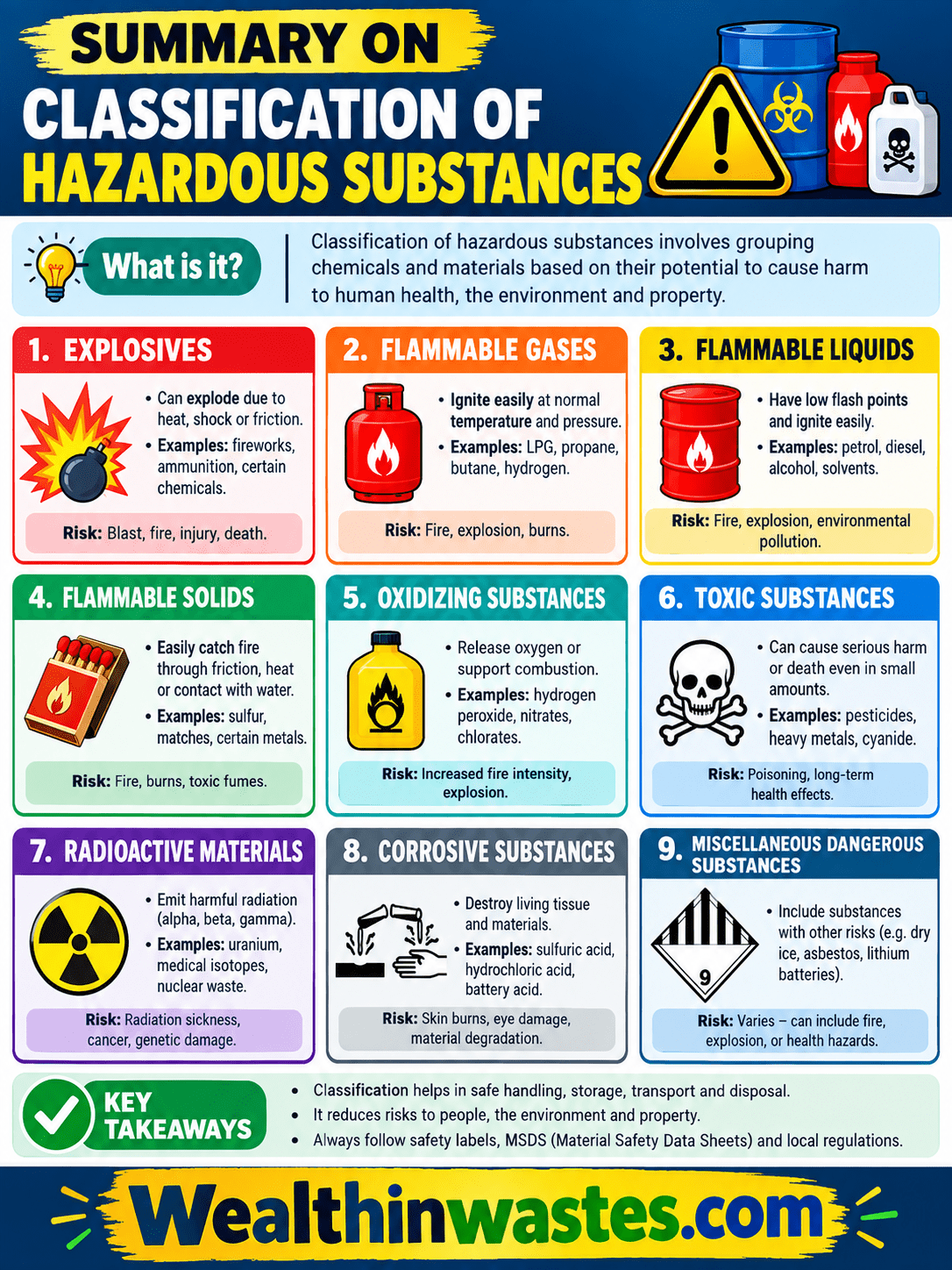
| Classification Area | Main Description |
|---|---|
| Health Hazards | Include acute and chronic effects such as poisoning, cancer, irritation, sensitization, and organ damage. |
| Physical Hazards | Include fire, explosion, instability, pressure, and dangerous chemical reactions. |
| Class 1 | Explosives. |
| Class 2 | Gases. |
| Class 3 | Flammable liquids. |
| Class 4 | Flammable solids, spontaneously combustible materials, and dangerous water-reactive substances. |
| Class 5 | Oxidizing substances and organic peroxides. |
| Class 6 | Toxic and infectious substances. |
| Class 7 | Radioactive materials. |
| Class 8 | Corrosive substances. |
| Class 9 | Miscellaneous hazardous materials. |
Frequently Asked Questions About Classification of Hazardous Substances: 9 Key Classes
1. What is the classification of hazardous substances?
It is the process of grouping hazardous materials according to properties and risks such as explosivity, flammability, toxicity, corrosivity, infectivity, radioactivity, and chemical reactivity.
2. How many major hazardous-material classes exist?
There are nine major classes commonly used for dangerous goods classification, although individual classes may contain further divisions based on specific hazard characteristics.
3. What are the main physical hazards?
The main physical hazards include fire, explosion, pressure, instability, oxidation, spontaneous combustion, and dangerous reactions with incompatible materials.
4. What are health-related hazardous properties?
Health-related properties include acute toxicity, chronic toxicity, carcinogenicity, mutagenicity, teratogenicity, irritation, sensitization, and infectivity.
5. Why do hazardous substances require classification?
Classification helps determine suitable labels, containers, storage arrangements, transportation controls, protective equipment, emergency procedures, treatment methods, and disposal requirements.
6. Can one substance have more than one hazard?
Yes. A single material may present several hazards, such as toxicity and flammability, so management decisions must consider all relevant properties rather than one characteristic alone.
7. What is the most important step before handling hazardous materials?
Accurate identification comes first. Workers should review labels, safety information, known properties, storage conditions, and applicable requirements before handling, transporting, treating, or disposing of dangerous materials.
8. Where can hazardous substances be found?
They can occur in homes, farms, hospitals, laboratories, factories, construction areas, workshops, commercial facilities, transport systems, and waste-management operations.
Do you have any questions, suggestions, or contributions? If so, please feel free to use the comment box below to share your thoughts. We also encourage you to kindly share this information with others who might benefit from it. Since we can’t reach everyone at once, we truly appreciate your help in spreading the word. Thank you very much for your support and for sharing!
Read Also: Pesticide Residue Decline in Agricultural Produce