


It is nearly impossible to investigate an entire environmental population because sites can be extensive, diverse, and constantly changing. Reliable analysis therefore depends on obtaining representative samples from carefully selected locations.
A representative sample reflects the composition of the material being investigated within a clearly defined analytical problem. Without representative sampling, laboratory results may become meaningless, misleading, or difficult to interpret with confidence.
Incorrect sample selection introduces errors that laboratory analysis cannot correct later. Therefore, environmental investigators must understand sampling objectives, select appropriate methods, use suitable equipment, and maintain consistent procedures throughout collection.
Water, soil, and sediment require different collection approaches because their physical characteristics, depths, movement patterns, and contamination behaviour vary considerably. Good planning helps investigators obtain useful information while controlling unnecessary field effort.
This article explains sampling planning, sample types, equipment selection, collection procedures, handling requirements, and quality assurance measures. It also identifies common mistakes that can compromise environmental monitoring and analytical accuracy.
Pre-Sampling Activities
Before fieldwork begins, clearly establish why samples are required, which substances require analysis, and which environmental media need investigation. These decisions determine suitable methods, equipment, containers, preservation, and handling requirements.
A clearly defined monitoring objective connects field observations with laboratory measurements and improves interpretation of results. Environmental monitoring programme design should therefore begin before sample collection activities start.
Site information should include known pollution sources, drainage patterns, access limitations, seasonal conditions, earlier analytical records, and suspected contaminants. Such information supports practical decisions about sampling locations, frequency, and field procedures.
Where investigations involve contaminated land or industrial activities, preliminary knowledge of pollutant pathways becomes especially valuable. Environmental waste impacts can help identify media requiring closer examination.
A written sampling strategy should identify sampling locations, matrices, analytical parameters, sample quantities, equipment, preservation requirements, personnel responsibilities, transport arrangements, and quality control measures before investigators enter the field.
Regulatory requirements can influence sampling decisions during compliance investigations, environmental inspections, disputes, or permitted discharge assessments. Investigators should understand applicable requirements before collection begins to prevent avoidable procedural problems.
Prepare clean containers, labels, preservatives, storage materials, protective equipment, field instruments, sampling tools, documentation sheets, and suitable transport containers before travelling to the sampling location and starting collection.
Personnel should understand the monitoring objective and collection procedures before fieldwork begins. Training helps reduce inconsistent techniques, accidental contamination, incorrect labelling, and mistakes caused by unfamiliar sampling equipment.
Read Also: Waste Sampling Equipment and Waste Sampling Procedures
Sampling Plan Design

A sampling plan should support the analytical objective and provide a logical method for obtaining representative information. The design should answer four fundamental questions concerning location, sample type, quantity, and number.
1. Sampling Location: Determine where within the target population samples should come from, considering pollution sources, environmental conditions, spatial variation, accessibility, and the purpose of the investigation.
2. Sample Type: Decide whether grab, composite, or in-situ samples provide the required information.The choice should match the monitoring objective, environmental medium, expected variability, and analytical requirements.
3. Sample Quantity: Establish the minimum amount required for each laboratory determination. An inadequate quantity can prevent complete analysis, whereas excessive quantities increase collection, transport, storage, and analytical costs.
4. Number of Samples: Determine how many samples and environmental matrices require analysis to describe the target population adequately. Consider spatial variation, contamination patterns, statistical needs, resources, and analytical objectives.
Random sampling provides an unbiased approach when every location has an opportunity for selection. Understanding pollution source classifications can help investigators recognize where sampling locations may require broader coverage.
Selective or judgmental sampling uses available site information to choose locations considered important. This approach may require fewer samples, but assumptions about the population can introduce greater selection bias.
Systematic sampling divides an investigation area into an organized grid or sequence before collection. Investigators then collect samples at planned points, improving spatial coverage and making field operations easier.
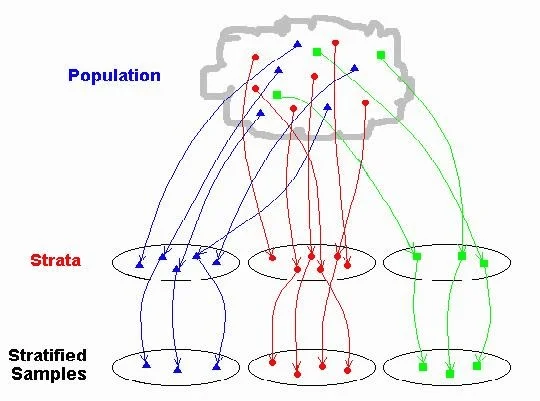
Stratified sampling separates the target population into meaningful groups based on characteristics such as depth, land use, pollution zones, or habitat. Samples then come from each group for improved representation.
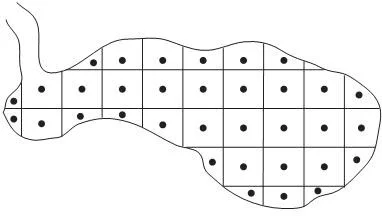
Figure: Systematic sampling of a lake (Harvey, 2000)
Figure: Illustration of Stratified sampling
Sampling Types and Selection
Different sampling types provide different forms of information. Choosing correctly depends on whether investigators need a single-time measurement, an average representation across several locations, or continuous information from the environmental medium.
1. Grab Sampling: A grab sample removes a portion of the target population from one location at a particular time. It therefore provides a snapshot of environmental conditions during collection.
2. Composite Sampling: A composite sample combines several individual grab samples into one mixture. Properly collected composites can represent average conditions across defined locations, depths, periods, or sampling intervals.
3. In-Situ Sampling: In-situ sampling uses a sensor or measuring device directly within the target environment. It supports continuous observation without repeatedly removing separate physical samples from the system.
4. Matrix-Based Sampling: Sampling may target surface water, groundwater, soil, sediment, vegetation, fish, or other matrices. Each matrix requires methods that match its physical properties and analytical objectives.
Grab sampling works well when conditions at a specific location and time matter most. For flowing rivers, changing industrial discharges, or variable weather conditions, collection timing can strongly influence results.
Composite sampling can reduce analytical workload when average conditions matter more than individual variations. However, combining samples may conceal localized contamination requiring separate investigation and additional sampling points.
In-situ measurements suit parameters that change rapidly, including temperature and pH. Water pollution characteristics can guide investigators when selecting parameters that need immediate field measurement.
The selected sampling type should appear clearly in the field plan. Investigators should record whether samples represent single locations, combined points, repeated times, particular depths, or continuous field measurements.
Sampling Equipment for Water, Soil and Sediment
Environmental sampling equipment must match the medium under investigation, required depth, expected contamination, site conditions, and analytical purpose. Correct equipment improves representativeness while reducing disturbance and cross contamination.
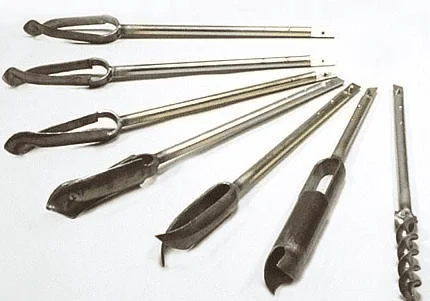
1. Soil Auger: A soil auger collects soil from selected depths and supports vertical profiling.Marking intervals such as 0–15 centimetres and 15–30 centimetres allows separate samples for analysis.
2. Hand Trowel: A hand trowel provides a simple method for collecting shallow topsoil when deeper profiling is unnecessary. It suits straightforward surface investigations where controlled sampling depth remains important.
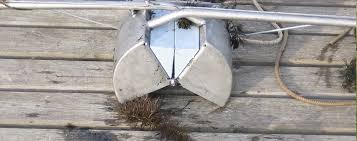
3. Van Veen Grab: A Van Veen grab sampler collects sediment from riverbeds and deeper waters. Its closing mechanism and attached rope make it useful where water movement complicates manual collection.
4. Ekman Grab: An Ekman grab sampler suits shallow, slow-moving water and collects sediment through a closing mechanism activated during deployment. It can also support deeper sampling with suitable adaptation.
Soil augers come in different designs because soil texture and structure influence collection. Soil characteristics and properties should therefore guide equipment selection and field technique.
Soil samples collected from separate depth intervals should receive individual labels and containers. Separating topsoil from deeper material helps investigators identify vertical changes in contamination and other measured characteristics.
Soil erosion processes can influence the movement and redistribution of contaminants, making equipment choice and sampling depth particularly important when investigating agricultural, industrial, or disturbed land.
Figure: Image of Various Designs of Soil Auger (Online)
Sediment grabbers vary according to water depth, current speed, bottom characteristics, and required sample volume. Equipment should reach the target bed without unnecessarily disturbing surrounding sediment layers.
Sediment sources and transport processes can influence where materials accumulate, making suitable collection equipment important when assessing contamination within rivers, lakes, or other water bodies.
Figure: Van-veen Grab Sampler
Sample Collection and Handling

Collection procedures should protect samples from contamination, deterioration, loss, and unnecessary disturbance. Investigators should use clean equipment, suitable containers, controlled techniques, and documented handling procedures throughout field operations.
For water samples, the collection point should reflect the monitoring objective. Investigators should avoid unnecessary disturbance, observe flow conditions, and record relevant field measurements that support interpretation of laboratory findings.
Groundwater requires particular attention because contaminants can move below the surface through aquifers. Groundwater pollution pathways should inform location selection when subsurface contamination forms part of the investigation.
For soil, collect material from defined depths using a consistent technique at every location. This improves comparability between sites and helps identify contamination gradients across the investigation area.
For sediment, operate grab samplers carefully so collected material remains representative of the intended riverbed or lakebed layer. Excessive disturbance can mix different layers and weaken interpretation of results.
Water samples may require attention to particular pollutants, including metals. Heavy metal contamination pathways can affect sampling locations, container selection, preservation, and laboratory requirements.
Sample containers should match the analytical parameter and preservation requirements. Some determinations require completely filled containers, while others require controlled headspace to accommodate mixing, aeration, or thermal expansion.
Preservatives should be added when required and in appropriate quantities. Water quality guideline requirements can help investigators understand why correct preservation, storage, and analytical preparation matter.
Samples should travel in suitable storage containers with temperature control where required. Field teams should coordinate collection schedules with laboratories to reduce holding-time problems and unnecessary sample deterioration.
Detailed handling records can include filtration status, preservation used, storage conditions, collection time, transport details, and laboratory requirements. These records create a useful history for every environmental sample.
Quality Assurance in Sampling
Quality assurance begins before collection and continues through transportation, laboratory analysis, and reporting. Every stage should protect sample identity, integrity, representativeness, and traceability so analytical results remain dependable.
1. Clean Equipment: Sampling tools should be cleaned and quality-assured before use. Cleaning reduces cross contamination between locations and prevents residues from previous samples affecting subsequent measurements.
2. Clean Containers: Containers must remain free from contaminants and compatible with planned analyses. Laboratory-approved preparation can reduce background contamination from unsuitable bottles during sensitive environmental determinations.
3. Correct Labelling: Label every sample immediately after collection using durable identification. Records should include location, date, time, sample type, identification code, and information required for traceability.
4. Complete Field Records: Maintain sampling notes covering location, GPS position, weather, water level, stream flow, temperature, pH, handling, filtration, preservatives, and relevant field observations.
Field teams should define the sampling technique before collection and apply it consistently. Sampling checklist practices can help personnel confirm that essential equipment and documentation requirements receive attention.
Sample containers should never be overfilled when preservatives are present because dilution or loss of preservative can change preservation conditions. Investigators should follow the selected analytical method carefully.
When volatile organic compounds require analysis, maintain specified headspace conditions and protect samples from excessive heat. Small handling errors can affect volatile compounds before laboratory measurements begin.
Quality assurance also includes appropriate blanks, duplicates, equipment checks, and documentation where required by the monitoring programme. These controls help identify contamination, procedural problems, and unusual analytical variation.
Read Also: Checklist for Waste Sampling
Common Sampling Errors to Avoid

Sampling errors often begin in the field rather than the laboratory. Poor site selection, unsuitable equipment, inadequate sample quantities, contamination, weak preservation, and incomplete records can reduce analytical confidence.
One major error occurs when investigators choose locations without considering the sampling objective. A convenient location may not represent the population, especially where contamination varies strongly across space.
Another problem occurs when personnel use the wrong equipment for the environmental medium. Unsuitable augers, sediment grabbers, bottles, or collection techniques can alter samples before laboratory analysis even begins.
Cross contamination presents another serious concern. Dirty equipment, contaminated gloves, reused containers, or careless transfer procedures can introduce substances that were not originally present within environmental samples.
Improper sampling can become especially serious during oil pollution investigations. Oil pollution movement and contamination pathways can extend beyond the visible spill location into soil, water, sediment, and biological systems.
Insufficient sample volume can prevent required laboratory determinations, while excessive collection can increase cost without improving information. Good sampling practice balances analytical needs with practical field requirements.
Failure to preserve samples properly may change chemical or biological characteristics before analysis. Temperature, light, oxygen exposure, evaporation, and storage duration can influence some measured parameters significantly.
Industrial sites require particular attention because discharges can affect several environmental media. Industrial waste impacts can extend across water, soil, sediment, and nearby ecological systems.
Incomplete field notes create another weakness because laboratory results need context. Records should identify where, when, how, and under what conditions each sample was collected, transported, and stored.
Sampling teams should avoid treating every investigation as identical. Different sites require procedures that respond to their objectives, suspected pollutants, environmental media, spatial variation, and likely contamination pathways.
Sampling for Reliable Environmental Analysis
The quality of analytical results cannot exceed the quality of samples submitted for analysis. Reliable environmental monitoring therefore begins with representative locations, suitable sample types, correct equipment, and careful field control.
Sampling should connect directly with the environmental question being investigated. Water pollution assessments, for example, require locations that reflect potential sources, flow patterns, affected areas, and suitable comparison points.
Industrial wastewater investigations require particular attention to the composition and variability of collected samples. Industrial wastewater characteristics can guide sampling locations around treatment systems and discharge points.
Wastewater monitoring may also require samples from influent and effluent streams because treatment performance can change with flow, composition, operating conditions, and pollutant loading throughout the day.
Investigators should understand treatment systems when interpreting wastewater samples. Wastewater treatment processes can influence which pollutants remain in treated water and which sampling points provide meaningful information.
Water quality investigations should connect field sampling with wider environmental monitoring objectives. Reliable measurements support assessment of changes in rivers, lakes, groundwater systems, and receiving waters over time.
Environmental pollution can affect aquatic communities, so biological observations may supplement chemical measurements. Biological effects of polluted waters can provide additional context when interpreting water quality findings.
Sediment samples can reveal information about materials transported from surrounding land and deposited within water bodies. Investigators should therefore consider erosion, runoff, current conditions, and deposition patterns.
Soil investigations should consider land use, depth, drainage, and suspected contamination pathways. Land and soil pollution characteristics can support better decisions about sampling depth and location.
Water pollution prevention and control also depend on reliable monitoring information. Water pollution reduction strategies become more useful when monitoring identifies sources, affected locations, and environmental conditions requiring action.
Broader assessments may examine pollution effects on people, animals, crops, and aquatic resources. Water pollution effects can help place analytical findings within their wider environmental and public-health context.
Investigators should review sampling results alongside field observations and historical records. Repeated measurements can reveal trends and relationships that isolated analytical values may not adequately explain.
Ultimately, careful planning, appropriate sampling equipment, representative collection, proper preservation, accurate documentation, and quality assurance create the foundation for defensible environmental analysis and informed pollution management decisions.
Agricultural water and land pollution concerns can also provide useful context when environmental sampling involves farms, irrigation areas, agricultural runoff, or contaminated soils near production systems.
Summary on Sampling and Sampling Equipment for Water, Soil and Sediment
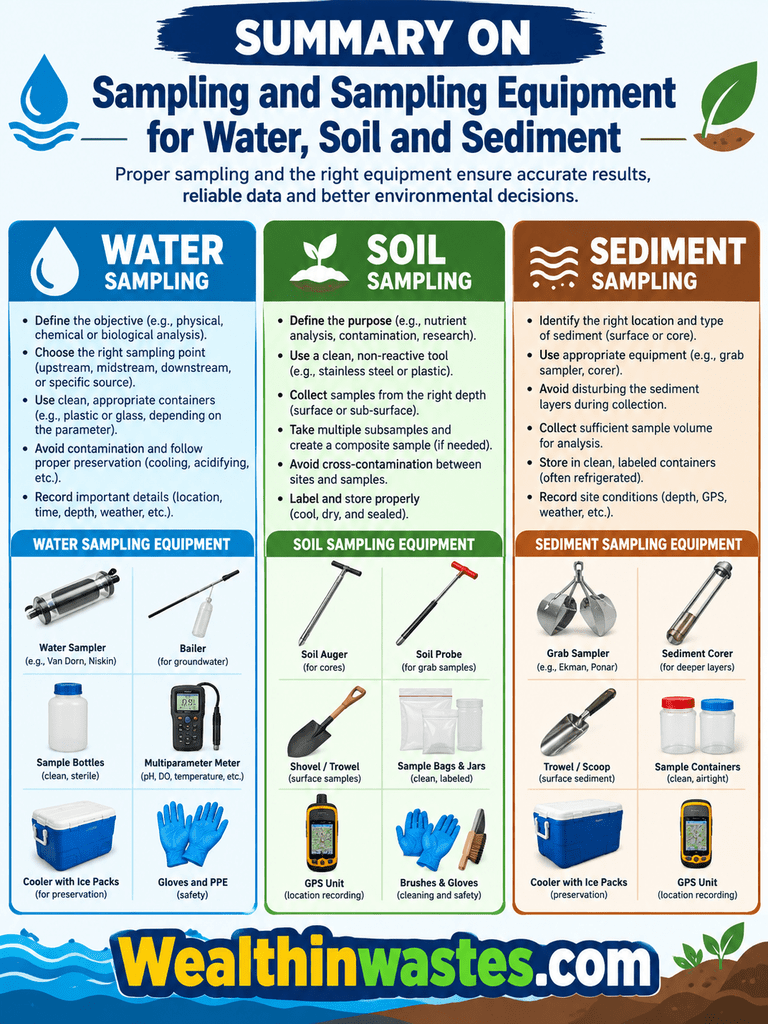
| Aspect | Key Point |
|---|---|
| Purpose | Obtain representative samples that accurately support the defined analytical objective. |
| Sampling plan | Define locations, sample types, quantities, numbers, matrices, equipment, preservation, and quality controls. |
| Sampling types | Grab, composite, and in-situ sampling provide different forms of environmental information. |
| Soil equipment | Soil augers support depth profiling, while hand trowels suit shallow surface collection. |
| Sediment equipment | Van Veen and Ekman grab samplers collect sediment according to site and water conditions. |
| Handling | Use clean containers, correct preservatives, suitable storage, accurate labels, and complete records. |
| Quality assurance | Prevent contamination, preserve integrity, maintain traceability, and apply consistent procedures. |
| Main lesson | Reliable laboratory results depend strongly on representative sampling and careful field practices. |
Frequently Asked Questions About Sampling and Sampling Equipment for Water, Soil & Sediment
1. What is a representative sample?
A representative sample reflects the relevant composition and characteristics of the target population within the defined analytical objective.
2. What are the main types of environmental samples?
The main types are grab samples, composite samples, and in-situ sampling, depending on the monitoring objective and environmental conditions.
3. Which equipment is commonly used for soil sampling?
Soil augers commonly support depth profiling, while hand trowels can collect shallow topsoil when deeper sampling is unnecessary.
4. What equipment is used for sediment sampling?
Grab samplers such as Van Veen and Ekman designs can collect sediment, with selection depending on depth, current, and site conditions.
5. Why is sample preservation important?
Preservation helps maintain sample characteristics between field collection and laboratory analysis, reducing changes caused by storage or environmental exposure.
6. What causes sampling errors?
Common causes include poor location selection, unsuitable equipment, contamination, inadequate quantities, improper preservation, inconsistent techniques, and incomplete documentation.
7. Why should samples be labelled immediately?
Immediate labelling prevents identification errors and preserves essential information about location, date, time, sample type, and collection conditions.
8. Why is sampling planning important?
Sampling planning ensures locations, sample types, quantities, equipment, preservation methods, and quality controls align with the analytical objective.
Do you have any questions, suggestions, or contributions? If so, please feel free to use the comment box below to share your thoughts. We also encourage you to kindly share this information with others who might benefit from it. Since we can’t reach everyone at once, we truly appreciate your help in spreading the word. Thank you very much for your support and for sharing!
Read Also: Examples of Oil Crops and Their Uses