


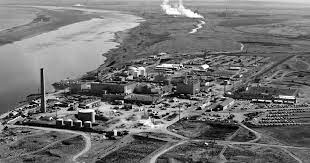
Radioactive pollution occurs when radioactive substances enter the environment and create unnecessary exposure risks for people, animals, plants, soil, water, or other ecological resources through contamination or uncontrolled releases.
Radionuclides can originate from natural materials, medical applications, industrial activities, research facilities, mining operations, nuclear installations, accidents, and improperly managed radioactive wastes that remain hazardous for varying periods of time.
The effects depend on the type of radionuclide, the radiation emitted, the quantity released, the exposure pathway, and the duration of exposure. Effective controls therefore require scientifically based risk assessment.
Prevention focuses on stopping radioactive materials from escaping into the environment, while control measures reduce exposure when contamination has already occurred. Both approaches require planning, regulation, monitoring, trained personnel, and appropriate technology.
Strong pollution control institutions also help establish standards, assign responsibilities, enforce safety requirements, and coordinate emergency responses that protect communities from avoidable environmental and public health risks.
What Is Radioactive Pollution?
Radioactive pollution refers to environmental contamination involving radionuclides or radioactive materials at levels that can increase radiation exposure. Such contamination may affect air, water, soil, food, buildings, equipment, or living organisms.
Ionizing radiation differs from ordinary chemical pollution because exposure can occur through external radiation or through radioactive substances entering the body by inhalation, ingestion, wounds, or other contamination pathways.
The health significance depends strongly on dose and exposure circumstances. Very high exposures can cause immediate tissue damage, while lower doses may increase long-term risks, including cancer, depending on cumulative exposure.
Natural background radiation exists everywhere, so the presence of radiation alone does not automatically mean pollution. The major concern arises when radioactive materials become uncontrolled, concentrated, improperly handled, or widely dispersed.
Understanding contamination is important because radioactive materials can move through environmental pathways. Contaminated soil may affect crops, surface water can transport radionuclides, and airborne particles may spread materials beyond the original source.
Environmental pollution generally develops when harmful substances accumulate or move beyond acceptable conditions. Similar concerns apply to radioactive materials, making environmental pollution management important for communities and institutions.
Read Also: Complete List of Recyclable Wastes (Waste Recyclables)
Major Sources And Pathways Of Radioactive Pollution

1. Nuclear Activities: Nuclear power generation, fuel processing, research, reactor operation, and decommissioning can generate radioactive materials that require strict containment, treatment, monitoring, storage, transportation, and eventual disposal.
2. Mining And Milling: Uranium and other mineral extraction can produce tailings and processing residues containing naturally occurring radioactive materials. Poorly managed tailings may contaminate surrounding soil, groundwater, surface water, and air.
3. Medical Applications: Hospitals use radionuclides for diagnosis and treatment, generating radioactive sources and wastes that require controlled handling. Proper segregation and storage prevent unnecessary exposure among workers, patients, visitors, and waste handlers.
4. Industrial And Research Uses: Radioactive sources support industrial testing, measurement, research, and other technical applications. Damaged, misplaced, abandoned, or poorly controlled sources can create serious contamination risks when safety systems fail.
5. Accidents And Releases: Nuclear incidents, transport accidents, equipment failures, fires, or containment breaches can release radionuclides.Emergency planning must therefore identify potential exposure routes and provide timely protective actions.
6. Naturally Occurring Materials: Certain geological formations contain naturally occurring radionuclides. Activities such as mining, oil and gas production, and mineral processing can concentrate these materials and require additional management controls.
Many industrial activities generate hazardous residues requiring controlled management. Effective industrial waste source identification helps facilities distinguish radioactive materials from ordinary wastes before treatment, storage, transportation, or disposal decisions.
Radioactive pollution may also interact with broader waste streams, which makes segregation essential. Facilities should never mix radioactive materials with ordinary waste because doing so can expand contamination and complicate safe handling procedures.
The connection between industrial operations and pollution control also appears in industrial environmental management, where preventing releases at their source reduces risks before contaminants reach surrounding communities or ecosystems.
Radioactive Pollution Control Measures
1. Establish Restricted Areas: Authorities can restrict access to contaminated locations after an accident or release. Excluding unnecessary occupants reduces exposure while specialists assess contamination levels and determine appropriate remediation measures.
2. Monitor Radiation Levels: Continuous or periodic monitoring identifies changes in radiation levels and helps authorities detect abnormal releases. Reliable measurements also guide decisions about evacuation, cleanup, food restrictions, and public protection.
3. Remove Contaminated Materials: In small or manageable areas, workers may remove contaminated soil, debris, vegetation, equipment, or other materials. Appropriate containment and disposal procedures must accompany removal activities to prevent further spread.
4. Control Environmental Pathways: Authorities can limit exposure by restricting contaminated food, water, land use, agriculture, or construction. These controls prevent radionuclides from moving through environmental pathways into people, livestock, and ecosystems.
5. Apply Suitable Remediation: Remediation may involve soil removal, stabilization, isolation, shielding, controlled excavation, vegetation management, or other site-specific approaches. Specialists should select methods according to radionuclide characteristics and environmental conditions.
6. Educate The Public: Clear public information helps people understand contamination boundaries, food restrictions, protective measures, and emergency instructions. Accurate communication reduces panic while encouraging residents to follow scientifically supported safety directions.
Waste prevention strengthens radioactive pollution control because fewer unnecessary materials require treatment or disposal. Facilities can apply principles explained in proper waste reduction practices to reduce avoidable waste generation.
Broader waste systems also benefit from waste management hierarchy principles, although radioactive wastes require specialized controls that ordinary recycling, composting, or municipal disposal systems cannot safely provide.
Management Of Radioactive Waste
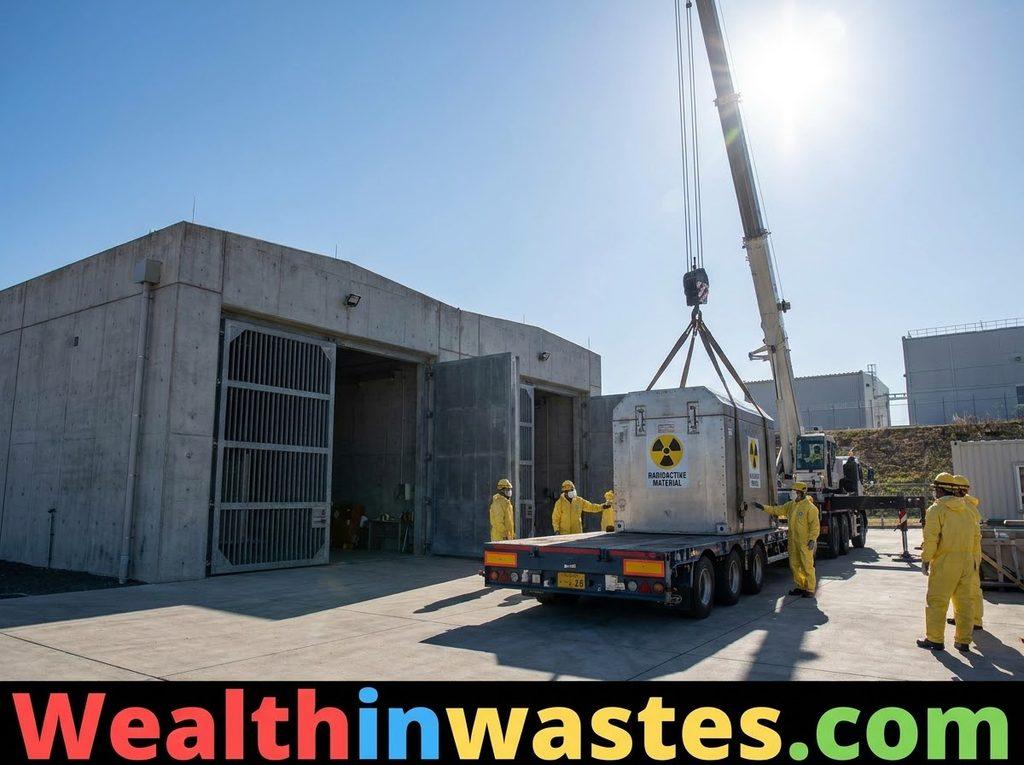
Radioactive waste management aims to isolate radioactive materials from people and the environment while providing safe treatment, storage, transport, and disposal throughout the waste’s hazardous lifetime.
Waste managers first characterize radioactive materials according to activity, radionuclide composition, physical form, half-life, and other safety properties. Classification helps determine appropriate containment, shielding, treatment, storage, and disposal options.
Short-lived radioactive wastes may require temporary storage until radioactivity decreases sufficiently. Longer-lived or higher-activity wastes demand stronger containment and carefully engineered disposal facilities designed for long-term isolation.
Some wastes require immobilization within materials such as cement, bitumen, resin, or glass before final disposal. The selected treatment should prevent radioactive substances from spreading under expected environmental conditions.
Waste facilities also need records that identify waste characteristics, quantities, locations, handling histories, and transfer activities. Reliable records support traceability and reduce mistakes during storage, transportation, treatment, and final disposal.
General waste systems emphasize safe storage and disposal, as described in waste management processes, but radioactive wastes require additional radiation protection measures and dedicated regulatory oversight.
Choosing suitable disposal locations also requires careful environmental assessment. Guidance on disposal site selection factors illustrates how geology, hydrology, soil conditions, infrastructure, accessibility, and environmental sensitivity influence containment decisions.
Decontamination Of Radioactive Areas
Decontamination reduces radioactive contamination on people, equipment, buildings, surfaces, soil, vegetation, or other materials. Specialists select methods according to contamination type, surface characteristics, radionuclide behaviour, accessibility, and expected radiation exposure.
For localized contamination, workers may remove affected soil, wash surfaces, collect contaminated debris, strip surface materials, or isolate polluted areas. These activities must prevent contaminated dust, water, and materials from spreading.
Large contaminated areas present greater challenges because removing every affected material could create enormous waste volumes. In such situations, authorities may combine restrictions, monitoring, land-use controls, shielding, and targeted remediation.
Food pathways require particular attention because radionuclides can move from contaminated soil or water into crops, livestock, milk, meat, and other products. Authorities may therefore restrict harvesting, grazing, fishing, or food distribution.
In some circumstances, carefully selected agricultural or soil treatments can reduce radionuclide transfer into crops or livestock. Specialists must evaluate effectiveness, environmental effects, food safety, and long-term consequences before application.
Contamination control should also consider ordinary waste generated during cleanup. Suitable industrial waste management practices can provide useful organizational principles, although radioactive cleanup waste requires dedicated radiation controls and licensed handling.
Improper disposal can spread contaminants through water, soil, or air. Understanding the broader environmental effects of waste disposal reinforces the importance of controlled containment during radioactive remediation projects.
Safe Storage And Transport Of Radioactive Materials

Radioactive materials require secure storage areas that provide appropriate shielding, containment, access control, ventilation where necessary, warning signs, and protection against damage, theft, fire, flooding, and other hazards.
Storage containers should match the characteristics of the radioactive material and remain suitable throughout the intended storage period. Inspection programmes help identify corrosion, deterioration, leakage, damage, or unauthorized access.
Transport requires equally careful planning because radioactive materials may travel between mines, hospitals, research centres, treatment facilities, reactors, storage locations, and disposal sites across multiple jurisdictions.
Packaging should provide appropriate containment and shielding while meeting applicable regulatory requirements. Labels, transport documents, emergency information, handling instructions, and security measures help workers identify and manage shipments correctly.
Transport risks can also affect surrounding communities when shipments pass through populated areas. Route planning, emergency preparedness, trained personnel, secure handling, and compliance with recognized transport regulations reduce unnecessary risks.
Although radioactive materials need specialized transportation controls, broader principles from proper waste disposal methods emphasize planning, suitable facilities, responsible handling, and prevention of uncontrolled releases across waste management systems.
Industrial wastewater can carry contaminants away from operational sites when facilities release inadequately treated effluent. The principles discussed in industrial wastewater treatment demonstrate why controlled discharge and monitoring remain important environmental safeguards.
Decommissioning Nuclear Facilities Safely
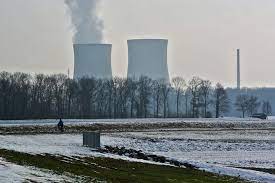
Decommissioning begins when a nuclear facility or radioactive-material installation reaches the end of its useful life or no longer requires continued operation under its existing purpose.
The process can include facility characterization, equipment removal, decontamination, dismantling, radioactive waste management, worker protection, environmental monitoring, and eventual release or continued controlled use of the site.
Workers must carefully assess structures, systems, and equipment before dismantling activities begin. Radiation surveys identify areas requiring shielding, remote handling, specialized tools, protective equipment, or additional contamination controls.
Remote handling can reduce worker exposure when radioactive components remain highly active or difficult to access safely. Careful sequencing also prevents unnecessary disturbance of contaminated materials during dismantling operations.
Decommissioning generates radioactive and non-radioactive materials. Teams must characterize each waste stream accurately so that radioactive materials receive appropriate management while suitable non-radioactive materials avoid unnecessary classification as radioactive waste.
Large projects can generate substantial quantities of conventional debris alongside radioactive residues. Broader guidance on recommended waste disposal methods can inform general planning while specialized radioactive waste rules remain applicable.
Long-term site protection also depends on environmental monitoring. Monitoring plans should consider groundwater, surface water, soil, air, radiation levels, worker exposure, and potential pathways connecting the facility with surrounding communities.
Regulation, Training And Environmental Monitoring
Effective radioactive pollution prevention requires clear laws, technical standards, licensing systems, inspections, emergency procedures, and enforcement. Regulatory bodies should establish responsibilities for organizations that produce, use, transport, store, or dispose of radioactive materials.
Training remains equally important because even well-designed safety systems can fail when workers misunderstand procedures or ignore established controls. Personnel should understand radiation protection, contamination prevention, emergency actions, monitoring, and waste handling.
Environmental monitoring provides evidence about whether controls are working. Regular measurements can reveal changing contamination levels, unexpected migration, equipment failures, or releases that require corrective action before exposure increases.
Monitoring should continue long enough to identify meaningful trends, especially at sites containing persistent radionuclides. Data should remain traceable, quality-assured, and understandable to regulators, technical teams, and affected communities.
Authorities can strengthen radioactive pollution prevention by integrating radiation safety with wider environmental governance. industrial waste management planning demonstrates how procedures, accountability, compliance, and documentation support consistent environmental performance.
Water protection is also essential because radionuclides can move through aquatic pathways. Practical approaches discussed in water and wastewater management reinforce the importance of treatment, monitoring, controlled discharge, and environmental protection.
Read Also: Hurts Wastewater Management Complete Guide
Role Of Waste Reduction And Cleaner Energy
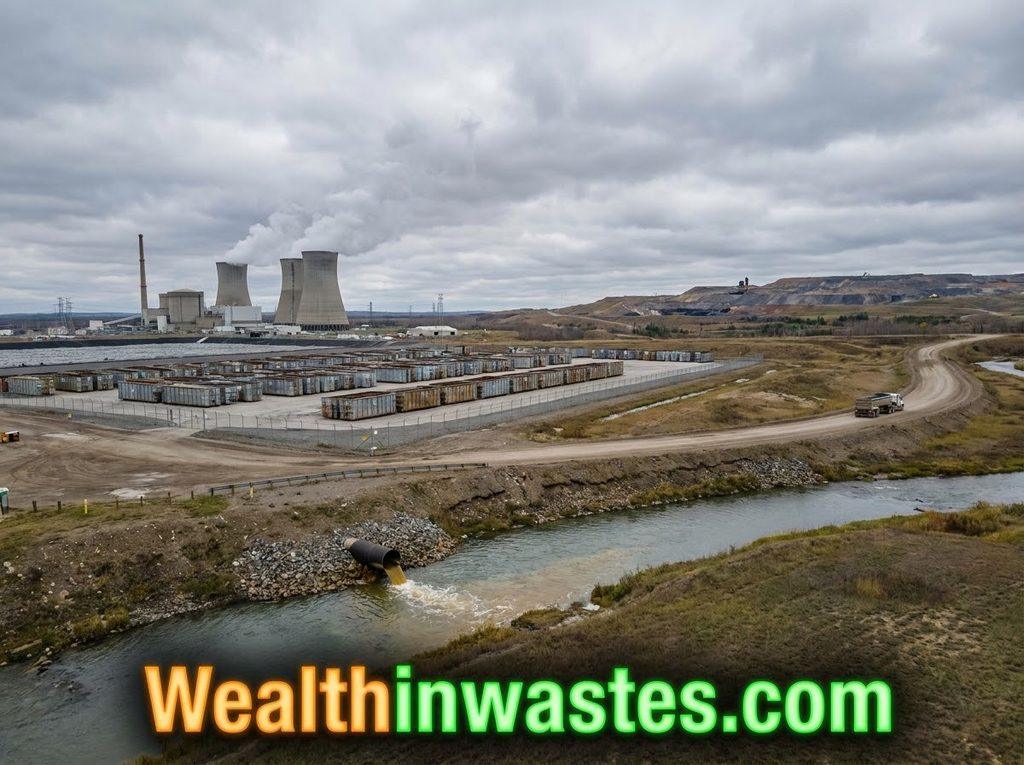
Reducing radioactive waste at its source can lower the quantity of material requiring treatment, storage, transportation, and disposal. Facilities should maintain efficient processes and prevent unnecessary contamination of tools, equipment, and ordinary materials.
Waste minimization should complement, rather than replace, radiation protection. Radioactive materials cannot become harmless simply because organizations reduce the amount of waste they generate or improve general housekeeping procedures.
Facilities should also avoid unnecessary use of radioactive sources and select suitable technologies that achieve operational objectives with the lowest reasonably achievable exposure. Such decisions can reduce risks throughout the material’s life cycle.
Energy policy can also influence environmental risk, although nuclear energy should not be described as automatically causing radioactive pollution during normal operation. Safety depends on containment, regulation, waste management, and emergency preparedness.
Renewable energy technologies such as solar and wind can diversify electricity systems and reduce dependence on some conventional energy sources. However, their environmental benefits should complement rather than replace strong radiation safety programmes.
Resource conservation can support wider environmental goals. Guidance on environmental sustainability highlights prevention, responsible resource use, environmental governance, public education, and protection of natural resources as interconnected priorities.
Similarly, better waste treatment technologies can support broader pollution prevention, provided operators understand that radioactive materials require dedicated technologies and cannot undergo ordinary treatment without proper authorization.
Protecting water resources remains another important priority because environmental contamination can create pathways between waste sites and communities. Broader water waste management practices therefore complement wider environmental protection efforts.
Industrial pollution controls also remain relevant where facilities handle radioactive materials alongside conventional wastes. Effective industrial effluent management helps prevent secondary contamination and supports responsible environmental monitoring.
Finally, public institutions should connect radiation safety with broader pollution policies. Well-developed pollution source management can improve identification, monitoring, enforcement, and prevention across multiple environmental hazards.
Summary on Control and Prevention of Radioactive Pollution
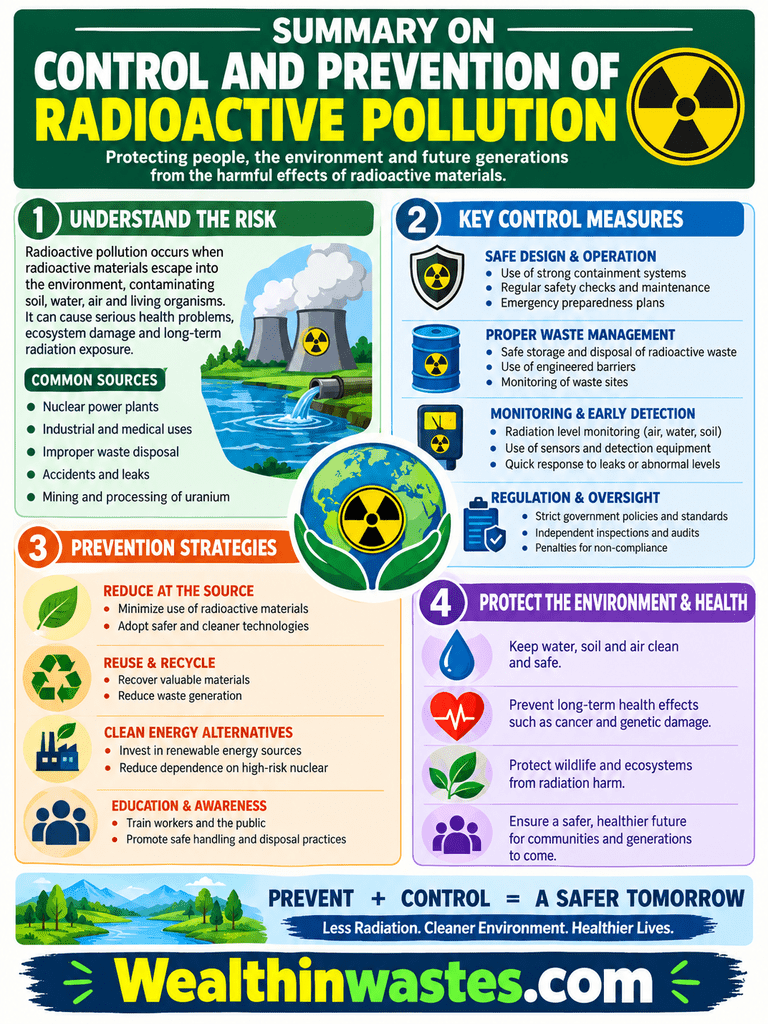
| Section | Main Idea | Why It Matters |
|---|---|---|
| Meaning | Radioactive pollution involves uncontrolled contamination or unnecessary radiation exposure. | Understanding the hazard supports appropriate prevention and control. |
| Sources | Sources include nuclear activities, mining, medicine, industry, research, accidents, and naturally occurring materials. | Identifying sources helps prevent releases at their origin. |
| Control | Restricted areas, monitoring, remediation, pathway controls, and public education reduce exposure. | These measures protect people and ecosystems after contamination occurs. |
| Waste Management | Radioactive waste requires characterization, treatment, storage, transport, and disposal. | Specialized containment prevents long-term environmental contamination. |
| Decontamination | Contaminated materials and areas require carefully selected cleanup or isolation measures. | Proper remediation reduces exposure and limits environmental spread. |
| Storage And Transport | Secure containers, shielding, labeling, monitoring, and regulated transport provide protection. | These controls reduce accidental releases and worker exposure. |
| Decommissioning | Old facilities require characterization, dismantling, decontamination, and waste management. | Safe closure prevents abandoned radioactive materials from causing future hazards. |
| Regulation | Training, legislation, licensing, inspections, monitoring, and emergency planning support safety. | Strong governance ensures consistent compliance and accountability. |
| Prevention | Waste minimization and responsible technology selection reduce avoidable radioactive risks. | Preventing contamination is safer and usually easier than cleaning it afterward. |
Frequently Asked Questions About Control and Prevention of Radioactive Pollution Safely
1. What Is Radioactive Pollution?
Radioactive pollution occurs when radioactive substances contaminate environmental media or create unnecessary radiation exposure beyond normal background conditions.
2. What Are Major Sources Of Radioactive Pollution?
Important sources include nuclear facilities, uranium mining, medical uses, industrial sources, research activities, accidents, and some naturally occurring radioactive materials.
3. How Can Radioactive Pollution Be Prevented?
Prevention requires safe handling, containment, monitoring, regulatory compliance, waste minimization, secure storage, controlled transport, worker training, and emergency preparedness.
4. How Is Radioactive Waste Managed?
Radioactive waste undergoes characterization, segregation, suitable treatment, secure storage, regulated transportation, and disposal according to its radioactive properties and hazard level.
5. What Happens During Radioactive Decontamination?
Workers identify contamination, remove or isolate affected materials, control environmental pathways, manage cleanup waste safely, and monitor the area afterward.
6. Why Are Restricted Areas Used After Nuclear Accidents?
Restricted areas prevent unnecessary access and reduce exposure while authorities measure contamination, establish protective actions, and determine suitable cleanup or long-term management strategies.
7. Does Touching Radioactive Material Always Cause Radiation Exposure?
Not necessarily. Risk depends on the material, radiation type, exposure conditions, and contamination pathway. External exposure and internal contamination require different protective measures.
8. Why Is Proper Radioactive Material Storage Important?
Secure storage prevents unauthorized access, leakage, damage, unnecessary exposure, and environmental release while maintaining the material until treatment, transfer, or disposal becomes appropriate.
9. How Does Monitoring Help Control Radioactive Pollution?
Monitoring detects unusual radiation levels, identifies contamination trends, verifies control measures, supports emergency decisions, and helps protect workers, communities, food supplies, and environmental resources.
10. Who Should Control Radioactive Pollution?
Responsibility involves regulatory authorities, facility operators, radiation safety professionals, emergency agencies, waste managers, transporters, trained workers, and communities following established safety guidance.
Do you have any questions, suggestions, or contributions? If so, please feel free to use the comment box below to share your thoughts. We also encourage you to kindly share this information with others who might benefit from it. Since we can’t reach everyone at once, we truly appreciate your help in spreading the word. Thank you very much for your support and for sharing!
Read Also: Proper Farm Waste Management Guide