


Degradation determines how long a pesticide remains active after reaching soil, while transformation pathways influence whether residues become less harmful, mobile, persistent, or available for uptake by plants and soil organisms.
Types of pesticides in soils differ in chemical structure, environmental behaviour, and resistance to breakdown. Their persistence therefore varies considerably between products, soil conditions, application practices, and prevailing seasonal conditions.
Alongside sorption, degradation remains one of the most important processes for predicting pesticide fate in soils. Many compounds gradually disappear through biological activity, chemical reactions, sunlight exposure, volatilization, leaching, or plant uptake.
Mineralization represents a particularly important endpoint because microorganisms can transform pesticide molecules into simpler substances such as water, carbon dioxide, ammonia, and inorganic nutrients during natural transformation under favourable soil conditions.
However, degradation does not always produce harmless products immediately. Some transformation products may remain biologically active, persist longer than the parent compound, or move differently through soil and surrounding environmental compartments.
Understanding these pathways helps farmers, environmental managers, and regulators choose appropriate products, application methods, and monitoring practices. It also improves predictions about residues, crop safety, groundwater protection, and long-term soil quality.
Pesticide Degradation in Soil
Once a pesticide reaches soil, its concentration begins changing through several processes. Degradation converts the original molecule into other compounds, while movement and uptake can transfer residues beyond the application zone.
Understanding this relationship is important because pesticide persistence affects crop protection, rotational crop safety, soil organisms, groundwater quality, and the duration of environmental exposure after an application under changing field conditions.
Some compounds break down quickly, allowing residues to decline within a short period. Others remain for months or longer because their molecular structures resist biological attack or chemical transformation under particular soil conditions.
Pesticide degradation can also reduce effectiveness when the active ingredient disappears before sufficient pest control occurs. This situation may become important when weather, soil conditions, or repeated exposure accelerates breakdown.
The interaction between degradation and sorption strongly influences pesticide fate. Soil particles may hold molecules tightly, limiting movement and changing their availability for microbial activity, chemical reactions, or plant uptake.
Because field conditions vary considerably, the same pesticide may show different persistence in neighbouring soils. Reliable assessment therefore requires attention to both the pesticide itself and the environment receiving it.
Pesticide movement through soil also affects how long residues remain available for degradation because dissolved compounds and particle-bound residues experience different environmental conditions during their movement.
The quality and condition of soil properties can therefore influence both pesticide retention and degradation, making soil assessment an important part of responsible chemical management before application.
Read Also: Factors Affecting the Mobility of Other Toxicants in Soil
Types of Pesticide Degradation

1. Microbial Degradation: Soil bacteria, fungi, and other microorganisms can use pesticide molecules as carbon, energy, or nutrient sources, transforming them into simpler products through metabolic and catabolic reactions in active soils.
2. Chemical Degradation: Non-biological reactions can break pesticide molecules without direct microbial action. Hydrolysis, oxidation, reduction, and related reactions depend strongly on water, temperature, pH, and chemical structure within the soil environment.
3.Photodegradation: Light-driven reactions can destroy pesticides exposed on soil surfaces, foliage, or other illuminated areas. Sunlight intensity, exposure duration, application method, and compound properties determine the extent of this pathway.
4. Mineralization: Complete microbial transformation can convert pesticide residues into simpler inorganic substances, including carbon dioxide, water, ammonia, and mineral nutrients, representing an important endpoint of pesticide decomposition within suitable environmental conditions.
5. Metabolic Transformation: Degradation may first produce intermediate compounds before complete breakdown occurs. These metabolites can have different toxicity, solubility, mobility, persistence, and biological activity compared with the original pesticide.
These pathways often operate simultaneously rather than independently. A pesticide may first undergo changes caused by site conditions, followed by microbial or chemical transformation as moisture, temperature, oxygen, and pH change.
The final environmental behaviour therefore depends on the balance between degradation and movement. Transport into surface waters can occur when residues remain available for runoff after rainfall or irrigation events.
Microbial Degradation of Soil Pesticides
Microbial degradation often provides the major biological route for pesticide disappearance in soil. Bacteria, fungi, and other microorganisms produce enzymes that attack susceptible chemical bonds and convert complex molecules under favourable conditions.
The abundance and activity of soil microorganisms depend on moisture, temperature, aeration, pH, organic matter, nutrient availability, and other environmental conditions. Consequently, microbial degradation can change substantially between seasons and fields.
Repeated pesticide applications may produce a distinctive effect called accelerated degradation. After frequent exposure, microbial populations capable of using the chemical may increase, causing later applications to disappear faster within treated fields.
Accelerated microbial degradation can weaken pest control because the active ingredient may decline before reaching sufficient exposure time. Farmers can reduce this risk by avoiding unnecessary repeated applications of one chemical.
Alternating products with different modes of action can reduce pressure for both accelerated degradation and pesticide resistance. Good pesticide management practices also help reduce unnecessary environmental exposure.
Microbial communities do not always destroy pesticide molecules completely at the first stage. They may transform parent compounds into intermediate metabolites, which then undergo additional microbial or chemical reactions under natural field conditions.
Organic matter can influence microbial processes by providing energy sources that support microbial populations. However, strong adsorption to organic matter may also reduce pesticide availability, demonstrating how soil processes interact rather than act independently.
Healthy soil communities therefore play an important role in pesticide transformation. Their activity should be considered alongside broader hazardous-substance impacts on soil when evaluating environmental risks associated with repeated pesticide use.
Chemical Degradation of Soil Pesticides

1. Hydrolysis: Water participates directly in hydrolytic reactions that split susceptible pesticide molecules. Reaction rates often depend on pH, temperature, moisture conditions, and the molecular structure of the active ingredient within soil layers.
2. Oxidation: Oxidation changes pesticide molecules through reactions involving oxygen or other oxidizing agents. Such reactions may occur naturally in soil and can alter biological activity, mobility, and persistence within exposed soil layers.
3. Reduction: Reduction reactions involve chemical changes associated with gaining electrons or hydrogen.They may become important where oxygen availability falls, particularly in saturated soils with strongly reducing conditions within poorly aerated soil.
4. pH-Dependent Reactions: Soil acidity or alkalinity can greatly influence reaction rates. Some pesticide groups hydrolyze more rapidly under alkaline conditions, while others show different stability patterns as soil pH changes.
5. Formulation Effects: The formulation and spray mixture can influence chemical stability after application. Labels may warn against incompatible water, fertilizers, or tank mixtures because unsuitable conditions can accelerate degradation.
The chemistry of soil also affects pesticide behaviour through adsorption and desorption. Understanding chemical mobility within soil helps explain why certain residues remain strongly associated with soil particles.
Applications made under unsuitable conditions may also increase environmental losses. Careful attention to pollutant control measures becomes especially important where accidental spills, incompatible mixtures, or heavily contaminated soils require management.
Photodegradation of Pesticides in Soil
Photodegradation occurs when light provides energy that drives chemical transformation of pesticide molecules. The process can remove residues from exposed surfaces before other degradation pathways become dominant at the soil surface.
Sunlight usually affects pesticides most strongly when they remain on the soil surface. Once incorporated beneath soil particles, light penetration decreases sharply, so photodegradation generally becomes less important beneath the surface layer.
The intensity and duration of sunlight influence the amount of pesticide degraded. Clear conditions can promote faster surface losses, while shading, plant cover, residue, or burial can restrict exposure during exposed periods.
The chemical structure of a pesticide also determines its sensitivity to light. Some active ingredients absorb relevant wavelengths efficiently, whereas others show greater stability and remain exposed for longer periods.
Application timing and method can alter photodegradation losses. Products placed directly on foliage or exposed soil may receive more sunlight than products incorporated promptly into the soil during application carefully.
Photodegradation should therefore be considered alongside microbial and chemical degradation rather than treated as an isolated process. The dominant pathway may change as the pesticide moves from the surface into soil.
Reduced sunlight exposure may preserve pesticide activity, but that persistence can increase the time available for leaching, runoff, plant uptake, or contact with soil organisms and other environmental receptors after surface application.
Where residues reach water bodies, sunlight can influence their subsequent environmental fate. Related information on water pollution effects highlights why preventing pesticide transfer remains important beyond the treated field.
Factors Controlling Pesticide Degradation
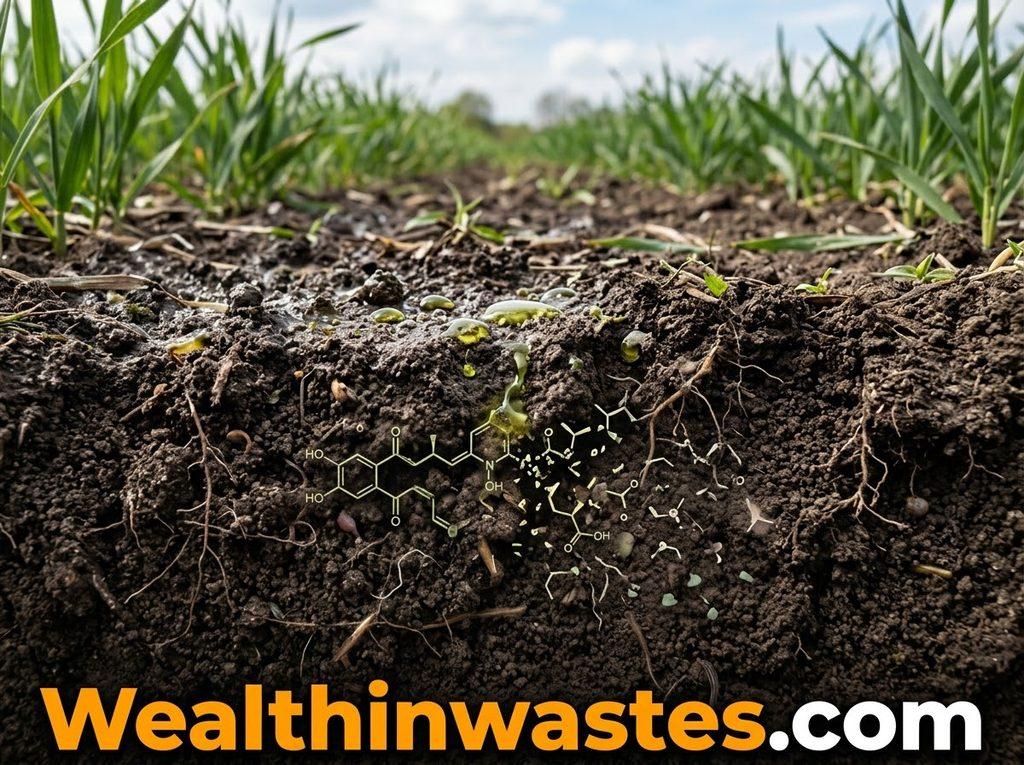
1. Soil Texture: The proportions of sand, silt, and clay influence adsorption, water movement, aeration, and microbial habitat. Fine-textured soils often hold pesticides differently from coarse sandy soils during pesticide application.
2. Soil Organic Matter: Organic matter provides microbial habitat and important binding sites for pesticides. Greater adsorption can reduce dissolved concentrations, sometimes limiting immediate degradation while retaining residues within soil.
3. Soil pH: Soil acidity or alkalinity affects pesticide ionization, adsorption, and reaction rates. Changes in pH can therefore alter both the chemical stability and biological availability of residues after pesticide application.
4. Soil Moisture: Microbial activity and chemical reactions generally require suitable moisture. Very dry conditions can slow transformation, whereas saturated conditions can restrict oxygen and favour different degradation pathways during the breakdown process.
5.Temperature And Aeration: Warm conditions often increase chemical and biological activity, while aeration determines whether microorganisms operate mainly under oxygen-rich or oxygen-limited conditions across different soil environments.
Soil structure can also determine how water and pesticide molecules move through pores and cracks. Sustainable soil management can help maintain physical conditions that support productive and resilient soils.
The soil environment does not act alone because rainfall, irrigation, groundwater depth, and drainage influence moisture and oxygen. These relationships explain differences in pesticide behaviour under different site conditions.
Land use and contamination history also matter when assessing pesticide persistence. Broader land pollution processes can alter soil conditions and increase concerns about cumulative chemical exposure.
Pesticide Persistence and Half-Life
Pesticide persistence describes how long a chemical or its residue remains detectable or biologically relevant after application. Persistence depends on degradation speed, movement, environmental conditions, and the properties of transformation products.
A common measure is the half-life, often expressed as DT50, which indicates the time required for approximately half of the initial pesticide amount to dissipate under defined conditions after a pesticide application.
A short half-life does not necessarily mean complete disappearance because degradation products can remain. Likewise, a long half-life does not describe one universal field duration because soil and weather conditions influence actual dissipation rates.
Laboratory studies provide controlled information about degradation, while field studies capture realistic influences from soil structure, rainfall, temperature, vegetation, cultivation, and management practices. Both approaches support environmental assessment and management decisions.
Field-to-field variation is expected because soils differ in texture, organic carbon, pH, microbial populations, moisture, drainage, and other characteristics. Therefore, pesticide persistence should not be inferred from one soil type alone.
Persistence also affects mobility. A rapidly degraded pesticide has less opportunity to leach or run off, whereas a persistent compound may remain available for transport long after application in the environment.
Understanding persistence helps guide crop rotation, harvest intervals, monitoring, application timing, and pesticide selection. It also supports decisions about groundwater protection and preventing unwanted residues in subsequent crops on farms and managed landscapes.
Persistent residues can eventually affect food crops or livestock through environmental exposure. Studies concerning pesticide residues in food crops demonstrate the importance of controlling unnecessary persistence.
Residues can also reach crops harvested for human consumption and animal feeding. Understanding pesticide residues in grains is therefore relevant when evaluating long-term implications of pesticide use and soil contamination.
Pesticide movement away from agricultural soils may eventually affect aquatic environments. Understanding surface-water pesticide transport therefore strengthens assessment of persistence beyond the original treatment area.
Read Also: Soil Properties Affecting Pesticide Mobility in Soil
Safe Management of Soil Pesticides

1. Follow The Label: Use the approved dose, timing, method, and crop restrictions because label directions are designed to achieve effective control while limiting unnecessary exposure and environmental losses for every application.
2. Avoid Unnecessary Reapplication: Repeated use of the same pesticide can encourage accelerated microbial degradation and resistance. Apply only when monitoring shows that pest pressure justifies another treatment whenever alternatives are practical.
3.Protect Soil And Water: Avoid applications immediately before heavy rainfall or excessive irrigation when conditions could increase runoff and leaching. Maintain buffers and follow site-specific restrictions near sensitive waters and vulnerable areas.
4. Rotate Modes Of Action: Alternating pesticide groups can reduce selection pressure for resistant pests and may also reduce the risk of rapid degradation caused by populations repeatedly exposed to one compound where programs allow.
5. Manage Storage And Waste: Prevent spills and dispose of unused products, contaminated soil, and empty containers according to approved procedures. Proper waste handling reduces secondary contamination of soil and water throughout handling chain.
Application decisions should account for rainfall, irrigation, soil characteristics, and the pesticide’s properties. Appropriate management practices for pesticide use can reduce avoidable environmental losses.
Careful storage and disposal are equally important because residues can enter soil through leaking containers, wash water, spills, or abandoned pesticide materials. Proper pesticide container disposal reduces these risks.
Where pesticide residues already contaminate soil, appropriate assessment should come before remediation. Responsible pesticide waste disposal practices can prevent additional contamination of nearby soil, drainage systems, and groundwater.
Reducing chemical waste at the source also helps protect the environment. Strategies for reducing waste generation can lower the amount of leftover pesticide material requiring storage, treatment, or final disposal.
Pesticide contamination can also affect livestock when polluted soil, feed, water, or vegetation contributes residues to animal exposure. Relevant guidance on managing pesticide residues in livestock reinforces the value of prevention.
Environmental protection extends beyond pesticides because contaminated agricultural soils may contain other chemical hazards. Understanding heavy-metal contamination of soil provides useful context when several pollutants occur together.
Food safety considerations also extend to animal products where contaminated feed or environmental exposure introduces residues. Information on residue contamination in animal products illustrates this wider exposure pathway.
Maintaining clean soil supports broader environmental quality because soil contamination can eventually affect water resources and ecological systems. Appropriate prevention remains preferable to relying entirely on costly cleanup after contamination occurs.
Summary on Degradation and Types of Pesticides in Soils
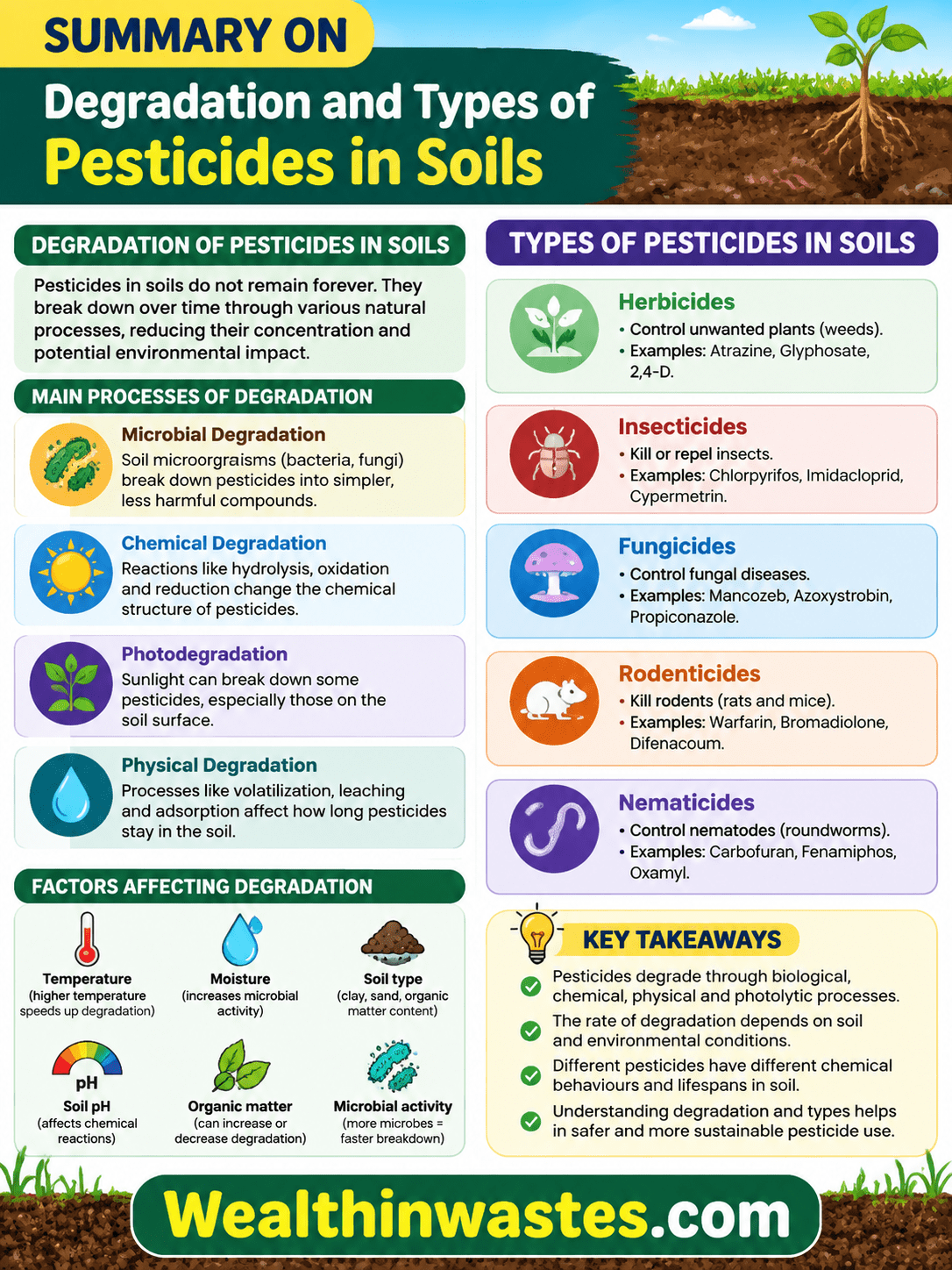
| Topic | Key Point |
|---|---|
| Pesticide degradation | It reduces the amount of active pesticide through biological, chemical, and light-driven processes. |
| Microbial degradation | Bacteria, fungi, and other microorganisms transform pesticide molecules into simpler compounds. |
| Chemical degradation | Hydrolysis, oxidation, reduction, and pH-related reactions can change pesticide molecules. |
| Photodegradation | Sunlight can break down pesticides exposed on soil and plant surfaces. |
| Soil factors | Texture, organic matter, pH, moisture, temperature, and aeration influence degradation. |
| Persistence | Half-life or DT50 helps describe the time required for pesticide dissipation under defined conditions. |
| Safe management | Correct application, rotation, storage, disposal, and monitoring reduce environmental risks. |
Frequently Asked Questions About Degradation and Types of Pesticides in Soils
1. What is pesticide degradation in soil?
It is the breakdown or transformation of pesticide molecules through microbial, chemical, or light-driven processes after they enter the soil environment.
2. What are the main types of pesticide degradation?
The major types are microbial degradation, chemical degradation, and photodegradation, while mineralization and metabolic transformation describe important transformation outcomes.
3. What is microbial pesticide degradation?
It occurs when microorganisms such as bacteria and fungi transform pesticide molecules through metabolic or catabolic processes in soil.
4. What does pesticide half-life mean?
Half-life, commonly expressed as DT50, represents the time required for approximately half of the initial pesticide amount to dissipate under defined conditions.
5. Which soil factors affect pesticide degradation?
Important factors include soil texture, organic matter, pH, moisture, temperature, aeration, microbial activity, and the pesticide’s chemical characteristics.
6. Does pesticide degradation always make residues harmless?
No. Transformation can produce intermediate compounds with different persistence, mobility, toxicity, or biological activity from the original pesticide.
7. How can farmers reduce pesticide persistence problems?
Farmers should follow labels, avoid unnecessary applications, rotate modes of action, monitor field conditions, and manage pesticide waste responsibly.
Do you have any questions, suggestions, or contributions? If so, please feel free to use the comment box below to share your thoughts. We also encourage you to kindly share this information with others who might benefit from it. Since we can’t reach everyone at once, we truly appreciate your help in spreading the word. Thank you very much for your support and for sharing!
Read Also: Pesticides and their Role in Agricultural Pest Management