


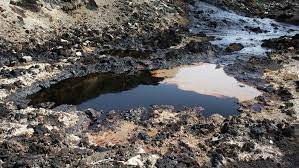
Heavy metal contamination in soil occurs when potentially toxic metallic elements accumulate at concentrations that can alter soil functions, plant growth, water quality, or ecological processes over time and across affected sites.
Industrial development, mining, waste disposal, irrigation with contaminated water, and repeated agricultural inputs can introduce metals into soils, allowing pollutants to persist and move between environmental compartments through natural and human activities.
Unlike many organic pollutants, metals do not simply disappear through ordinary biological breakdown. Their environmental behaviour depends strongly on soil chemistry, particle interactions, moisture, and biological activity within affected soil layers.
Understanding contamination sources, movement, effects, testing, remediation, and prevention helps farmers, industries, communities, and environmental managers protect productive land while reducing risks to groundwater, crops, animals, and people over time.
What Is Heavy Metal Contamination in Soil?
Heavy metal contamination in soil refers to the buildup of metallic elements, including lead, cadmium, mercury, chromium, nickel, copper, and arsenic, at concentrations capable of causing serious environmental concern across affected landscapes.
Some metals occur naturally through weathering of parent materials, while human activities can add much larger amounts. Mining, industrial discharge, waste disposal, pesticides, fertilizers, and sewage materials can increase concentrations.
The properties of soil resources influence how metals behave after entering the ground, especially where mining, industrial operations, or agricultural activities disturb natural soil conditions and local ecological processes significantly.
Industrial operations can introduce metals through process residues, wastewater, dust, and discarded materials. The wider discussion of industrial waste impacts helps explain these pollution pathways and environmental pressures around affected communities.
Contamination does not always remain visible at the soil surface. Metals may attach to particles, dissolve in soil water, enter groundwater, or become available for plant uptake under changing conditions.
Read Also: Soil Fumigation, Importance and Types of Fumigation
Major Sources of Heavy Metal Contamination

1. Industrial And Mining Activities: Industrial effluent, mine tailings, quarry residues, metal processing wastes, and contaminated dust can deposit metallic pollutants directly on surrounding land and gradually increase soil concentrations.
2. Agricultural Inputs And Waste: Some fertilizers, pesticides, manure, sewage sludge, and other agricultural materials may contain trace metals. Repeated application can contribute to gradual accumulation when management remains excessive.
3. Waste Disposal And Urban Activities: Batteries, paints, electronic waste, ash, household refuse, and poorly managed landfills can release metals when materials break down, burn, leak, or weather. Agricultural waste controls reduce risks.
4. Contaminated Water And Petroleum Releases: Irrigation with polluted wastewater, industrial effluent, oil spills, and runoff can carry metals onto agricultural fields, drainage areas, wetlands, and other receiving environments. Wastewater source control reduces these pathways.
5. Atmospheric Deposition: Metal-containing dust and airborne particles from traffic, combustion, industrial processing, or exposed waste can settle on nearby soils. Repeated deposition may gradually raise surface concentrations in receiving areas.
Factors Affecting Heavy Metal Mobility in Soil
Several soil properties determine whether metals remain strongly bound to particles or become mobile enough to enter soil water. This distinction directly affects leaching, plant uptake, and groundwater contamination potential.
Soil pH is especially important because acidity can increase the solubility and mobility of some metals, while alkaline conditions may encourage stronger retention. Organic matter can also alter metal binding behaviour.
The factors controlling chemical mobility are not identical to metal transport factors, but soil texture, moisture, organic matter, and pH provide useful environmental context for understanding contaminant movement across soil layers.
Chemical breakdown differs among pollutants, yet the discussion of soil degradation factors illustrates how environmental conditions can influence persistence, movement, and interactions within contaminated soil over extended periods and varying field conditions.
Clay content, cation exchange capacity, drainage, redox conditions, competing ions, and interactions among different elements also influence metal availability, movement, and persistence within contaminated soil profiles. Water quality principles add useful context.
Metal contamination can occur in surface soil or deeper layers, depending on the source and transport pathway. Rainfall, irrigation, erosion, dust deposition, and groundwater movement may redistribute pollutants across vulnerable areas.
The same concentration can produce different environmental behaviour because metals may exist in several chemical forms. Strongly retained metals generally move differently from dissolved or weakly bound fractions within soil.
Land use also changes the importance of contamination. Agricultural fields require particular attention because metals that become available near roots may affect crop growth, harvest quality, or movement through food systems.
Effects of Heavy Metal Contamination in Soil
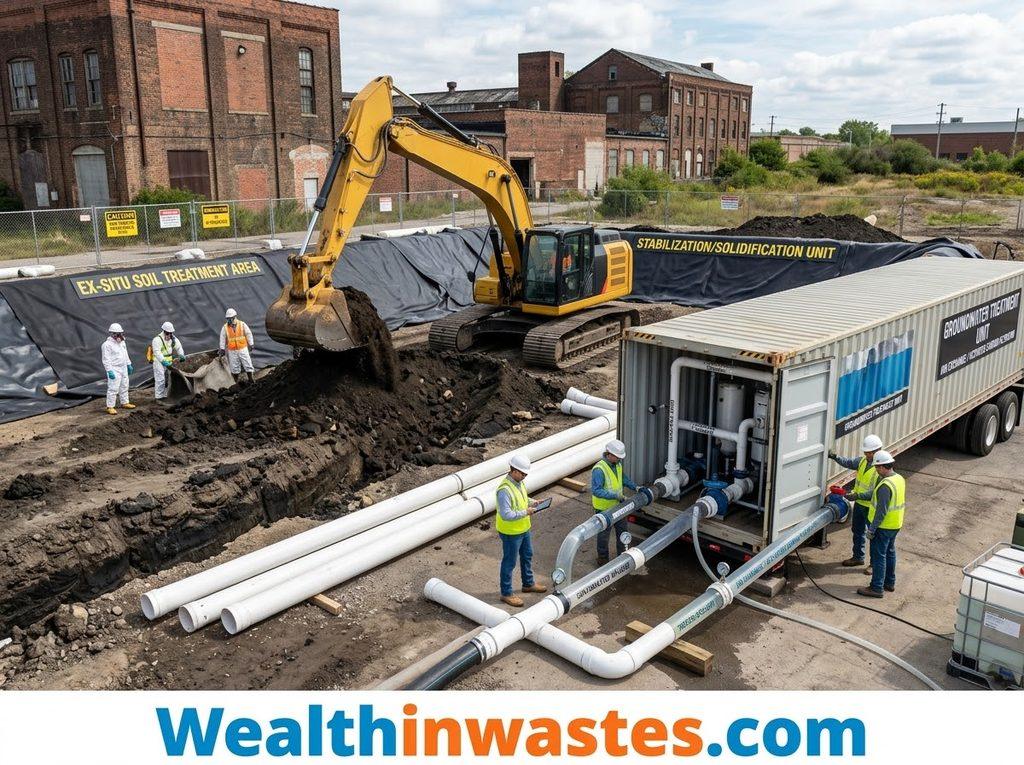
1. Crop Growth And Yield: High concentrations of toxic metals can interfere with root development, nutrient balance, germination, and plant metabolism, potentially reducing crop establishment, productivity, quality, and overall field performance.
2. Soil Biological Activity: Metal toxicity can disturb microorganisms and soil enzymes responsible for decomposition and nutrient cycling. Reduced biological activity may weaken organic matter turnover and other essential soil functions.
3. Water And Food Chain Risks: Mobile metals can migrate toward groundwater or enter crops, livestock, and wildlife. These pathways can move contaminants beyond the original soil compartment. Related metal contamination pathways can extend risks.
4. Wider Environmental Damage: Contaminated land can interact with erosion, runoff, dust movement, and waste pathways. Managing land pollution sources therefore supports broader contamination control measures across vulnerable affected areas.
5. Human And Ecological Exposure: Contaminated soil can create exposure through direct contact, dust inhalation, crop uptake, or movement into water. Limiting these pathways helps protect workers, communities, livestock, wildlife, and ecosystems.
Soil Testing for Heavy Metal Contamination
Reliable assessment should begin with a clear understanding of the suspected pollution source, affected land use, contamination history, soil depth, and possible pathways toward crops, water, workers, animals, and nearby communities.
Representative samples matter because a laboratory result is only useful when the collected soil reflects the area being investigated. Guidance on representative soil sampling emphasizes careful and systematic field collection.
Laboratories can determine total metal concentrations and, where necessary, examine chemical forms or extractable fractions that help estimate mobility and potential availability. Analytical planning should match the environmental question being investigated.
Environmental testing may use laboratory instruments capable of detecting trace metals in soil and related materials. Proper soil analysis equipment improves monitoring, interpretation, reporting, and remediation decisions across contaminated sites.
Assessment should also consider surrounding land use, water resources, waste sources, and long-term environmental consequences. Broader planning through strategic environmental assessment can connect these factors before major interventions begin safely.
Sampling plans should identify probable source zones, reference locations, drainage pathways, and areas where people, crops, or animals could encounter contaminated soil. Consistent methods make results easier to compare accurately.
Laboratory results should be interpreted against appropriate environmental standards, background concentrations, land-use objectives, and site-specific exposure pathways. A single number should not determine remediation without proper scientific context or review.
Repeat testing can track changes after source control or remediation. Monitoring trends over time can show whether metal concentrations, mobility, or exposure pathways are decreasing and whether additional action is necessary.
Engineering Remediation of Heavy Metal Contamination
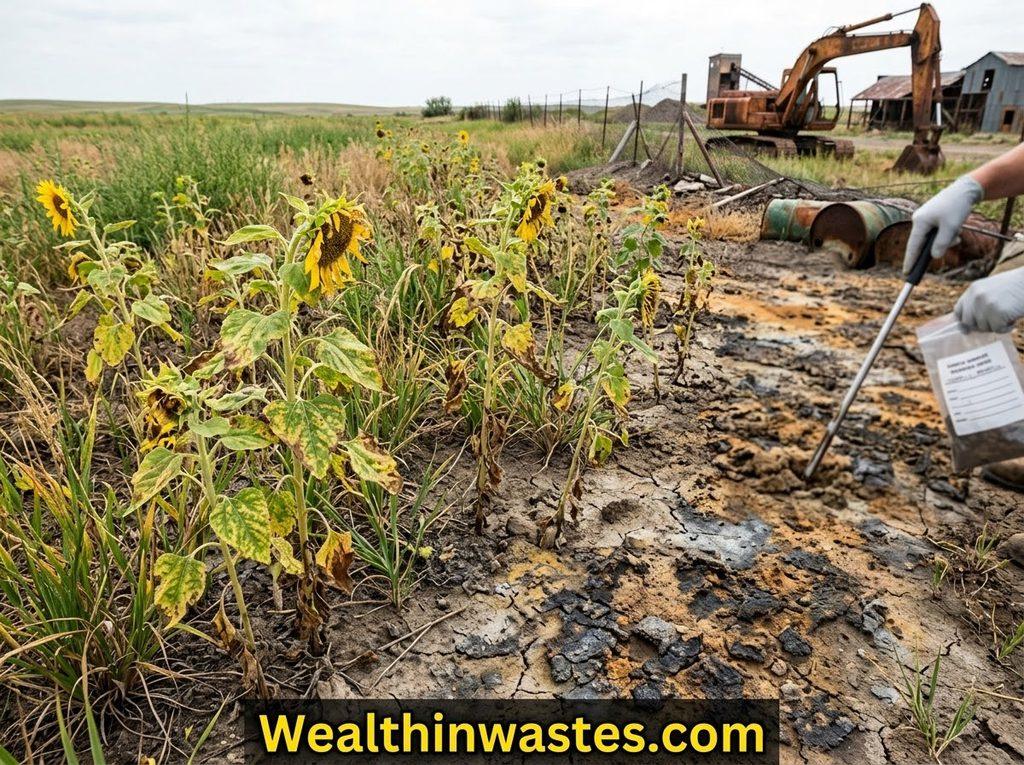
Engineering remediation focuses on physically removing, isolating, immobilizing, or chemically treating contaminated soil when contamination levels, site conditions, or land uses demand direct intervention and stronger exposure controls for affected areas.
1. Excavation And Soil Replacement: Heavily contaminated soil can be excavated and transferred to an appropriately controlled destination, then replaced with clean material. The choice of disposal site matters greatly.
2. Soil Isolation And Capping: Clean cover materials or engineered barriers can separate contaminated soil from people, plants, or rainwater. Reducing direct soil exposure helps control contact, movement, and environmental disturbance.
3. Soil Washing And Chemical Treatment: Selected reagents can separate some metals from soil particles, while chemical amendments may reduce mobility by changing metal availability, binding conditions, or soil chemistry. Choices should match site conditions.
4. Electrokinetic Remediation: An electric field can move charged contaminants through low-permeability soil toward collection zones. This method can be useful where conventional flushing or excavation faces physical limitations. Targeted cleanup methods provide context.
5. Stabilization And Solidification: Chemical or mineral amendments can bind metals within soil or waste materials, lowering mobility and exposure. These methods support containment when removal is impractical or contaminated areas cover larger sites.
Biological Remediation of Heavy Metal Contamination
Biological remediation uses living organisms or plant-based processes to reduce metal mobility, uptake, or environmental exposure. These approaches generally require careful selection according to contaminant type, site conditions, and intended land use.
1. Phytoremediation: Selected plants can absorb or stabilize metals in contaminated soil. Harvesting metal-rich plant tissues can gradually remove certain contaminants, while the biological remediation approach may support broader site recovery.
2. Phytostabilization: Some plants reduce contaminant movement by trapping metals around roots or encouraging stronger retention in the rhizosphere. Proper hazardous substance control should still limit new pollutant inputs effectively.
3. Microbial Remediation: Bacteria and fungi can influence metal behaviour through biosorption, precipitation, oxidation, reduction, or production of compounds that alter metal interactions with soil minerals. Microbial performance depends strongly on suitable environmental conditions.
4. Soil Fauna And Biological Recovery: Earthworms and other organisms can modify soil structure and contaminant interactions. Their use requires site-specific evaluation because biological activity may help or complicate contaminant movement. Water protection remains important.
5. Plant–Microbe Partnerships: Roots and associated microorganisms can influence metal uptake, retention, and transformation in the rhizosphere. Carefully selected plant–microbe systems may improve remediation performance where soil and climate conditions support them.
Read Also: Roles of Producers and Corporations in Waste Management
Prevention and Long-Term Soil Protection

Prevention is usually more practical than treating widespread metal contamination after pollutants become established. Effective control begins by preventing contaminated materials, wastewater, dust, and residues from reaching agricultural or residential soils.
Responsible waste handling is essential because industrial, electronic, household, and hazardous materials can release metals when they are dumped, burned, leaked, or stored without adequate containment. Proper controls should operate before contamination occurs.
Industrial facilities should treat and safely discharge effluents because metal-bearing releases can affect soil, water, crops, livestock, and communities. The discussion of industrial effluent impacts reinforces this important need clearly.
Agricultural managers should evaluate inputs carefully, avoid unnecessary applications, protect irrigation sources, and monitor soils where contaminated water, waste-derived amendments, mining activities, or industrial discharges create potential exposure and long-term risks.
Long-term environmental management should combine monitoring, source control, safe waste practices, and appropriate land management. Pollution prevention measures strengthen these practical controls across farms, industries, and communities for sustained protection.
Careful environmental monitoring should recognize that soil pollution includes more than visible waste. The discussion of soil and land pollution composition provides useful context for identifying less obvious contamination pathways.
Monitoring should continue after remediation because changing moisture, soil chemistry, erosion, or land use can influence contaminant movement. Long-term records help determine whether treatment objectives remain effective and protective over time.
Protective measures should be reviewed whenever land use changes, new industries appear, waste streams increase, or irrigation sources change. Periodic soil monitoring helps identify emerging risks before contamination becomes widespread.
Summary on Factors and Effects of Heavy Metal Contamination in Soil
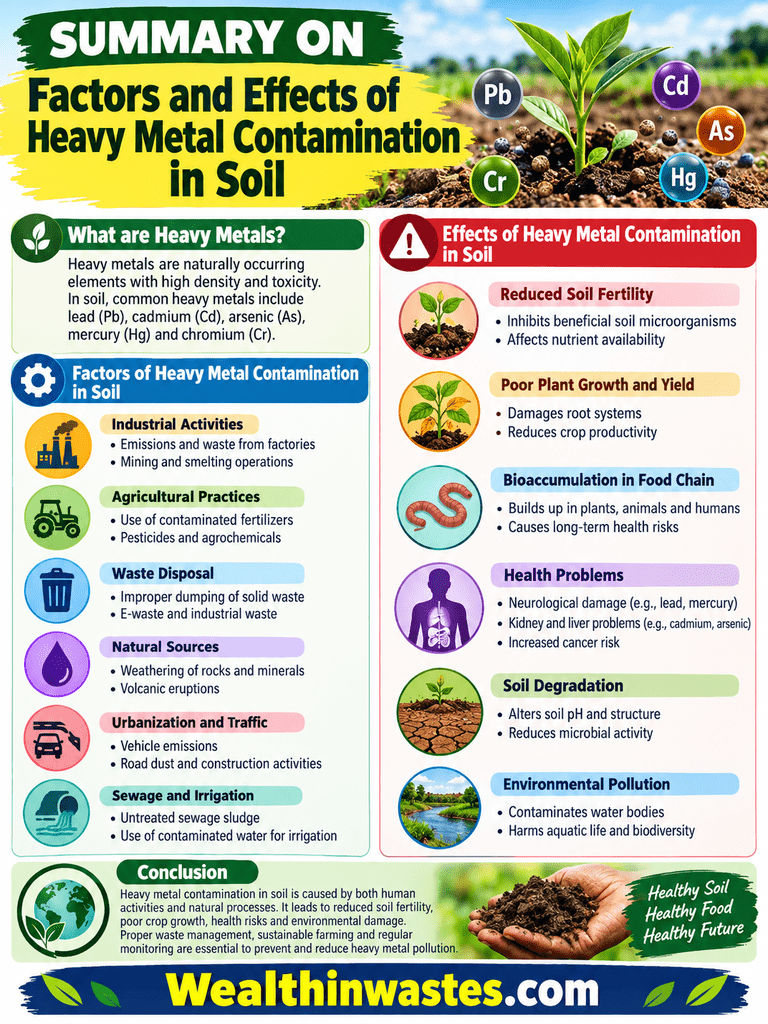
| Section | Main Idea | Why It Matters |
|---|---|---|
| What It Means | Explains heavy metal buildup and behaviour in soil. | Establishes the contamination concept. |
| Main Sources | Identifies industrial, agricultural, waste, water, and atmospheric pathways. | Helps locate and control pollution sources. |
| Soil Mobility | Examines pH, organic matter, clay, drainage, and related factors. | Explains movement and availability. |
| Environmental Effects | Covers crop, biological, water, food-chain, and ecosystem impacts. | Shows why contamination requires attention. |
| Testing | Describes representative sampling and laboratory assessment. | Supports accurate decisions. |
| Engineering Remediation | Includes excavation, isolation, treatment, and electrokinetic methods. | Provides direct cleanup options. |
| Biological Remediation | Covers plants, microbes, stabilization, and biological recovery. | Provides lower-disruption treatment approaches. |
| Prevention | Emphasizes source control, waste management, monitoring, and long-term protection. | Reduces future contamination. |
Frequently Asked Questions About Heavy Metal Contamination in Soil: Causes and Solutions
1. What is heavy metal contamination in soil?
It is the accumulation of metallic pollutants in soil at concentrations that can affect soil functions, plants, water resources, organisms, or wider environmental quality.
2. What are common sources of heavy metals in soil?
Common sources include mining, industrial waste, contaminated wastewater, fertilizers, pesticides, sewage materials, batteries, electronic waste, petroleum releases, and atmospheric deposition.
3. What soil factors control metal mobility?
Soil pH, organic matter, clay content, cation exchange capacity, moisture, drainage, redox conditions, and interactions among elements can affect metal movement and availability.
4. Can heavy metals affect crop production?
Yes. Toxic metal concentrations can interfere with root growth, nutrient balance, germination, plant metabolism, crop productivity, and the quality of harvested agricultural products.
5. How is contaminated soil tested?
Assessment normally combines representative soil sampling with laboratory analysis, site history, suspected pollution sources, land use, soil depth, and potential exposure pathways.
6. Can contaminated soil be remediated?
Yes. Depending on site conditions, remediation may use excavation, isolation, soil washing, stabilization, electrokinetic treatment, phytoremediation, microbial methods, or combined approaches.
7. What is phytoremediation?
Phytoremediation uses selected plants to absorb, stabilize, or otherwise manage contaminants in soil. Harvesting can remove accumulated metals when suitable plant species and conditions exist.
8. How can heavy metal contamination be prevented?
Prevention includes controlling industrial discharges, managing hazardous waste safely, protecting irrigation sources, monitoring soils, using agricultural inputs responsibly, and responding early to contamination risks.
Do you have any questions, suggestions, or contributions? If so, please feel free to use the comment box below to share your thoughts. We also encourage you to kindly share this information with others who might benefit from it. Since we can’t reach everyone at once, we truly appreciate your help in spreading the word. Thank you very much for your support and for sharing!
Read Also: Water and Land Pollution in Agriculture