


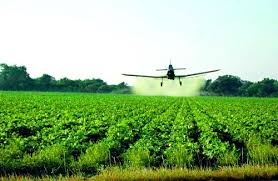
Mishonga yesora inosvika muvhu inodyidzana nezvidimbu zvevhu, mvura, organic matter, microorganisms, uye mamiriro ezvakatipoteredza izvo zvinokanganisa mafambiro, kuwanikwa, kuramba, kuparara, uye kushanda kwayo zvachose mushure mekushandiswa.
Mishonga yesora inopinda muvhu kuburikidza nekutanga kudyara uye preemergence application, kuyerera kwemashizha mushure mekurapa mushure mekumera, nekuora kana kuiswa kwezvisaririra zvezvirimwa zvine masara emakemikari.
These soil herbicide interactions determine whether molecules remain available for weed uptake, become strongly attached to soil particles, move through the profile, volatilize, or undergo chemical and biological transformation.
Persistence also matters because a herbicide that disappears too quickly may provide inadequate control of later-emerging weeds, while excessive persistence can threaten sensitive rotational crops.
Therefore, understanding soil herbicide interaction helps farmers select suitable products, application rates, timings, and management practices for reliable weed control while reducing unnecessary movement and environmental losses.
What Soil Herbicide Interaction Means
Soil herbicide interaction describes the physical and chemical relationships between an applied herbicide, soil particles, soil water, organic matter, microorganisms, and surrounding environmental conditions after application.
These interactions determine how much herbicide stays dissolved in soil water and how much becomes attached to clay, organic matter, mineral surfaces, or other soil components.
Strong adsorption can reduce immediate weed uptake because less chemical remains in soil solution, although temporary binding may also reduce leaching and protect against rapid chemical loss.
Weak adsorption can leave more herbicide available for uptake, but it may also increase movement through runoff, leaching, volatilization, or other transfer pathways.
The relationship becomes especially important when farmers use pesticide movement in soil principles to understand whether herbicides can reach germinating weed seeds without moving beyond the intended treatment zone.
Ultimately, effective herbicide performance depends on maintaining sufficient chemical availability near target weeds while limiting losses that reduce control, increase residue concerns, or contaminate surrounding environmental resources.
Read Also: Management Practices Affecting the Mobility of Pesticides in Soil
Herbicide Absorption Mechanisms in Soil

1. Hydrophobic Partitioning: This process moves an organic herbicide from soil water into hydrophobic organic matter, where nonpolar regions provide favourable sites for retaining chemical molecules away from the soil solution.
2. London-Van Der Waals Forces: These weak attractions develop from temporary electron distribution between nearby molecules, become stronger across larger contact areas, and commonly influence neutral compounds with relatively high molecular weights.
3. Hydrogen Bonding: Hydrogen bonding creates stronger electrostatic attractions involving hydrogen and electronegative atoms, allowing several herbicide functional groups to interact with organic surfaces and mineral sites within soil.
4. Cation And Water Bridging: Exchangeable metal cations can connect polar herbicide groups with soil surfaces, while water molecules may remain between the cation and herbicide when direct displacement does not occur.
5. Ionic And Surface Interactions: Charged herbicide molecules can exchange with oppositely charged soil sites, particularly on clay minerals, organic matter, iron oxides, and other reactive surfaces within different soil environments.
Hydrophobic And Van Der Waals Interactions
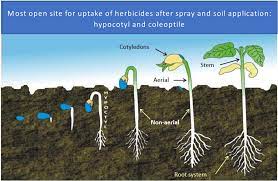
Hydrophobic partitioning occurs when an organic herbicide leaves the aqueous phase and associates with comparatively hydrophobic portions of soil organic matter, reducing its concentration in soil water temporarily.
This interaction depends strongly on the chemical characteristics of the herbicide and the quantity and quality of organic matter present within the soil environment.
London-van der Waals forces produce weaker attractions than several other bonding mechanisms, but many individual interactions can combine across broad contact surfaces between soil particles and herbicide molecules.
Because these forces weaken rapidly with distance, molecules must remain relatively close to the adsorbing surface for the interaction to remain significant over time.
Farmers should therefore recognize that soil properties affecting pesticide mobility can alter the balance between retained herbicide and dissolved herbicide available for plant uptake.
Adsorption data often rely on mathematical models such as Freundlich and Langmuir equations, which help describe how chemical concentrations partition between soil surfaces and surrounding solution.
Hydrogen Bonding And Water Bridging
1. Hydrogen Bonding: Soil surfaces containing suitable functional groups can attract herbicides through hydrogen bonds, creating stronger associations than ordinary London-van der Waals forces under comparable conditions.
2. Organic Surface Attraction: Organic matter provides reactive locations where herbicide molecules can form multiple interactions, making soil organic matter an important component of herbicide retention.
3. Cation Bridging: Exchangeable cations can form connections between herbicide molecules and negatively charged soil surfaces, particularly where the chemical contains anionic or strongly polar functional groups.
4. Water Bridging: Water molecules may remain around exchangeable cations and create an indirect connection between the cation and herbicide when the herbicide cannot directly replace coordinated water molecules.
5. Environmental Dependence: Moisture, mineral composition, organic matter, and competing dissolved substances can change the strength and duration of these interactions, making adsorption conditions highly variable.
Ion Exchange And Ligand Interactions

1. Anion Bonding: Negatively charged herbicide molecules can attach to positively charged sites on certain acidic mineral surfaces, especially where iron oxides and variable-charge materials provide suitable adsorption locations.
2. Ligand Exchange: A herbicide containing carboxylate or hydroxyl groups can replace water or hydroxyl groups surrounding metal ions on mineral surfaces, producing relatively strong surface associations.
3. Protonation: Basic herbicide groups can accept protons under acidic conditions, changing their charge and increasing attraction toward negatively charged mineral surfaces and other soil colloids.
4. Cation Exchange: Positively charged herbicides can exchange with other cations on negatively charged clay and organic surfaces, making this mechanism especially important for strongly cationic compounds.
5. Charge-Dependent Behaviour: Soil pH controls chemical ionization for many herbicides, so changes in acidity can alter adsorption, mobility, availability, degradation, and the potential for crop injury.
The importance of these mechanisms becomes clearer when considering soil factors controlling pollutant mobility, because pH, clay content, organic matter, and mineral surfaces influence chemical partitioning.
Covalent Bonding And Herbicide Persistence
Covalent bonding differs from weak reversible adsorption because it can create much stronger associations between herbicide molecules, metabolites, and components of soil organic matter.
These bonds may form through oxidative coupling, enzymatic reactions, or other transformation pathways that attach chemical residues to complex organic structures within the soil.
Once covalent associations develop, extraction and biological availability can decline substantially, which may reduce immediate herbicide activity while increasing the quantity retained within soil.
However, reduced extractability does not automatically mean permanent removal because environmental changes can sometimes alter bound residues or release previously retained chemical fractions.
Understanding persistence therefore requires attention to factors influencing pesticide degradation, including microbial activity, temperature, moisture, soil chemistry, pesticide properties, and surrounding environmental conditions.
Persistent residues can create useful residual weed control in some cropping systems, but excessive persistence can injure sensitive rotational crops and complicate future herbicide selection.
Soil Factors That Affect Herbicide Efficacy

1. Soil Texture: Sandy soils usually allow faster water movement, while clay-rich soils provide greater surface area for adsorption, creating different patterns of herbicide availability, mobility, and persistence.
2. Organic Matter: Organic matter provides numerous binding sites for pesticide molecules and can reduce downward movement, although strong retention may also lower immediate availability for weed uptake.
3. Soil Moisture: Water competes for adsorption sites and also supports microbial activity, so changes in moisture can influence herbicide dissolution, movement, degradation, and biological availability.
4. Soil pH: Acidity changes the charge and chemical form of many herbicides, altering adsorption strength, persistence, degradation pathways, and the amount remaining available for plant uptake.
5. Soil Structure: Aggregation, cracks, pores, compaction, and preferential flow pathways influence how water and dissolved herbicides travel through the profile after rainfall or irrigation.
Herbicide Mobility, Degradation And Crop Safety
Herbicide mobility determines whether the active ingredient remains near the treatment zone or moves into deeper soil, surface runoff, groundwater, or the surrounding atmosphere.
Leaching occurs when dissolved herbicide travels downward with infiltrating water, while runoff carries chemicals across the soil surface when rainfall or irrigation exceeds infiltration capacity.
Farmers can better manage these risks by understanding site conditions affecting pesticide mobility, including groundwater depth, geology, permeability, rainfall patterns, temperature, and wind.
Degradation may occur through microbial activity, chemical reactions, or photodegradation, and each pathway responds differently to soil moisture, temperature, pH, oxygen availability, and sunlight.
Research on soil pollution and chemical contamination also shows why responsible herbicide management matters, especially where repeated applications could contribute to long-term environmental pressure.
Proper timing, correct application rates, suitable soil conditions, and careful weather monitoring help maintain herbicide efficacy while reducing unnecessary losses and protecting non-target plants and water resources.
Read Also: Site Conditions Affecting the Mobility of Pesticides in Soil
Practical Factors For Better Herbicide Performance

Effective herbicide performance requires farmers to match chemical behaviour with soil conditions, crop requirements, weed pressure, rainfall expectations, and the desired duration of weed suppression.
Water-soluble herbicides may move readily after rainfall, whereas strongly adsorbed products may remain close to the application zone and provide different patterns of root uptake and persistence.
For better environmental control, farmers should also understand management practices that influence pesticide transport, especially irrigation timing, application rate, application method, and field conditions.
Runoff prevention becomes particularly important on sloping land, compacted fields, or areas receiving intense rainfall because water can transport herbicide residues away from intended treatment zones.
Understanding soil conservation practices can support herbicide stewardship because vegetation cover, reduced disturbance, improved infiltration, and erosion control can reduce chemical movement from treated fields.
Farmers should always follow the product label for crop restrictions, rates, application timing, protective measures, and environmental precautions because formulations differ substantially in behaviour and regulatory requirements.
Environmental Effects Of Soil Herbicide Interaction
When herbicides move beyond their intended targets, they may affect non-target vegetation, aquatic environments, soil organisms, and future crops, depending on concentration, persistence, exposure route, and sensitivity.
Surface runoff can carry herbicides into streams, ponds, and drainage channels, while downward transport can introduce dissolved residues into groundwater where soil and geological conditions permit rapid movement.
The connection between agriculture and water contamination is discussed in sources and types of water pollution, where agricultural runoff represents an important non-point pollution pathway.
Groundwater protection also requires careful consideration of herbicide solubility, persistence, soil texture, permeability, application timing, rainfall, and the distance separating treated fields from groundwater.
Information on groundwater pollution management reinforces the importance of preventing chemical movement because remediation can become technically difficult, expensive, and time-consuming after contamination occurs.
Farmers can reduce these risks by avoiding unnecessary applications, preventing overuse, respecting weather restrictions, maintaining soil cover, and selecting herbicides appropriate for the specific soil and cropping system.
Additional perspective on water quality protection principles emphasizes prevention and sound agricultural practices as practical ways to limit diffuse contamination from farms.
Good stewardship also supports protection of water resources by reducing opportunities for agricultural chemicals to enter wells, streams, rivers, ponds, and other important water sources.
Soil contamination concerns extend beyond water because repeated chemical inputs can contribute to broader land pollution when products are misused, spilled, or poorly managed.
The wider implications of contamination are discussed under effects of hazardous substances on soil, including potential impacts on soil productivity, organisms, vegetation, and environmental quality.
Farm chemical stewardship should therefore form part of a broader environmental management approach that protects soil functions while maintaining reliable and economically useful weed control.
Related agricultural pressures are also discussed in agricultural waste management, where pesticides and herbicides appear among materials requiring careful handling and responsible management.
Similarly, agricultural waste management practices demonstrate why prevention, proper storage, responsible handling, and appropriate disposal are important throughout agricultural production systems.
The effects of contamination may also influence food safety, making agricultural chemical contamination of food an important consideration whenever herbicide residues remain in production environments.
Protecting productive soils remains essential, and understanding soil properties helps farmers interpret how texture, structure, water, organic matter, and chemical conditions influence herbicide behaviour.
Long-term stewardship also connects with soil resource management, which emphasizes maintaining soil functions and productive capacity while limiting degradation caused by inappropriate agricultural practices.
Land-use decisions matter because land degradation and environmental pressure can increase when contamination, erosion, compaction, salinity, and poor management interact across agricultural landscapes.
Finally, broader water pollution effects show why chemical losses deserve attention, especially because polluted water can affect ecosystems and living organisms when contaminants reach sensitive aquatic environments.
Understanding these connections allows farmers and environmental managers to treat soil herbicide interaction as part of an integrated system rather than viewing weed control as an isolated chemical operation.
Summary on Soil Herbicide Interaction and Herbicide Efficacy
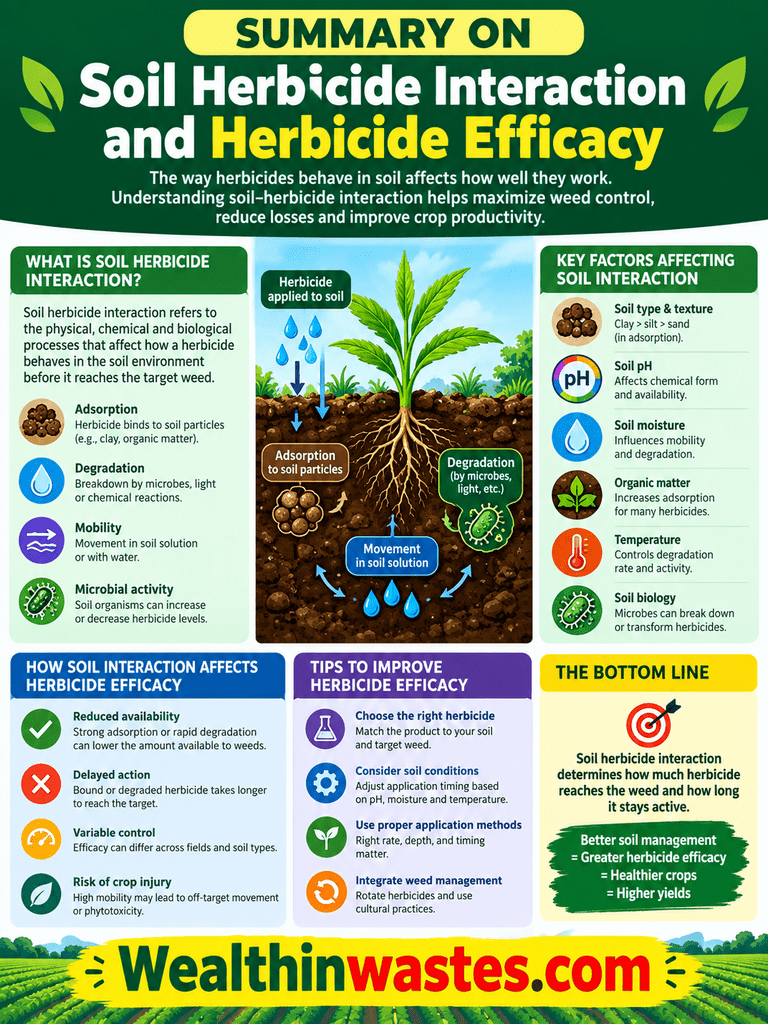
| Aspect | Key Point |
|---|---|
| Soil Herbicide Interaction | Describes how herbicides interact with soil particles, water, organic matter, microorganisms, and environmental conditions. |
| Adsorption | Controls how strongly herbicides bind to soil surfaces and how much remains available in soil solution. |
| Bonding Mechanisms | Include hydrophobic partitioning, van der Waals forces, hydrogen bonding, cation bridging, protonation, ion exchange, ligand exchange, and covalent bonding. |
| Soil Factors | Texture, organic matter, moisture, pH, structure, and mineral composition strongly influence herbicide behaviour. |
| Herbicide Efficacy | Depends partly on keeping sufficient active ingredient available near target weeds for effective uptake. |
| Persistence | Longer persistence may improve residual weed control but can increase rotational crop injury risks. |
| Mobility | Leaching, runoff, volatilization, and preferential flow can move herbicides away from target areas. |
| Environmental Protection | Correct product selection, timing, application rates, weather monitoring, and soil management can reduce unnecessary chemical losses. |
Frequently Asked Questions About Soil Herbicide Interaction and Herbicide Efficacy Explained
1. What is soil herbicide interaction?
It describes the relationships between herbicides and soil particles, organic matter, water, minerals, microorganisms, and environmental conditions that determine herbicide availability, movement, persistence, degradation, and efficacy.
2. How does adsorption affect herbicide efficacy?
Strong adsorption can reduce the herbicide concentration in soil solution and limit weed uptake, although it may also reduce leaching and extend residual activity under certain conditions.
3. Why does soil pH matter for herbicides?
Soil pH can change herbicide charge and chemical form, which alters adsorption, mobility, degradation, persistence, availability, and potential crop injury for certain herbicide groups.
4. Can organic matter reduce herbicide movement?
Yes. Organic matter can provide binding sites that retain herbicide molecules, reducing their movement through soil, although very strong retention can sometimes reduce immediate availability for weed control.
5. How can rainfall affect soil herbicide behaviour?
Rainfall can move dissolved herbicides through soil or across the surface, potentially improving root-zone delivery or causing leaching and runoff when water movement becomes excessive.
6. Why can persistent herbicides damage later crops?
A persistent herbicide can remain biologically active after the original crop season, allowing residues to affect sensitive rotational crops when soil conditions release enough chemical for plant uptake.
7. What determines herbicide movement through soil?
Movement depends on herbicide solubility, adsorption strength, persistence, soil texture, structure, moisture, organic matter, pH, rainfall, irrigation, slope, and geological conditions.
8. How can farmers improve herbicide performance?
Farmers can improve performance by selecting suitable products, following label directions, applying correct rates, choosing proper timing, monitoring weather, and considering soil characteristics before treatment.
Do you have any questions, suggestions, or contributions? If so, please feel free to use the comment box below to share your thoughts. We also encourage you to kindly share this information with others who might benefit from it. Since we can’t reach everyone at once, we truly appreciate your help in spreading the word. Thank you very much for your support and for sharing!
Read Also: Chemical Methods of Weed Control Guide