


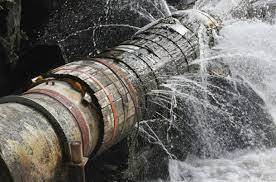
Water resources support human life, agricultural production, economic activities, environmental protection, sanitation, energy generation, and countless social needs. Their availability influences development, livelihoods, food security, and ecosystem stability.
Although water continually moves through the hydrologic cycle, accessible supplies remain limited in particular places and periods. Population growth, pollution, changing rainfall, rising temperatures, and competing demands increase pressure significantly.
Effective management therefore requires governments, communities, farmers, industries, households, and environmental managers to use available supplies carefully. Their decisions must balance economic benefits, social needs, ecosystem protection, and long-term sustainability.
Understanding water resources begins with knowing where water exists, how much remains available, how water moves through the environment, and how natural processes replenish different reservoirs over time.
This article examines water volume and the water cycle alongside groundwater resources, water availability, agricultural uses, conservation strategies, and major challenges affecting sustainable water management today.
Water Resources And Global Demand
Water resources include natural freshwater sources such as rainfall, rivers, lakes, reservoirs, wetlands, soil moisture, glaciers, and groundwater. These sources support different activities and provide essential services to communities.
Rising demand makes responsible allocation increasingly important because agriculture, households, industries, energy producers, and ecosystems often depend on the same water sources within shared watersheds.
Growing populations also increase demand for drinking water, sanitation, food production, manufacturing, electricity, recreation, and ecosystem protection. Poor planning can therefore create competition and intensify pressure on vulnerable supplies.
Water quality matters alongside water quantity because polluted water may remain physically present while becoming unsuitable for drinking, irrigation, industry, fisheries, wildlife, or other valuable purposes.
For this reason, pollution-related economic losses can extend beyond immediate cleanup expenses and affect agriculture, fisheries, public health, productivity, infrastructure, and community livelihoods.
Sound water-resource planning must therefore consider quantity, quality, timing, location, environmental flows, infrastructure, climate variability, population needs, and the ability of natural systems to replenish water.
Read Also: Complete List of Recyclable Wastes (Waste Recyclables)
Water Volume And The Hydrologic Cycle
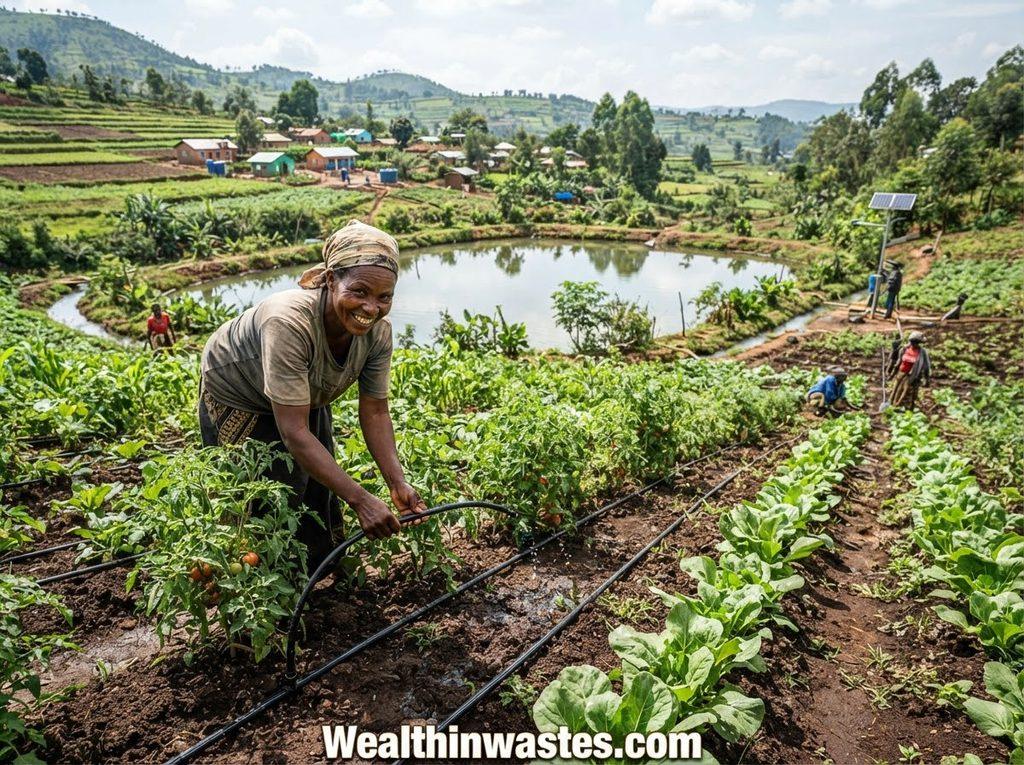
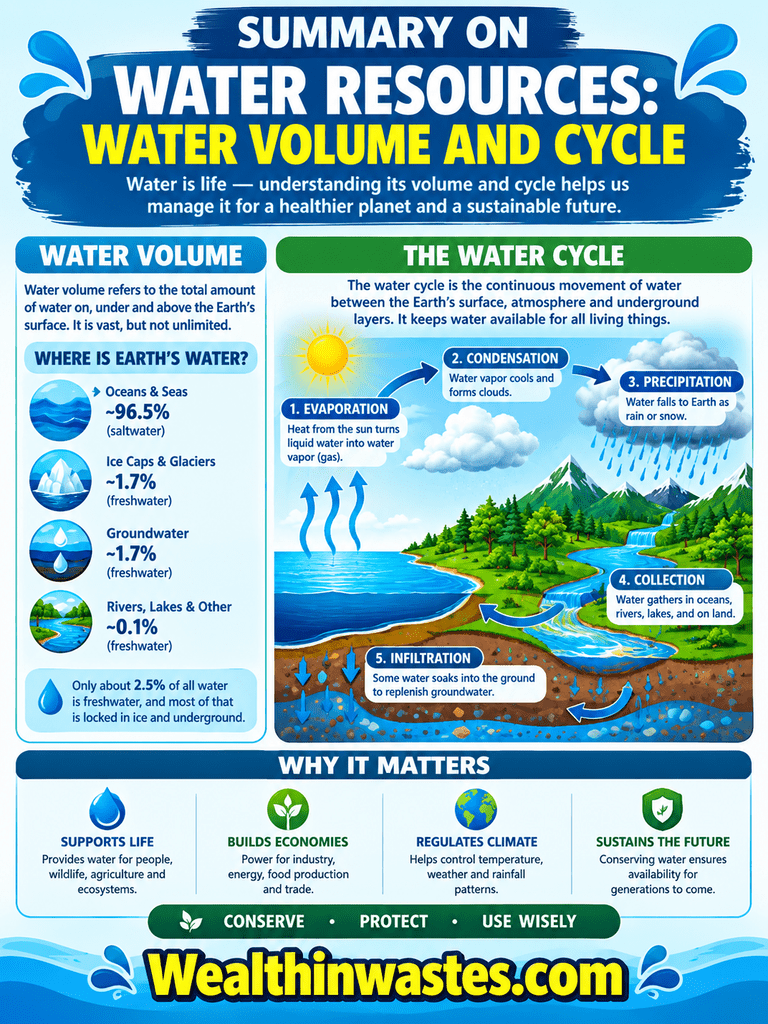
Earth contains an enormous quantity of water, but most of it occurs in oceans and remains unsuitable for ordinary freshwater needs without treatment or desalination. Only a relatively small proportion is readily accessible.
Freshwater occurs in glaciers, permanent snow, groundwater, lakes, rivers, reservoirs, wetlands, soil moisture, and the atmosphere. Each storage location interacts with others through the continuous hydrologic cycle.
Solar energy drives evaporation from oceans, lakes, rivers, and land surfaces. Plants also release water vapor through transpiration, while combined evaporation and transpiration contribute to atmospheric moisture.
Atmospheric moisture eventually condenses into clouds before returning to Earth through precipitation. Rainfall and snowfall replenish surface water, soil moisture, glaciers, and groundwater depending on local conditions.
Water reaching the ground may infiltrate the soil, become surface runoff, evaporate again, or move into streams and rivers. This movement eventually returns substantial quantities to oceans.
The hydrologic cycle continuously redistributes water among atmospheric, surface, and underground stores. However, redistribution does not guarantee equal availability because climate, geography, geology, and human demand differ among regions.
Protecting water quality within this cycle remains essential because contamination can move between land, surface water, groundwater, and biological systems. Environmental and health effects of waste therefore deserve serious attention wherever waste can enter water pathways.
Groundwater Resources And Recharge
Groundwater forms when water infiltrates beneath the soil surface and occupies pores, cracks, and openings within geological formations. Aquifers store this underground water and can supply wells, springs, farms, and communities.
Many aquifers accumulated water over long periods, while others receive regular recharge from rainfall, rivers, wetlands, irrigation return flows, or seepage from surrounding water bodies.
Groundwater moves slowly compared with most surface water, making some underground reserves naturally resilient during short dry periods. However, excessive pumping can lower water tables and reduce future availability.
Four important characteristics determine the usefulness and sustainability of groundwater resources.
1. Aquifer Storage: Aquifers store water within permeable geological formations, providing dependable supplies for domestic, agricultural, and industrial needs when surface sources become unreliable or seasonal.
2. Groundwater Recharge: Recharge occurs when water moves downward from the surface into underground formations. Protecting infiltration areas helps maintain groundwater levels and supports long-term water availability.
3. Sustainable Withdrawal: Pumping should remain consistent with recharge and environmental requirements. Excessive withdrawal can lower groundwater levels, increase pumping costs, dry springs, and damage connected ecosystems.
4. Groundwater Protection: Preventing contamination from chemicals, poorly managed waste, leaking infrastructure, and polluted runoff protects underground supplies because groundwater remediation often requires considerable time and resources.
Water Availability And Regional Scarcity
Water availability describes how much usable water exists within a particular location and period. Although rainfall replenishes renewable supplies, accessible water remains limited by season, geography, quality, infrastructure, and demand.
Two regions can receive similar rainfall while experiencing very different water conditions. Temperature, evaporation, soil properties, vegetation, storage capacity, population size, and economic activity influence usable supplies.
Water scarcity develops when demand approaches or exceeds dependable supply, when pollution reduces usable water, or when infrastructure prevents communities from accessing otherwise available sources effectively.
Important factors influencing regional water availability include the following.
1. Rainfall Pattern: The amount, timing, intensity, and seasonal distribution of rainfall determine how much water reaches soils, rivers, reservoirs, wetlands, and aquifers available for later use.
2. Evaporation Demand: High temperatures, strong winds, and dry atmospheric conditions can increase evaporation and reduce the amount of water remaining for crops, reservoirs, ecosystems, and households.
3. Population Pressure: Large or rapidly growing populations increase water requirements for drinking, sanitation, food production, manufacturing, energy, housing, and other economic activities that depend upon reliable water supplies.
4. Water Quality: Pollution reduces effective availability because contaminated water may require treatment before use. Proper water waste management helps protect sources from avoidable contamination.
Regions experiencing prolonged shortages may increase storage, improve irrigation efficiency, protect watersheds, recycle wastewater, control pollution, and develop alternative sources while maintaining environmental safeguards.
Uses Of Water Resources In Society
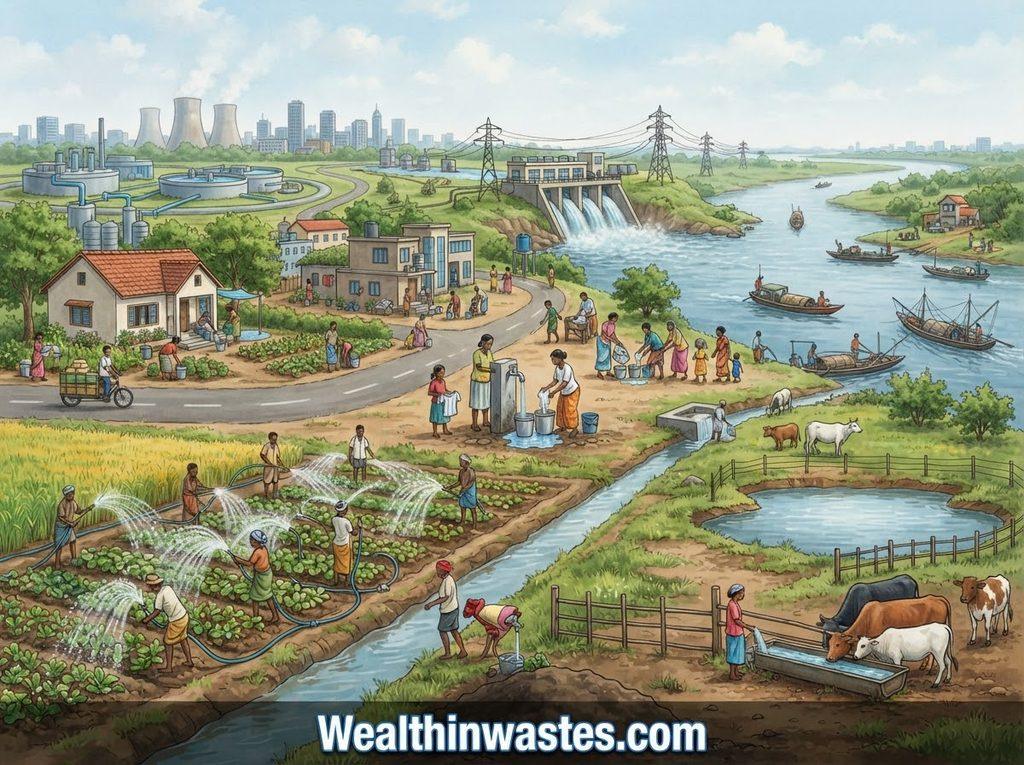
Water resources serve households, farms, industries, energy systems, ecosystems, transport networks, fisheries, recreation, and cultural activities. Each use creates different requirements for quantity, quality, reliability, timing, and access.
Water use becomes more sustainable when users understand the opportunity cost of consumption and reduce unnecessary losses. Careful allocation can provide wider economic benefits while protecting ecosystems.
The major uses of water resources include several interconnected activities.
1. Agricultural Production: Crops and livestock require water for growth, cooling, processing, cleaning, and general husbandry. Efficient irrigation helps farmers maintain production when rainfall becomes insufficient or unreliable.
2. Domestic Consumption: Households use water for drinking, cooking, bathing, washing, cleaning, sanitation, gardening, and other daily activities. Reliable domestic supplies are fundamental to healthy and productive communities.
3. Industrial Activities: Industries use water for processing, cooling, cleaning, manufacturing, steam production, and material handling. Effective treatment and reuse can reduce freshwater demand and limit wastewater discharge.
4. Ecosystem Support: Rivers, lakes, wetlands, groundwater systems, and coastal environments require sufficient water to sustain habitats, biodiversity, nutrient movement, fisheries, vegetation, and ecological processes.
Wastewater management also influences available water resources. Understanding wastewater sources and characteristics helps users identify pollution pathways and opportunities for safer treatment, reuse, and disposal.
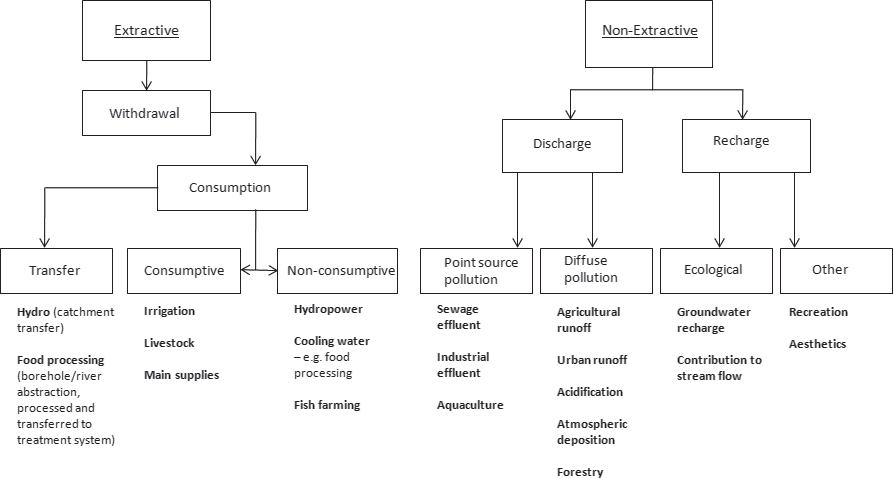
Figure 1: Uses of water. Source: Adapted from Moran and Dann (2008).
Water demand will continue to increase as economies grow and populations expand. Better conservation, efficient infrastructure, pollution control, and responsible allocation can help societies meet competing requirements.
Water Resources In Agriculture
Agriculture depends heavily on dependable water resources because water supports seed germination, nutrient transport, photosynthesis, cell expansion, crop cooling, livestock production, and post-harvest operations.
Rainfall provides much of the water required by rain-fed farming, while irrigation supplements natural precipitation when rainfall becomes inadequate or poorly distributed throughout the growing season.
Farmers should match irrigation amounts with crop requirements, soil characteristics, weather conditions, growth stages, and available water supplies. Excess application can cause runoff, erosion, waterlogging, nutrient losses, and wasted energy.
Four principles help agricultural producers use water resources more effectively.
1. Efficient Irrigation: Drip, sprinkler, properly designed surface systems, and careful irrigation scheduling can reduce avoidable losses while delivering water closer to crop requirements and improving production efficiency.
2. Soil Moisture Conservation: Mulching, suitable soil management, organic matter improvement, and appropriate cultivation practices can help soils retain moisture and reduce rapid water loss between rainfall events.
3. Rainwater Harvesting: Farms can capture suitable runoff or rainfall in tanks, ponds, reservoirs, and other structures, creating supplementary supplies for livestock, irrigation, cleaning, and other agricultural activities.
4. Pollution Prevention: Farmers should manage fertilizers, pesticides, manure, plastics, and other agricultural materials carefully to reduce contamination of rivers, ponds, groundwater, drainage channels, and surrounding ecosystems.
Proper agricultural waste management matters because poorly handled farm residues and animal wastes can contaminate water. Farmers can learn more from agricultural waste sources and characteristics when developing practical resource-management plans.
Organic matter can also improve soil water retention when properly incorporated. Converting organic waste into compost can therefore support soil improvement while reducing waste entering disposal systems.
Read Also: Top Wastewater Management Companies in the World
Water Conservation And Sustainable Management

Sustainable water management seeks to meet present needs without damaging the ability of future generations to access reliable water. It requires coordination across sectors, communities, ecosystems, infrastructure, and governance systems.
Conservation does not simply mean using less water. It also means improving efficiency, preventing pollution, protecting recharge zones, reducing unnecessary losses, reusing suitable water, and maintaining natural systems that regulate water supplies.
Practical conservation measures should address both supply and demand while considering local climate, geology, population, agriculture, infrastructure, economic conditions, and environmental requirements.
1. Reduce Water Loss: Repair leaking pipes, channels, tanks, irrigation equipment, and storage facilities promptly. Reducing losses increases the quantity available for productive uses without requiring additional withdrawals.
2. Reuse Suitable Water: Properly treated wastewater can support selected agricultural, industrial, landscaping, and other non-potable applications. Understanding wastewater flow characteristics helps determine appropriate treatment and reuse requirements.
3. Protect Watersheds: Vegetation, wetlands, riverbanks, soils, and recharge areas should receive protection because healthy watersheds help regulate runoff, sediment movement, infiltration, water quality, and downstream flows.
4. Control Pollution: Preventing contaminants from reaching water sources is generally more effective than cleaning heavily polluted supplies later. Proper waste disposal practices can reduce pollution entering drainage systems and waterways.
Wastewater treatment can further protect water resources by removing solids, organic matter, nutrients, pathogens, and other contaminants before discharge or suitable reuse.
For example, sedimentation in wastewater treatment can remove settleable materials before subsequent treatment stages, helping facilities improve overall treatment performance and protect receiving water bodies.
Water Resource Challenges And Practical Solutions
Water resources face pressure from population growth, urbanization, agricultural expansion, industrial activity, pollution, inefficient infrastructure, drought, flooding, groundwater depletion, and changing climate conditions.
These challenges often interact rather than occur independently. For instance, poor waste disposal can contaminate water, while drought can increase groundwater pumping and intensify competition among users.
Several practical responses can reduce these pressures when governments, communities, businesses, farmers, households, and environmental organizations coordinate their efforts.
1. Improve Water Infrastructure: Maintain reservoirs, pipelines, irrigation systems, treatment plants, drainage networks, wells, and storage facilities so that available water reaches users efficiently and safely.
2. Strengthen Pollution Prevention: Communities and industries should control discharges and manage waste responsibly. Understanding the environmental effects of waste reinforces the importance of preventing contaminants from reaching surface and underground water.
3. Protect Groundwater: Monitoring abstraction, controlling contaminant sources, protecting recharge zones, and managing land use can help prevent declining water tables and long-term deterioration of underground resources.
4. Promote Resource Recovery: Recycling materials and recovering useful resources from waste can reduce pollution and pressure on natural resources. Waste recycling practices support broader resource-efficiency goals.
Water resources also benefit when households and businesses reduce unnecessary material consumption because poorly managed waste can ultimately affect drainage systems, rivers, lakes, and groundwater supplies.
Useful supporting practices include recycling for pollution control, efficient waste recycling, reducing waste impacts, and protecting communities from poorly managed disposal sites.
Landfill management also deserves attention because poorly controlled leachate can threaten surface and groundwater. Landfill impacts on water resources demonstrate why appropriate site management remains necessary.
Additional measures include proper sewage characterization, safer handling of hazardous wastes, and appropriate treatment of contaminated water before discharge into the environment.
Recycling and resource recovery can also complement water conservation by reducing the environmental burden associated with extracting, processing, manufacturing, transporting, and disposing of materials used throughout society.
Communities can additionally support water protection through environmentally responsible recycling and effective water waste management strategies that reduce pollution and conserve valuable resources.
Summary on Water Resources: Water Volume and Cycle
| Section | Main Idea | Why It Matters |
|---|---|---|
| Water Resources And Global Demand | Water supports human, agricultural, economic, and environmental needs. | Responsible allocation prevents unnecessary competition and shortages. |
| Water Volume And The Hydrologic Cycle | Water continually moves among oceans, atmosphere, land, and underground stores. | The cycle explains replenishment and natural water movement. |
| Groundwater Resources And Recharge | Aquifers store important freshwater reserves and receive varying levels of recharge. | Sustainable pumping protects long-term underground supplies. |
| Water Availability And Regional Scarcity | Availability depends on climate, geography, quality, infrastructure, and demand. | Understanding scarcity supports better planning and allocation. |
| Uses Of Water Resources In Society | Water supports households, agriculture, industry, ecosystems, and other activities. | Competing uses require balanced and efficient management. |
| Water Resources In Agriculture | Farming requires reliable rainfall, irrigation, and careful soil-water management. | Efficient water use improves productivity and reduces losses. |
| Water Conservation And Sustainable Management | Conservation combines efficiency, pollution prevention, reuse, and ecosystem protection. | These practices help protect water for present and future users. |
| Water Resource Challenges And Practical Solutions | Pollution, infrastructure problems, depletion, climate variability, and rising demand create pressure. | Integrated solutions can improve water security and resilience. |
Frequently Asked Questions About Water Resources: Understanding Water Volume and the Cycle
1. What Are Water Resources?
Water resources are natural water sources, including rainfall, rivers, lakes, reservoirs, wetlands, groundwater, glaciers, and soil moisture, that support human, agricultural, industrial, and environmental needs.
2. What Is The Water Cycle?
The water cycle is the continuous movement of water through evaporation, transpiration, condensation, precipitation, infiltration, runoff, groundwater movement, and return flows.
3. Why Is Groundwater Important?
Groundwater provides dependable supplies for households, farms, industries, and ecosystems, particularly where surface water becomes seasonal, unreliable, or insufficient for local requirements.
4. What Causes Water Scarcity?
Water scarcity can result from low rainfall, high evaporation, drought, pollution, population growth, excessive withdrawals, poor infrastructure, and increasing competition among different users.
5. How Is Water Used In Agriculture?
Agriculture uses water for crop growth, livestock production, irrigation, cleaning, processing, cooling, nutrient transport, and other activities required throughout agricultural production systems.
6. How Can Water Resources Be Conserved?
Water can be conserved through efficient irrigation, leak prevention, rainwater harvesting, wastewater reuse, watershed protection, pollution control, soil-moisture conservation, and responsible consumption.
7. Why Does Water Quality Matter?
Water quality determines whether available water remains suitable for drinking, irrigation, industry, fisheries, ecosystems, sanitation, and other uses that require safe and appropriate water.
8. Why Is Sustainable Water Management Important?
Sustainable management balances human needs, economic development, agricultural production, environmental protection, and future water availability while reducing waste, pollution, and resource depletion.
Do you have any questions, suggestions, or contributions? If so, please feel free to use the comment box below to share your thoughts. We also encourage you to kindly share this information with others who might benefit from it. Since we can’t reach everyone at once, we truly appreciate your help in spreading the word. Thank you very much for your support and for sharing!
Read Also: Usefulness of Water Resources in Agriculture