


Physico-Chemical Parameters of Water are measurable physical and chemical properties that show whether a sample suits drinking, household activities, irrigation, aquaculture, industry or environmental discharge, according to established water-quality principles.
These tests reveal suspended particles, dissolved minerals, acidity, nutrients and pollutants that may affect health, crop performance, industrial equipment and aquatic organisms, helping communities practise sustainable freshwater management and make informed decisions.
No single test describes water quality completely. The right combination depends on the source, likely contaminants, treatment history and intended use; understanding water-resource development problems helps prioritise monitoring and action.
This article explains the main parameters, common laboratory methods, interpretation of results and selected drinking-water limits, with practical context for households, farms, laboratories and environmental monitoring in Nigerian communities and resource-protection decisions.
Understanding Physico-Chemical Water Parameters
Water quality describes how physical, chemical and biological characteristics affect a designated use. A clear understanding of water-quality principles helps readers match results to the intended purpose at each water source.
Physico-chemical tests describe measurable properties such as temperature, colour, turbidity, pH, dissolved salts and oxygen-demand indicators. They complement, but never replace, microbiological and radiological investigations when those risks require attention.
Water dissolves many minerals and carries contaminants through rivers, aquifers and treatment systems. This solvent behaviour explains why clear-looking water can contain substances that visual inspection cannot reveal, as described in water’s solvent properties.
Read Also: Importance of Water and Its Unique Properties
Physical Parameters Used to Assess Water
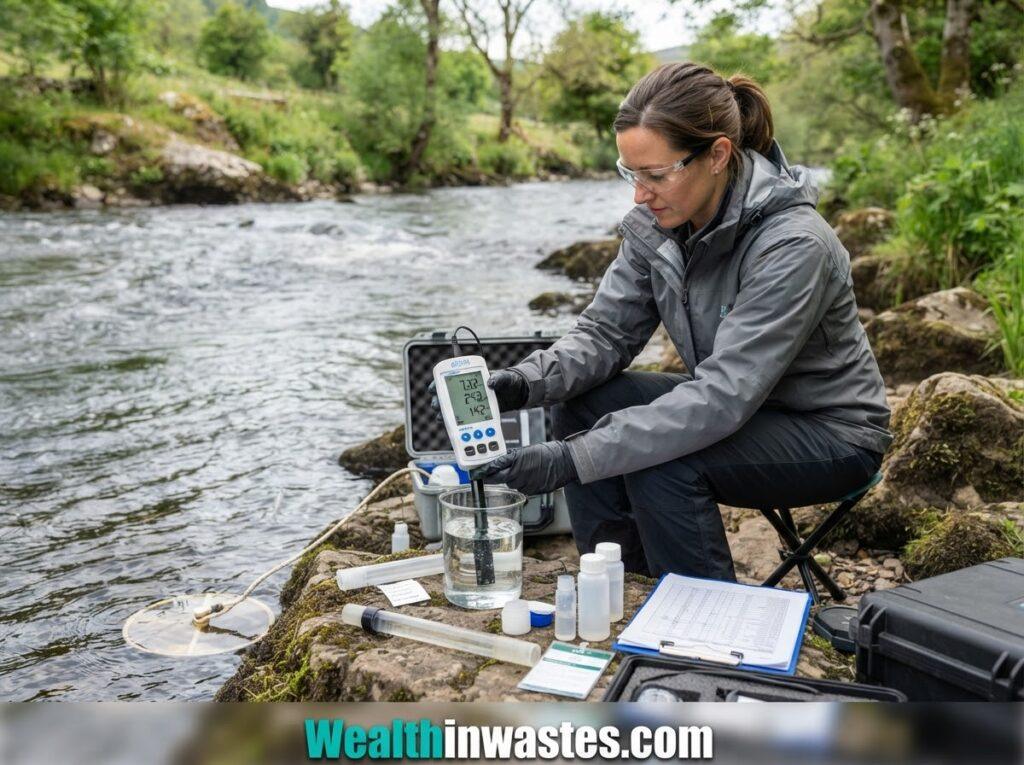
1. Temperature: Water temperature affects reaction rates, gas solubility and aquatic metabolism. Changes may stress fish, while warmer water holds less dissolved oxygen than cooler water, including in estuaries and coastal waters.
2. Colour, taste and odour: Unusual colour may indicate dissolved organic matter, metals or suspended particles, while taste and smell can signal treatment problems. These observations identify concerns but cannot prove safety.
3. Turbidity: Turbidity measures cloudiness caused by fine particles, plankton or organic matter. High readings can interfere with disinfection because particles may shield microorganisms, affecting sensitive organisms in polluted-water ecology.
4. Total suspended solids: Suspended solids include particles retained by a filter under a defined laboratory method. High concentrations reduce light penetration, clog equipment and smother habitats; their removal often involves sedimentation processes.
Chemical Parameters That Define Water Quality
1. pH: This scale indicates how acidic or alkaline water is, with 7 representing neutrality at standard conditions. A calibrated pH meter measures it, and extreme values can affect treatment, corrosion and aquatic life.
2. Electrical conductivity and TDS: Conductivity estimates the water’s ability to conduct electricity through dissolved ions. Total dissolved solids measures dissolved material, while conductivity provides a screening estimate for water-resource management, not an identical result.
3. Hardness: Calcium and magnesium ions cause most natural water hardness. Laboratories commonly use EDTA complexometric titration, while high hardness can produce scale, reduce soap lather and affect boilers or industrial processes.
4. Alkalinity and acidity: Alkalinity measures the capacity to neutralise acids, mainly through bicarbonate and carbonate ions. Acid titration determines it, and sufficient alkalinity helps resist sudden pH changes in water bodies.
5. Major dissolved ions: Chloride, sulphate, sodium, calcium, magnesium and potassium come from rocks, seawater intrusion, wastewater or other pollution sources. Their concentrations influence taste, salinity, scaling, corrosion and irrigation suitability.
6. Carbonate and bicarbonate: These forms of dissolved inorganic carbon contribute to alkalinity and interact with carbon dioxide. Titration can estimate them, although the distribution between forms changes with pH and sample conditions.
Dissolved Oxygen, BOD and COD
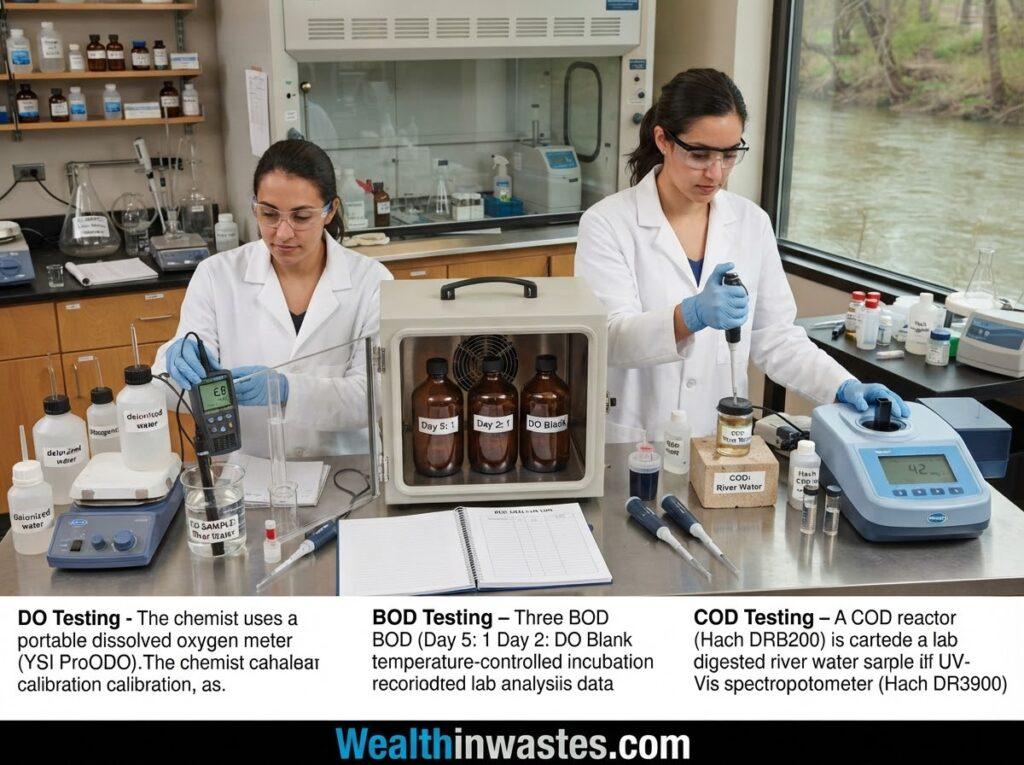
1. Dissolved oxygen: DO is the oxygen available in water for fish, invertebrates and aerobic microorganisms. A calibrated optical or electrochemical probe measures it directly, while the Winkler titration provides a laboratory alternative.
2. Biochemical oxygen demand: BOD measures oxygen consumed as microorganisms break down biodegradable material in water. A BOD5 test compares oxygen levels before and after five days at 20°C, helping assess municipal wastewater treatment.
3. Chemical oxygen demand: COD estimates the oxygen equivalent of substances oxidised by a chemical oxidant, commonly dichromate. It is faster than BOD and helps evaluate wastewater treatment options, but does not measure biodegradability directly.
4. Carbon dioxide: Dissolved carbon dioxide affects pH and carbonate balance, and changes with respiration, photosynthesis and gas exchange. Laboratories may assess it alongside pH, alkalinity and dissolved inorganic carbon.
Nutrients, Metals and Organic Contaminants
1. Nitrogen compounds: Ammonia, nitrite and nitrate enter water through sewage, animal waste, fertiliser runoff and decomposition. Testing helps identify pollution, track treatment performance and assess risks to infants and aquatic organisms.
2. Phosphate and silicate: Phosphate can stimulate excessive algal growth when supplies become enriched, while silicate supports some microscopic algae. Colorimetric or spectrophotometric methods measure these dissolved nutrients in suitable samples.
3. Trace metals: Arsenic, lead, cadmium, mercury, chromium, iron and manganese may originate from geology, mining, plumbing or industrial discharge. Sensitive instruments detect metals at low concentrations; hazardous substances can damage aquatic ecosystems.
4. Organic contaminants: Pesticides, petroleum compounds, solvents and industrial chemicals may enter water through runoff, spills or effluent. Their effects extend beyond the sample itself, as shown by the impact of industrial wastes.
Water-quality assessments often consider several contaminants together. For an overview of common types of water pollutants, identify likely sources and pathways before selecting methods and reporting limits for each source and intended use.
| Parameter | Possible source | Why it matters |
|---|---|---|
| Turbidity and suspended solids | Soil erosion, runoff and effluent | Reduce clarity and light penetration; particles may interfere with disinfection. |
| Nitrate and ammonia | Fertiliser, manure, sewage and decomposition | Indicate nutrient inputs; nitrate requires attention in drinking-water supplies. |
| Phosphate | Detergents, fertiliser and wastewater | Excess inputs can promote algal growth and oxygen depletion. |
| Chloride and sulphate | Natural minerals, saline intrusion and waste | May affect taste, salinity, corrosion or scaling. |
| Trace metals | Geology, plumbing, mining and industry | Some metals can cause harm at elevated concentrations. |
| Pesticides and solvents | Agricultural runoff, spills and industry | Require targeted testing because effects depend on the chemical and exposure. |
| Biodegradable organic matter | Sewage and other organic wastes | Raises oxygen demand and may reduce dissolved oxygen. |
Laboratory Methods for Water Analysis

1. Calibrate field meters: Check pH, conductivity, dissolved oxygen and turbidity instruments with suitable standards before use. Record calibration details, sample temperature, instrument identification and any measurement adjustments for each testing session.
2. Use titration for suitable tests: Acid titration measures alkalinity, while EDTA titration determines hardness and silver nitrate titration measures chloride. Correct reagents, endpoints, blanks and standard solutions support reliable results.
3. Apply colorimetric methods: Reagents produce measurable colour changes for selected nutrients and metals. A spectrophotometer compares absorbance with standards, so analysts prepare calibration curves and control reaction conditions carefully.
4. Select instrumental analysis: Flame photometry can determine sodium and potassium, while atomic absorption or ICP-MS can measure metals. Gas chromatography and liquid chromatography identify particular organic contaminants; environmental analysis tools support such investigations.
5. Protect sample integrity: Collect clean containers appropriate for each analysis, label them and prevent contamination during transport. Follow holding times, preservation instructions, blanks and duplicates; for effluent work, wastewater flow estimates inform sampling.
| Parameter | Common method | What it indicates |
|---|---|---|
| Temperature | Thermometer or probe | Thermal conditions |
| Colour, taste and odour | Visual and sensory checks | Appearance and acceptability |
| Turbidity | Nephelometer or turbidity meter | Cloudiness from particles |
| pH | Calibrated pH meter | Acidity or alkalinity |
| Conductivity | Conductivity meter | Dissolved ionic content |
| TDS | Gravimetric method; meter estimates | Total dissolved material |
| Hardness | EDTA titration | Calcium and magnesium |
| Alkalinity | Acid titration | Acid-neutralising capacity |
| Dissolved oxygen | Probe or Winkler titration | Oxygen present in sample |
| BOD5 | Five-day incubation and DO test | Biodegradable oxygen demand |
| COD | Dichromate digestion | Chemically oxidisable load |
| Trace metals | AAS or ICP-MS | Selected metal concentrations |
| Organic contaminants | GC-MS or LC-MS | Selected pesticides and chemicals |
Drinking Water Quality Standards and Limits
Drinking-water limits depend on national law, local regulation and the purpose of each value. The WHO’s updated guidance supports risk-based standards, while water-treatment objectives help explain how treatment targets protect public health.
This table summarises selected limits in Lagos State’s 2020 drinking-water standards. Other Nigerian states and water uses may require different criteria, so confirm applicable rules before judging compliance during routine monitoring.
| Parameter | Selected Lagos State value | Unit or condition |
|---|---|---|
| Colour | 15 | TCU maximum |
| Turbidity | 5 | NTU maximum |
| pH | 6.5–8.5 | Acceptable range |
| Electrical conductivity | 1,000 | µS/cm maximum |
| Total hardness | 150 | mg/L as CaCO3 maximum |
| Chloride | 250 | mg/L maximum |
| Fluoride | 1.5 | mg/L maximum |
| Nitrate (as NO3) | 50 | mg/L maximum |
| Nitrite (as NO2) | 0.2 | mg/L maximum |
| Sulphate | 100 | mg/L maximum |
| Total dissolved solids | 500 | mg/L maximum |
| Iron | 0.3 | mg/L maximum |
| Arsenic | 0.01 | mg/L maximum |
| Lead | 0.01 | mg/L maximum |
| E. coli | Not detectable | In any 100 mL sample |
Select Tests for Different Water Uses

1. Drinking water: Test microbial indicators, pH, turbidity, conductivity, nitrate, nitrite and metals. Add pesticide or industrial chemical tests when local activities suggest contamination; select suitable water treatment methods after interpreting results.
2. Irrigation water: Measure salinity or conductivity, sodium hazard, chloride, boron, bicarbonate and pH. Crop tolerance, soil drainage and climate determine whether water may cause salt accumulation; protect supplies through water-source protection measures.
3. Aquaculture: Monitor temperature, dissolved oxygen, pH, ammonia, alkalinity and suspended particles. Fish species, stocking density and feeding rates influence acceptable conditions, so check the water regularly rather than occasionally.
4. Wastewater discharge: Analyse BOD, COD, suspended solids, nutrients, pH, oil, metals and microbial indicators. Compare findings with permits and the specific needs of industrial wastewater treatment before discharge occurs.
5. Industrial processes: Choose tests according to equipment and production needs. Hardness, silica, chloride, sulphate, conductivity, iron and organic compounds can affect scaling, corrosion, product quality and treatment efficiency during routine operation.
Microbiological Testing and Water Safety
Water’s physico-chemical results do not show whether disease-causing microorganisms are present. Drinking-water assessments therefore pair chemical analysis with sanitary inspections and microbiological tests for Escherichia coli and other relevant indicators.
The WHO states that E. coli must not be detectable in any 100 mL sample of water intended for drinking. Detection requires prompt investigation and corrective action, even when the sample looks clear.
Laboratories use membrane filtration, multiple-tube fermentation or validated presence-and-absence methods, depending on the test. Collect microbiological samples in sterile containers and follow laboratory instructions to avoid contamination before laboratory processing.
Read Also: Environmental Factors Affecting Agribusiness Managerial Functions
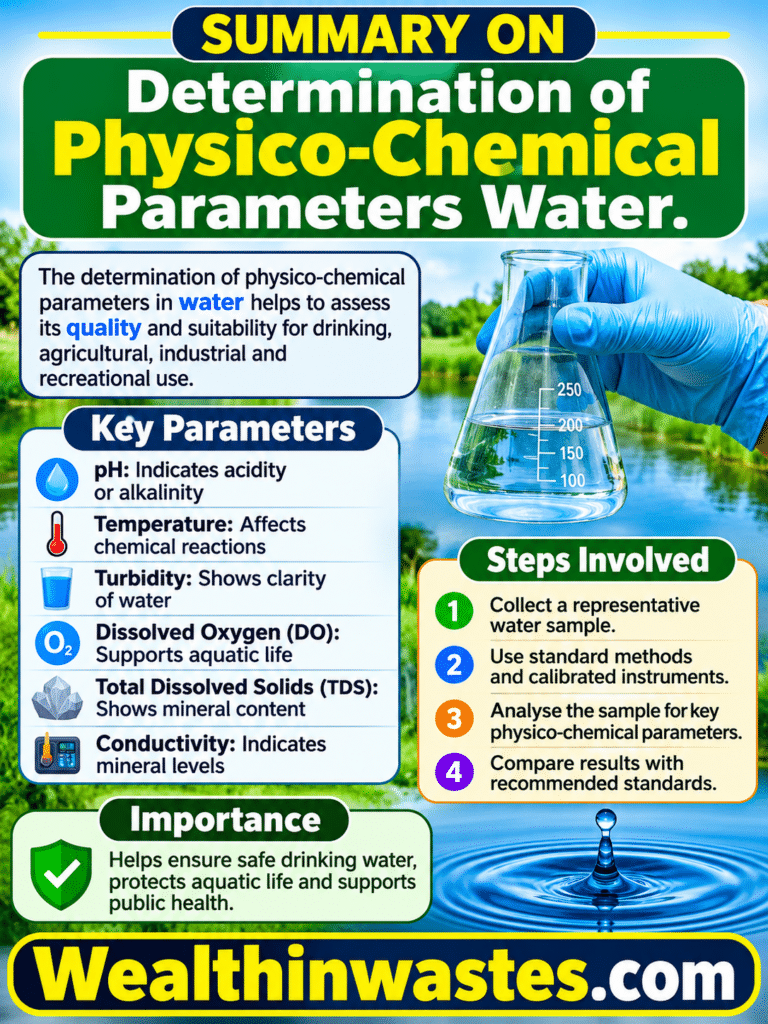
Summary on Determination of Physico-Chemical Parameters Water
| Area | Main parameters or tests | Practical purpose |
|---|---|---|
| Physical properties | Temperature, colour, odour, turbidity and suspended solids | Describe appearance, particles and thermal conditions. |
| General chemistry | pH, conductivity, TDS, hardness and alkalinity | Assess dissolved minerals, acidity, scaling and buffering. |
| Oxygen indicators | DO, BOD5 and COD | Assess oxygen availability and organic or chemical loads. |
| Nutrients and contaminants | Ammonia, nitrate, phosphate, metals and pesticides | Identify nutrient enrichment and potentially harmful substances. |
| Laboratory analysis | Meters, titration, colorimetry and instrumental methods | Produce reliable measurements when samples and instruments are controlled. |
| Drinking-water safety | Applicable chemical limits and E. coli testing | Check compliance and reduce health risks. |
| Use-specific testing | Drinking, irrigation, aquaculture, industry or wastewater tests | Match the test package to the intended water use. |
Frequently Asked Questions About Physico-Chemical Parameters of Water and How to Test Them
1. What Are Physico-Chemical Parameters of Water?
They are measurable physical and chemical properties used to assess water quality and suitability for a particular purpose.
2. What Are the Most Important Parameters?
Common tests include temperature, pH, turbidity, conductivity, TDS, hardness, alkalinity, dissolved oxygen, nutrients and relevant contaminants.
3. How Is Water pH Measured?
A calibrated pH meter measures the hydrogen-ion activity in a water sample. Analysts should calibrate it with suitable buffer solutions.
4. What Is the Difference Between BOD and COD?
BOD estimates oxygen used by microorganisms to break down biodegradable matter. COD measures the oxygen equivalent of chemically oxidisable substances.
5. Does Clear Water Mean It Is Safe to Drink?
No. Clear water may contain dissolved chemicals or harmful microorganisms. Laboratory testing and sanitary inspection are needed to assess safety.
6. How Often Should Water Be Tested?
Frequency depends on the source, treatment system, local rules and risk. Test after repairs, flooding, suspected contamination or changes in taste, colour or smell.
7. Which Parameters Matter for Irrigation?
Farmers commonly assess salinity, conductivity, sodium hazard, chloride, boron, bicarbonate and pH, alongside crop and soil conditions.
Do you have any questions, suggestions, or contributions? If so, please feel free to use the comment box below to share your thoughts. We also encourage you to kindly share this information with others who might benefit from it. Since we can’t reach everyone at once, we truly appreciate your help in spreading the word. Thank you very much for your support and for sharing!
Read Also: Economics of Irrigation and Water Use in Agriculture