


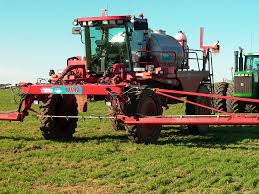
Herbicide absorption determines how much of an applied chemical becomes available to plants and reaches its intended site of action. Soil conditions strongly influence this availability after application in agricultural fields.
Once herbicides enter soil, they may become adsorbed by clay and organic matter, remain dissolved in soil water, or move through the soil profile with water and air currents.
The balance among these processes affects weed control, crop safety, herbicide persistence, and contamination possibilities. Therefore, understanding these factors supports better herbicide application decisions across different agricultural soils.
Several soil and herbicide properties interact during this process. Clay type, organic matter, soil pH, moisture, chemical structure, leaching, diffusion, and mass flow all influence herbicide availability.
This article explains how these factors control herbicide absorption and movement in soil. It also shows why the same herbicide can behave differently under different soil and environmental conditions.
Clay Colloids And Herbicide Absorption
1. Clay Surface Area: Clay type strongly affects adsorption because clay particles provide extensive surfaces and electrical charges that retain herbicide molecules, leaving less chemical dissolved in soil solution.
2. Montmorillonite: Montmorillonite has an expanding lattice and provides external and internal surfaces for adsorption. Its structure gives greater adsorptive capacity than illite, while kaolinite usually provides weaker adsorption.
3. Illite And Kaolinite: Illite has three layers without montmorillonite’s expanding character. Kaolinite contains alternating layers and fewer residual charges, although its hydroxyl surface can retain some organic chemicals strongly.
Read Also: Factors Affecting the Mobility of Other Toxicants in Soil
Soil Organic Matter and Herbicide Binding

Organic matter represents one of the most important factors affecting herbicide adsorption in soil. It includes humic materials, plant residues, animal residues, and microorganisms that provide additional binding sites.
Humic acid, fulvic acid, and humin form the principal humic fractions. These materials influence how strongly herbicides bind, while decomposing residues can develop greater sorptive capacity as cellulose declines.
Strong organic matter adsorption can reduce herbicide concentration in soil solution and lower immediate plant uptake. However, later desorption may return part of the retained chemical into solution again.
Soil pH And Herbicide Absorption
1. Herbicide Ionization: Soil pH changes herbicide charge and alters interactions with negatively charged clay and organic matter. It can also influence cation exchange capacity and microbial reactions affecting behavior.
2. Acidic And Basic Herbicides: Acidic herbicides such as 2,4-D, MCPA, dicamba, and picloram can release hydrogen ions in neutral solutions. Basic herbicides can instead accept hydrogen ions under acidic conditions.
3. Strongly Basic Herbicides: Strongly basic herbicides such as paraquat and diquat can remain positively charged across common soil pH conditions. They therefore bind rapidly and tightly to clay and organic matter.
Soil Moisture and Herbicide Availability
Soil moisture affects adsorption, desorption, diffusion, and phytotoxicity of herbicides present in the soil solution. Water molecules compete with organic compounds for available adsorption sites within soil particles.
Under dry conditions, fewer water molecules compete for adsorption sites, allowing some herbicides to become more strongly retained. Increasing moisture can displace previously adsorbed molecules into soil solution.
Greater water content also promotes molecular diffusion and mass flow through soil pores. Consequently, moisture can increase herbicide availability for plant uptake while simultaneously increasing movement beyond the target zone.
Chemical Properties and Herbicide Absorption
1.Molecular Structure: The chemical nature of a herbicide determines its polarity, ionization, solubility, adsorption strength, volatility, and movement within soil. Functional groups create important differences among herbicide compounds.
2. Ionic Character: Permanently ionized herbicides behave differently from ionizable and neutral compounds. Charged molecules interact strongly with soil surfaces, whereas nonionic herbicides generally depend more on physical adsorption forces.
3. Water Solubility: Water solubility affects the amount potentially available in soil water, although solubility alone does not predict free concentration. Soil adsorption can dominate equilibrium between dissolved and retained herbicide.
Leaching and Herbicide Movement
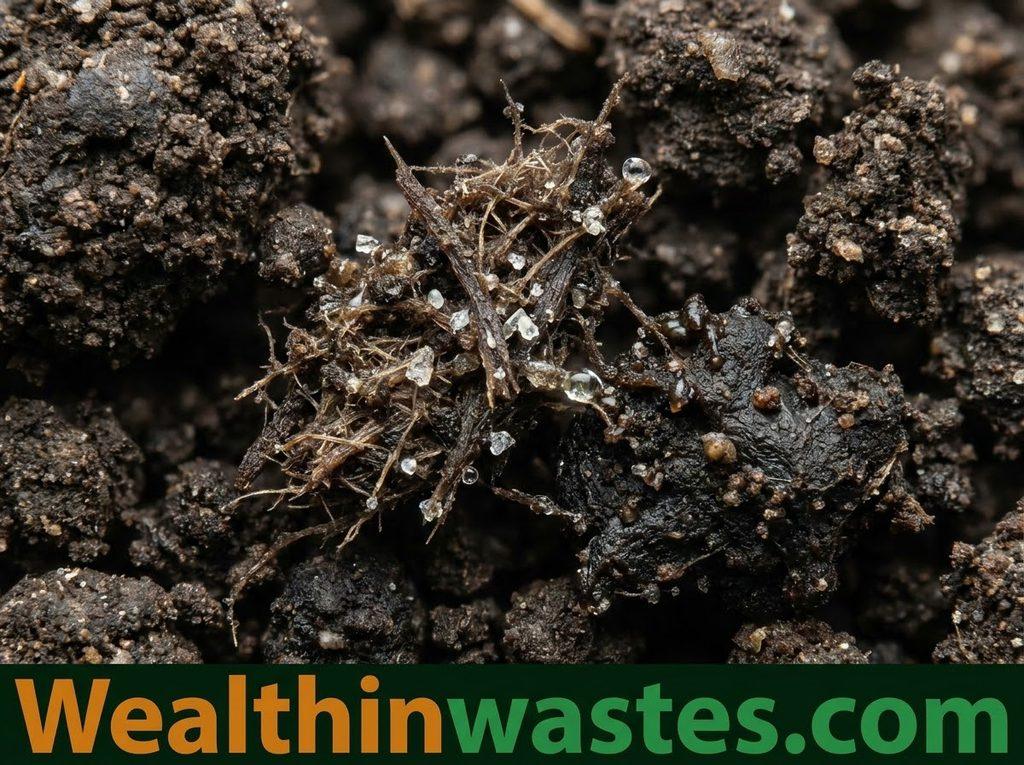
Leaching describes herbicide movement downward through soil with infiltrating water. Its intensity depends on herbicide properties, soil adsorption capacity, soil permeability, water supply, and application conditions.
Excessive leaching can move herbicide below the zone containing shallow-rooted weeds, reducing control. Conversely, movement toward deeper roots can increase exposure and cause injury to susceptible crops.
Rainfall or irrigation soon after application can increase downward movement, especially when soil remains permeable and the herbicide dissolves readily. Proper timing therefore matters for efficacy and environmental protection.
Diffusion and Herbicide Transport
1. Concentration Gradient: Diffusion moves herbicide molecules along concentration gradients from higher concentrations toward lower concentrations. This process helps distribute herbicides through liquid and gaseous phases within soil.
2. Moisture And Temperature: Diffusion changes with soil moisture and temperature. Very dry soil can restrict activity of herbicides that depend on soil water movement, while additional moisture improves transport.
3. Dry Soil Limitations: Herbicides such as trifluralin and triallate may perform poorly in extremely dry soil when movement toward roots becomes limited. Rainfall or irrigation can restore sufficient moisture for transport.
Mass Flow And Herbicide Uptake
Mass flow carries dissolved herbicide with water moving through soil and into plants during transpiration. The amount reaching roots depends strongly on water movement through the soil-plant-atmosphere system.
As soil water content declines, resistance within the soil and plant system increases, reducing transport. Atmospheric conditions such as radiation, temperature, and wind also affect transpiration and herbicide uptake.
Under suitable moisture conditions, herbicide uptake often correlates with transpiration rate. Higher plant water movement can increase delivery of dissolved herbicide to roots and influence concentration within plant tissues.
Read Also: Soil Herbicide Interaction and Herbicide Efficacy
Herbicide Uptake and Environmental Risk

Herbicide absorption depends mainly on the portion remaining free in soil water rather than strongly bound to soil colloids. Desorption therefore plays an important role in chemical availability.
Herbicide concentration in soil water reflects combined effects of solubility, adsorption, desorption, and soil water content. These relationships explain why identical application rates can produce different results.
Understanding absorption helps farmers balance effective weed control with crop safety and environmental protection. Strong retention can reduce activity, whereas excessive mobility can increase leaching, runoff, and contamination risks.
Soil and water contamination risks increase when herbicides move beyond their intended target areas. Farmers should therefore consider soil texture and related soil properties before application.
Adsorption controls whether chemicals remain attached to soil particles or move with water. A clear understanding of pesticide movement and absorption in soil helps explain these differences.
Management practices also influence how readily herbicides leave treated areas.Appropriate timing, application rates, and irrigation practices described in pesticide mobility management practices can reduce unnecessary movement.
Herbicide persistence can change the duration of exposure after application. The discussion of pesticide degradation factors in soil shows how moisture, pH, microorganisms, temperature, and chemical properties influence persistence.
Groundwater depth and underlying geological conditions can also determine transport pathways. Information on site conditions affecting pesticide mobility helps farmers recognize situations where deeper movement may occur.
Herbicides reaching streams or other surface waters may remain dissolved or attach to particles. The article on pesticide transport through surface waters explains how these forms move differently.
Soil contamination from chemicals can affect plants, microorganisms, and water resources. Readers can further examine these concerns through the effects of hazardous substances on soil and plant life.
Preventing pesticide movement requires careful water management and suitable application conditions. Practical recommendations for preventing water pollution include avoiding unnecessary pesticide losses into drainage channels.
Agricultural pesticide runoff represents an important non-point pollution source. Understanding sources and types of water pollution helps place herbicide movement within the wider environmental contamination picture.
Herbicide movement can contribute to broader land contamination when chemicals accumulate or migrate outside treated areas. The discussion of land pollution causes, effects, and solutions provides useful context.
Water quality assessment becomes important where agricultural chemicals reach surface or underground water. Readers can explore water quality principles and management for additional environmental understanding.
Where contamination occurs, appropriate control measures depend on the pollutant and affected environment. Guidance on cleaning up and controlling specific pollutants discusses broader pollution-management approaches.
Reliable analysis can help identify pesticide residues and contamination in environmental samples. Information about air, water, and soil analysis tools explains why testing supports environmental decisions.
Pesticide use can also generate agricultural waste through containers and chemical applications. The article on agricultural waste sources and characteristics addresses these related environmental concerns.
Herbicide residues that move through soil and water can eventually affect animals through contaminated feed or drinking sources. See sources of pesticide residue contamination for further context.
Once plants absorb pesticides, biochemical processes may transform them within plant tissues. The discussion of pesticide degradation and metabolism in plants explains these reactions.
Pollution can create economic consequences when agricultural productivity, water resources, or other environmental services become affected. The article on economic losses resulting from pollution explores this broader effect.
Effective pollution control also requires responsible institutions, monitoring, and enforcement. Readers interested in governance can review institutional arrangements for pollution control for additional information.
Finally, herbicide contamination forms part of wider environmental waste concerns involving soil, water, and land. The discussion of general waste impacts on the environment provides broader perspective.
Summary on Factors Affecting the Absorption of Herbicides
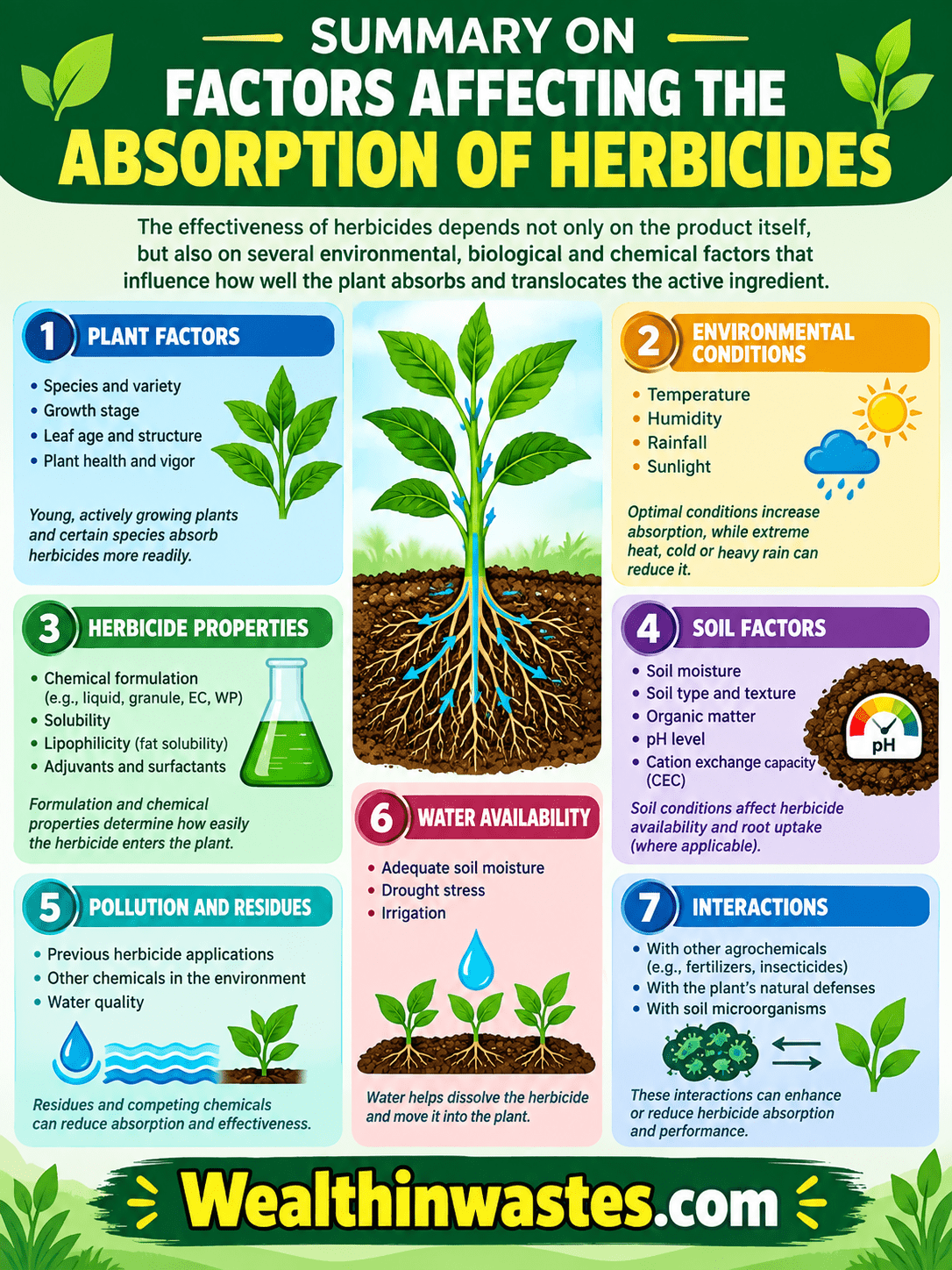
| Factor | Main Effect | Importance |
|---|---|---|
| Clay colloids | Adsorb herbicide molecules and reduce free concentration | Clay type determines adsorption strength |
| Organic matter | Provides important binding sites | Strongly influences adsorption and availability |
| Soil pH | Changes herbicide ionization and soil charge relationships | Controls adsorption for many ionic herbicides |
| Soil moisture | Affects adsorption, desorption, diffusion, and mass flow | Controls movement toward plant roots |
| Chemical nature | Determines polarity, solubility, ionization, and adsorption | Different herbicides behave differently |
| Leaching | Moves dissolved herbicides downward | Can improve or reduce weed control |
| Diffusion | Moves molecules along concentration gradients | Supports movement toward roots |
| Mass flow | Carries dissolved herbicide with moving water | Links soil water movement with plant uptake |
Frequently Asked Questions About Factors Affecting the Absorption of Herbicides
1. What is the main factor affecting herbicide absorption?
Soil adsorption strongly controls the amount of herbicide remaining in soil solution, while soil moisture, pH, organic matter, and chemical properties also contribute.
2. How does clay affect herbicide absorption?
Clay provides charged surfaces that can adsorb herbicides. Montmorillonite generally has greater adsorption capacity than illite and kaolinite because of its expanding lattice.
3. Why does soil organic matter affect herbicides?
Organic matter provides binding sites that can retain herbicide molecules. Strong adsorption may reduce immediate plant uptake, although later desorption can return chemicals to soil solution.
4. Does soil pH change herbicide absorption?
Yes. Soil pH changes the ionization and charge of many herbicides, affecting their attraction to negatively charged soil and organic matter surfaces.
5. How does moisture influence herbicide availability?
Water competes with herbicide molecules for adsorption sites. Increasing moisture can release some retained chemicals into soil solution and improve diffusion and mass flow.
6. What is herbicide leaching?
Leaching is the downward movement of herbicides through soil with infiltrating water. Excessive leaching can reduce weed control and increase risks to groundwater and susceptible crops.
7. What is the difference between diffusion and mass flow?
Diffusion moves molecules along concentration gradients, while mass flow carries dissolved herbicides with moving water associated with soil transport and plant transpiration.
8. Why can the same herbicide behave differently in different soils?
Different soils vary in clay content, organic matter, pH, moisture, permeability, and biological activity. These differences change adsorption, desorption, movement, degradation, and plant availability.
Do you have any questions, suggestions, or contributions? If so, please feel free to use the comment box below to share your thoughts. We also encourage you to kindly share this information with others who might benefit from it. Since we can’t reach everyone at once, we truly appreciate your help in spreading the word. Thank you very much for your support and for sharing!
Read Also: Chemical Methods of Weed Control Guide