



Noise policies help governments manage unwanted sound from transportation, industries, households, construction activities, and other sources that can interfere with health, comfort, communication, productivity, and environmental quality.
Countries do not regulate noise in exactly the same way because legal responsibilities, measurement methods, land-use patterns, industrial activities, and public expectations differ considerably across national and local jurisdictions.
Some governments focus strongly on workplace exposure, while others emphasize community noise, transportation corridors, airport planning, industrial emissions, or restrictions on household equipment and nighttime activities within residential neighborhoods.
Effective noise policies normally combine standards, monitoring, planning controls, enforcement procedures, public education, and practical reduction measures to reduce excessive exposure while allowing essential economic and social activities.
This article examines selected approaches in Argentina, Australia, South Africa, and the United States, while explaining common policy elements and why stronger coordination remains important for environmental health worldwide.
What Noise Policies Aim to Achieve
Noise policies establish acceptable limits and management procedures that help authorities identify excessive sound, protect sensitive populations, guide development decisions, and encourage responsible operation of noisy facilities.
Countries often connect regulatory standards with action plans whenever measured exposure becomes unacceptable. These plans can address transportation, industry, neighborhoods, construction, entertainment venues, and other relevant sources.
Strong regulatory systems also encourage prevention instead of relying entirely on complaints after problems occur. Planning authorities can consider noise before approving roads, airports, factories, housing developments, and other projects.
1. Public Health Protection: Noise policies help reduce excessive exposure that may contribute to hearing problems, sleep disturbance, stress, communication difficulties, reduced concentration, and other harmful effects on people.
2. Environmental Protection: Noise controls can reduce disturbance to wildlife and sensitive ecosystems, particularly where transportation, industrial operations, construction, or urban expansion generates persistent or sudden high-intensity sounds.
3. Community Compatibility: Regulations help different land uses coexist by separating noisy activities from sensitive locations and by establishing operating conditions for businesses, machinery, transport systems, and neighborhood activities.
Read Also: Types of Wastewater and Motivational Factors for Recycling/Reuse
Key Features of Effective Noise Policies
Although national frameworks differ, successful noise policies usually contain several connected elements that define responsibilities, establish measurable standards, and create practical mechanisms for controlling noise from multiple sources.
1. Noise Standards: Authorities establish measurable limits using appropriate sound descriptors, exposure periods, locations, and times of day so officials can compare observed noise with accepted regulatory conditions.
2. Monitoring Systems: Reliable measurements allow environmental agencies, employers, municipalities, and communities to identify problem areas, assess compliance, investigate complaints, and evaluate whether control programmes actually reduce exposure.
3. Land-Use Planning: Planning controls can prevent incompatible development by considering noise when authorities approve housing, highways, airports, factories, commercial facilities, and other developments near sensitive receptors.
4. Enforcement Procedures: Clear enforcement procedures help authorities respond to violations through inspections, warnings, corrective requirements, penalties, and other appropriate measures that encourage compliance with established noise standards.
Noise Policies and Regulations in Argentina
Argentina provides an example of a regulatory approach that combines workplace exposure controls with municipal measures addressing unnecessary and excessive community noise in residential and other zones.
The reference material describes a national workplace approach that limited daily eight-hour industrial noise exposure to 80 dB, alongside hearing assessments, medical follow-up, and continuing workplace noise control measures.
Industrial employers responded through regular assessment of noise sources, technical advice, worker education, and appropriate personal protective equipment. These measures support a broader understanding of environmental pollution as a controllable public concern.
Municipal approaches distinguish unnecessary noise, which authorities may prohibit, from excessive noise, which may receive specific day and night limits depending on activities and the characteristics of different zones.
Such arrangements show why environmental management principles matter when governments balance economic activities with community wellbeing. Local authorities remain important because many noise complaints occur within neighborhoods.
Noise Policies and Controls in Australia

Australia shares noise-control responsibilities primarily between state and local governments, while nationally agreed requirements also influence airport planning and noise emissions from newly manufactured vehicles.
The Australian Noise Exposure Forecast, or ANEF, describes aircraft noise exposure around airports. Planning controls restrict certain residential development within higher exposure contours and require sound insulation within specified areas.
Road traffic noise limits vary between states because authorities use different exposure metrics and allowable levels. New vehicles also follow stringent design requirements covering noise and other environmental emissions.
Local governments can regulate household equipment and noisy machinery by controlling operating periods. These practical measures reflect the wider principles found in environmental management for cities, where urban authorities address several environmental pressures together.
Australia therefore demonstrates how federal, state, and municipal responsibilities can operate together. Similar coordination can support environmental management best practices while allowing regional authorities to address local conditions.
Noise Policies and Regulation in South Africa
South Africa developed noise-control measures over several decades, beginning with professional codes of practice and later introducing legal provisions covering noise, vibration, and shock.
The Environment Conservation Act of 1989 provided a basis for regulations, and regulations published in 1990 allowed local authorities to apply national provisions within their areas under the framework described.
Later constitutional arrangements placed legislative responsibility for noise control primarily with provincial and local authorities. This approach made enforcement closely connected to subnational government structures and local responsibilities.
1. Provincial Responsibility: Provincial structures can develop or apply regulatory provisions suited to regional circumstances while maintaining a broader legal framework for managing environmental noise.
2. Local Enforcement: Municipal authorities play a central role in investigating complaints, applying operating requirements, managing land-use conflicts, and enforcing noise controls within communities and commercial areas.
3. Environmental Integration: Noise regulation works best when authorities coordinate it with broader pollution control, sanitation, planning, and environmental programmes instead of treating sound as an isolated issue.
Integrated management also connects noise control with institutional arrangements for pollution control, where different government bodies share responsibilities for monitoring, enforcement, and environmental protection.
Read Also: Proper Waste Control Complete Guide
Noise Policies and Regulation in the United States

The United States treated environmental noise as a national policy concern through the Noise Control Act of 1972, which directed federal authorities to develop scientific information and guidance concerning noise exposure and health.
The policy framework aimed to protect public health and wellbeing with an adequate margin of safety. The U.S. Environmental Protection Agency subsequently published information describing exposure levels and associated effects.
The framework considered sound descriptions, human responses, important health effects, and exposure criteria. Environmental impact guidance later strengthened the use of consistent sound descriptors for assessing community noise.
Environmental noise also connects with broader sources and types of environmental pollution, because transportation, industry, combustion equipment, construction, and urban activities often generate several pollutants simultaneously.
The United States example demonstrates the importance of scientific evidence when governments create standards. Effective air and environmental quality policies similarly depend on measurements, health information, monitoring, and enforceable regulatory approaches.
Noise policies should also consider economic consequences because communities and industries may face costs when pollution remains uncontrolled. Research into economic losses resulting from pollution illustrates why prevention can have wider social value.
How Countries Compare Their Noise Policies
Comparing national approaches reveals that governments share similar objectives, even when their legislation, institutions, standards, and enforcement procedures differ. The strongest systems combine technical rules with practical implementation.
1. Workplace Focus: Some systems emphasize occupational exposure because workers may experience prolonged contact with machinery, engines, industrial equipment, and other high-level noise sources.
2. Community Focus: Other systems place stronger emphasis on residential areas, transportation, entertainment, household equipment, and nighttime disturbance because these sources frequently generate public complaints.
3. Planning Focus: Airport, highway, industrial, and housing decisions can incorporate noise exposure before construction begins, reducing future conflicts between incompatible land uses.
4. Enforcement Focus: Effective regulation requires clear responsibilities, competent inspectors, reliable measurements, complaint procedures, penalties, corrective actions, and opportunities for affected communities to participate in environmental decision-making.
5. Public Awareness: Education helps residents and businesses understand applicable limits, reporting channels, responsible equipment use, and practical prevention measures that can reduce unnecessary noise.
Why Stronger Global Noise Policies Matter

Noise crosses administrative boundaries through roads, airports, industrial corridors, ports, and expanding cities. For this reason, stronger cooperation can help countries share research, measurement methods, planning practices, and successful control strategies.
Noise reduction should form part of broader environmental programmes. For example, effective sanitation and environmental management already recognize unwanted noise as a community nuisance requiring appropriate attention.
Governments can also reduce noise through better equipment design, preventive maintenance, quieter transport technologies, building insulation, vegetation barriers, zoning controls, operating-hour restrictions, and thoughtful infrastructure planning.
These strategies become more effective when communities understand them. Public education and stakeholder participation can strengthen compliance, while pollution reduction practices encourage prevention before environmental problems become difficult or expensive to manage.
Businesses can also connect noise management with industrial environmental management, particularly where factories generate noise alongside solid waste, air emissions, wastewater, and other environmental pressures requiring coordinated controls.
At household and community levels, reducing unnecessary consumption and waste can support quieter, cleaner surroundings. practical environmental management measures can complement direct noise-control initiatives.
Noise management can further benefit from energy-conscious equipment choices. energy-saving environmental practices often encourage efficient machines and responsible transportation decisions that can also reduce unnecessary mechanical noise.
Communities should also understand how environmental risks interact. environmental and health effects of pollution can include several simultaneous pressures, making integrated planning more useful than isolated regulatory responses.
Waste prevention and recycling programmes can also contribute to more orderly communities. waste reduction at source reduces activities such as collection, transportation, and processing that may generate additional vehicle and machinery noise.
Recycling remains another useful environmental management strategy. recycling as a pollution-control method supports efficient resource use and can form part of broader sustainability programmes that include responsible noise management.
Households can similarly benefit from household waste minimization practices, especially where cleaner neighborhoods, responsible equipment use, and better community planning contribute to reduced environmental nuisance.
Water and noise management may appear unrelated, yet both require monitoring, enforcement, and prevention. Lessons from water pollution control show the importance of identifying sources and managing environmental risks systematically.
Authorities can also learn from practical pollution-control strategies, particularly the value of preventing contamination at source and combining technical measures with regulation, monitoring, education, and institutional cooperation.
Modern environmental management increasingly emphasizes prevention, accountability, and continuous improvement. The principles discussed in waste minimization and reduction planning can equally support a preventive approach to noise control.
Protecting people from environmental hazards requires reliable evidence. Research concerning pollution impacts on human health reinforces the need for policies that address environmental exposures before they create avoidable health burdens.
Environmental planning also benefits from practical city-level strategies. urban environmental management can incorporate transportation planning, green spaces, waste management, energy efficiency, and noise reduction within one coordinated framework.
Finally, governments need consistent review of their standards as technology, urban density, transport patterns, and public expectations change. Good policy remains adaptable while retaining clear protections for health, communities, and ecosystems.
Summary on Noise Policies and Controls in Different Countries
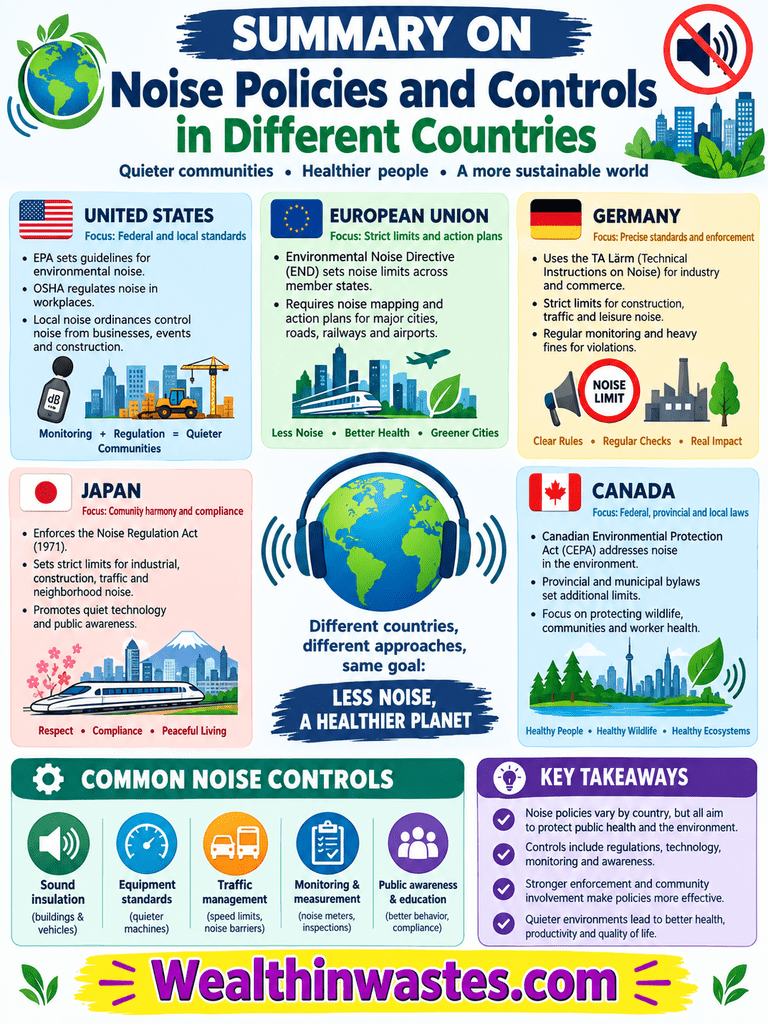
| Country or Topic | Main Approach | Important Policy Element |
|---|---|---|
| Argentina | Workplace and municipal controls | Industrial exposure management and day/night community limits |
| Australia | State and local regulation | Airport planning, vehicle standards, traffic controls, household restrictions |
| South Africa | Provincial and local responsibility | Noise, vibration, enforcement, and environmental regulation |
| United States | Federal scientific framework | Noise exposure research, criteria, descriptors, and environmental assessment |
| Global Direction | Integrated environmental management | Monitoring, planning, prevention, enforcement, education, and cooperation |
Frequently Asked Questions About Noise Policies in Different Countries
1. What are noise policies?
Noise policies are laws, standards, planning rules, and control measures that regulate excessive sound and protect people, communities, workplaces, and environments.
2. Why do countries have different noise policies?
Countries differ because their legal systems, urban structures, transportation networks, industries, environmental priorities, measurement methods, and government responsibilities vary.
3. Which country uses the ANEF approach?
Australia uses the Australian Noise Exposure Forecast system to describe aircraft noise exposure and guide airport-related land-use planning decisions.
4. What does the Noise Control Act of 1972 relate to?
It established environmental noise as a significant national policy issue in the United States and directed federal authorities toward scientific noise guidance.
5. Why are nighttime noise limits important?
Nighttime controls help protect sleep, reduce disturbance in residential communities, and manage activities that could create persistent or disruptive environmental noise.
6. How can communities reduce excessive noise?
Communities can support monitoring, responsible equipment use, appropriate operating hours, better land-use planning, quieter technologies, public education, and enforcement of applicable regulations.
7. Do noise policies protect workers?
Yes. Occupational noise rules can limit exposure, encourage hearing conservation programmes, require monitoring, and promote protective equipment where workplace noise remains excessive.
8. Can noise policies protect wildlife?
Yes. Appropriate controls can reduce disturbance from transportation, construction, industrial activities, and other high-intensity sources affecting sensitive habitats and wildlife behavior.
Do you have any questions, suggestions, or contributions? If so, please feel free to use the comment box below to share your thoughts. We also encourage you to kindly share this information with others who might benefit from it. Since we can’t reach everyone at once, we truly appreciate your help in spreading the word. Thank you very much for your support and for sharing!
Read Also: Fungi: Nature’s Recyclers and Their Impact on Life