



The dissemination of environmental information helps research findings, environmental knowledge, policies, and practical recommendations reach people who can apply them effectively. Good dissemination connects reliable information with decisions that influence environmental conditions.
Once the dissemination objective and audience have been identified, organizations can select suitable channels for sharing environmental information. The method should reflect the audience’s knowledge, communication needs, resources, location, and expected response.
There is no single communication method that works equally well for every environmental issue or audience. Researchers, government agencies, community groups, businesses, and educators often combine several methods to improve understanding and practical application.
Environmental information may concern pollution, waste management, natural resources, climate change, water quality, biodiversity, environmental health, or sustainable development. Effective dissemination makes such information accessible, understandable, timely, and relevant.
The most successful approaches connect researchers and information users through publications, meetings, training, media, community activities, websites, and interactive communication. These approaches encourage wider participation and support better environmental decision-making.
Purpose of Environmental Information Dissemination
Dissemination serves more than the simple distribution of information. It helps organizations communicate evidence, explain environmental problems, influence responsible behaviour, strengthen professional practice, and support decisions that protect natural resources.
Organizations also need dependable systems for managing information, especially when environmental records come from many programmes and stakeholders. Digital environmental management tools can support organized information handling, analysis, compliance activities, and stakeholder communication.
The quality of environmental communication also depends on clear objectives and responsible presentation. Guiding principles of environmental management can help organizations present information in ways that support balanced decisions, public responsibility, and environmental protection.
Dissemination therefore creates a bridge between knowledge producers and information users. When this bridge functions effectively, research findings can influence policies, improve professional practices, increase public awareness, and strengthen environmental action.
Research Channels for Environmental Information
1. Peer-Reviewed Publications: Peer-reviewed publications remain important for communicating environmental research to scientists, academics, ministries, agencies, and technical specialists because professional review improves credibility and supports confidence in research findings.
2. Professional Journals: Professional journals communicate practical environmental knowledge to engineers, consultants, planners, and environmental managers. They can translate specialized research into information that practitioners can apply during routine environmental planning and management.
3. Research Briefings: Research briefings summarize important findings for decision-makers who may not have time to study complete research reports. They highlight key evidence, implications, uncertainties, recommendations, and practical actions in accessible language.
4. Special Briefings: Special briefings combine findings from several related studies and present them around a major environmental issue. This approach can reveal broader patterns, identify knowledge gaps, and provide stronger evidence for policy discussions.
5. Project Reports: Project reports document objectives, methods, findings, challenges, and recommendations. Organizations can use them to update funders, government agencies, research partners, and other stakeholders while maintaining a useful record for future programmes.
Environmental research often depends on reliable field information and clearly presented evidence. Classified sources of water pollution provide an example of information that can support technical education, environmental assessment, and pollution-control discussions.
Monitoring information also becomes more useful when researchers communicate what the data means and how decision-makers can use it. Environmental monitoring programmes can supply evidence for identifying environmental changes, assessing risks, and tracking progress.
Likewise, research concerning industrial activities can reach regulators, companies, and communities through suitable publications and briefings. Industrial waste impacts illustrate how technical findings can explain environmental risks linked with industrial waste generation.
Read Also: Methods of Dissemination of Environmental Information
Professional Methods of Environmental Information Dissemination

1. Conferences And Meetings: Conferences allow researchers, government officials, environmental professionals, businesses, and community representatives to exchange evidence, compare experiences, discuss emerging problems, and develop relationships that support continuing environmental collaboration.
2. Face-To-Face Communication: Face-to-face communication allows information users to ask questions directly and request clarification. Researchers can explain assumptions, limitations, uncertainties, and practical implications more effectively during personal discussions with stakeholders.
3. Regular Forums: Regular forums bring together research institutions, government, businesses, communities, and professional organizations around important environmental concerns. They encourage repeated information exchange and can strengthen cooperation between groups with different responsibilities.
4. Informal Networks: Informal networks enable professionals and local institutions to exchange environmental information regularly without relying entirely on formal publications. They can provide quick updates about emerging problems, local experiences, and practical responses.
5. Research Site Visits: Excursions to laboratories, monitoring stations, treatment facilities, and field sites help users understand research processes and environmental conditions directly. They can make technical information more practical, memorable, and easier to interpret.
Professional communication becomes especially important where environmental problems create measurable financial consequences. Economic losses from pollution can help decision-makers understand why environmental information matters for planning, regulation, investment, and prevention.
Social communication also matters because communities experience environmental problems differently. Community responses to environmental pollution can help organizations understand public perceptions, local concerns, and barriers that may affect environmental programmes.
Strong institutions provide another important communication pathway. Institutional arrangements for pollution control show how agencies can coordinate responsibilities, communicate information, and support programmes designed to control environmental hazards effectively.
Community Methods for Environmental Information
1. Posters And Information Packs: Posters, slides, brochures, guides, and audio-visual materials can present environmental messages in simple formats. They work particularly well in schools, community centres, health facilities, agricultural programmes, offices, and public events.
2. Local Languages And Dialects: Environmental information becomes easier to understand when organizations communicate through languages familiar to their audiences. Local terminology can reduce misunderstanding and increase participation among people with limited access to technical information.
3.Rural Exhibitions: Special exhibitions during fairs, festivals, agricultural events, and community gatherings provide opportunities to display environmental information through demonstrations, photographs, posters, models, and discussions that attract diverse audiences.
4. Community Meetings: Community meetings allow environmental organizations to present information directly to residents, answer questions, listen to concerns, and understand local experiences. They can also encourage communities to participate in environmental monitoring and action.
5. Adult Education Programmes: Adult education programmes can incorporate practical environmental topics into existing learning activities. This approach helps participants connect environmental information with household practices, farming activities, sanitation, waste management, health, and resource conservation.
Community communication should address environmental issues that people experience directly. Different sources and types of environmental pollution can be explained through familiar examples that help residents understand local environmental risks.
Water-related information also benefits from practical communication. Practical approaches to controlling water pollution can provide communities with understandable guidance about prevention, responsible waste handling, and protection of water resources.
Climate information requires similarly accessible communication because changing environmental conditions can affect households, ecosystems, and livelihoods. Climate change and sustainability information can support public understanding of environmental risks and responsible adaptation.
Digital Methods of Environmental Information Dissemination

1. Organizational Websites: Websites provide a permanent location for publishing reports, newsletters, research summaries, policy documents, educational materials, project updates, and announcements that users can access whenever necessary.
2. Social Media: Social media platforms can distribute environmental messages rapidly to large audiences. Organizations can share short explanations, graphics, videos, project updates, event notices, research highlights, and links to detailed publications.
3. Digital Newsletters: Digital newsletters help organizations maintain continuing relationships with subscribers and professional networks. Regular editions can summarize programme developments, recent research, upcoming events, policy changes, environmental alerts, and opportunities for participation.
4. Press Releases: Press releases provide journalists and media organizations with concise information about new research, environmental projects, policy developments, campaigns, and significant findings that deserve wider public attention.
5. Online Briefings: Webinars and online meetings allow researchers and organizations to communicate with audiences who cannot attend physical events. They can combine presentations, visual materials, questions, discussions, and recorded sessions for later viewing.
Digital dissemination works best when online information remains clear, organized, and updated. Effective waste-management strategies show how structured environmental information can support coordinated planning, implementation, monitoring, and communication.
Policy communication can also benefit from online publication. Effective waste-management policies can be presented through websites and social media so professionals, communities, businesses, and institutions can review important responsibilities and environmental objectives.
Recycling information can reach even broader audiences through digital channels. Recycling as an environmental pollution-control approach can be shared through educational posts, instructional materials, campaigns, videos, and community recycling programmes.
Audience-Based Environmental Information Strategies
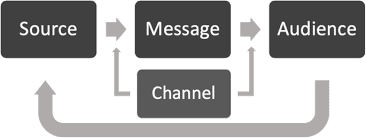
Effective dissemination begins with understanding who needs the information and what they intend to do with it.Researchers may require technical detail, while communities may prefer practical messages, demonstrations, local examples, and understandable explanations.
Government officials often need concise evidence that supports policy decisions, regulations, budgeting, and programme evaluation. Businesses may seek information that clarifies environmental responsibilities, operational risks, compliance requirements, resource efficiency, and possible financial consequences.
Water-quality information, for example, should match the needs of the intended users. Water-quality principles provide technical knowledge that professionals can interpret, while educators can simplify the same information for community learning.
Different audiences may also require different communication speeds and formats. Water-pollution information and classifications can support detailed professional discussions, while shorter summaries can help households understand pollution sources and prevention measures.
Audience-based planning improves the chances that environmental information will lead to meaningful action. Organizations should therefore consider language, literacy, technical background, access to communication channels, cultural context, and the audience’s practical responsibilities.
Challenges In Environmental Information Dissemination
Environmental information may fail to achieve its purpose when technical language, limited resources, poor communication infrastructure, misinformation, weak coordination, or low public interest prevents audiences from understanding or using the information correctly.
Another difficulty arises when information reaches users without adequate context. Clear explanations should identify the problem, evidence, uncertainty, expected consequences, and practical responses so readers can distinguish reliable findings from unsupported claims.
Information about waste reduction offers a practical example. Waste minimization and reduction guidance can help organizations explain preventive measures instead of focusing only on disposal after waste has already been generated.
Household communication also needs practical recommendations that people can follow consistently. Household waste reduction approaches can strengthen environmental education by connecting information with everyday consumption, reuse, recovery, and disposal practices.
Organizations can overcome many dissemination barriers by combining communication methods, training information providers, using local languages, simplifying technical findings, updating digital platforms, and creating opportunities for users to ask questions and provide feedback.
Read Also: Tools Used for Dissemination of Environmental Information
Measuring Environmental Information Dissemination Success

Dissemination should not end when information reaches an audience. Organizations should evaluate whether people understood the message, trusted the evidence, changed their knowledge, adopted recommended practices, or used the information in decision-making.
Useful indicators may include publication downloads, website visits, newsletter subscriptions, meeting attendance, training participation, media coverage, stakeholder feedback, policy references, community actions, and improvements in environmental practices following communication activities.
Waste-management information provides useful examples of measurable outcomes. Proper waste-disposal methods can be evaluated by examining whether users adopt safer disposal practices, improve waste separation, reduce pollution, or increase material recovery.
Recycling campaigns can similarly measure changes in participation, collection volumes, material recovery, and public knowledge. Recycling guidance and its environmental advantages can support evaluation of whether communicated messages encourage practical recycling behaviour.
Evaluation findings should then improve future communication.Organizations can identify which channels performed well, which audiences remained unreached, which messages caused confusion, and which approaches encouraged stronger environmental decisions or practical behavioural change.
Summary on Methods of Dissemination of Environmental Information
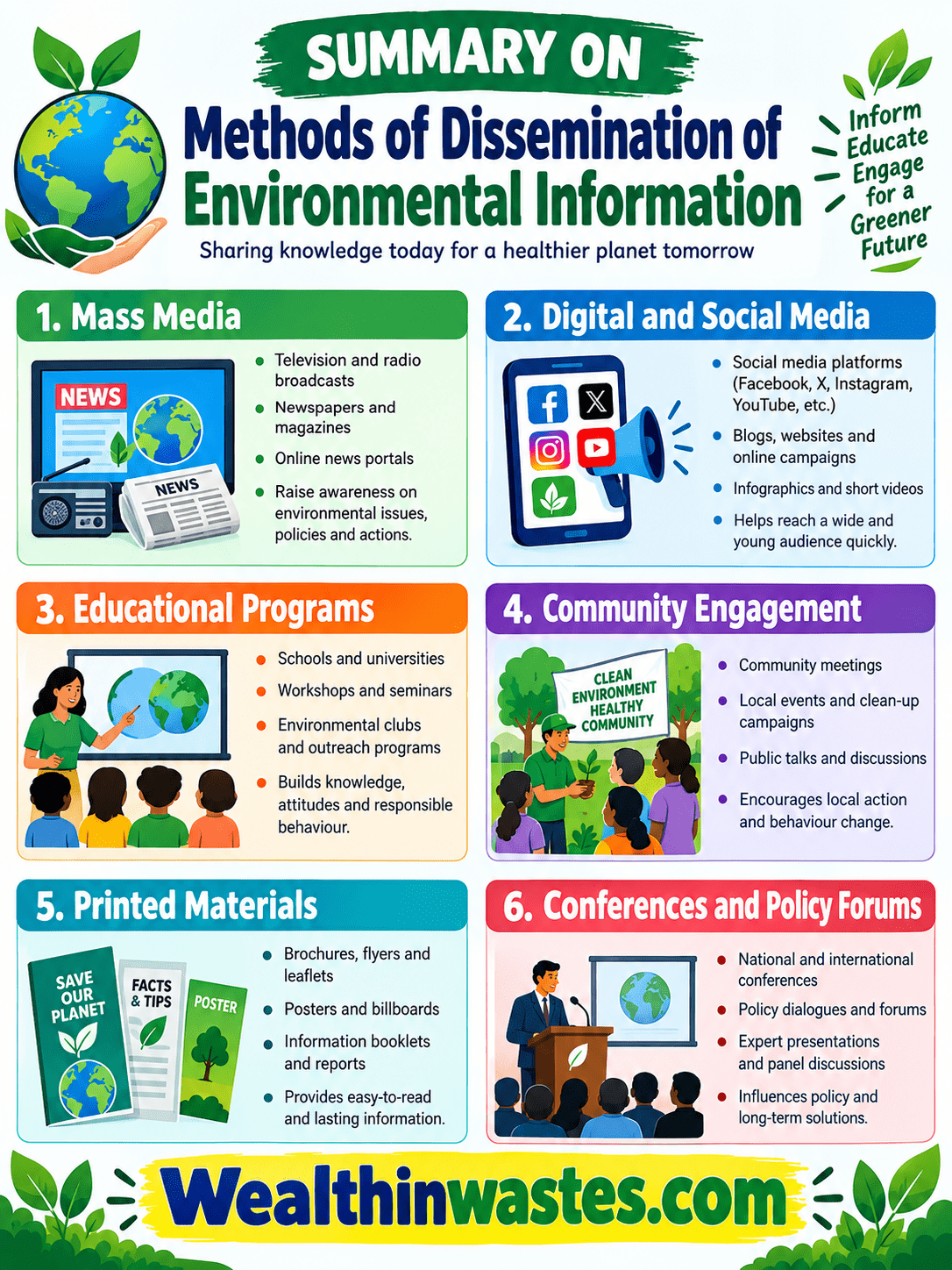
| Aspect | Summary |
|---|---|
| Purpose | Connect environmental knowledge with people who can apply it. |
| Research Channels | Peer-reviewed publications, journals, briefings, reports, and conferences communicate reliable evidence. |
| Community Methods | Posters, local languages, exhibitions, meetings, and adult education improve public understanding. |
| Digital Methods | Websites, newsletters, social media, press releases, and webinars expand information reach. |
| Audience Strategy | Messages should match users’ knowledge, responsibilities, language, needs, and communication access. |
| Professional Communication | Forums, networks, meetings, and site visits strengthen collaboration and direct understanding. |
| Evaluation | Success can be measured through reach, understanding, participation, adoption, feedback, and environmental outcomes. |
Frequently Asked Questions About Methods of Dissemination of Environmental Information
1. What is dissemination of environmental information?
Dissemination of environmental information is the organized sharing of environmental research, knowledge, policies, findings, and recommendations through communication channels that reach relevant users and support informed environmental decisions.
2. Why is environmental information dissemination important?
It helps researchers, governments, businesses, communities, and professionals understand environmental problems, apply useful findings, support sound policies, improve practices, and participate more effectively in environmental protection activities.
3. What is the best method of environmental communication?
No single method works best for every audience. Effective organizations normally combine publications, meetings, community outreach, digital platforms, media communication, training, and other approaches according to audience needs.
4. How can communities receive environmental information?
Communities can receive environmental information through local meetings, posters, exhibitions, radio, newspapers, social media, adult education programmes, community organizations, local languages, and direct communication with environmental professionals.
5. How does social media support environmental dissemination?
Social media allows organizations to distribute environmental messages quickly, share visual materials, promote events, publish research highlights, answer public questions, direct users to detailed resources, and reach geographically dispersed audiences.
6. Why should environmental information use local languages?
Local-language communication can improve comprehension, reduce confusion, encourage participation, and make environmental information more relevant to people who may have limited access to technical terminology or formal scientific publications.
7. How can organizations measure dissemination success?
Organizations can measure success through audience reach, publication use, participation, feedback, knowledge improvement, media attention, policy application, behavioural changes, and environmental outcomes associated with the communicated information.
8. Who should disseminate environmental information?
Researchers, environmental agencies, government institutions, professional organizations, educational institutions, community groups, businesses, journalists, and trained information officers can disseminate environmental information effectively to appropriate audiences.
Do you have any questions, suggestions, or contributions? If so, please feel free to use the comment box below to share your thoughts. We also encourage you to kindly share this information with others who might benefit from it. Since we can’t reach everyone at once, we truly appreciate your help in spreading the word.Thank you very much for your support and for sharing!
Read Also: Proper Farm Waste management guide