


Plants require water for photosynthesis, growth, reproduction, nutrient movement, and temperature regulation. Because crops continually lose water through transpiration, adequate moisture remains essential for maintaining healthy development and achieving satisfactory agricultural yields.
Crop water demand varies considerably according to species, climate, soil characteristics, growth stage, planting density, and management practices. Understanding these differences helps farmers determine when irrigation becomes necessary and how applications should be managed.
Rainfall supplies much of the water required for crop production, but seasonal shortages can interrupt plant development, particularly in dry or semi-arid regions. Irrigation provides additional water when natural precipitation cannot meet crop demand.
The relationship between irrigated crops and land use extends beyond simply supplying water. Irrigation can improve land productivity, support multiple cropping, stabilize yields, and increase the value of agricultural land when resources remain carefully managed.
However, poorly planned irrigation can create serious problems, including excessive water consumption, rising production costs, salinity, waterlogging, erosion, nutrient losses, and declining groundwater supplies. Sustainable irrigation therefore requires careful coordination between land, water, energy, and crop management.
Understanding Irrigated Crops and Land Use
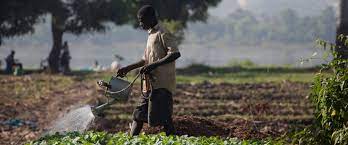
Irrigated crops are plants grown with supplemental water supplied through irrigation systems when rainfall cannot provide enough moisture. Farmers use irrigation to maintain suitable soil moisture and reduce production risks associated with dry periods.
Irrigation becomes especially important where rainfall is seasonal, unpredictable, or insufficient. In such environments, controlled water supplies can extend growing seasons and allow farmers to produce crops during periods when rainfed cultivation becomes difficult.
The water required by crops can range widely because each species has different physiological needs and growing conditions. Soil properties also determine how much available moisture roots can store and access during crop development.
Effective land use therefore depends on matching irrigation practices with soil capacity, crop requirements, climate conditions, drainage characteristics, and available water resources. Farmers should evaluate these factors before expanding irrigated production.
Good land management protects productive soils while conserving water and maintaining long-term agricultural value. Detailed discussion of these relationships is also available in this guide to land distribution and agricultural land suitability.
Likewise, maintaining healthy soils helps irrigation remain productive because soil structure influences infiltration, water storage, drainage, root development, and nutrient availability throughout the growing season. Farmers therefore need integrated land and water planning.
Soil quality can decline when farmers repeatedly cultivate land without protecting organic matter, structure, drainage, and biological activity. Sustainable practices therefore remain essential wherever irrigation intensifies agricultural production.
Read Also: On-site Municipal Wastewaters Treatment
Water Requirements of Irrigated Crops
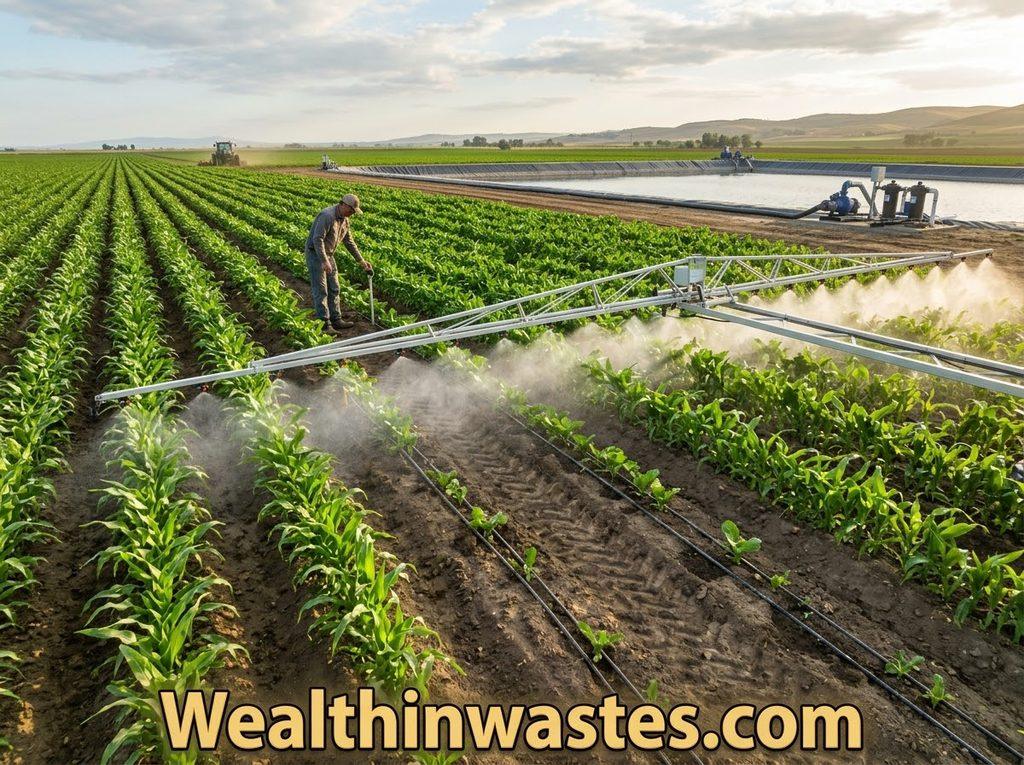
1. Crop Water Demand: Crop water demand represents the amount of water required to maintain growth, development, transpiration, and production under particular environmental and management conditions throughout the growing period.
2. Soil Moisture: Plants perform best when the soil contains enough available moisture for roots to absorb water without becoming excessively saturated. Different crops tolerate different moisture levels before stress reduces productivity.
3. Evapotranspiration: Evapotranspiration combines water lost through soil evaporation and plant transpiration. Temperature, sunlight, humidity, wind speed, canopy size, and crop growth stage can substantially influence these losses.
4.Water Application: Farmers should apply irrigation according to actual crop demand rather than simply flooding fields at fixed intervals. Correct application reduces waste while maintaining adequate moisture throughout critical growth stages.
Food and forage crops can require hundreds or thousands of litres of water for every kilogram of dry matter produced. Water demand therefore differs greatly among crops and management systems.
For example, high-yielding crops can consume several million litres of water per hectare during one growing season. Crop yield, biomass production, weather conditions, and soil characteristics all influence this total requirement.
Water requirements also change during crop development. Germination, flowering, fruit formation, and grain filling may require reliable moisture because severe water stress during these stages can significantly reduce final yields.
Farmers can improve irrigation decisions by understanding the protection and development of water resources that support agricultural production and ensuring that water withdrawals remain within sustainable limits.
Water quality matters as much as quantity because contaminated irrigation supplies may introduce salts, pathogens, nutrients, or toxic substances into farmland. Such problems can gradually reduce soil quality and affect crop performance.
Understanding water quality principles helps farmers recognize why irrigation sources require regular assessment, particularly when surface water, wastewater, or groundwater supplies experience contamination risks.
Factors That Shape Irrigation Demand
Climate strongly influences irrigation demand because temperature, rainfall, solar radiation, humidity, and wind determine how quickly water leaves soil and plants. Hot, dry, windy conditions generally increase crop water requirements.
Soil texture also matters because sandy soils usually drain quickly, while finer soils can retain more water. Organic matter can improve soil structure and increase its capacity to hold available moisture.
Vegetative cover protects soil surfaces from direct sunlight and rainfall impact while reducing unnecessary evaporation and erosion. Farmers who maintain suitable ground cover can improve moisture conservation and protect agricultural land.
Topography affects how irrigation water moves across fields. Sloping farmland may experience runoff, erosion, or uneven distribution, while poorly drained areas can accumulate excess water and create conditions that damage crop roots.
Crop type and rooting depth also influence irrigation demand. Deep-rooted plants can access water from larger soil volumes, whereas shallow-rooted crops may require more frequent applications to avoid moisture stress.
Farmers should also consider soil degradation because compaction and declining organic matter can reduce infiltration and water-holding capacity. Guidance on soil and mineral resource management highlights these important land-quality relationships.
Land degradation can increase irrigation losses by encouraging runoff, limiting root penetration, and reducing the amount of water stored within the crop root zone. Protecting soil structure therefore supports efficient water use.
Farmers can adopt soil conservation practices such as mulching, cover cropping, minimum tillage, contour cultivation, and organic matter management. These approaches can reduce runoff while improving infiltration and moisture retention.
The broader principles discussed in resource conservation and water conservation also demonstrate why agricultural water management must protect freshwater supplies for present and future users.
Irrigated Crops and Agricultural Land Productivity
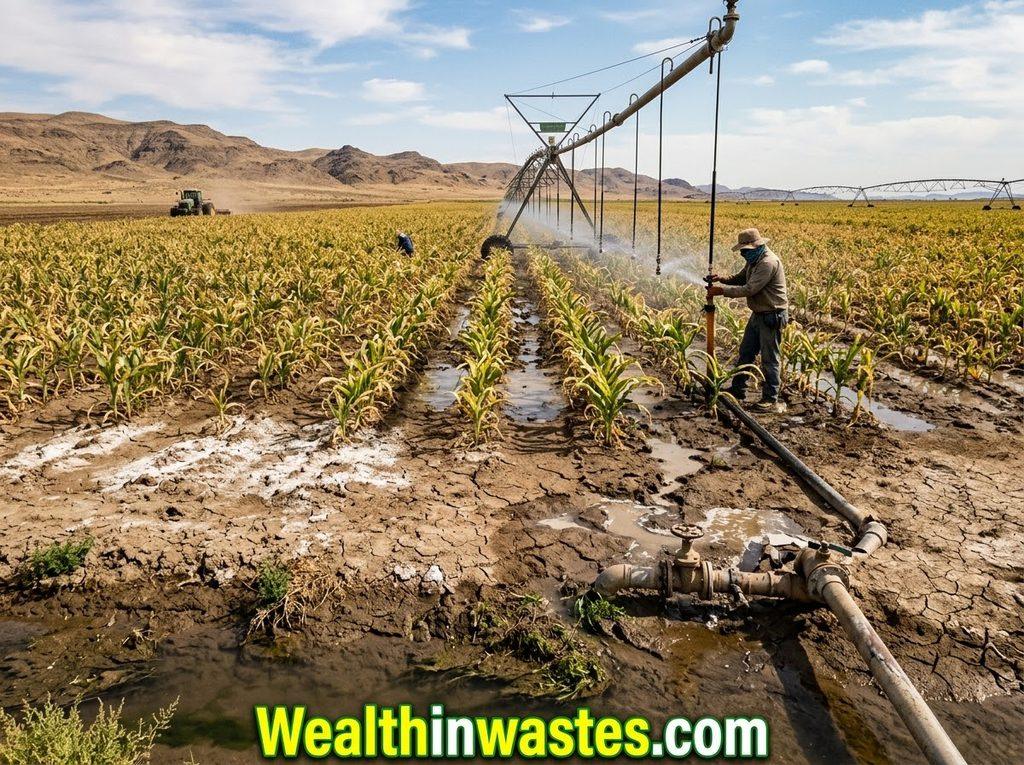
1. Higher Yield Potential: Irrigation can supply moisture during periods when rainfall cannot satisfy crop requirements, allowing farmers to reduce drought-related losses and achieve more reliable yields from productive agricultural land.
2.Multiple Cropping: Reliable water supplies can extend growing seasons and support more than one crop cycle where climate, soil fertility, labour, and market conditions permit profitable production.
3. Improved Land Utilization: Irrigation can make some seasonally dry areas more productive by providing controlled moisture. Proper planning can therefore increase land-use intensity without requiring continuous expansion into new agricultural areas.
4. Greater Production Stability: Dependable irrigation reduces farmers’ dependence on uncertain rainfall, helping stabilize production when dry spells occur. This can support household food supplies, market planning, and agricultural investment decisions.
Irrigated agriculture occupies only part of global cropland, yet it makes a major contribution to food production. This demonstrates the importance of water control in improving agricultural land productivity.
However, higher productivity does not automatically mean sustainable land use. Farmers must balance production gains with water availability, soil condition, energy costs, drainage requirements, and potential environmental impacts.
Land productivity can decline when irrigation causes salinity or prolonged saturation. These problems reduce root activity, interfere with nutrient uptake, and may eventually make productive farmland difficult or expensive to cultivate.
Information on conservation of soil and freshwater resources reinforces the need to protect the natural resource base while using irrigation to strengthen agricultural production.
Good irrigation planning therefore treats land and water as connected resources. Farmers should evaluate field suitability, crop profitability, drainage conditions, and long-term water availability before making major investments.
Improved land productivity also depends on maintaining soil fertility because crops receiving adequate water still require sufficient nutrients. Proper nutrient management should accompany irrigation rather than replace fundamental soil improvement practices.
Energy Costs of Irrigated Crop Production
Irrigation requires energy whenever farmers pump, lift, pressurize, transport, or distribute water. Consequently, irrigated crops often require greater energy inputs than comparable rainfed systems, particularly where water must travel long distances.
The energy requirement depends heavily on the water source and lifting height. Surface water delivered by gravity may require relatively little pumping, while deep groundwater can demand substantially more energy.
Fuel and electricity expenses directly affect farm profitability. Rising pumping costs can make irrigation uneconomical when crop prices remain low, especially for farmers operating on small margins or using inefficient equipment.
Efficient irrigation systems can reduce energy use by applying water more accurately and minimizing unnecessary pumping. Regular maintenance also helps prevent leaks, pressure losses, blocked emitters, and inefficient water distribution.
Energy costs should therefore form part of irrigation investment decisions rather than remain an afterthought. Farmers need to compare installation costs, operating expenses, expected yields, and long-term maintenance requirements before selecting systems.
Water conservation can lower energy demand because every unnecessary litre pumped represents additional work. Practices that improve soil moisture retention and reduce irrigation frequency can consequently benefit both farm finances and resource efficiency.
The environmental consequences of poor resource management can also increase agricultural costs. Research summarized in the economic losses resulting from pollution illustrates how environmental damage can affect productive activities.
Farmers should also prevent contaminated water from entering irrigation systems because pollution can damage soils and crops while creating additional treatment or remediation expenses. Clean water supplies remain a valuable production asset.
Where energy prices are high, farmers can consider gravity-fed systems, efficient pumps, properly sized pipes, improved scheduling, and suitable low-pressure irrigation technologies. These measures can reduce operating costs while maintaining adequate crop moisture.
Read Also: Meaning and Scope of Environmental Geoscience
Common Challenges in Irrigated Crop Systems
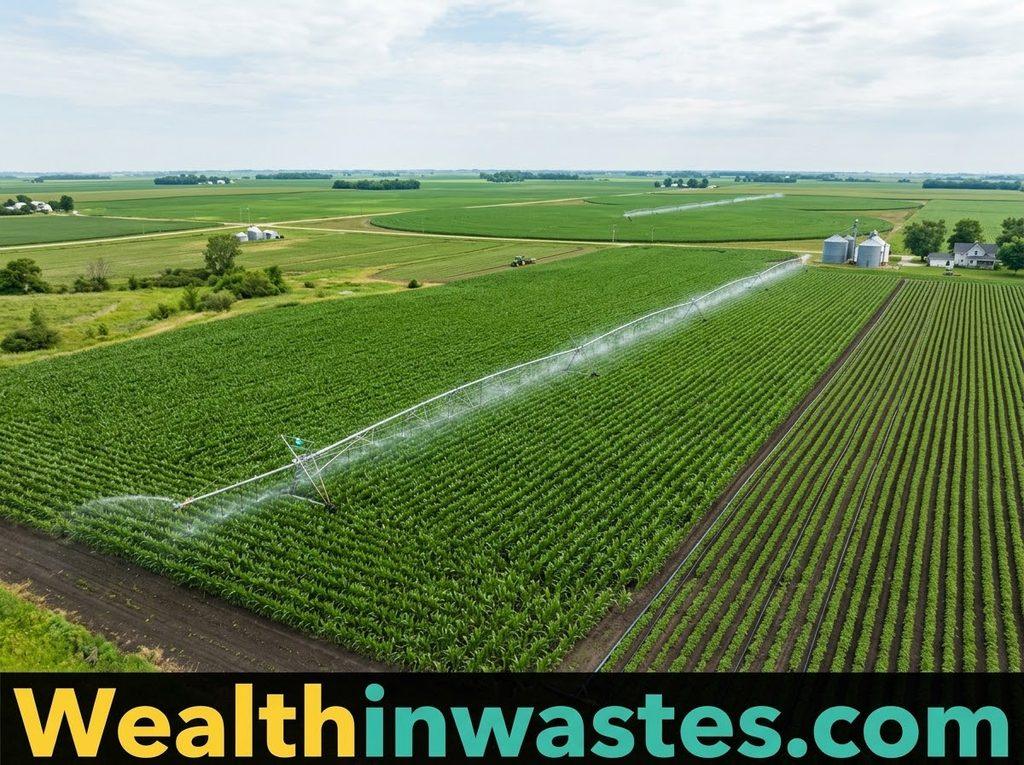
1. Soil Salinity: Repeated irrigation can introduce dissolved salts into soil, especially where evaporation is high and drainage is inadequate. Salt accumulation can impair root water uptake and gradually reduce crop productivity.
2. Waterlogging: Excessive irrigation or poor drainage can saturate the root zone for prolonged periods. Waterlogging reduces soil aeration, weakens roots, encourages disease, and can seriously affect sensitive crops.
3. Nutrient Losses: Applying more water than crops require can move soluble nutrients below the root zone or carry them into surface waters. Efficient irrigation helps reduce these unnecessary losses.
4. Water Pollution: Irrigation runoff can transport fertilizers, pesticides, sediment, and other contaminants into streams and groundwater. Farmers need careful application practices that protect surrounding water resources and aquatic ecosystems.
Salinity represents one of the major threats to irrigated land because accumulated salts can make soils progressively less suitable for agriculture. Effective drainage and appropriate irrigation management help control this risk.
Waterlogging creates another serious problem because roots require oxygen as well as water. Fields that remain saturated for long periods can experience poor nutrient uptake, root damage, and reduced crop growth.
Excess water can also increase runoff and transport agricultural chemicals into nearby water bodies. Farmers can learn more about these pathways through guidance on water pollution sources and classifications.
Pesticide movement becomes particularly important when irrigation produces surface runoff. Information on pesticide movement and absorption in soil shows why careful water application should accompany responsible pesticide management.
Farmers should avoid irrigating with contaminated water because polluted supplies may introduce harmful substances into agricultural soils. Untreated industrial effluents can create additional risks for crop quality and soil productivity.
Recent guidance on industrial effluents and their environmental impacts reinforces the importance of protecting irrigation sources from industrial contamination.
Where wastewater enters agricultural systems, appropriate treatment and water-quality monitoring become essential. Farmers should understand the source, composition, and potential contamination of any non-freshwater supply before using it for crops.
Sustainable Land Use for Irrigated Crops
1. Improve Soil Structure: Adding organic matter, reducing unnecessary tillage, maintaining crop residues, and protecting soil cover can improve infiltration, reduce runoff, and increase the amount of water available to crop roots.
2. Strengthen Drainage: Effective drainage removes excess water from the root zone and reduces waterlogging. Drainage design should suit soil properties, terrain, rainfall patterns, irrigation intensity, and the crop production system.
3. Protect Water Sources: Farmers should prevent agricultural chemicals, wastes, sediments, and contaminated discharges from entering irrigation sources. Protecting rivers, reservoirs, wells, and groundwater supports reliable production over time.
4. Use Water Efficiently: Farmers should match irrigation timing and application volumes with crop demand, soil conditions, weather, and field capacity. Efficient systems reduce evaporation, runoff, deep drainage, and unnecessary pumping.
Sustainable irrigation begins with healthy soil because well-structured soils generally accept and store water more effectively.Compost and other organic amendments can improve physical properties while supporting long-term soil productivity.
Farmers can explore organic waste composting for agriculture as one practical approach to increasing soil organic matter and improving water retention in appropriate production systems.
Agricultural residues can also provide useful soil amendments when farmers manage them safely. Proper recycling reduces waste while returning organic materials and nutrients to productive land.
Guidance on agricultural waste management explains why responsible handling of farm residues can support soil resources and reduce environmental problems associated with unmanaged agricultural wastes.
Farmers may also use crop residues, compost, manure, and suitable cover crops to improve soil moisture retention. These practices can reduce dependence on frequent irrigation while supporting soil fertility and biological activity.
Proper management of manure and organic materials remains important because excessive or poorly timed applications can contribute to nutrient runoff. Sustainable land use requires balancing fertility improvement with water-quality protection.
Better Water Management for Crop Production
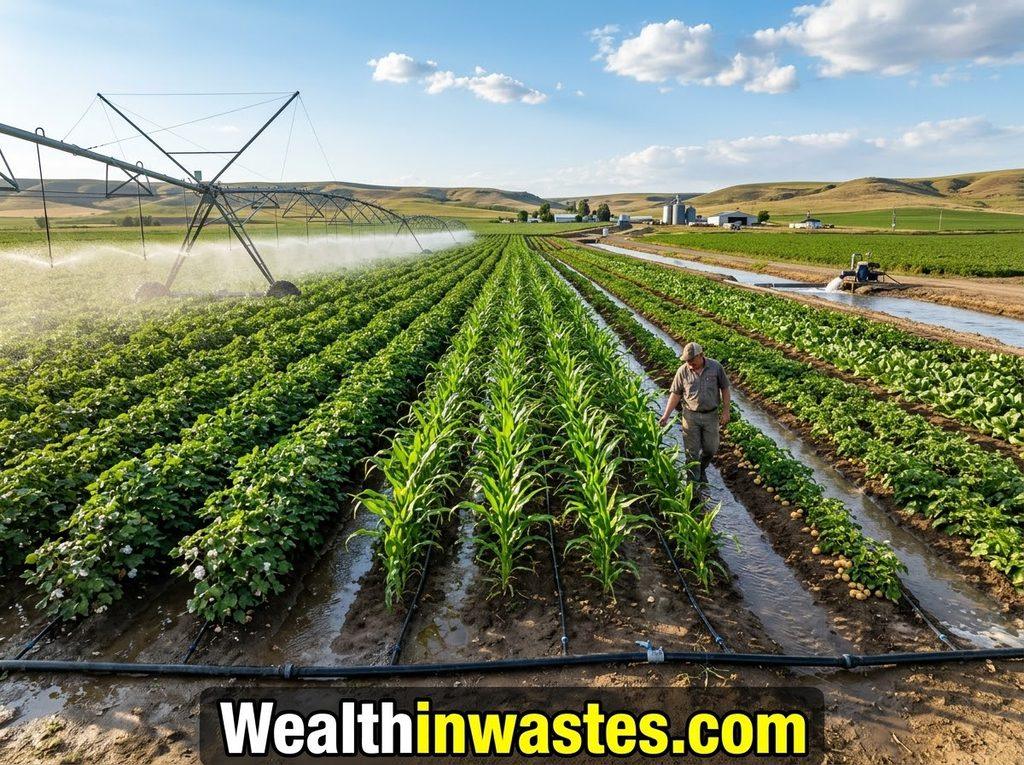
Efficient water management starts with knowing how much moisture crops need and when they need it. Irrigation should respond to crop growth stages, weather conditions, soil moisture, and field drainage conditions.
Farmers can use soil observations, irrigation schedules, weather information, and suitable monitoring tools to avoid applying excessive water. Better timing improves crop performance while reducing pumping costs and unnecessary water losses.
Water conservation also requires protecting watersheds because rivers, reservoirs, wetlands, and groundwater systems support agricultural production. Land-use decisions upstream can influence both the quantity and quality of water available downstream.
Protecting surrounding ecosystems can therefore contribute to agricultural resilience. The discussion on watershed pollution solutions and management provides useful context for protecting water resources from agricultural and other pollution sources.
Wastewater reuse may support irrigation where freshwater supplies are limited, but farmers must ensure appropriate treatment and water-quality standards. Untreated wastewater can introduce pathogens, salts, toxic compounds, and excessive nutrients.
Information about wastewater sources and management highlights why farmers should assess irrigation water before reuse and adopt treatment measures where contamination creates potential risks.
Farmers can also reduce pollution risks by limiting fertilizer and pesticide applications to crop requirements. Proper timing helps prevent excess chemicals from leaving fields through runoff or infiltrating groundwater.
Guidance on water quality improvement methods also emphasizes pollution prevention, runoff control, buffer vegetation, and responsible agricultural practices that protect water bodies and surrounding ecosystems.
Organic residues and recyclable agricultural materials can support more sustainable land management when properly reused. Farmers can examine agricultural waste recycling options for ways to turn useful residues into soil improvement resources.
Compost produced from suitable organic materials can improve soil condition and help conserve moisture. Practical information on composting and manure management can support responsible application decisions on farms.
Food and organic residues can also enter composting systems instead of disposal streams. Farmers interested in sustainable resource recovery can review food waste management and composting practices for additional soil-building approaches.
Reducing waste remains another part of sustainable land use because poorly managed solid materials can occupy agricultural land, contaminate water, and create environmental burdens. Responsible disposal and recycling therefore complement irrigation management.
Farmers and communities can review proper waste management methods to understand practices that reduce pollution risks and support cleaner agricultural environments around productive irrigated areas.
Protecting farmland from broader land pollution also matters because contamination can interfere with soil productivity and water quality. More information is available through this resource on land pollution and its composition.
Finally, environmental impacts from poorly managed waste can spread through soil and water systems. Farmers can consult information on environmental and health effects of wastes to better understand these interconnected risks.
Summary on Irrigated Crops and Land Use: Water, Energy and Yield
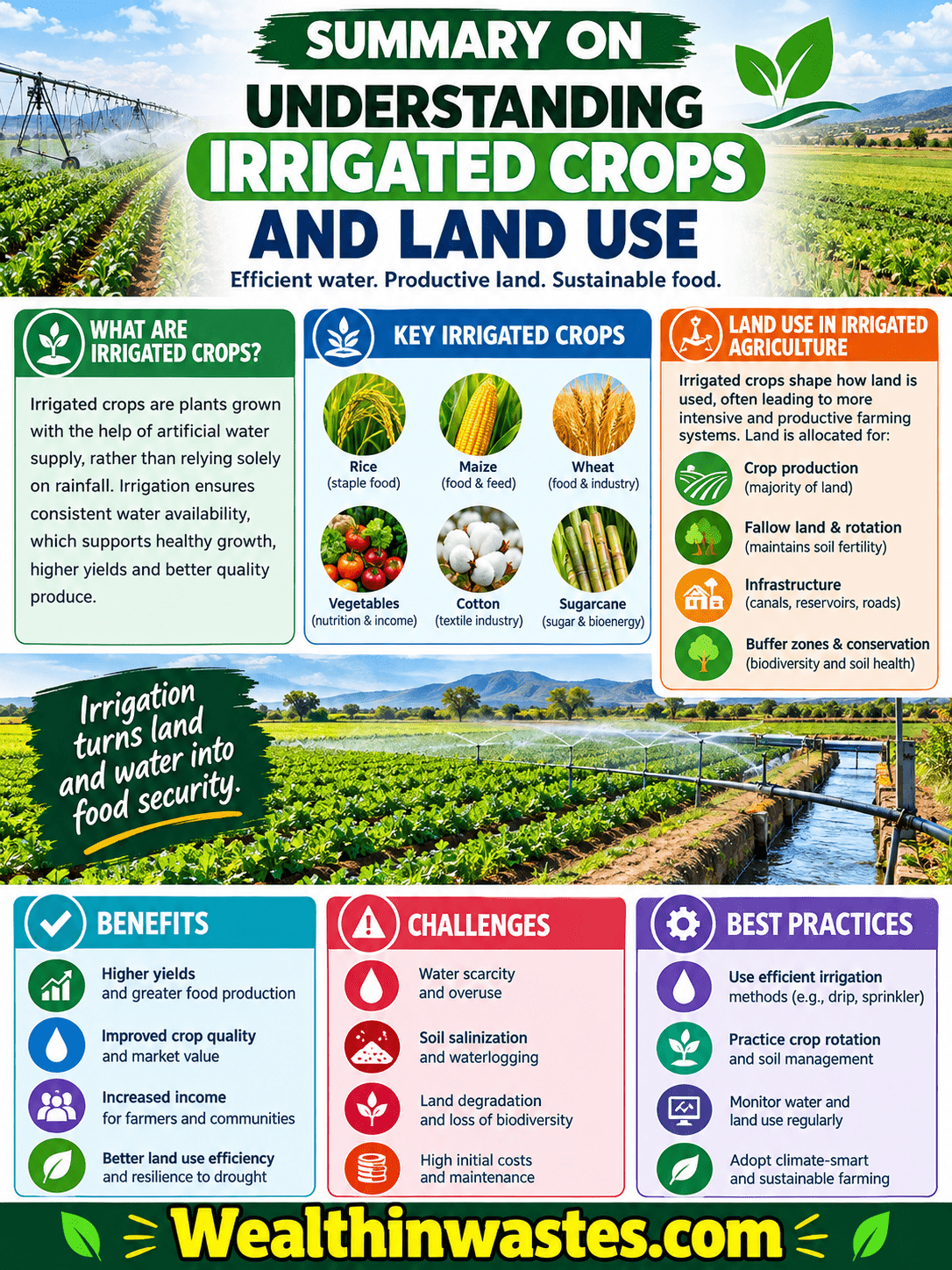
| Section | Main Idea | Why It Matters |
|---|---|---|
| Irrigated Crops | Supplemental water supports crop growth when rainfall is insufficient. | Improves production reliability and reduces drought risk. |
| Water Requirements | Crop demand varies with species, climate, soil, and growth stage. | Improves irrigation accuracy and reduces waste. |
| Land Productivity | Irrigation can increase yields and support multiple cropping. | Improves agricultural land utilization. |
| Energy Use | Pumping and water delivery consume energy. | Energy efficiency can improve farm profitability. |
| Irrigation Challenges | Salinity, waterlogging, pollution, and nutrient losses can reduce productivity. | Proper management protects farmland and water resources. |
| Sustainable Management | Soil conservation, efficient irrigation, drainage, and resource protection support long-term production. | Maintains land and water productivity for future farming. |
Frequently Asked Questions About Irrigated Crops and Land Use: Water, Energy and Yield
1. What are irrigated crops?
Irrigated crops are crops that receive additional water through an irrigation system when rainfall alone cannot satisfy their moisture requirements.
2. Why is irrigation important in crop production?
Irrigation helps maintain crop moisture during dry periods, stabilize yields, extend growing seasons, and support agricultural production where rainfall remains inadequate.
3. What factors determine irrigation water requirements?
Climate, crop type, growth stage, soil texture, rooting depth, rainfall, temperature, wind, humidity, and irrigation method influence crop water requirements.
4. Can irrigation improve agricultural land productivity?
Yes. Well-managed irrigation can increase yields, support multiple cropping, reduce drought losses, and improve the productive use of suitable farmland.
5. What are major problems associated with irrigation?
Major problems include soil salinity, waterlogging, nutrient leaching, runoff, groundwater depletion, pollution, high pumping costs, and inefficient water application.
6. Does irrigation require much energy?
Energy demand depends on water source, pumping height, distance, pressure requirements, irrigation technology, and equipment efficiency.
7. How can farmers conserve irrigation water?
Farmers can conserve water through accurate scheduling, drip systems, soil moisture management, mulching, organic matter improvement, drainage control, and reduction of unnecessary runoff.
8. Why does land management matter in irrigated farming?
Good land management protects soil structure, drainage, fertility, and water-holding capacity, helping irrigation remain productive without accelerating land degradation.
Do you have any questions, suggestions, or contributions? If so, please feel free to use the comment box below to share your thoughts. We also encourage you to kindly share this information with others who might benefit from it. Since we can’t reach everyone at once, we truly appreciate your help in spreading the word. Thank you very much for your support and for sharing!
Read Also: Crop Water Requirement in Agricultural Production