


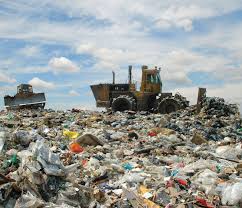
Environmental site investigation is an essential process for understanding whether contamination exists, where it may occur, how it moves, and what risks it could create for people and surrounding ecosystems.
A reliable investigation does not begin with field sampling alone. It begins by gathering existing information about the site, its history, surrounding environment, previous activities, structures, wastes, and potential contamination sources.
Historical records can reveal previous industrial operations, waste storage areas, drainage systems, spills, underground tanks, septic systems, building foundations, and other features that influence sampling decisions and investigation safety.
Physical and environmental information is equally important because contaminants can move through soil, groundwater, surface water, air, vegetation, and other pathways depending upon site conditions and contaminant characteristics.
A carefully prepared sampling plan brings these different information sources together. It helps investigators select suitable sampling locations, determine sample numbers, choose analytical parameters, and collect representative samples.
Defining the Physical Environment

The first stage of defining the physical environment involves reviewing information that describes the site and its previous activities. Historical records can reveal locations where potentially hazardous materials were handled or released.
Useful records may include historical maps, site plans, aerial photographs, building layouts, drainage pathways, contours, foundations, storage areas, production processes, disposal locations, and documented spills or leaks.
Investigators should also examine information about surrounding land uses because nearby agricultural operations, industries, residential areas, roads, waste facilities, and water bodies may influence contamination patterns.
Available files may identify areas used for particular manufacturing, storage, treatment, or disposal activities. Such information helps investigators determine where contaminants are most likely to have originated.
Investigators should consider reviewing historical waste-generating activities because different sources produce different contaminants and may require different analytical parameters during site characterization and subsequent environmental assessment.
Geographic Information System data can provide valuable spatial information for environmental investigations. Mapped datasets may show land use, soil characteristics, geology, drainage features, contours, wetlands, and other important site conditions.
By identifying materials previously handled at a site, investigators can develop a more focused list of substances requiring laboratory analysis. This approach reduces unnecessary testing while improving the investigation’s relevance.
Historical information can also improve health and safety planning because it may indicate whether workers could encounter hazardous chemicals, unstable structures, contaminated surfaces, explosive conditions, or other occupational hazards.
Where reliable information cannot be obtained, investigators should avoid assuming that the site is safe. Appropriate precautions should be adopted because unknown materials and unexpected contamination may be present.
Investigators should then conduct a pre-sampling site visit to compare available records with actual field conditions. This visit may reveal changes, undocumented structures, disturbed soil, or other useful evidence.
Labels, markings, shipping documents, tank identifiers, drum information, and other records found during the site visit may provide valuable clues about substances previously manufactured, stored, transported, or discarded.
These observations should be documented carefully because seemingly minor details can influence sampling locations, analytical selections, protective measures, equipment requirements, and the overall effectiveness of the investigation.
The environmental fate of contaminants depends on the contaminant’s properties, the source, and the physical environment receiving the material. Different contaminants behave differently within different environmental matrices.
Important environmental characteristics include soil texture, permeability, groundwater conditions, surface-water movement, rainfall patterns, topography, geological formations, vegetation, drainage systems, and nearby sensitive ecological environments.
Groundwater investigations should consider groundwater depth, flow direction, recharge areas, seasonal variations, and relationships with nearby surface-water bodies. These characteristics can identify potential pathways for contaminant migration.
Surface-water investigations should examine nearby streams, rivers, drains, wetlands, ponds, and other water bodies. Flow direction and discharge points are particularly important when contamination may move through water.
Biological conditions should also be considered. Investigators may examine vegetation, wildlife, agricultural organisms, sensitive habitats, and signs of ecological stress that could indicate environmental exposure.
Stressed vegetation may provide useful evidence of possible contaminant movement, although visible plant damage should never be treated as definitive proof without appropriate sampling and laboratory confirmation.
A broader understanding of environmental contamination pathways helps investigators recognize how pollutants may move between land, water, air, plants, animals, and nearby communities.
Overall, defining the physical environment allows investigators to develop reasonable hypotheses about where contaminants may be located and which pathways should receive greater sampling attention.
Migration pathways should be identified before finalizing field sampling locations. Samples should be positioned where they can provide meaningful information about sources, movement, concentration, distribution, and potential environmental exposure.
The information gathered during historical review, site inspection, and environmental assessment provides the foundation for developing a complete sampling plan that is practical, defensible, and responsive to investigation objectives.
Greater knowledge of contamination sources, movement patterns, environmental media, and potential exposure routes generally improves the investigator’s ability to select appropriate samples and interpret resulting analytical data.
Investigators should document important findings from records and field observations so that sampling decisions can be traced back to specific evidence, assumptions, or site conditions identified during planning.
Read Also: Occupational Hazards associated with Waste Handling
Sample Locations and Numbers

The objective of the sampling event should guide decisions about where samples are collected. Sampling locations should be selected to produce information capable of answering the investigation’s specific questions.
When little background information is available and obvious contamination cannot be identified, a random sampling strategy may provide broader coverage and reduce personal selection bias.
Random sampling uses chance-based selection to identify sampling locations within a defined population. Proper randomization helps prevent investigators from unconsciously selecting locations that support their expectations.
Random numbers, computerized randomization, or other recognized statistical approaches can assist investigators in selecting unbiased locations when a random sampling design is appropriate for the investigation.
Investigators should also consider the site’s environmental setting before selecting random locations. Soil properties, drainage, topography, groundwater movement, waste patterns, and physical accessibility can strongly influence contamination.
Sampling at suspected hazardous-waste sites commonly aims to discover contamination and determine its extent, concentration, distribution, and variability across different environmental media.
For these objectives, judgmental sampling can be valuable because investigators can deliberately target locations with historical evidence, visible staining, waste deposits, process areas, or other contamination indicators.
Judgmental samples are selected using available information about contaminant sources, previous activities, contaminant behavior, environmental conditions, and suspected migration pathways across the investigation area.
Investigators can strengthen the overall design by combining different sampling approaches rather than relying exclusively on one technique when site conditions require more comprehensive characterization.
For example, judgmental samples may target former disposal areas, stained soil, leaking storage locations, drainage channels, or stressed vegetation, while random samples provide broader coverage elsewhere.
This combined approach can be particularly useful when contamination is expected to be concentrated in certain areas but substantial portions of the site remain poorly characterized.
Systematic sampling may also be useful when investigators need consistent spatial coverage. A site can be divided into grids, with samples collected according to predetermined locations or intervals.
Stratified sampling can be considered when the site contains distinct areas with different characteristics. Each stratum can then receive an appropriate sampling strategy based on its environmental conditions.
The number and location of samples should ultimately reflect the investigation objectives rather than an arbitrary target. More samples are not automatically better if they fail to answer meaningful questions.
Sampling locations should also be accessible and safe. A technically ideal location may require modification when physical hazards, unstable structures, restricted access, or dangerous conditions are present.
Detailed records of sampling coordinates, site features, environmental observations, weather conditions, and field measurements can improve the interpretation of results after laboratory analysis.
Accurate documentation is especially important when multiple sampling rounds are required because investigators need to identify the same areas consistently and compare changes over time.
Information about representative sampling locations should therefore be incorporated into the sampling plan before fieldwork begins, including location identifiers, matrices, depths, frequencies, and collection procedures.
A well-designed location strategy should produce information capable of distinguishing potential source areas from unaffected areas, supporting contamination delineation, background assessment, and subsequent environmental decision-making.
When the investigation is adequately planned, the selected sampling locations provide a logical connection between existing site information, field observations, analytical testing, and the final conclusions.
Sample Size Parameters
The number of samples required for site characterization depends on several interacting factors. Investigators should determine sample numbers from the study objectives, environmental conditions, statistical needs, and expected contamination patterns.
The major factors that influence sample numbers include exposure pathways, statistical performance objectives, data quality objectives, quality assurance requirements, background samples, sampling objectives, and site-specific conditions.
1. Exposure pathways: The suspected routes through which people, animals, plants, or ecological receptors may contact contaminants can influence the number, location, and environmental media selected for sampling during investigation activities.
2. Statistical performance objectives: Statistical requirements help determine how many samples are needed to detect, estimate, compare, or characterize contaminant concentrations with an acceptable level of confidence for the investigation.
3. Data quality objectives: Data quality objectives define how accurate, precise, complete, representative, and reliable analytical information needs to be before the investigation can support important decisions.
4.Quality assurance objectives: Quality assurance requirements influence the number and types of quality-control samples, including blanks, duplicates, reference materials, and other checks needed to evaluate data reliability.
5. Background samples: Background samples help establish natural or unaffected environmental conditions so investigators can compare potentially contaminated locations with conditions that existed outside suspected influence areas.
6. Sampling objectives: The intended purpose of sampling determines the required sample quantity. Screening for possible contamination may require fewer samples than detailed delineation of a known contaminated area.
7. Site-specific conditions: Site size, geology, hydrology, waste distribution, accessibility, environmental variability, historical activities, and contaminant characteristics may increase or decrease the appropriate number of samples.
For example, determining whether contamination may be present could require a relatively limited number of strategically selected samples when background information is strong and potential source areas are identifiable.
However, greater sampling effort may be necessary when contamination is confirmed and investigators must establish its horizontal and vertical extent across soil, groundwater, sediment, or other environmental media.
Statistical methods can help determine appropriate sample sizes, particularly when investigators need defensible estimates of concentration, variability, confidence, or differences between contaminated and background areas.
Investigators should avoid selecting sample numbers solely because they appear convenient. Sample size should be justified by the questions being addressed, the variability expected, and the decisions supported.
Sampling efficiency is also important because unnecessary samples increase laboratory costs and fieldwork requirements, while insufficient samples may produce unreliable conclusions and require additional investigation later.
The planning of waste analysis also benefits from considering sample size, sampling strata, and analytical objectives before the field team begins collection activities.
Sample numbers may need adjustment when preliminary field results reveal unexpected contamination patterns. A flexible investigation can allow additional samples where evidence indicates that further characterization is necessary.
Investigators should clearly document the basis for the selected sample number, including statistical assumptions, site conditions, expected variability, analytical requirements, and any regulatory or project-specific requirements.
A defensible sampling plan therefore explains not only how many samples will be collected, but also why that number is appropriate for achieving the stated investigation objectives.
Read Also: Rationale for Waste Sampling and Techniques
Sample Methodology and Matrix

After sampling locations and numbers have been established, investigators must select collection methods that can obtain representative samples without introducing significant contamination, loss, alteration, or other sources of error.
The sampling method should be matched to the environmental matrix being investigated. Soil, groundwater, surface water, sediment, sludge, waste, and biological materials may require different collection procedures and equipment.
Investigators should consider whether the sample is intended to represent a specific location, depth, period, stratum, or combination of locations before selecting the collection technique.
Grab sampling collects material from a particular location and time, while composite sampling combines portions from multiple locations, depths, or times according to the investigation’s defined sampling design.
Composite sampling can provide useful information about average conditions, but it may reduce the ability to identify localized contamination because high and low concentrations can become combined within the composite.
Equipment selection is also important because sampling devices should not react with, contaminate, adsorb, absorb, or otherwise alter the material being collected in ways that could affect analytical results.
The materials, design, condition, cleaning, decontamination, and handling of sampling equipment should therefore be specified within the sampling plan before field activities begin.
Investigators should select equipment according to the physical characteristics of the matrix. Viscous materials, solids, liquids, sludges, sediments, and mixed wastes may present different collection challenges.
The selection of appropriate sampling equipment should account for matrix characteristics, accessibility, potential hazards, required sample volume, desired depth, and the possibility of cross-contamination during collection.
Sample containers should also be compatible with the analytical requirements. Different analyses may require different materials, capacities, closures, preservatives, handling practices, or temperature controls.
Where preservation is required, the correct preservative and quantity should be specified in advance. Improper preservation can alter sample characteristics and compromise the reliability of subsequent laboratory results.
Sampling personnel should record essential information immediately after collection, including sample identification, location, date, time, environmental conditions, matrix, collection method, and relevant field observations.
GPS coordinates may be useful for documenting sampling positions, particularly where repeat sampling, spatial interpretation, mapping, or comparison of different investigation rounds is required.
Investigators should maintain appropriate chain-of-custody records so that each sample can be tracked from collection through transportation, laboratory receipt, analysis, and final reporting.
Sample containers should be properly labelled using information that remains legible throughout transportation and laboratory handling. Incomplete or incorrect identification can make otherwise useful analytical results difficult to interpret.
Field notes should document unusual observations, deviations from planned procedures, unexpected site conditions, equipment problems, weather changes, and other factors that could influence sample quality.
Samples should be protected from cross-contamination throughout collection, preparation, storage, and transportation. Equipment decontamination and appropriate sequencing are especially important when moving between potentially contaminated and cleaner locations.
Comprehensive sample handling procedures should address containers, labels, transportation, storage, preservation, documentation, laboratory coordination, and other practices needed to maintain sample integrity.
Laboratory requirements should be considered before fieldwork begins. Investigators should confirm analytical methods, sample quantities, holding times, container specifications, preservation requirements, and laboratory acceptance procedures.
Where hazardous materials may be encountered, sampling procedures must incorporate appropriate health and safety controls. Personnel should understand site hazards, required protective equipment, emergency procedures, and safe equipment handling.
Guidance concerning health risks associated with environmental waste exposure can help investigators appreciate why sampling activities require careful planning, protection, and control of exposure.
Investigators should also avoid unnecessary disturbance of contaminated materials because aggressive collection methods may spread contaminants, release hazardous vapours, create exposure risks, or change the physical characteristics of samples.
For waste units or containers, the equipment and method should reflect the waste’s physical state, suspected contents, container configuration, accessibility, and identified hazards before opening or sampling.
Information about safe sampling procedures for waste units is particularly useful when investigators must work around drums, tanks, waste piles, impoundments, sludges, or other difficult matrices.
Sampling activities should be performed consistently according to the approved plan while allowing controlled adjustments when field evidence demonstrates that the original design cannot adequately meet the investigation objectives.
Any significant deviation should be recorded and assessed because changes in equipment, locations, depths, timing, preservation, or analytical requirements can affect interpretation of the final dataset.
Investigators should ensure that the final dataset represents actual site conditions as closely as possible. Sample quality depends on thoughtful planning, appropriate equipment, careful collection, proper handling, and reliable laboratory analysis.
Quality Assurance and Documentation Considerations

Quality assurance should be incorporated throughout site investigation activities because errors introduced during planning, collection, handling, transportation, or documentation may compromise the usefulness of laboratory results.
A strong quality assurance programme begins before fieldwork. Sampling objectives, analytical parameters, equipment, containers, preservation requirements, quality-control samples, laboratory procedures, and documentation requirements should be defined beforehand.
Field personnel should understand the sampling plan and receive appropriate instruction on the procedures they are expected to follow. Clear responsibilities reduce confusion and improve consistency.
Equipment should be inspected, cleaned, and prepared before field deployment. Equipment that can introduce contaminants or interfere with analysis should not be used without suitable controls.
Quality-control samples may include blanks, duplicates, splits, or other samples designed to identify contamination, variability, handling problems, analytical issues, or other potential sources of error.
Field documentation should be sufficiently detailed to allow another investigator to understand what was collected, where it was collected, how it was collected, and under which conditions.
Investigators should maintain a clear record of samples and observations because environmental investigations often involve multiple personnel, laboratories, sampling rounds, and decision-making stages.
A practical sampling and analysis programme should therefore coordinate field operations with laboratory requirements so that sample quality and analytical reliability are protected from collection through reporting.
Proper scheduling can also prevent avoidable delays. Samples may have specific holding times, storage conditions, transportation requirements, and laboratory acceptance criteria that must be satisfied.
Sampling personnel should prepare equipment lists, station information, sample labels, containers, safety supplies, maps, documentation materials, and other necessities before leaving for the field.
A pre-field checklist helps reduce omissions and may identify problems before they affect the investigation. It can also improve coordination between sampling teams, project managers, laboratories, and site representatives.
When conditions change during sampling, investigators should document the circumstances and determine whether modifications are necessary. Any changes should remain consistent with the objectives and quality requirements.
The quality of analytical conclusions depends heavily on the quality of samples collected. Reliable laboratory equipment cannot correct errors caused by poor sample selection, contamination, improper preservation, or inadequate documentation.
Investigators should therefore treat sampling as an integrated process rather than an isolated field activity. Planning, collection, handling, analysis, interpretation, and reporting must work together to produce defensible results.
Interpreting Sampling Results
Laboratory results should be interpreted in relation to the original sampling objectives, site history, environmental conditions, background information, and sampling design rather than considering individual analytical values in isolation.
Investigators should compare concentrations across locations, depths, environmental media, and relevant background areas to identify patterns that may indicate contamination sources or migration pathways.
Unexpected results should be evaluated carefully because they may indicate localized contamination, sampling variability, laboratory issues, unusual environmental conditions, or previously unknown site activities.
Where results suggest contamination extending beyond the original sampling area, additional investigation may be necessary to establish the full extent and understand potential risks.
Spatial data can improve interpretation because mapped results allow investigators to compare analytical concentrations with drainage pathways, land use, geology, groundwater movement, topography, and historical source locations.
Environmental monitoring programmes benefit from consistent methods because comparable procedures make it easier to evaluate changes in contaminant concentrations and determine whether conditions are stable or changing.
Information from pollutant and contaminant monitoring methods can support broader understanding of how contaminants are measured across environmental media and how monitoring results can inform environmental decisions.
Interpretation should also recognize uncertainty. Environmental systems are heterogeneous, and samples represent limited portions of much larger populations that may vary considerably across space and time.
Where uncertainty is substantial, investigators should identify the limitations clearly rather than presenting interpretations with greater confidence than the available evidence can support.
Additional sampling may be appropriate when existing results cannot adequately answer important investigation questions. The decision should be based on remaining uncertainties and the consequences of unresolved contamination.
A well-designed investigation should ultimately provide sufficient information to understand contamination sources, affected media, migration pathways, concentration patterns, and the need for additional assessment or management.
The investigation report should connect analytical findings with historical evidence, field observations, sampling procedures, quality-control information, and interpretation so that conclusions are transparent and technically defensible.
Summary on Site History-Evaluating Existing Data/File Information
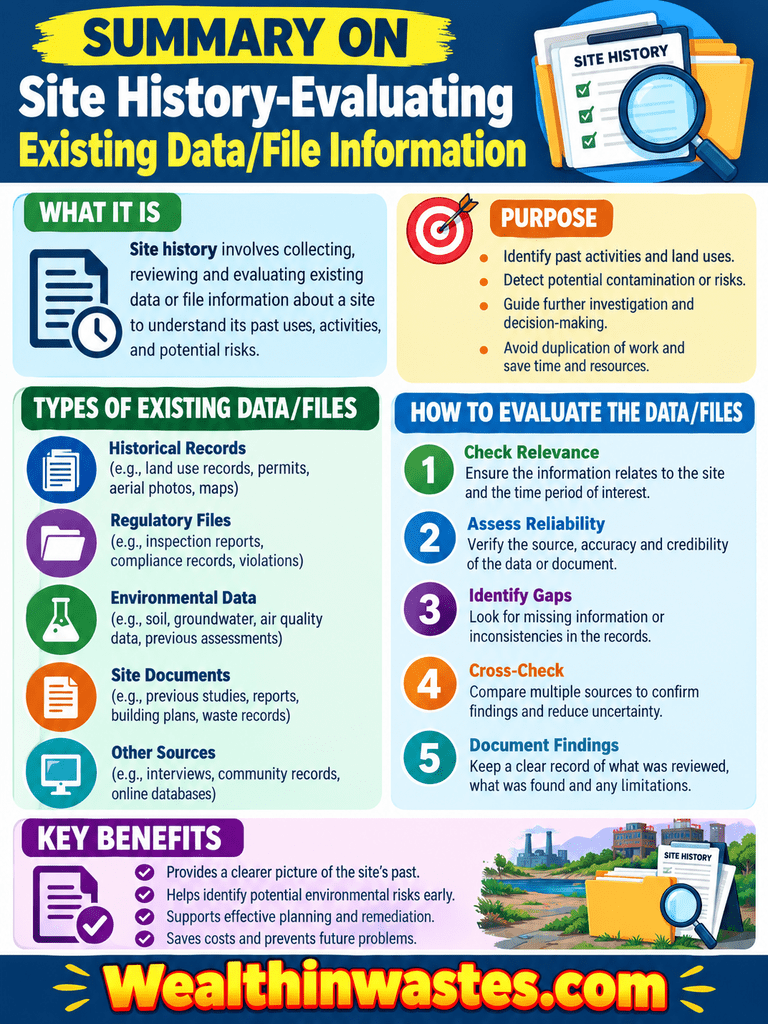
| Area | Summary |
|---|---|
| Background information | Historical records, site plans, aerial information, previous activities, drainage features, storage areas, and spill records establish important investigation context. |
| Physical environment | Geology, soil, groundwater, surface water, climate, topography, vegetation, wildlife, and land use influence contaminant movement and sampling decisions. |
| Site visit | A pre-sampling inspection verifies existing information and identifies labels, structures, waste areas, environmental indicators, hazards, and undocumented conditions. |
| Sampling locations | Locations should be selected according to sampling objectives, contamination evidence, site conditions, expected pathways, accessibility, and the need for representative information. |
| Sampling strategies | Random, judgmental, systematic, stratified, or combined approaches may be used depending on available information and the objectives of the investigation. |
| Sample numbers | Sample quantity depends on exposure pathways, statistical objectives, data quality requirements, background needs, sampling objectives, and site-specific characteristics. |
| Sampling methodology | Collection methods and equipment should match the environmental matrix, physical conditions, analytical requirements, safety considerations, and desired sample representation. |
| Sample handling | Correct containers, preservation, labels, transportation, chain of custody, decontamination, and documentation help protect sample integrity and analytical reliability. |
| Quality assurance | Quality-control procedures should cover planning, equipment preparation, field procedures, laboratory coordination, documentation, and evaluation of potential sources of error. |
| Result interpretation | Analytical findings should be interpreted alongside site history, environmental conditions, sampling design, spatial patterns, background information, and recognized uncertainties. |
Frequently Asked Questions About Site Investigation and Sampling Plan
1. What is a site investigation and sampling plan?
A site investigation and sampling plan is a structured document describing what information will be collected, where samples will come from, how they will be collected, and why.
2. Why is historical site information important before sampling?
Historical information can identify former industrial processes, storage locations, disposal areas, spills, drainage routes, and other conditions that help investigators locate potential contamination sources more efficiently.
3. How are sampling locations selected during a site investigation?
Sampling locations may be selected using random, judgmental, systematic, stratified, or combined approaches, depending on site information, investigation objectives, environmental conditions, and contamination patterns.
4. What determines the number of samples required?
Sample numbers depend on exposure pathways, statistical requirements, data quality objectives, quality assurance needs, background sampling, investigation objectives, site conditions, and expected contaminant variability.
5. What is judgmental or biased sampling?
Judgmental sampling deliberately selects locations based on historical evidence, visible contamination, known processes, contaminant behavior, environmental pathways, or other information suggesting a higher probability of impact.
6. What is random sampling used for?
Random sampling helps provide broader and less biased coverage when background information is limited and investigators do not have sufficient evidence for selecting specific locations preferentially.
7. Why is the environmental matrix important when selecting sampling methods?
Different matrices such as soil, groundwater, surface water, sediment, sludge, and waste have different physical properties, requiring collection methods and equipment suited to obtaining representative samples.
8. Why is proper sample handling important?
Proper handling prevents contamination, degradation, misidentification, and other errors that could alter analytical results and make laboratory findings unreliable for environmental decision-making.
9. What role does quality assurance play in sampling?
Quality assurance establishes procedures for equipment preparation, field collection, documentation, quality-control samples, laboratory coordination, sample handling, and evaluation of potential errors affecting analytical data.
10. When is additional sampling necessary?
Additional sampling may be necessary when initial results reveal unexpected contamination, substantial uncertainty, unexplained concentration patterns, or insufficient information to define contamination extent and migration pathways.
Do you have any questions, suggestions, or contributions? If so, please feel free to use the comment box below to share your thoughts. We also encourage you to kindly share this information with others who might benefit from it. Since we can’t reach everyone at once, we truly appreciate your help in spreading the word. Thank you very much for your support and for sharing!
Read Also: Interconnections Between Soil Chemistry, Water Chemistry, and Pollution Science