



Water bodies possess physical and chemical properties that determine their ecological condition, biological productivity, and suitability for drinking, agriculture, recreation, industry, fisheries, and ecosystem support.
These properties do not remain completely constant because weather, seasons, depth, geology, biological activity, water movement, and human activities can continuously influence conditions within rivers, lakes, reservoirs, and wetlands.
Understanding the properties of a water body helps environmental managers identify unusual changes, recognize pollution problems, protect aquatic organisms, and determine whether water remains suitable for specific beneficial uses.
Physical characteristics such as temperature, turbidity, and suspended solids interact closely with chemical characteristics including dissolved oxygen, pH, salinity, nutrients, metals, and organic matter.
Because these characteristics influence one another, effective water quality assessment requires several measurements rather than depending on one parameter, especially when evaluating environmental change or pollution impacts.
Temperature and Thermal Conditions
1. Temperature Meaning: Water temperature is a major physical property because it influences chemical reactions, metabolic activity, photosynthesis, oxygen availability, and the distribution of organisms throughout aquatic environments.
2. Daily Variation: Water temperature commonly changes during the day as sunlight warms surface waters, while cooling occurs later, creating predictable daily patterns that vary with weather and location.
3. Seasonal Variation: Seasonal temperatures generally reflect changing air temperatures, although water depth, flow, shading, cloud cover, and groundwater inputs can moderate the magnitude of temperature fluctuations.
4. Thermal Stratification: Deeper lakes and reservoirs can develop distinct temperature layers when warmer surface water separates from colder deeper water, especially during periods of strong seasonal heating.
5. Ecological Effects: Temperature affects metabolic rates, reproduction, growth, feeding, and survival, meaning sudden or prolonged changes can favor certain species while creating stressful conditions for other organisms.
6. Pollution Influence: Industrial cooling discharges can raise receiving-water temperatures and alter aquatic habitats, while vegetation removal can increase solar heating and reduce natural thermal protection.
7. Water Management: Monitoring temperature alongside other water pollution control measures helps identify thermal disturbances and supports better protection of aquatic habitats and water quality.
8. Oxygen Connection: Temperature strongly affects oxygen solubility because warm water generally holds less dissolved oxygen, making thermal conditions important when assessing oxygen stress and aquatic ecosystem stability.
Dissolved Oxygen and Water Quality
1. Meaning Of Dissolved Oxygen: Dissolved oxygen represents oxygen gas held within water and provides an essential resource for fish, aquatic invertebrates, microorganisms, and other aerobic organisms.
2. Oxygen Sources: Oxygen enters water through atmospheric diffusion, turbulence, waterfalls, waves, and photosynthesis by algae and aquatic plants growing within illuminated parts of the water body.
3. Biological Importance: Adequate dissolved oxygen supports respiration and metabolism, while insufficient concentrations can stress sensitive species, restrict activity, alter habitats, and eventually cause aquatic organism mortality.
4. Temperature Effect: Increasing temperature normally reduces oxygen solubility, meaning warm water can contain less dissolved oxygen and may become more vulnerable to oxygen depletion.
5. Pollution Effect: Organic wastes can stimulate microbial decomposition that consumes oxygen, making organic and other water pollutants important factors when investigating declining oxygen conditions.
6.Nutrient Influence: Excess nitrogen and phosphorus can stimulate algal growth, followed by decomposition that increases oxygen consumption and may create oxygen-poor conditions in affected water bodies.
7. Monitoring Value: Dissolved oxygen provides useful information about aquatic health, especially when professionals compare readings with temperature, flow conditions, organic loading, nutrients, and biological activity.
8. Wastewater Connection: Poorly managed industrial wastewater treatment processes can increase oxygen-demanding substances, making oxygen monitoring important near discharge points and downstream aquatic environments.
Read Also: What is Wastewater and Sources of Wastewaters
pH and Alkalinity In Water Bodies

1. Meaning Of pH: pH describes hydrogen ion activity and indicates whether water shows acidic, neutral, or alkaline conditions, making it a central chemical property used during water assessment.
2. Acidic Conditions: Water becomes more acidic when hydrogen ion activity increases, causing lower pH values that can influence metals, nutrients, biological processes, and organism tolerance.
3. Alkaline Conditions: Water becomes more alkaline when hydrogen ion activity decreases, producing higher pH values that may alter chemical reactions and the availability of dissolved substances.
4. pH Scale: The pH scale follows a logarithmic relationship, so relatively small numerical changes can represent substantial differences in hydrogen ion conditions within aquatic environments.
5. Biological Importance: Aquatic organisms generally tolerate particular pH ranges, and substantial departures from normal conditions can interfere with respiration, reproduction, growth, feeding, and other physiological functions.
6. Meaning Of Alkalinity: Alkalinity describes water’s ability to neutralize acids and resist rapid pH changes, providing buffering capacity that helps maintain more stable chemical conditions.
7. Buffering Compounds: Bicarbonate and carbonate compounds commonly contribute to alkalinity, especially in freshwater systems, because they react with hydrogen ions and reduce sudden changes in acidity.
8. Pollution Connection: Changes caused by water treatment processes and pollution control can alter pH, making regular monitoring useful when evaluating contaminated or heavily managed water bodies.
9. Chemical Stability: Stable pH and adequate alkalinity support predictable chemical behavior, while abrupt changes can increase contaminant mobility or toxicity and place additional stress on aquatic organisms.
10. Management Value: Combining pH measurements with other chemical properties gives managers a clearer understanding of water conditions and helps distinguish natural variation from environmental disturbances.
Turbidity and Suspended Solids
1. Meaning Of Turbidity: Turbidity describes the loss of water clarity caused by suspended particles, microorganisms, sediments, organic materials, or other substances that scatter and absorb incoming light.
2. Sediment Sources: Clay, silt, eroded soil, shoreline materials, and stream sediments can enter water bodies naturally or through land disturbance, rainfall runoff, construction, and poor watershed management.
3. Biological Sources: Phytoplankton and other microorganisms can increase suspended material, particularly during periods of high productivity when abundant biological growth reduces water transparency.
4. Human Activities: Agriculture, forestry, mining, construction, urban drainage, and industrial activities can increase sediment transport and introduce suspended substances into rivers, lakes, streams, and reservoirs.
5. Light Penetration: High turbidity reduces sunlight penetration, potentially limiting photosynthesis, altering aquatic plant distribution, and changing habitats available to organisms that depend upon sufficient illumination.
6.Suspended Solids: Total suspended solids provide a quantitative indication of particulate material in water, while transparency measurements provide practical information about how far visible light travels.
7. Sedimentation Effects: Excess sediment can cover bottom habitats, smother aquatic organisms, interfere with fish reproduction, and reduce habitat quality, especially where sediment deposition occurs continuously or rapidly.
8. Treatment Connection: Effective sedimentation processes in wastewater treatment remove substantial particulate material before effluent reaches receiving waters, helping reduce turbidity and suspended solids.
9. Measurement Methods: Water professionals commonly assess turbidity using instruments, while Secchi disks and related transparency methods can provide useful field observations in lakes and reservoirs.
10. Watershed Protection: Preventing erosion and controlling runoff can reduce sediment delivery, making proper waste and land management important for maintaining clearer and healthier aquatic environments.
Salinity and Major Ionic Composition
1. Meaning Of Salinity: Salinity describes the concentration of dissolved salts in water and helps distinguish freshwater environments from brackish and saline systems.
2. Major Cations: Calcium, magnesium, sodium, and potassium are important positively charged ions that contribute to dissolved mineral content and vary naturally among different water bodies.
3. Major Anions: Bicarbonate, carbonate, sulphate, and chloride commonly contribute negatively charged ions, with concentrations influenced by geology, climate, runoff, evaporation, and human activities.
4. Geological Control: Minerals dissolve from rocks and soils as water moves through landscapes, giving each drainage basin a characteristic chemical signature that can influence major ion composition.
5. Salinity Changes: Evaporation can concentrate dissolved salts, while rainfall, river inflows, groundwater contributions, and freshwater releases can reduce concentrations and shift overall water chemistry.
6. Biological Importance: Aquatic organisms maintain internal salt and water balance within specific limits, so significant changes in salinity can affect growth, reproduction, movement, and survival.
7. Conductivity: Specific conductance indicates how readily water carries electrical current, and higher dissolved ion concentrations generally produce higher conductivity values.
8. Wastewater Influence: Wastewater discharges can change dissolved ion concentrations, particularly when effluent contains salts or minerals, making wastewater treatment options relevant to salinity management.
9. Pollution Detection: Unexpected conductivity changes can provide an early indication of altered ionic conditions, especially when monitoring locations upstream and downstream of suspected pollutant sources.
10. Agricultural Relevance: Salinity matters in irrigation because excessive dissolved salts can affect soils and crops, making appropriate water-quality assessment important for sustainable agricultural production.
Nutrients and Aquatic Productivity

1. Nutrient Meaning: Nutrients are chemical elements required for metabolism, growth, reproduction, and cellular functions, making them essential components of aquatic productivity and ecosystem development.
2. Major Nutrients: Nitrogen and phosphorus are particularly important in aquatic ecosystems because they frequently limit primary production and strongly influence algae and aquatic plant growth.
3. Natural Inputs: Nutrients enter water bodies through weathering, atmospheric deposition, biological processes, groundwater movement, natural runoff, and decomposition of organic materials within catchments.
4.Human Inputs: Fertilizers, sewage, animal wastes, detergents, and agricultural runoff can increase nutrient concentrations, especially where land management practices allow pollutants to reach surface water.
5. Primary Production: Algae, aquatic plants, and microorganisms require nutrients for growth, so changes in nutrient availability can alter productivity, species composition, food webs, and ecosystem functioning.
6. Excess Nutrients: Large nutrient inputs can stimulate excessive algal growth, followed by decomposition that consumes dissolved oxygen and may create unsuitable conditions for fish and other aquatic organisms.
7. Pollution Link: Nutrient enrichment often accompanies water pollution consequences, particularly where untreated wastewater, agricultural runoff, or poorly controlled discharges enter rivers, lakes, and reservoirs.
8. Management Approach: Reducing nutrient pollution requires better fertilizer management, wastewater treatment, erosion control, sanitation, and monitoring of drainage systems throughout surrounding watersheds.
9. Agricultural Importance: Agricultural areas require special attention because rainfall can transport soluble nutrients and soil particles into streams, increasing nutrient loading and changing ecological conditions downstream.
10. Nutrient Balance: Healthy water bodies require nutrient availability without excessive enrichment, because both deficiency and overabundance can influence ecosystem productivity and long-term biological stability.
Read Also: Types of Wastewater and Motivational Factors for Recycling/Reuse
Metals and Organic Matter

1. Natural Metals: Metals occur naturally in rocks, soils, sediments, and water, and some trace elements perform essential biological functions when organisms encounter them at suitable concentrations.
2. Toxic Metals: Elevated concentrations of metals such as lead, mercury, cadmium, and arsenic can harm organisms, especially when exposure persists or contaminants accumulate in tissues.
3. Pollution Sources: Mining, manufacturing, industrial discharge, waste disposal, atmospheric deposition, and urban activities can increase metal concentrations above natural background conditions.
4. Sediment Association: Metals often bind to sediments, meaning contaminated bottom materials can influence surrounding water chemistry and remain environmental concerns after direct pollutant inputs decline.
5. Chemical Controls: pH, oxygen conditions, organic matter, and other chemical factors influence whether metals remain dissolved, attach to particles, or become available to aquatic organisms.
6. Organic Matter: Organic matter supports carbon and nutrient cycling, providing energy and materials for microorganisms that decompose plant residues, animal wastes, and other biodegradable substances.
7. Oxygen Consumption: Excess organic matter can increase microbial respiration, consuming dissolved oxygen and creating stressful conditions where decomposition proceeds rapidly within poorly flushed or polluted waters.
8. Waste Connection: Proper control of industrial waste reaching water bodies helps reduce metal and organic contamination that can alter aquatic chemical conditions.
9. Human Health: Contaminated water can create exposure risks when people consume polluted water, contaminated aquatic foods, or crops irrigated with unsuitable sources.
10. Monitoring Need: Assessing both water and sediments can provide a more complete picture of contamination because some pollutants remain associated with bottom materials and may re-enter water.
Biological Components And Oxygen Demand
1. Biological Components: Water bodies contain microorganisms, algae, aquatic plants, invertebrates, fish, birds, and other organisms whose interactions influence ecosystem structure and environmental processes.
2.Microbial Activities: Bacteria, fungi, and other microorganisms decompose organic materials, recycle nutrients, transform chemicals, and contribute substantially to natural biological processes within aquatic ecosystems.
3. Food Webs: Producers capture energy, consumers feed on other organisms, and decomposers recycle materials, creating interconnected food webs that depend on suitable physical and chemical conditions.
4. Pollution Response: Biological communities often respond quickly to pollution, while changes in species abundance, diversity, and health can reveal environmental disturbances that chemical measurements sometimes miss.
5. Aquatic Animals: Pollution can damage aquatic organisms through toxins, oxygen depletion, habitat degradation, and food-web disruption, as documented in discussions about water pollution affecting animals.
6. Biochemical Oxygen Demand: BOD estimates oxygen consumed by microorganisms while decomposing biodegradable organic matter, making higher BOD values useful indicators of greater biodegradable pollution loads.
7. Chemical Oxygen Demand: COD estimates oxygen associated with chemically oxidizable substances and provides another measurement for assessing wastewater and pollution containing organic or reducing materials.
8. Pollution Assessment: BOD and COD measurements can help identify pollution near sewage outfalls, industrial discharges, and other areas receiving substantial organic or chemically oxidizable materials.
9. Treatment Importance: Effective water waste management practices can reduce organic loading and help protect dissolved oxygen levels in receiving waters.
10. Ecosystem Protection: Maintaining biological diversity requires control of pollution, responsible land use, suitable wastewater treatment, and continuous monitoring of physical and chemical properties.
11. Governance: Stronger institutional arrangements for pollution control can improve monitoring, regulation, enforcement, and coordinated management of water quality across drainage basins.
12. Integrated Assessment: Combining biological observations with temperature, oxygen, pH, turbidity, salinity, nutrients, metals, and oxygen-demand measurements gives a more reliable understanding of water-body condition.
Summary on Properties of a Water Body: Chemical and Physical Features
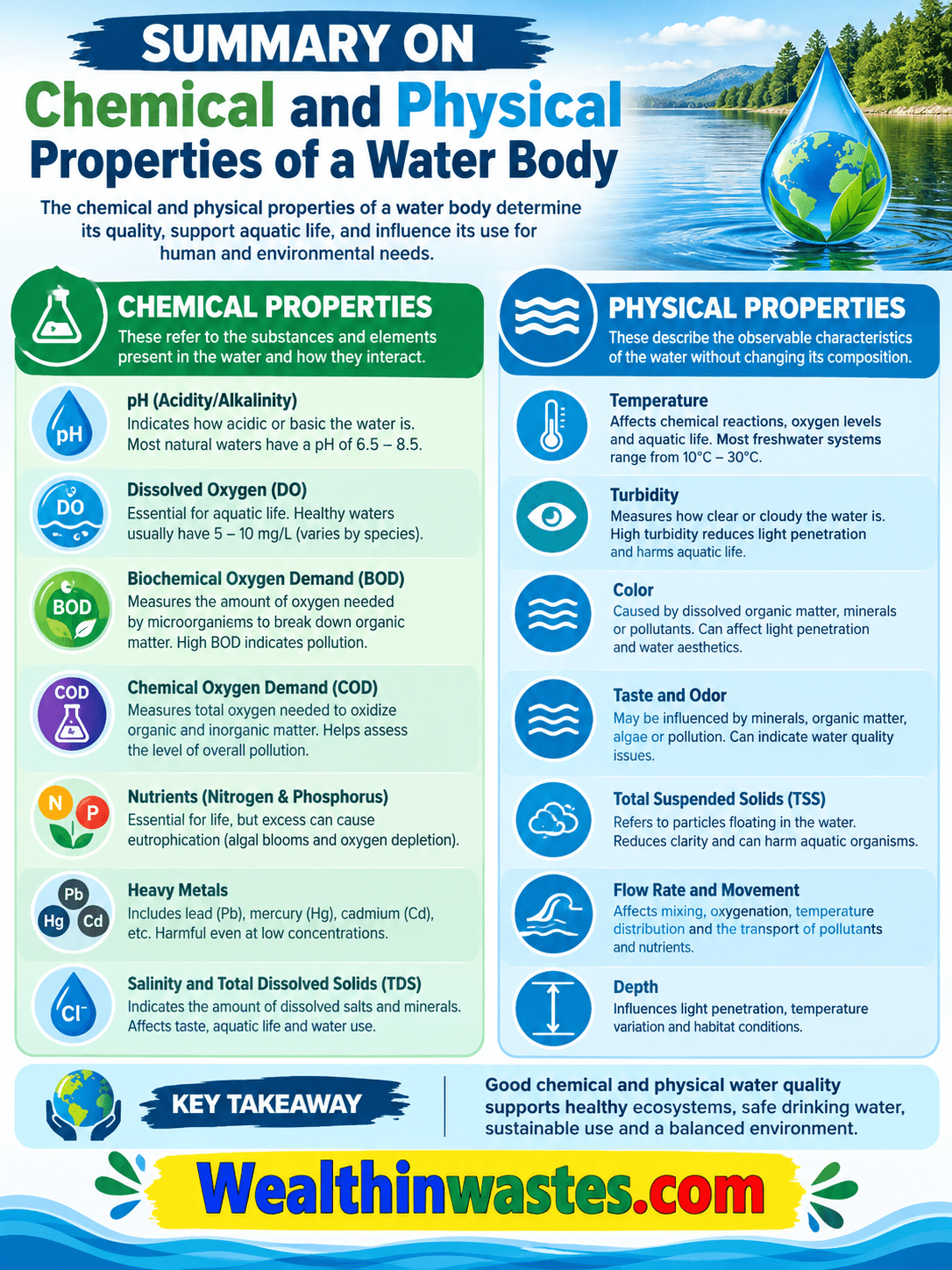
| Property | Summary |
|---|---|
| Temperature | Influences chemical reactions, metabolism, photosynthesis, oxygen availability, thermal stratification, and aquatic species distribution. |
| Dissolved Oxygen | Supports aerobic organisms and provides important information about aquatic health and pollution conditions. |
| pH | Indicates hydrogen ion conditions and helps describe whether water is acidic, neutral, or alkaline. |
| Alkalinity | Shows the capacity of water to resist sudden changes in pH caused by acidic additions. |
| Turbidity | Reflects water clarity and suspended materials from sediments, microorganisms, organic matter, and human activities. |
| Salinity | Describes dissolved salt concentration and influences organisms according to their tolerance ranges. |
| Major Ions | Include calcium, magnesium, sodium, potassium, bicarbonate, carbonate, sulphate, and chloride. |
| Nutrients | Support biological productivity but can cause ecological problems when nitrogen and phosphorus become excessive. |
| Metals | May support biological functions at suitable concentrations but can become toxic when levels rise. |
| Organic Matter | Supports nutrient and energy cycling but excessive quantities can increase microbial oxygen consumption. |
| Biological Components | Include microorganisms, plants, invertebrates, fish, birds, populations, and communities that sustain ecosystem processes. |
| BOD And COD | Provide measurements of oxygen demand associated with biodegradable and chemically oxidizable materials. |
Frequently Asked Questions About Properties of a Water Body: Chemical and Physical Features
1. What are the main properties of a water body?
Major properties include temperature, dissolved oxygen, pH, alkalinity, turbidity, suspended solids, salinity, major ions, nutrients, metals, organic matter, and oxygen demand measurements.
2. Why is water temperature important?
Temperature influences chemical reactions, metabolism, photosynthesis, oxygen availability, reproduction, growth, and the distribution and survival of aquatic organisms within water bodies.
3. What does dissolved oxygen mean?
Dissolved oxygen refers to oxygen present in water and supports respiration and metabolism in fish, microorganisms, aquatic invertebrates, and other aerobic organisms.
4. What is the difference between pH and alkalinity?
pH describes hydrogen ion conditions, while alkalinity describes water’s capacity to resist changes in pH after acidic substances enter the aquatic environment.
5. What causes turbidity in water bodies?
Turbidity can result from sediments, clay, silt, phytoplankton, organic materials, erosion, runoff, construction, urban drainage, and industrial discharges entering aquatic environments.
6. Why does salinity matter to aquatic organisms?
Different aquatic species tolerate particular salinity ranges, so significant changes can disrupt physiological balance, growth, reproduction, movement, survival, and ecological distribution.
7. Why are nutrients important in aquatic ecosystems?
Nutrients support algae, aquatic plants, and microorganisms, but excessive nitrogen and phosphorus can encourage harmful growth, decomposition, oxygen depletion, and ecological imbalance.
8. What are BOD and COD used for?
BOD and COD help assess oxygen demand associated with organic and chemically oxidizable materials, making them useful indicators when evaluating wastewater and pollution conditions.
Do you have any questions, suggestions, or contributions? If so, please feel free to use the comment box below to share your thoughts. We also encourage you to kindly share this information with others who might benefit from it. Since we can’t reach everyone at once, we truly appreciate your help in spreading the word. Thank you very much for your support and for sharing!
Read Also: Systems of Soil Conservation and Improvement