



Water has economic importance because people, farms, industries, ecosystems, and governments depend on reliable supplies. Unlike many commodities, water moves naturally, varies widely, and supports essential life processes across societies.
These characteristics make water markets, pricing decisions, investment choices, and allocation policies more complicated than ordinary transactions. A litre of water can have different values depending on location, quality, timing, and purpose.
Understanding the economic features of water requires more than measuring volumes consumed. Decision-makers must consider scarcity, opportunity costs, environmental effects, infrastructure expenses, and competing users when evaluating water-related economic choices.
Water also creates benefits that markets do not always capture. Irrigated agriculture can generate income and employment, while rivers, wetlands, lakes, and groundwater systems provide valuable ecological services to communities.
Because water supports private activities and shared environmental functions, sound water policy must balance economic efficiency with equity, conservation, public health, and long-term resource protection for future generations.
Key Economic Features of Water
Water possesses several economic characteristics that distinguish it from land, manufactured goods, and many other resources. These features influence allocation, pricing, investment, conservation, and the distribution of benefits among users.
Access to land and water resources strongly affects agricultural productivity, especially where irrigation provides greater control over production conditions and reduces dependence on uncertain rainfall patterns.
Water also has a changing economic value because demand varies among agriculture, households, industries, energy producers, and ecosystems. Scarcity can increase its opportunity cost and encourage more careful allocation.
The economic importance of water therefore extends beyond direct consumption. Its availability influences production, employment, food security, public health, ecosystem services, infrastructure investment, and the economic development of communities.
Effective water conservation can protect economic value by reducing unnecessary withdrawals, maintaining supplies for future users, and preserving the natural systems that support agriculture, fisheries, and communities.
The combination of scarcity, essentiality, mobility, variability, and multiple uses makes water an unusual economic resource. These characteristics explain why simple market mechanisms cannot address every water-management problem.
Read Also: Soil Salinization and Waterlogging in Irrigation
Private and Public Economic Features of Water
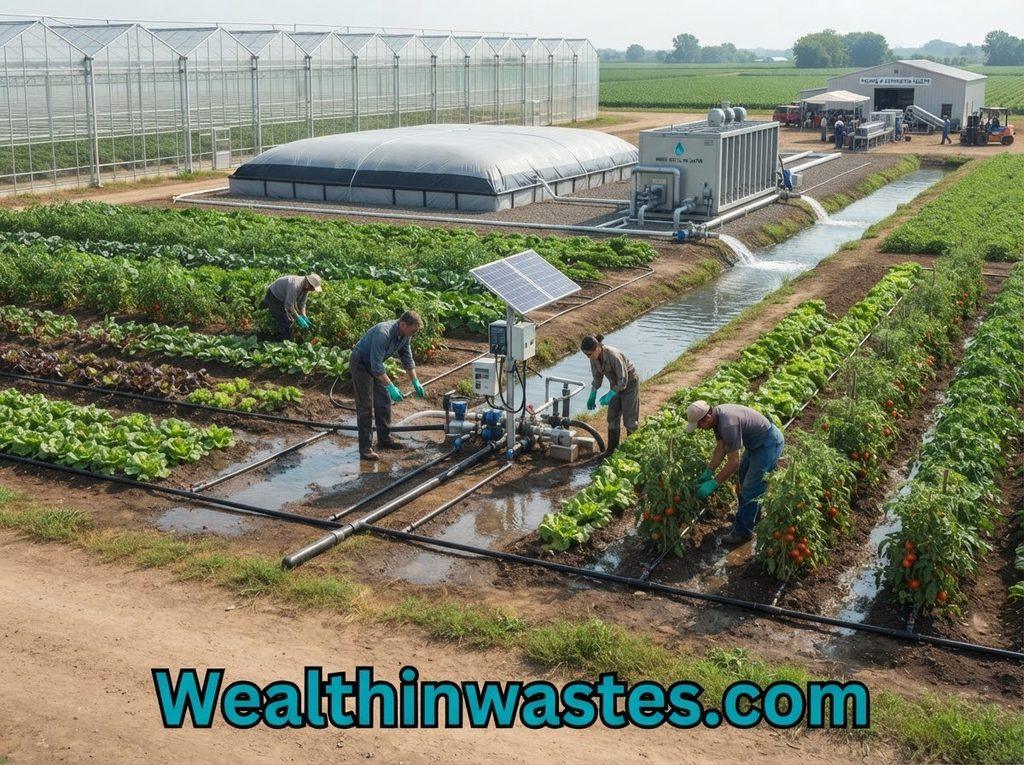
Water can display private and public-good characteristics depending on how people use it. This distinction affects ownership, allocation mechanisms, market arrangements, and the responsibilities of governments and communities.
1. Private Use: When farmers, households, or companies extract water for their own productive activities, they receive direct benefits from its use, making that quantity function economically as a private good.
2. Public Benefits: Water remaining within rivers, wetlands, lakes, and natural ecosystems generates benefits that many people can enjoy collectively, although private markets may not adequately value those environmental services.
3. Public Ownership: In many systems, governments or public institutions control water resources and regulate extraction, even when private farms, households, and industries receive direct benefits from using supplied water.
4. Shared Stewardship: Managing water requires stewardship because excessive withdrawals, contamination, or poorly planned development can reduce supplies and impose costs on downstream users, communities, ecosystems, and future generations.
5.Institutional Oversight: Strong water supply governance helps coordinate competing demands, establish rights, enforce standards, and protect public interests where private decisions can create wider social consequences.
Water Mobility and Heterogeneity
Water differs from many economic goods because it constantly moves through natural and human-managed systems. Its flow creates opportunities for reuse but also makes ownership, measurement, and allocation complicated.
1. Natural Mobility: Water flows through rivers and channels, infiltrates soils, evaporates into the atmosphere, and moves underground, meaning that one user’s withdrawal can influence availability for another user.
2. Reuse Potential: Water discharged after one use may become available to another user downstream, although its quality and treatment requirements can determine whether reuse remains practical and economically beneficial.
3. Spatial Differences: A quantity of water available beside a river does not have the same economic value as an equal quantity located far from farms, cities, industries, or treatment infrastructure.
4. Quality Differences: Water quality influences economic usefulness because drinking water, irrigation water, industrial process water, and ecosystem water require different characteristics and may involve different treatment or management costs.
5. Seasonal Variability: Water availability changes between wet and dry seasons and across years, making groundwater resources and stored supplies particularly important where rainfall patterns remain uncertain.
Water Value, Scarcity and Governance

Water has a critical role in sustaining life and economic production, but its basic necessity alone cannot determine the value of every additional unit used. Economic value changes with scarcity, timing, and application.
1. Critical Importance: Water is indispensable for humans, animals, crops, and ecosystems, so societies must maintain minimum supplies even when market prices alone cannot capture its essential social importance.
2. Scarcity Value: When available supplies become limited, the opportunity cost of water rises because using one unit for a particular activity can prevent another activity from receiving that same resource.
3. Environmental Value: Rivers, lakes, wetlands, and aquifers can provide habitat, flood regulation, groundwater recharge, recreation, and other services that remain difficult to represent through ordinary market prices.
4. Governance Complexity: Effective protection of water sources often involves national authorities, regional institutions, local governments, communities, water associations, environmental agencies, and resource users.
5. Security Concerns: Strong water security planning becomes essential when population growth, climate variability, pollution, infrastructure limitations, and competing demands place greater pressure on reliable water supplies.
Economic Value of Water Uses
The value of water includes benefits from direct use, indirect use, social objectives, environmental functions, and intrinsic qualities. These benefits may vary substantially among locations, users, seasons, and economic activities.
1. Productive Value: Water supports productive activities such as irrigated farming, livestock production, manufacturing, energy generation, and commercial services, where availability can directly influence output and income.
2. Return Flow Benefits: Water diverted for agriculture can return through drainage, runoff, or groundwater recharge, creating additional benefits for downstream users when the returning water retains suitable quality.
3. Social Benefits: Irrigation and reliable water supplies can increase agricultural production, support employment, strengthen rural economies, and contribute to food availability, especially in communities dependent upon farming activities.
4.Environmental Benefits: Maintaining water in natural ecosystems supports biodiversity and ecological processes. Sound ecosystem diversity can therefore protect services that contribute to long-term economic and environmental resilience.
5. Intrinsic Value: Scenic waterscapes, recreational opportunities, cultural connections, and aesthetic qualities create benefits that may not have conventional market prices, despite their importance to communities and visitors.
Costs of Water Supply and Use

The cost of water includes more than pumping and delivering a particular quantity. Economic assessment must consider infrastructure, operation, opportunity costs, externalities, environmental effects, and long-term resource sustainability.
1. Operating Costs: Operation and maintenance expenses include labour, electricity, repairs, fuel, monitoring, administration, and other routine activities required to keep water supply systems functioning reliably.
2. Capital Costs: Infrastructure investment may include dams, reservoirs, treatment plants, pipelines, pumps, irrigation canals, storage facilities, and distribution networks that require substantial long-term financial commitments.
3. Opportunity Costs: When water becomes scarce, allocating it to one user can prevent another user from obtaining it. The forgone benefit represents an important component of the economic cost.
4. External Costs: Water use can generate positive or negative externalities. Groundwater recharge may benefit others, while pollution, salinity, over-abstraction, and downstream shortages can impose wider economic losses.
5. Treatment Costs: Poor quality water may require additional processing before use, increasing expenditure. Effective water treatment processes can improve suitability but also add infrastructure, energy, chemical, and maintenance costs.
Water supply also experiences economies of scale because large infrastructure can serve many users efficiently. However, transporting water over long distances remains expensive because water is bulky and heavy.
Project design becomes more complicated when one system serves agriculture, households, industries, and energy production. The marginal value of an additional unit can therefore change significantly among users and seasons.
Understanding economic losses from pollution also matters because contamination can increase treatment expenses, reduce agricultural productivity, damage fisheries, affect health, and reduce the value of water resources.
Virtual Water and Water Footprints
Virtual water refers to the water used to produce goods that move through trade. The concept helps illustrate how international trade can transfer the effective use of water between countries without physically transporting equivalent volumes.
Virtual water analysis can show that countries participate in international trade as net importers or exporters of water embedded within agricultural and livestock commodities, depending on their production and trading patterns.
However, water availability alone does not establish comparative advantage. Production decisions also depend on land, labour, capital, technology, climate, transportation, markets, productivity, and other economic conditions affecting international trade.
Water footprints estimate the volume of water associated with production and consumption. They can help compare water use among individuals, regions, products, or countries and can highlight areas where resource demand deserves attention.
Nevertheless, a water footprint measures volume rather than the complete economic or environmental consequence of using that water. A cubic metre withdrawn in a wet area may have a different significance from one removed in a severely water-scarce basin.
Consequently, water footprint information works best when combined with water quality management, scarcity assessments, environmental information, economic valuation, and local institutional knowledge before major policy decisions are made.
Related sustainability concerns also include climate sustainability, because changing rainfall patterns, drought risks, floods, and other environmental pressures can alter the economic availability and reliability of water.
Read Also: Climate Change and Sustainability for a Resilient Future
Efficient Water Management for Economic Benefits

Efficient water management aims to secure reliable supplies while reducing waste, protecting ecosystems, and directing available water toward uses that generate appropriate economic, social, and environmental benefits.
Efficient allocation should recognize scarcity and opportunity costs rather than treating water as completely free. Appropriate pricing, rights, regulations, monitoring, and incentives can encourage users to conserve available supplies.
Conservation efforts should also address losses from inefficient infrastructure, excessive irrigation, leakage, inappropriate applications, and unnecessary withdrawals. Water conservation practices can improve resource efficiency across households, agriculture, and industry.
Reusing suitable water can reduce pressure on freshwater sources. Properly treated wastewater reuse can support selected agricultural, industrial, environmental, and municipal applications where health and quality requirements are satisfied.
Improved reclaimed water management requires appropriate treatment, monitoring, infrastructure, public confidence, and economic assessment. Its usefulness depends on local conditions, alternative water sources, quality requirements, and the cost of treatment.
Protecting water quality also supports economic efficiency because polluted supplies can become expensive to treat. Good agricultural water pollution control can reduce contaminants entering rivers, lakes, and groundwater from farming activities.
Water management should additionally consider the economic consequences of watershed degradation. Strong watershed management can protect water quality, reduce environmental damage, and safeguard communities whose livelihoods depend upon reliable natural resources.
Improved drinking water quality can reduce treatment burdens and health risks, while effective wastewater systems can protect downstream users and maintain the economic value of receiving water bodies.
Strong environmental planning also requires adaptation to climate conditions. Climate variability can alter rainfall, water availability, agricultural productivity, and infrastructure risks, making flexible management increasingly important.
Reliable infrastructure remains essential because poor system performance can increase losses and operating expenses. Regular wastewater treatment maintenance helps sustain operational efficiency and protect the quality of water released or reused.
Industrial users must also account for water quality and treatment requirements. Industrial wastewater treatment can reduce pollution risks while supporting safer discharge, recycling, and responsible management of industrial water demands.
Finally, responsible water pollution reduction protects economic value by limiting damage to human health, agriculture, fisheries, ecosystems, and infrastructure, while reducing costs that society may otherwise carry.
Summary on Distinct Economic Features of Water
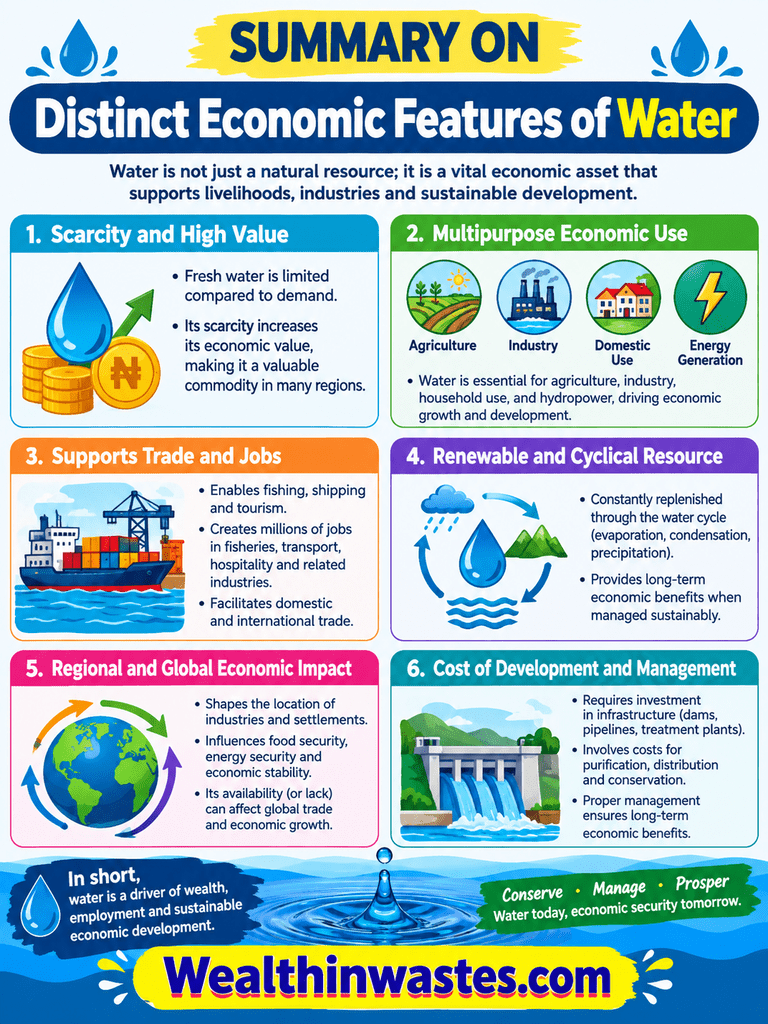
| Section | Main Idea | Why It Matters |
|---|---|---|
| Economic Features | Water has unique economic characteristics | They influence allocation and pricing |
| Private and Public Features | Water can provide private and shared benefits | Governance must balance competing interests |
| Mobility and Heterogeneity | Water varies by location, quality, and time | Supply and demand become harder to match |
| Value and Governance | Water has productive, social, and environmental value | Scarcity affects opportunity costs |
| Costs of Water | Supply includes operating, capital, and external costs | Full-cost assessment improves decisions |
| Virtual Water | Trade can transfer embedded water use | It helps explain international water relationships |
| Water Footprints | Footprints measure water associated with consumption | They support comparison but need wider analysis |
| Efficient Management | Conservation and good governance protect resources | They improve economic and environmental outcomes |
Frequently Asked Questions About Features of Water: Distinct Economic Features Explained
1. What are the main economic features of water?
Water is essential, mobile, variable, heterogeneous, difficult to transport, costly to supply, and capable of generating both private benefits and public environmental services.
2. Why does water have different economic values?
Its value changes according to location, quality, timing, scarcity, availability, user requirements, and the economic benefits generated by each possible use.
3. What is the opportunity cost of water?
Opportunity cost represents the benefit lost when water goes to one activity instead of another activity that could provide greater economic, social, or environmental benefits.
4. Why is water considered both private and public?
Extracted water can provide direct private benefits, while water remaining in natural ecosystems can generate shared environmental, recreational, cultural, and ecological benefits.
5. What is virtual water?
Virtual water describes the water used to produce goods and services traded between places, especially agricultural commodities whose production requires substantial water inputs.
6. What is a water footprint?
A water footprint estimates the amount of water associated with producing and consuming goods or services, helping compare water demand among people, products, regions, or countries.
7. Why are water footprints insufficient for policy decisions?
Water footprints mainly describe quantities used. They do not fully explain scarcity, opportunity costs, economic benefits, environmental damage, or the consequences of particular water withdrawals.
8. Why is water governance economically important?
Governance coordinates competing users, protects water quality, establishes rules, manages scarcity, reduces conflicts, and helps ensure that limited water resources support sustainable economic and environmental outcomes.
Do you have any questions, suggestions, or contributions? If so, please feel free to use the comment box below to share your thoughts. We also encourage you to kindly share this information with others who might benefit from it. Since we can’t reach everyone at once, we truly appreciate your help in spreading the word. Thank you very much for your support and for sharing!
Read Also: Usefulness of Water Resources in Agriculture