



Environmental Management Systems are structured arrangements that help organizations manage environmental issues while achieving defined environmental performance goals. They connect policy, planning, responsibilities, procedures, resources, monitoring, and continual improvement within daily operations.
An EMS also forms part of an organization’s wider management system because it helps develop environmental policy and manage environmental aspects. This approach gives organizations a practical framework for controlling activities that interact with nature.
A management system contains interrelated elements that organizations use to establish policies and objectives and achieve them. These elements include organizational structures, planning activities, responsibilities, practices, procedures, processes, and resources.
Environmental Management Systems support regulatory compliance while helping organizations identify, minimize, and manage environmental impacts. They also encourage prevention, efficient resource use, responsible operations, environmental monitoring, corrective action, and stronger organizational accountability.
Successful implementation begins with identifying environmental aspects, evaluating their significance, establishing objectives, and selecting practical measures for controlling environmental impacts. The organization then develops programmes, assigns responsibilities, monitors performance, and reviews results.
Environmental aspects may involve emissions, discharges, solid waste, resource consumption, noise, pollution, habitat disturbance, material selection, or customer consumption. Some aspects remain directly controllable, while others can only be influenced.
What Are Environmental Management Systems?
Environmental Management Systems provide organizations with a systematic way to manage environmental responsibilities through coordinated policies, procedures, operations, and resources. Their purpose extends beyond compliance because they support measurable environmental performance improvement.
An EMS helps management connect environmental objectives with everyday organizational activities. This connection allows environmental responsibilities to become part of normal decision-making rather than remaining separate activities handled only by environmental personnel.
Organizations can use an EMS to understand how products, services, processes, and activities interact with the environment. This understanding helps management identify significant concerns and determine where control or improvement should receive priority.
The framework can cover air emissions, water pollution, land pollution, noise, waste generation, natural resource consumption, and interactions with natural habitats. These areas provide a practical baseline for environmental performance management.
Effective environmental management also depends on knowing which environmental concerns the organization directly controls and which it can merely influence. This distinction helps managers assign realistic responsibilities and establish achievable improvement measures.
An EMS therefore becomes a practical bridge between environmental policy and operational practice. It transforms broad environmental commitments into objectives, targets, programmes, responsibilities, monitoring activities, corrective actions, and management decisions.
For organizations seeking stronger environmental performance, green environmental management practices can reinforce the wider EMS approach by connecting conservation, pollution prevention, sustainable development, and regulatory compliance.
Read Also: Types of Wastewater and Motivational Factors for Recycling/Reuse
Environmental Aspects And Impacts
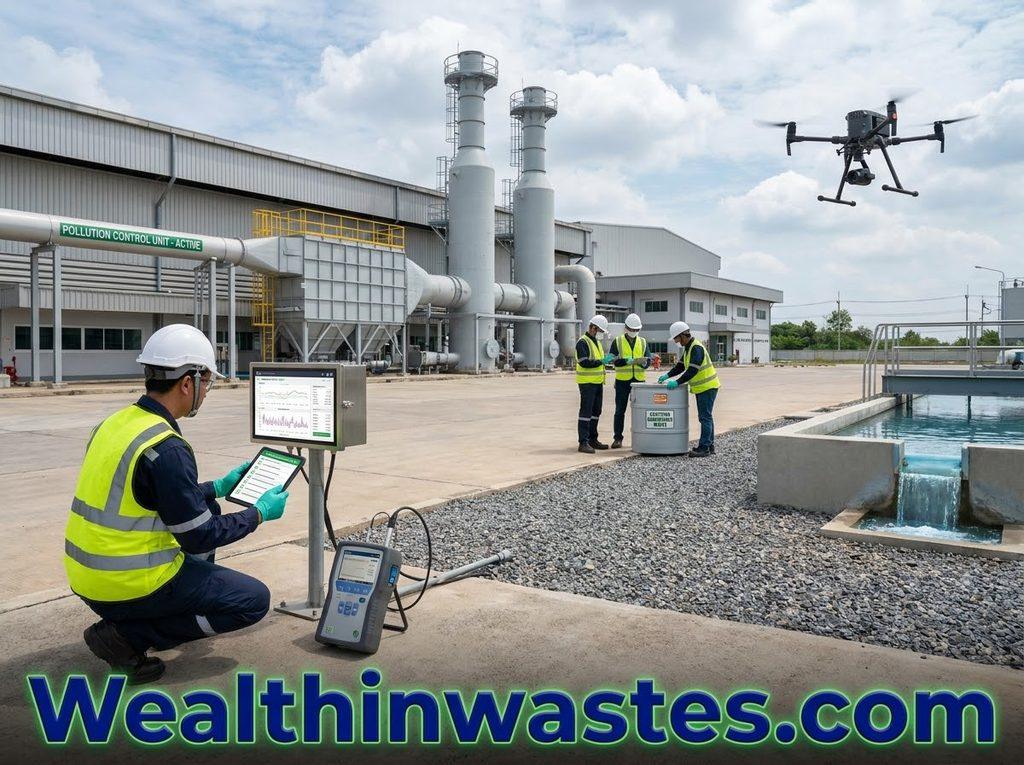
Environmental aspects refer to elements of an organization’s activities, products, or services that interact with the environment. Identifying them gives management the information required to determine potential environmental impacts and priorities.
Environmental impacts describe changes in the environment, whether adverse or beneficial, resulting wholly or partly from organizational activities, products, or services.Impacts may affect environmental quality, resources, ecosystems, or surrounding communities.
1. Air Pollution And Odour: Emissions, fumes, dust, gases, and unpleasant odours can arise from industrial processes, transportation, combustion, storage, or material handling. EMS planning should identify sources and appropriate control measures.
2. Land Pollution: Waste disposal, chemical releases, spills, poor storage, and contaminated materials may degrade land quality. Organizations should identify these sources and establish controls that reduce contamination risks during normal operations.
3. Water Pollution: Surface water, groundwater, and wastewater may receive pollutants through discharges, leaks, runoff, or improper waste handling. Effective EMS procedures identify these pathways and establish suitable prevention, reduction, or control measures.
4. Resource And Habitat Use: Organizations may consume water, energy, raw materials, land, or other natural resources while affecting habitats. Identifying these interactions supports resource conservation and helps reduce unnecessary environmental pressure.
Environmental aspects should also be separated according to control and influence. Directly controlled aspects include emissions, discharges, and solid waste, while influenced aspects can include material selection and customer consumption.
This assessment resembles broader pollutant and environmental risk assessment practices, where the nature, concentration, persistence, location, and timing of pollutants help determine their environmental significance.
Organizations should identify past, present, and foreseeable aspects and consider normal, abnormal, frequent, and infrequent conditions. The resulting information provides a baseline for setting objectives and deciding which environmental aspects require priority.
Planning An Environmental Management System
Planning establishes the direction of an EMS and converts environmental concerns into manageable actions. Organizations must establish policy, identify environmental aspects, understand applicable requirements, and formulate objectives and targets for improvement.
1. Environmental Policy: Top management should establish a clear policy expressing the organization’s environmental intentions and direction. The policy should support continual improvement, pollution prevention, regulatory compliance, and relevant organizational requirements.
2. Environmental Aspect Evaluation: Organizations should identify and evaluate environmental aspects using available data, experience, information, operational knowledge, and significance criteria. This process establishes a baseline for comparing objectives and improvement.
3. Legal And Regulatory Requirements: An organization needs procedures that provide access to relevant environmental laws and requirements. It should also determine how those obligations apply to identified environmental aspects and operational activities.
4. Objectives And Targets: Management should establish specific environmental objectives and targets for controlling significant impacts. Targets should reflect available technology, finance, operations, organizational priorities, and the views of interested parties.
5. Environmental Programme: The organization should maintain a programme explaining how it will achieve environmental objectives and targets. The programme should define responsibilities, authority, resources, controls, implementation methods, and suitable timescales.
Environmental objectives should follow the SMART principle: specific, measurable, attainable, relevant, and time-bound. Clearly documented objectives help different organizational levels understand what they must achieve and how progress will be measured.
Objectives may focus on regulatory control, environmental improvement, or investigation into future improvements through research. These priorities should reflect significant impacts and the organization’s available technical and financial capacity.
The planning process can also reflect fundamental environmental management principles, particularly prevention, responsible resource use, stakeholder considerations, and approaches that encourage organizations to reduce environmental damage before costly remediation becomes necessary.
Implementing Environmental Management Systems

Implementation converts EMS plans into operational practice. Organizations must assign responsibilities, provide resources, develop competence, maintain documentation, control operations, and prepare workers to respond appropriately to environmental emergencies.
1. Organization And Responsibilities: Different organizational units need clearly defined EMS responsibilities. Job descriptions should communicate environmental duties, while environmental management structures should integrate effectively with existing organizational arrangements.
2. Competence And Training: Personnel involved in environmental management need clearly defined competencies and qualifications. Appropriate training helps employees understand procedures, environmental responsibilities, operational controls, documentation requirements, and emergency response expectations.
3. Documentation And Procedures: EMS activities require suitable records, procedures, work instructions, and supporting documents. Proper documentation improves consistency, clarifies responsibilities, supports communication, and provides evidence that environmental controls operate as intended.
4. Operational Control: Significant environmental aspects require practical controls within daily operations. These controls should address emissions, waste, wastewater, materials, resource consumption, maintenance activities, and other processes capable of producing environmental impacts.
5. Emergency Preparedness: Organizations should prepare for environmental emergencies such as spills, accidental releases, equipment failures, fires, or uncontrolled discharges. Clear response arrangements reduce potential impacts and help employees act quickly during incidents.
Waste control forms an important operational area because poor handling can increase pollution, resource loss, and compliance risks. Organizations can strengthen this area through proper waste control practices integrated into everyday procedures.
Implementation also benefits from pollution prevention measures that address environmental problems at their source. waste treatment and disposal strategies can support controls for unavoidable residues after prevention, reduction, reuse, or recovery options have been considered.
Monitoring And Environmental Audits
Monitoring allows an organization to determine whether its environmental objectives, targets, and operational controls are delivering expected results. Records provide evidence for performance evaluation, corrective action, and management decision-making.
1. Environmental Monitoring: Monitoring methods depend on significant environmental aspects and related objectives. Organizations may use sampling, metering, measurements, inspections, records, or informed quantitative estimates to evaluate environmental performance.
2. Performance Records: Accurate records show what occurred, when activities happened, which personnel participated, and what results emerged. Good records help organizations compare actual performance against established objectives, targets, and regulatory requirements.
3. Internal EMS Audits: Internal audits involve personnel from within the organization examining EMS performance. These audits help identify gaps, evaluate conformity, and reveal opportunities for correcting weaknesses before they become larger problems.
4. External And Third-Party Audits: External audits use independent auditors to examine EMS performance. Third-party audits may involve independent certification organizations that provide objective assessments against specified requirements and established environmental management criteria.
5.Corrective And Preventive Action: Audit findings should lead to corrective action where necessary. Organizations should identify causes, assign responsibilities, establish timescales, prevent recurrence, and verify that corrective measures produce effective results.
Organizations can strengthen this auditing process through systematic environmental audit procedures that compare actual conditions with established criteria and help identify environmental risks, weaknesses, and potential cost-saving opportunities.
Monitoring programmes should clearly identify targets, frequency, responsible personnel, required resources, audit protocols, communication procedures, and mechanisms for corrective action. These details make environmental performance management more consistent and accountable.
Waste-related monitoring should also cover recycling, recovery, storage, treatment, and disposal practices. recycling and disposal guidance can support organizations when they design procedures for controlled handling of different waste streams.
Management Review And Continual Improvement

Management review provides an opportunity for senior leaders to evaluate whether an EMS remains effective, adequate, and suitable. The review should consider performance information, audit findings, objectives, and environmental concerns.
1. Review Environmental Performance: Management should examine monitoring results, environmental indicators, compliance information, audit findings, incidents, and progress toward objectives. This review shows whether existing controls continue to deliver expected environmental performance.
2. Identify Corrective Priorities: Where EMS weaknesses appear, management should determine suitable corrective actions and assign responsibilities. Corrective priorities should address root causes, reduce recurrence, and improve the reliability of environmental controls.
3. Update Policies And Objectives: Management review may require changes to environmental policy, objectives, targets, programmes, responsibilities, or operational controls. Adjustments should reflect environmental performance findings and changing organizational requirements.
4. Support Preventive Improvement: Continual improvement should emphasize preventing environmental problems rather than reacting only after damage occurs. Organizations should evaluate prevention, elimination, reduction, and control in that order of preference.
5. Maintain Improvement Programmes: Improvement programmes should remain practical, documented, measurable, and appropriately timed. Management should provide the resources needed to maintain improvements and ensure environmental objectives remain integrated within organizational operations.
Waste minimization can support continual improvement because it reduces unnecessary resource use and waste generation at their sources. Organizations can apply waste minimization approaches to improve efficiency and environmental performance together.
Organizations can also apply the three Rs of waste management by reducing unnecessary consumption, reusing suitable materials, and recycling recoverable resources within appropriate operational systems.
Continual improvement works best when management treats environmental performance as an ongoing responsibility rather than a one-time project. Regular review keeps policies, objectives, programmes, and controls aligned with organizational realities.
Benefits Of Environmental Management Systems
Environmental Management Systems can help organizations control environmental impacts while improving operational discipline. Their benefits depend on proper implementation, effective monitoring, appropriate responsibilities, adequate resources, and management commitment.
1. Better Regulatory Compliance: An EMS helps organizations identify applicable environmental requirements and connect them with operational activities. This structured approach makes compliance responsibilities clearer and supports ongoing attention to legal obligations.
2.Reduced Environmental Impacts: Identifying significant environmental aspects allows organizations to prioritize pollution prevention, resource conservation, waste reduction, and environmental controls. Such measures can reduce the environmental pressures associated with routine activities.
3. Improved Resource Efficiency: Environmental management encourages organizations to examine how they use materials, water, energy, land, and other resources. Better resource control can reduce unnecessary consumption and improve operational efficiency.
4. Stronger Organizational Accountability: Clearly assigned responsibilities help employees understand their environmental duties. Documentation, monitoring, audits, and management review further strengthen accountability by showing who must act and how performance should be evaluated.
5. Better Waste Management: EMS procedures can improve waste segregation, reduction, reuse, recycling, treatment, storage, and disposal. effective solid waste management supports environmental protection and responsible handling of generated waste.
Organizations can also strengthen material recovery through waste management hierarchy principles, which prioritize reduction, reuse, recycling, recovery, and appropriate final disposal according to environmental and operational considerations.
Where industrial activities produce significant residues, EMS controls can connect operational procedures with industrial waste management to reduce pollution risks involving water, air, land, and hazardous substances.
The overall value of an EMS comes from integration. Environmental objectives should become part of planning, procurement, operations, maintenance, training, monitoring, auditing, and management review rather than remaining isolated environmental activities.
Read Also: Waste Recycling and Disposal Guide
EMS, Pollution Control And Compliance

Environmental Management Systems provide a structured framework for controlling environmental risks associated with organizational activities. They support pollution prevention by helping organizations identify sources, evaluate significance, establish controls, and review performance continuously.
1. Pollution Prevention: Prevention should receive priority because avoiding pollution at its source can reduce the need for treatment, cleanup, and corrective actions later. EMS planning should therefore identify opportunities before releases occur.
2. Water Pollution Control: Organizations that generate wastewater or discharge pollutants need procedures for monitoring and controlling water-related impacts. appropriate wastewater treatment options can support environmental objectives where prevention alone cannot eliminate contamination.
3. Air Pollution Control: Facilities with significant emissions should identify sources and monitor relevant parameters. air quality management strategies can complement EMS controls aimed at maintaining acceptable emission and ambient air conditions.
4. Institutional Environmental Control: Effective environmental management may require coordination among organizational units and external institutions. institutional pollution control arrangements demonstrate how responsibilities, standards, monitoring, and enforcement can support environmental protection.
5. Resource Conservation: Organizations should reduce unnecessary pressure on natural resources by improving efficiency, minimizing losses, and supporting sustainable use. natural resource management provides useful context for understanding these environmental responsibilities.
Organizations must also consider land-related impacts because contamination can affect soil, groundwater, vegetation, and surrounding ecosystems. soil and mineral resource management can support controls for activities affecting land resources.
Air, water, and land pollution can arise from different organizational activities and waste streams. air pollution management knowledge helps organizations understand emissions, pollutants, and the need for suitable monitoring and control measures.
Environmental compliance should remain part of normal management activity. Organizations should maintain access to applicable requirements, evaluate performance regularly, correct identified weaknesses, and keep management review connected with changing environmental responsibilities.
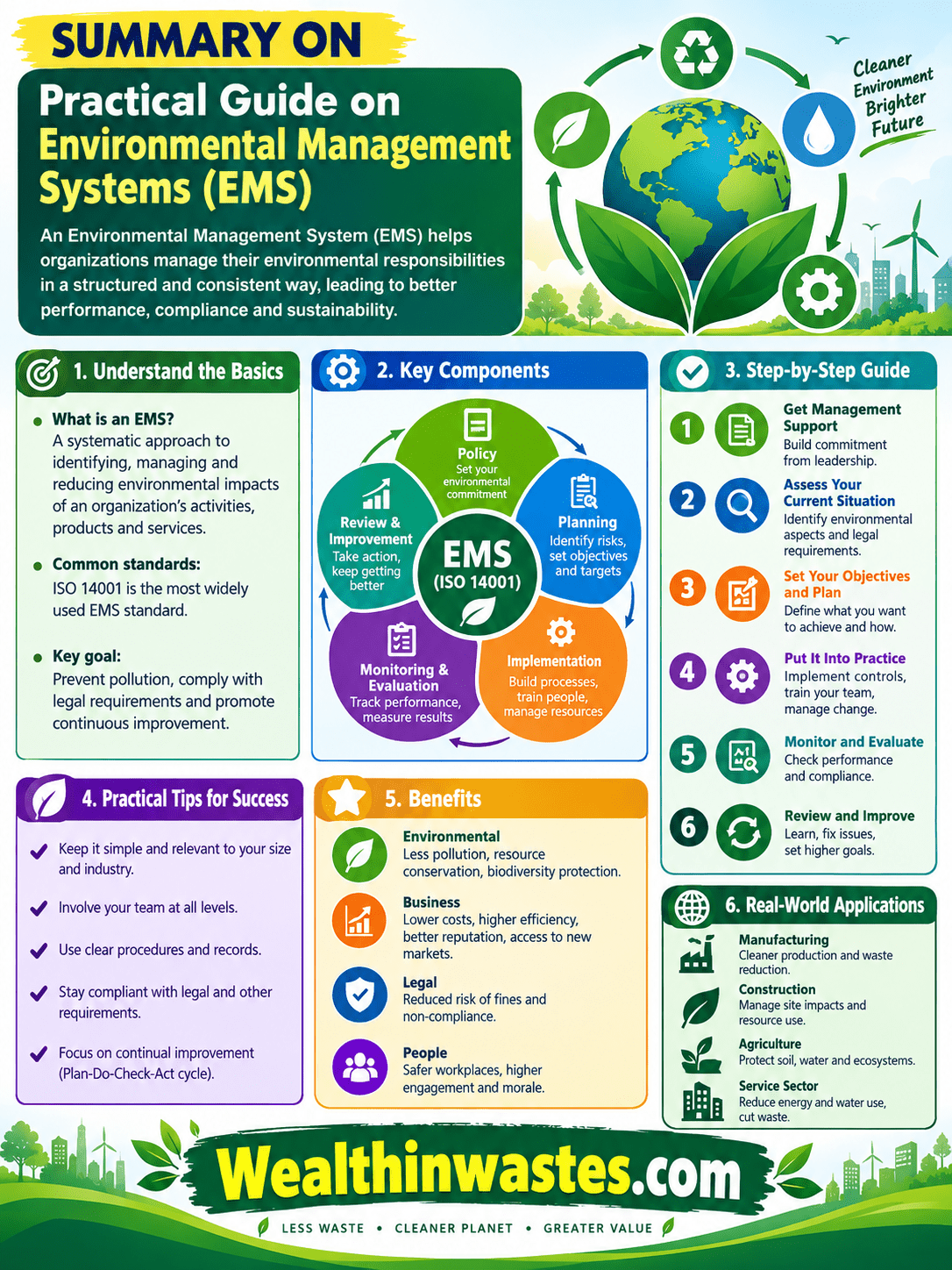
Summary on Practical Guide on Environmental Management Systems (EMS)
| Aspect | Summary |
|---|---|
| Environmental Management Systems | A structured framework for managing environmental issues, responsibilities, objectives, procedures, resources, and environmental performance. |
| Environmental Policy | Defines organizational intentions and direction regarding environmental performance, pollution prevention, compliance, and continual improvement. |
| Environmental Aspects | Elements of activities, products, or services that interact with the environment and require identification and evaluation. |
| Environmental Impacts | Adverse or beneficial changes in the environment resulting wholly or partly from organizational activities, products, or services. |
| Planning | Includes aspect evaluation, legal requirements, SMART objectives, targets, responsibilities, programmes, and environmental priorities. |
| Implementation | Turns EMS plans into practice through responsibilities, training, documentation, operational controls, and emergency preparedness. |
| Monitoring And Audits | Measures environmental performance, maintains records, identifies weaknesses, and supports corrective and preventive action. |
| Management Review | Assesses EMS effectiveness, adequacy, and suitability while supporting policy changes, new objectives, and continual improvement. |
| Pollution Control | Prioritizes prevention, elimination, reduction, and control across air, water, land, waste, resource, and habitat impacts. |
| Overall Benefit | Improves environmental performance, accountability, compliance, resource efficiency, waste control, and continual organizational improvement. |
Frequently Asked Questions About Environmental Management Systems: A Practical Guide
1. What are Environmental Management Systems?
Environmental Management Systems are structured arrangements and processes organizations use to manage environmental issues, implement environmental policy, achieve objectives, control impacts, and improve environmental performance continually.
2. What is the purpose of an EMS?
An EMS helps organizations identify environmental aspects, control significant impacts, meet applicable environmental requirements, establish objectives, monitor performance, correct weaknesses, and strengthen continual environmental improvement.
3. What are environmental aspects?
Environmental aspects are elements of an organization’s activities, products, or services that interact with the environment, including emissions, waste, wastewater, resource use, noise, land, and habitats.
4. What are environmental impacts?
Environmental impacts are adverse or beneficial changes in environmental conditions that result wholly or partly from an organization’s activities, products, or services and their interactions with environmental resources.
5. Why are environmental audits important?
Environmental audits help organizations compare actual performance with established criteria, identify weaknesses, assess EMS effectiveness, support corrective action, and reveal opportunities for stronger environmental management and compliance.
6. What does continual improvement mean in an EMS?
Continual improvement means regularly reviewing environmental performance and making appropriate changes to policies, objectives, programmes, operational controls, responsibilities, and procedures so environmental results continue improving over time.
7.What does SMART mean for EMS objectives?
SMART means specific, measurable, attainable, relevant, and time-bound. These characteristics help organizations create clear environmental objectives that teams can understand, implement, measure, monitor, and evaluate.
8. How does an EMS support pollution prevention?
An EMS identifies environmental sources and significant aspects, then establishes controls that prioritize prevention, elimination, reduction, and control. This sequence helps organizations reduce environmental problems before costly corrective measures become necessary.
Do you have any questions, suggestions, or contributions? If so, please feel free to use the comment box below to share your thoughts. We also encourage you to kindly share this information with others who might benefit from it. Since we can’t reach everyone at once, we truly appreciate your help in spreading the word. Thank you very much for your support and for sharing!
Read Also: Water and Land Pollution in Agriculture