


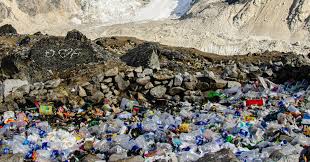
Human societies depend on land, water, air, forests, minerals, and living organisms for survival, development, food production, employment, and economic progress across communities, countries, and generations.
However, meeting present needs should not destroy the resources and ecological systems that future generations require for healthy lives, stable economies, and productive communities.
The need for environmental sustainability therefore begins with responsible choices that balance human development with resource conservation, pollution prevention, ecosystem protection, and efficient consumption.
Environmental sustainability also encourages households, businesses, schools, farmers, industries, and governments to understand how daily decisions influence natural resources, public health, and environmental quality.
When people reduce waste, conserve water, use energy efficiently, protect biodiversity, and manage natural resources responsibly, they create conditions that support both present prosperity and future security.
What Are We Doing To Nature?
Human activities have transformed natural systems on a massive scale, often faster than ecosystems can recover from extraction, pollution, habitat destruction, and changing patterns of resource consumption.
Communities face pressure from unsafe waste disposal, polluted water, air contamination, soil degradation, excessive resource extraction, deforestation, biodiversity loss, and expanding settlements that replace natural habitats.
These pressures can weaken ecosystem services that people depend upon, including clean water, fertile soil, pollination, climate regulation, flood protection, food production, and natural materials.
Waste also demonstrates how consumption decisions create environmental consequences. The sources and impacts of waste vary considerably, but poor management can harm land, water, air, wildlife, and communities.
Environmental sustainability requires people to recognize these connections and change practices before environmental damage becomes more expensive, difficult, or impossible to reverse.
Natural resources may appear abundant, but their availability depends on how quickly ecosystems regenerate, how heavily people use them, and whether pollution compromises their future usefulness.
Read Also: Complete List of Recyclable Plastics
Waste And Inequality
Resource consumption and waste generation are not equally distributed, creating an important connection between environmental sustainability, economic inequality, access to resources, and environmental responsibility across societies.
1. Reduce Wasteful Consumption: Using fewer unnecessary materials lowers environmental pressure while preserving resources for essential needs. The importance of waste reduction becomes clearer when communities face rising disposal costs.
2. Improve Resource Efficiency: Efficient production and consumption provide greater value from available materials, water, food, and energy. Better efficiency reduces losses while lowering environmental damage associated with extraction and disposal.
3. Promote Fair Access: Environmental sustainability should help communities meet basic needs without transferring pollution, resource shortages, or environmental costs to poorer populations that already face greater vulnerability.
Affluent communities often consume more energy, food, manufactured goods, and water, while poorer communities may experience greater exposure to polluted environments and inadequate waste services.
Responsible consumption can narrow this imbalance by reducing unnecessary demand, extending product life, supporting repair, and increasing the recovery of materials that would otherwise become waste.
How Resource Conservation Supports Sustainability
Resource conservation means using natural resources carefully so they remain available for future needs while ecological systems continue performing the functions that support human society.
1.Conserve Renewable Resources: Renewable resources such as freshwater, forests, and biological materials can recover when people keep extraction within sustainable limits. The different renewable and non-renewable resources therefore require careful management.
2. Protect Non-Renewable Resources: Minerals, fossil fuels, and other finite materials require efficient use because natural replacement occurs extremely slowly. Recycling and material recovery can reduce pressure on newly extracted resources.
3. Restore Degraded Ecosystems: Replanting vegetation, protecting wetlands, improving soils, and controlling erosion help damaged ecosystems recover their productive and protective functions while strengthening environmental resilience.
Conservation also depends on better planning because natural resources often interact. Poor land management can increase erosion, reduce water quality, destroy habitats, and weaken agricultural productivity simultaneously.
Communities can strengthen conservation through responsible land use, efficient irrigation, protected forests, reduced material waste, better recycling systems, and environmental regulations that discourage harmful practices.
Why Energy Efficiency Matters

Energy supports homes, transportation, industries, agriculture, communication, refrigeration, healthcare, and economic activity, making energy use a major part of environmental sustainability.
Using energy efficiently means obtaining the services people need while consuming fewer resources and producing fewer emissions. Simple actions can create meaningful reductions across many households and organizations.
People can choose efficient appliances, switch off unused equipment, improve building insulation, reduce unnecessary travel, and select lower-impact transport options whenever practical.
Renewable energy can complement efficiency efforts. Solar, wind, geothermal, biomass, and other cleaner sources can reduce dependence on fossil fuels when suitable systems and infrastructure are available.
Businesses can also reduce energy costs through equipment maintenance, production improvements, monitoring, efficient lighting, and better control of heating, cooling, pumping, and other energy-intensive operations.
Energy decisions influence air quality and climate impacts, so sustainable energy management benefits both environmental protection and long-term organizational efficiency.
How Freshwater Conservation Protects Life
Freshwater supports drinking, sanitation, agriculture, fisheries, industry, energy production, livestock, recreation, and ecosystems, making its protection central to environmental sustainability.
1. Protect Water Quality: Communities should prevent sewage, industrial effluents, chemicals, oils, plastics, and other pollutants from entering rivers, lakes, wetlands, groundwater, and other water sources.
2. Improve Water Efficiency: Households, farms, and industries can reduce unnecessary consumption by repairing leaks, improving irrigation, monitoring usage, reusing suitable water, and applying efficient technologies.
3. Protect Water Sources: Sustainable management requires protection of catchments, wetlands, rivers, springs, wells, boreholes, and reservoirs. The protection of water resources reduces contamination risks.
Water pollution prevention should focus on controlling contamination before pollutants reach treatment systems or natural waters. Preventive practices are usually more effective than expensive restoration after damage occurs.
Good wastewater management also matters because untreated discharge can degrade aquatic ecosystems and create public health concerns. Understanding wastewater characteristics and flow rates supports better treatment and control.
Farmers can protect freshwater by applying fertilizers carefully, preventing soil erosion, maintaining vegetative buffers, managing livestock waste properly, and reducing runoff into streams and reservoirs.
Why Clean Air Supports Sustainability

Clean air supports human health, animal life, vegetation, visibility, and ecosystem stability, while polluted air can create serious environmental and economic problems across communities.
Air pollution comes from transportation, industries, power generation, open burning, household fuels, agriculture, construction, and other activities that release harmful substances into the atmosphere.
Environmental sustainability encourages cleaner transport, improved industrial controls, energy efficiency, cleaner fuels, responsible waste management, and reduced open burning.
Effective air quality management strategies combine emission controls, monitoring, legislation, planning, and public awareness to reduce harmful environmental and health impacts.
Individuals can also make practical choices by walking, cycling, sharing transport, maintaining vehicles, avoiding unnecessary flights, and selecting products with lower emissions of volatile organic compounds.
Monitoring remains important because reliable measurements help authorities understand pollution sources, evaluate environmental risks, and improve measures designed to protect public health and environmental quality.
How Biodiversity Strengthens Environmental Sustainability
Biodiversity includes plants, animals, microorganisms, genes, and ecosystems that interact to support ecological processes, food systems, livelihoods, and resilience against environmental change.
1. Protect Natural Habitats: Forests, wetlands, grasslands, rivers, coastal areas, and other habitats provide food, shelter, breeding grounds, soil protection, and other ecological functions.
2. Reduce Habitat Destruction: Sustainable land use should limit unnecessary clearing, uncontrolled development, destructive extraction, and activities that fragment habitats or remove essential ecological connections.
3. Support Species Recovery: Conservation areas, habitat restoration, responsible resource use, pollution control, and community participation can improve conditions for threatened species and ecological communities.
Understanding biodiversity loss and species extinction helps communities recognize how pollution, habitat destruction, overexploitation, invasive species, and environmental changes can reduce ecological stability.
Healthy biodiversity also supports agriculture through pollination, nutrient cycling, natural pest regulation, soil formation, and genetic resources that can improve resilience and production.
People can support biodiversity by planting native vegetation, protecting wildlife habitats, reducing pollution, avoiding destructive harvesting, and maintaining natural areas around homes, farms, and communities.
Read Also: Waste Recycling and Disposal Guide
How Waste Management Advances Sustainability

Waste management is essential because discarded materials can become environmental hazards when people store, transport, process, burn, or dispose of them without appropriate controls.
1. Reduce Waste Generation: Preventing unnecessary waste is the most direct approach because materials never entering the waste stream create fewer collection, treatment, transportation, and disposal pressures.
2. Reuse Useful Materials: Reusing containers, clothing, furniture, equipment, packaging, and other products extends their service life and reduces demand for new materials and manufacturing inputs.
3. Recycle Recoverable Materials: Paper, metals, glass, plastics, and other suitable materials can return to production systems through organized collection, sorting, processing, and recycling operations.
The solid waste management hierarchy places prevention, reuse, recycling, recovery, treatment, and final disposal within a structured approach that prioritizes better environmental outcomes.
Households can also reduce waste by planning purchases, choosing durable goods, repairing products, separating recyclables, composting organic materials, and avoiding unnecessary disposable items.
Organic materials offer further opportunities because composting can transform suitable food and plant residues into a useful soil amendment. Composting organic waste can reduce disposal pressures.
Proper waste management also requires knowledge of waste categories. The classification of different wastes helps users select suitable handling, treatment, recycling, and disposal methods.
Organizations can improve sustainability by combining prevention, reuse, recycling, treatment, responsible disposal, employee education, procurement changes, and regular review of waste generation across operations.
Why Environmental Sustainability Benefits Organizations
The need for environmental sustainability extends beyond conservation because responsible environmental practices can reduce costs, improve efficiency, protect assets, strengthen reputation, and support long-term organizational resilience.
Organizations often lose money through unnecessary purchases, material losses, inefficient energy use, poor water management, avoidable disposal costs, damaged equipment, and inefficient production processes.
The waste minimization process encourages organizations to examine how resources move through their activities so they can prevent avoidable losses before those materials become waste.
Environmental management can also improve operational control by helping organizations establish responsibilities, monitor impacts, identify risks, set objectives, and measure progress toward sustainability goals.
An effective environmental management system can provide a structured framework for managing environmental responsibilities, monitoring performance, correcting problems, and continuously improving environmental results.
Businesses can also benefit from recovering useful materials from waste streams. Circular approaches can create new products, secondary raw materials, service opportunities, and income while reducing pressure on natural resources.
The economic case becomes even stronger when pollution creates financial losses. Studies of economic losses caused by pollution demonstrate why prevention should remain an important policy and management priority.
Environmental sustainability therefore supports both ecological protection and practical economic performance, making responsible resource management valuable for businesses, governments, communities, institutions, and households.
Integrated approaches can improve these outcomes by connecting waste prevention, resource recovery, environmental education, infrastructure, regulation, and community participation. Integrated waste management principles provide useful guidance.
Daily decisions still matter because collective behavior determines how much energy, water, food, packaging, fuel, and other resources society consumes and how much waste it returns to the environment.
People can choose simple sustainable habits, including carrying reusable containers, reducing unnecessary purchases, repairing useful products, conserving water, switching off unused appliances, and managing waste responsibly.
Environmental sustainability also requires better public awareness so that citizens understand the connection between personal choices, environmental quality, community health, resource availability, and the wellbeing of future generations.
Communities can strengthen awareness through environmental education, school programmes, workplace campaigns, public communication, practical demonstrations, recycling initiatives, conservation projects, and local participation in environmental decision-making.
Governments have an equally important role because environmental sustainability depends on effective standards, enforcement, infrastructure, planning, monitoring, investment, and policies that encourage efficient resource use.
Public institutions can also improve environmental performance by strengthening pollution control, supporting recycling markets, protecting water resources, improving waste services, and promoting cleaner technologies.
Environmental sustainability becomes most effective when responsibility is shared rather than placed on one group. Individuals, businesses, farmers, industries, communities, and governments must contribute according to their responsibilities and resources.
The environmental management practices that reduce waste can help households and organizations turn sustainability principles into practical actions that lower environmental pressure every day.
Similarly, protecting air quality requires reliable information because air pollution measurements help authorities identify harmful concentrations, understand trends, and design stronger control measures.
Environmental decisions should also consider local ecological conditions because species respond differently to changes in temperature, water availability, vegetation, land use, and other environmental factors.
Knowledge about environmental factors affecting biodiversity helps planners understand why certain species thrive in some habitats while struggling in others.
Finally, environmental sustainability should focus on long-term thinking. Decisions that appear convenient today can create expensive environmental problems tomorrow when resources become scarce or ecosystems lose their capacity to recover.
A sustainable society therefore aims to meet human needs while maintaining ecological functions, reducing avoidable waste, protecting natural resources, and keeping environmental risks within manageable limits.
Summary on The Need for Environmental Sustainability and Its Benefits
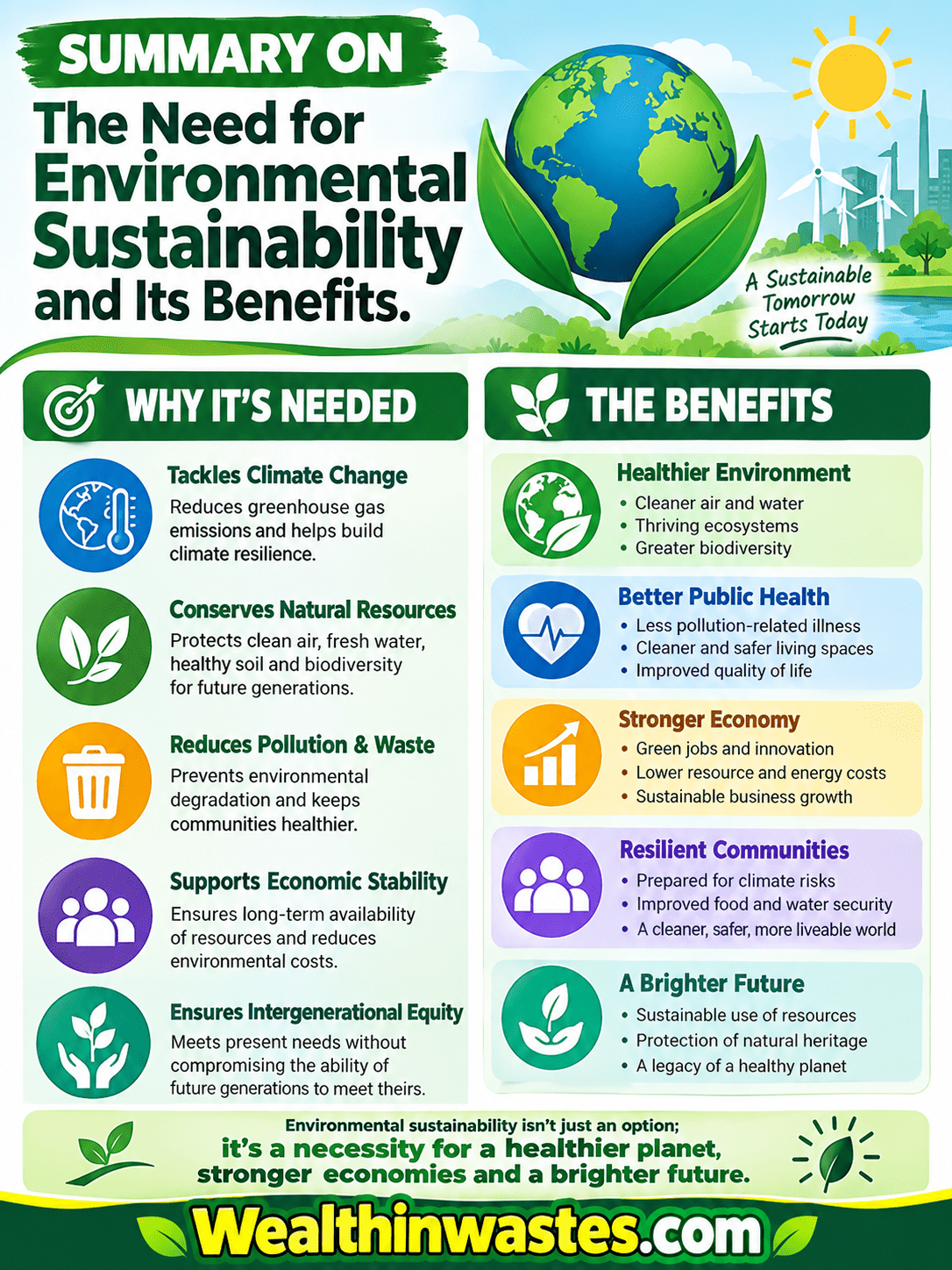
| Area | Key Sustainability Action | Main Benefit |
|---|---|---|
| Natural Resources | Use resources efficiently and protect renewable supplies | Preserves resources for future generations |
| Energy | Improve efficiency and adopt suitable cleaner energy sources | Reduces waste, emissions, and operating costs |
| Freshwater | Prevent pollution and reduce unnecessary water use | Protects water quality and availability |
| Air | Reduce harmful emissions and avoid open burning | Supports healthier communities and ecosystems |
| Biodiversity | Protect habitats and restore degraded ecosystems | Maintains ecological balance and resilience |
| Waste | Reduce, reuse, recycle, recover, and dispose responsibly | Lowers pollution and conserves materials |
| Organizations | Monitor environmental performance and improve resource efficiency | Reduces costs and strengthens resilience |
| Society | Combine public awareness, policy, infrastructure, and participation | Supports sustainable development over time |
Frequently Asked Questions About The Need for Environmental Sustainability and Its Benefits
1. What is the need for environmental sustainability?
It ensures people meet present needs while conserving natural resources, reducing pollution, protecting ecosystems, and maintaining environmental conditions needed by future generations.
2. Why is environmental sustainability important for future generations?
It helps preserve water, fertile soil, biodiversity, forests, energy resources, and healthy ecosystems so future communities can continue benefiting from essential natural resources.
3. How does waste management support environmental sustainability?
Proper waste management reduces pollution, encourages reuse and recycling, protects land and water, conserves materials, and reduces environmental pressures linked to disposal.
4. How can households support environmental sustainability?
Households can conserve energy and water, reduce unnecessary purchases, reuse products, recycle suitable materials, compost organic waste, avoid open burning, and choose sustainable alternatives.
5. What is the relationship between sustainability and resource conservation?
Resource conservation supports sustainability by reducing unnecessary extraction, maintaining ecosystem functions, improving resource efficiency, and keeping important natural resources available for future needs.
6. Why does biodiversity matter to environmental sustainability?
Biodiversity supports pollination, nutrient cycling, food systems, soil processes, habitat stability, and ecosystem resilience, making biological diversity essential for healthy environmental systems.
7. Can environmental sustainability reduce business costs?
Yes. Efficient energy, water, materials, and waste practices can reduce operating costs, disposal expenses, resource losses, and unnecessary purchases while improving productivity.
8. What role does government play in environmental sustainability?
Governments establish standards, provide infrastructure, enforce environmental laws, protect resources, monitor pollution, support public awareness, and create policies that encourage responsible environmental practices.
Do you have any questions, suggestions, or contributions? If so, please feel free to use the comment box below to share your thoughts. We also encourage you to kindly share this information with others who might benefit from it. Since we can’t reach everyone at once, we truly appreciate your help in spreading the word. Thank you very much for your support and for sharing!
Read Also: Soil and Water Conservation in Agriculture