


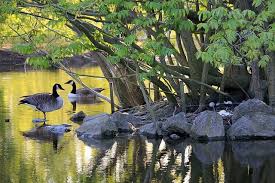
Biodiversity, or biological diversity, refers to the variety of living organisms found on Earth, including plants, animals, microorganisms, their genetic characteristics, and the ecosystems where these organisms live.
The living world contains enormous biological variation that has developed through evolutionary processes operating over very long periods. This diversity occurs within species, between species, and across ecosystems.
Biodiversity is therefore more than simply counting organisms. It includes differences in hereditary characteristics, differences among species, and variations among habitats, ecological communities, and ecological processes.
Every region contains its own combination of organisms and ecological relationships. Factors such as climate, soil, water availability, geographical location, and human activities influence the distribution of biodiversity.
Understanding biodiversity is important because healthy ecosystems depend on interactions among many organisms and environmental components. Its conservation supports ecological stability, natural resources, agriculture, and sustainable development.
Meaning and Scope of Biodiversity
Biodiversity describes the variety and variability of living organisms from terrestrial, marine, freshwater, and other environments, together with the ecological relationships connecting organisms within those environments.
Biologists commonly consider biodiversity at several interconnected levels because genetic characteristics, species populations, communities, and ecosystems influence one another through ecological and evolutionary processes.
At the broadest level, biodiversity encompasses life across the entire planet. At smaller scales, the term can describe biological variation within particular habitats, landscapes, regions, or countries.
The concept includes organisms that currently exist as well as biological lineages represented through evolutionary history. Consequently, biodiversity reflects both present biological patterns and processes that produced them.
Variation occurs naturally because organisms possess different hereditary characteristics, occupy different habitats, respond differently to environmental conditions, and interact with other organisms in numerous ecological relationships.
Some ecosystems contain large numbers of species, while others support fewer species but may contain organisms with unusual adaptations or important ecological functions that contribute significantly to biodiversity.
Biological diversity is closely connected with ecosystem functioning because organisms participate in processes such as nutrient cycling, pollination, decomposition, food webs, soil formation, and energy transfer.
Changes in biodiversity can therefore influence ecological stability and resilience. Biological sustainability and ecosystem health depend partly on maintaining functioning relationships among organisms and their surrounding environments.
Read Also: Objectives of Water Treatment and Water Treatment Processes
Genetic Diversity
Genetic diversity refers to differences in genetic characteristics among individuals, populations, and groups of organisms belonging to the same species.
These differences arise because individuals do not possess exactly identical genetic combinations. Such variation provides populations with characteristics that can influence growth, reproduction, disease resistance, and environmental adaptation.
Genetic variation can occur between populations of the same species that live in different geographical areas or experience different environmental conditions and selection pressures.
Variation also occurs among individuals within a single population. Some organisms may possess characteristics that allow them to survive environmental stresses more effectively than others.
In sexually reproducing organisms, genetic recombination creates new combinations of existing genetic information. Mutations can also introduce new genetic variation into populations over generations.
Natural selection can influence the frequency of genetic characteristics within populations because individuals possessing advantageous traits may survive and reproduce more successfully under particular environmental conditions.
The amount and distribution of genetic variation can differ greatly among species because populations have different histories, reproductive patterns, population sizes, habitats, and environmental pressures.
Maintaining genetic diversity is important because populations with broader genetic variation may have greater potential to respond to diseases, climate fluctuations, habitat changes, and other environmental pressures.
Genetic diversity is particularly important in agriculture because crop varieties and livestock populations with different characteristics can provide valuable resources for breeding, adaptation, disease resistance, and productivity.
Loss of genetic variation can occur through habitat destruction, population decline, replacement of traditional varieties, inbreeding, and other pressures. Genetic erosion can consequently weaken biological resources over time.
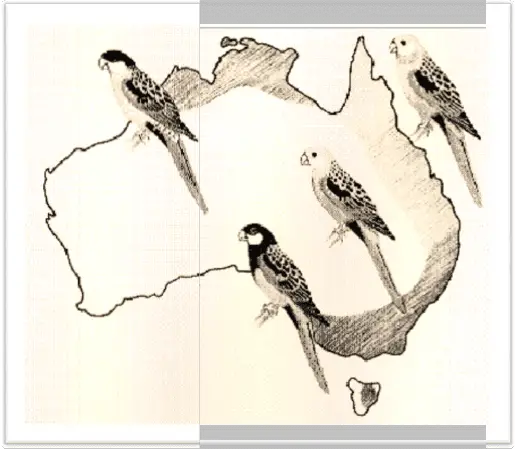
Figure 1: Genetic variation within the White-cheeked Rosella. Source: Wikipedia
The White-cheeked Rosella illustrates how genetic variation can produce differences in colour patterns and other observable characteristics among populations or varieties within the same species.
Genetic differences are not always immediately visible because many genetic characteristics influence biochemical functions, physiological processes, disease responses, reproductive traits, or other internal biological features.
Scientists can investigate genetic diversity using molecular methods, DNA analysis, population studies, breeding information, and other techniques that reveal relationships and differences among organisms.
Protecting genetic diversity requires maintaining viable populations and habitats while avoiding unnecessary isolation, population decline, and uncontrolled removal of individuals carrying valuable hereditary characteristics.
The conservation of genetic resources is particularly significant for food production because agricultural breeding programs depend on variation to develop organisms with desirable characteristics and better environmental adaptability.
1. Genetic variation within populations: Individuals belonging to the same population may possess different genetic characteristics, creating variation that contributes to the population’s adaptive potential.
2. Genetic variation between populations: Populations separated geographically or environmentally may gradually develop different genetic characteristics, especially when reproduction between those populations becomes limited.
3. Genetic conservation: Maintaining diverse populations and traditional biological resources helps preserve hereditary characteristics that may become valuable for future agriculture, environmental restoration, research, and conservation efforts.
Levels of Biodiversity
Biodiversity is commonly examined at three major levels: genetic diversity, species diversity, and ecosystem diversity. These levels are different but strongly connected within the natural environment.
Genetic diversity concerns variation in hereditary information within and between populations, species diversity concerns the variety of species, while ecosystem diversity concerns differences among habitats and ecological systems.
Considering these three levels together provides a broader understanding of biological variation because conserving species alone may not protect the genetic and ecological diversity associated with them.
Species diversity refers to the variety of distinct species occurring within a defined geographical area, habitat, ecosystem, or other ecological unit being studied.
Species diversity can be evaluated using measures such as species richness, which considers the number of species present, and species abundance, which considers their relative numbers.
Researchers may also examine taxonomic or evolutionary relationships among species to understand how biological diversity is distributed and how closely different organisms are related.
4. Ecosystem diversity: Ecosystem diversity concerns differences among habitats, biological communities, ecological processes, and environmental conditions occurring across landscapes, regions, and broader geographical areas.
Forests, grasslands, wetlands, rivers, lakes, mangroves, deserts, agricultural landscapes, and marine environments represent different ecological systems that support organisms adapted to particular environmental conditions.
The diversity of ecosystems influences the variety of organisms that can survive because different habitats provide different combinations of food, shelter, water, breeding sites, and environmental conditions.
5. Genetic diversity: Genetic diversity provides variation within populations and species, enabling organisms to respond differently to environmental conditions and supporting adaptation across generations.
6. Species diversity: Species diversity reflects differences in the number and relative abundance of organisms occupying a particular ecological area.
7. Ecosystem diversity: Ecosystem diversity reflects differences among habitats, communities, ecological processes, and environmental systems across geographical areas.
These levels operate together rather than separately. Changes in habitat conditions can affect species populations, while declining populations can reduce genetic diversity and ultimately alter ecosystem structure.
Reliable assessment of species diversity helps explain how biological communities are organized. Species richness and species diversity measurements provide useful information for ecological studies and conservation planning.
Read Also: On-site Municipal Wastewaters Treatment
Species Diversity
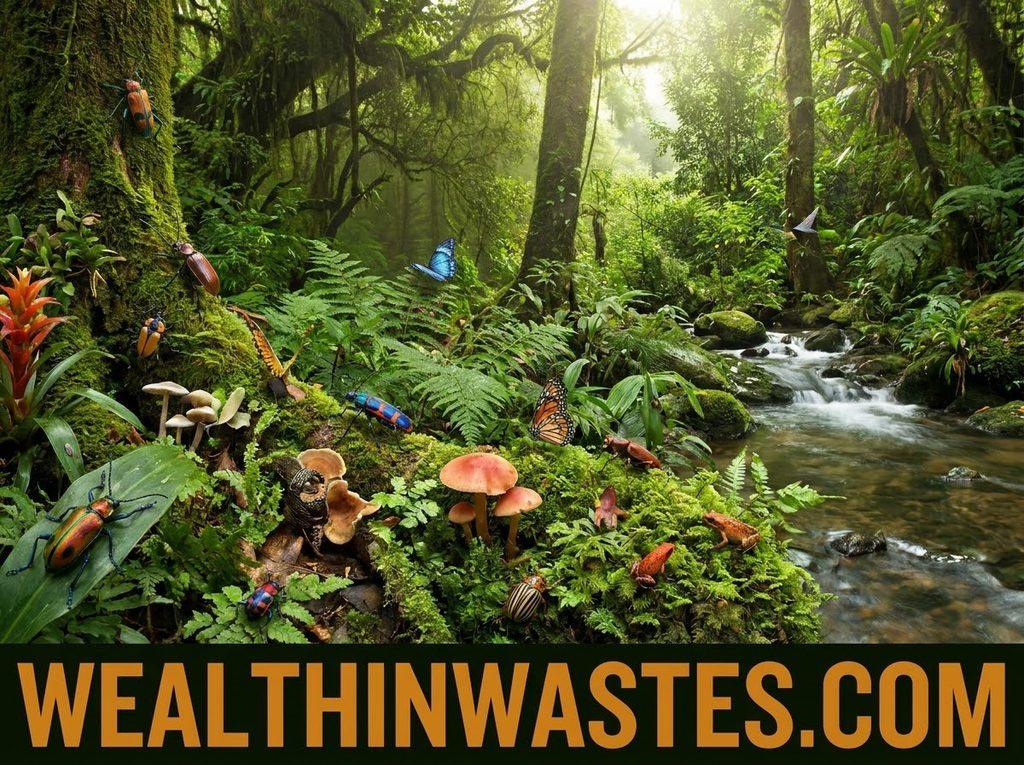
Species diversity describes the variety of species present within a particular geographical area or ecological community and represents one of the most recognizable dimensions of biological diversity.
A region may contain many species belonging to different groups, including plants, mammals, birds, insects, fungi, microorganisms, reptiles, amphibians, and aquatic organisms.
Species richness is one basic measure because it records the number of different species occurring within a defined area, regardless of how many individuals each species contains.
Species abundance provides additional information by considering the relative numbers of individuals belonging to different species within the community being examined.
A community containing many species but dominated by one species may differ ecologically from another community where individuals are distributed more evenly among numerous species.
Environmental conditions strongly influence species diversity because organisms have different requirements for temperature, moisture, nutrients, shelter, food availability, breeding conditions, and other ecological resources.
Species diversity can also vary geographically. Tropical regions often support high biological diversity because environmental conditions and historical factors have supported the persistence of numerous species.
Marine environments also contain substantial biological diversity, with different levels of species richness occurring among coastal zones, coral reefs, continental shelves, open oceans, and deeper waters.
Human activities can reduce species diversity when habitats are destroyed, pollution increases, organisms are overexploited, invasive species spread, or ecological conditions change beyond species tolerance limits.
Conserving species diversity requires protection of habitats, sustainable resource use, pollution control, restoration of degraded areas, and measures that prevent unnecessary population declines.
8. Species richness: Species richness is the number of different species recorded within a defined area, habitat, ecological community, or other geographical unit.
9.Species abundance: Species abundance describes the number of individuals belonging to particular species and helps explain how organisms are distributed within biological communities.
Understanding species diversity is valuable for environmental management because changes in species composition can indicate habitat disturbance, pollution, resource depletion, climate pressures, or ecological recovery.
Forest and wildlife resources contribute to biodiversity by providing habitats, ecological services, food resources, raw materials, cultural benefits, and natural processes that support human and environmental wellbeing.
Ecosystem Diversity
Ecosystem diversity refers to the variety of ecosystems, habitats, biological communities, and ecological processes occurring within a particular landscape, region, or broader geographical area.
Different ecosystems contain different combinations of organisms and physical conditions. Forests, wetlands, grasslands, rivers, lakes, mangroves, deserts, and marine environments therefore support distinct ecological communities.
The structure and functioning of ecosystems depend on interactions between living organisms and non-living factors such as soil, water, temperature, sunlight, minerals, and atmospheric conditions.
Ecosystem diversity provides a range of habitats that allow different organisms to survive and reproduce. It also supports ecological processes that benefit both natural systems and human communities.
Wetlands, for example, can provide habitats for aquatic organisms and birds while also supporting water regulation, nutrient cycling, and other important ecological functions.
Forests provide habitats for numerous organisms while contributing to soil protection, nutrient cycling, water regulation, climate processes, and the conservation of biological resources.
Marine and coastal ecosystems such as mangroves, estuaries, seagrass areas, and coral reefs support specialized organisms and contribute to coastal productivity, habitat provision, and ecological stability.
Human activities can alter ecosystem diversity through deforestation, agricultural expansion, urbanization, pollution, drainage, mining, infrastructure development, overexploitation, and unsustainable use of natural resources.
Protecting ecosystem diversity requires conserving representative habitats, maintaining ecological connections, reducing destructive activities, restoring degraded environments, and promoting sustainable use of natural resources.
The relationship between ecosystems and biodiversity is especially important in agriculture because farming landscapes depend on soil organisms, pollinators, natural predators, vegetation, water systems, and other biological resources.
Understanding ecosystem relationships helps farmers and environmental managers recognize how changes in one ecological component can influence organisms, resources, production systems, and overall environmental stability.
Ecosystem conservation is therefore not simply about protecting individual organisms. It requires maintaining the ecological conditions and relationships that enable communities and natural processes to continue functioning.
10. Terrestrial ecosystems: These ecosystems occur on land and include forests, grasslands, deserts, mountains, and other habitats shaped by terrestrial environmental conditions.
11. Aquatic ecosystems: These include freshwater and marine environments such as rivers, lakes, wetlands, estuaries, mangroves, coastal waters, and oceans.
Biodiversity conservation helps maintain ecosystem resilience by protecting biological resources and ecological relationships that support adaptation, recovery, sustainable resource use, and continued ecosystem functioning.
Importance and Conservation of Biodiversity

Biodiversity supports ecosystems by maintaining numerous biological interactions and ecological processes. Different organisms contribute to food webs, nutrient cycling, decomposition, pollination, and other environmental functions.
People also depend on biodiversity for food, fibres, medicines, timber, genetic resources, cultural values, recreation, and other goods and services obtained from natural and managed ecosystems.
Agriculture benefits from biodiversity through crop genetic resources, beneficial insects, soil organisms, pollinators, natural enemies of pests, vegetation, and ecological processes that support productive farming systems.
Loss of biodiversity can weaken ecosystems and reduce their ability to respond effectively to environmental disturbances. This makes conservation important for both present needs and future generations.
Biodiversity may be threatened by habitat destruction, pollution, excessive resource exploitation, invasive organisms, climate-related changes, unsustainable development, and other pressures associated with human activities.
Conservation involves protecting species, habitats, genetic resources, ecological communities, and the natural processes required to sustain biological diversity over time.
12. In-situ conservation: This approach conserves organisms within their natural habitats, allowing populations to continue interacting with their ecological surroundings and natural processes.
13. Ex-situ conservation: This approach conserves biological resources outside their natural habitats through facilities and methods designed to maintain species, populations, or genetic resources.
Protected areas, wildlife reserves, forests, wetlands, botanical gardens, seed banks, breeding programs, restoration projects, and sustainable land management can all contribute to biodiversity conservation.
Forest and wildlife conservation is particularly important because natural habitats provide shelter, feeding areas, breeding sites, and ecological conditions required by many species.
Agricultural communities can also contribute by maintaining vegetation, protecting waterways, conserving soil, reducing pollution, preserving traditional varieties, and avoiding unnecessary destruction of natural habitats.
Effective conservation should consider local environmental conditions and community needs because successful long-term protection depends on practical management, responsible resource use, monitoring, education, and participation.
Bio-resource management in agriculture connects biodiversity conservation with sustainable use of biological resources, supporting both agricultural production and long-term environmental management.
Protecting biodiversity is ultimately an investment in ecological stability and human wellbeing because healthy biological systems provide resources, services, resilience, and opportunities that societies depend upon.
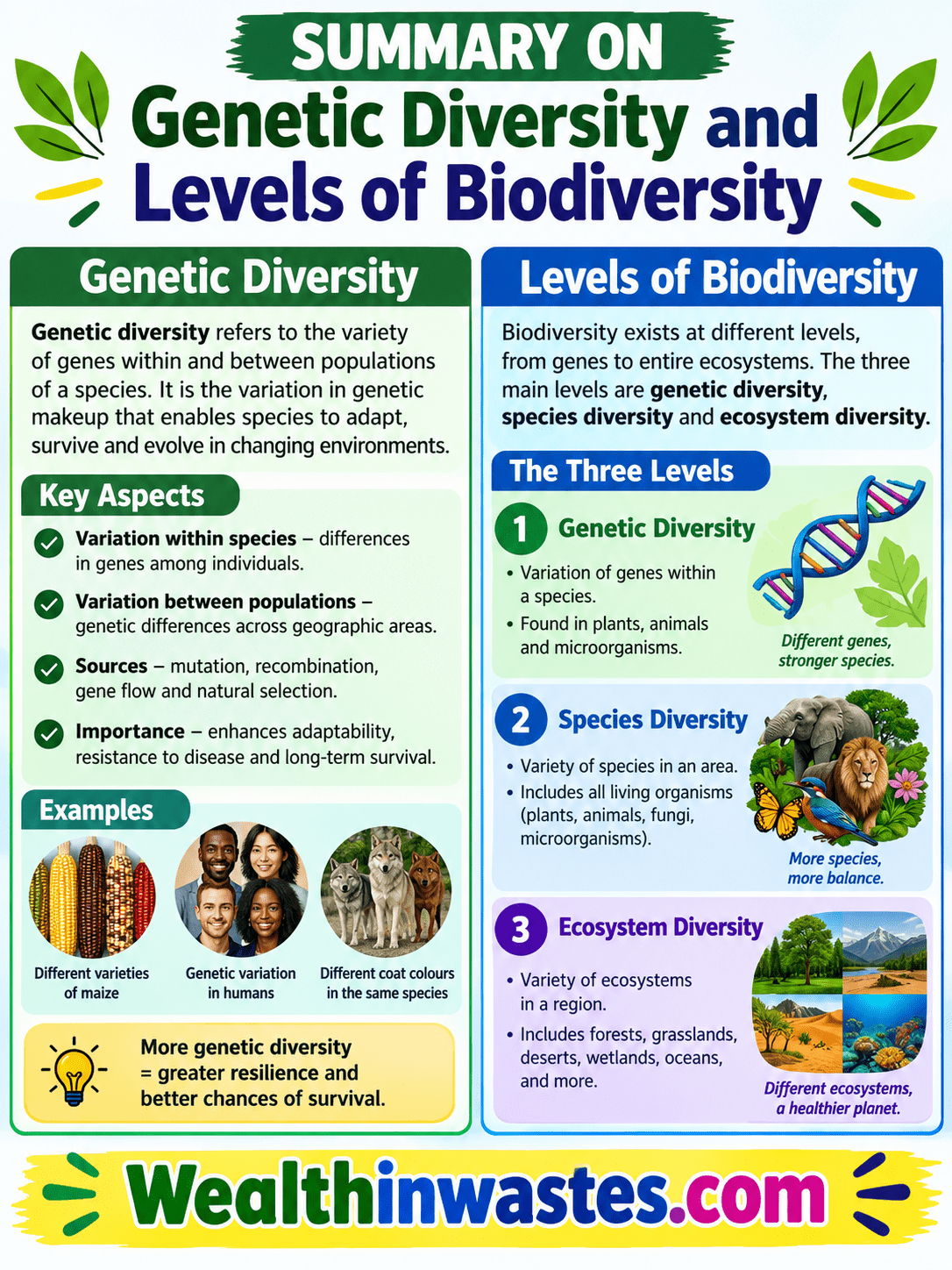
Summary on Meaning and Scope of Genetic Diversity and Levels of Biodiversity
| Aspect | Meaning | Key Importance |
|---|---|---|
| Biodiversity | The variety and variability of living organisms and ecosystems. | Supports ecological stability and human wellbeing. |
| Genetic Diversity | Variation in hereditary characteristics within and between populations. | Supports adaptation, breeding, resilience, and genetic conservation. |
| Species Diversity | The variety and relative abundance of species within an area. | Helps describe biological communities and ecological richness. |
| Ecosystem Diversity | Variation among habitats, communities, and ecological processes. | Provides different environments and ecological functions. |
| Conservation | Protection and sustainable management of biodiversity. | Prevents unnecessary biological loss and supports future generations. |
| In-situ Conservation | Protection of organisms within their natural habitats. | Maintains natural ecological relationships and processes. |
| Ex-situ Conservation | Conservation of biological resources outside natural habitats. | Provides additional protection for species and genetic resources. |
Biodiversity encompasses genetic, species, and ecosystem variation.Maintaining all three levels helps preserve ecological processes, biological resources, adaptive capacity, agricultural opportunities, environmental resilience, and sustainable development.
Frequently Asked Questions About Biodiversity: Definition, Genetic Diversity and Levels of Biodiversity
1. What is biodiversity?
Biodiversity is the variety and variability of living organisms, including plants, animals, microorganisms, their genetic characteristics, and the ecosystems in which they occur.
2. What are the three main levels of biodiversity?
The three major levels are genetic diversity, species diversity, and ecosystem diversity, which collectively describe biological variation from hereditary characteristics to ecological systems.
3. What is genetic diversity?
Genetic diversity is the variation in hereditary characteristics among individuals and populations. It provides biological populations with different traits that can support adaptation and survival.
4. Why is genetic diversity important?
Genetic diversity provides variation that can help populations respond to diseases, environmental changes, climatic pressures, and other challenges affecting survival and reproduction.
5. What is species diversity?
Species diversity refers to the variety and distribution of different species within a defined geographical area, habitat, ecosystem, or biological community.
6. What is ecosystem diversity?
Ecosystem diversity refers to differences among habitats, biological communities, ecological processes, and environmental systems found across particular landscapes or geographical regions.
7. How does biodiversity benefit agriculture?
Biodiversity supports agriculture through pollination, soil organisms, natural pest control, genetic resources, nutrient cycling, water regulation, and biological resources useful for crop and livestock production.
8. What causes biodiversity loss?
Biodiversity loss can result from habitat destruction, pollution, overexploitation, invasive organisms, unsustainable development, climate pressures, and other activities that disrupt natural ecological systems.
9. What is in-situ biodiversity conservation?
In-situ conservation protects organisms within their natural habitats, allowing populations to continue interacting with surrounding environmental conditions and maintaining natural ecological relationships.
10. What is ex-situ biodiversity conservation?
Ex-situ conservation protects biological resources outside their natural habitats using approaches such as seed banks, breeding facilities, botanical collections, and other specialized conservation systems.
Do you have any questions, suggestions, or contributions? If so, please feel free to use the comment box below to share your thoughts. We also encourage you to kindly share this information with others who might benefit from it. Since we can’t reach everyone at once, we truly appreciate your help in spreading the word. Thank you very much for your support and for sharing!
Read Also: How to Understand the Ecosystem Basics