



Wildlife conservation protects animals, plants, habitats, and ecological processes that support life. Protected areas provide practical spaces where governments and conservation managers can safeguard biological diversity effectively.
Among the different protected areas, a wildlife sanctuary has a particularly important role in protecting wild species and their habitats from activities that can cause serious environmental damage.
Although wildlife sanctuaries share conservation goals with national parks and other reserves, each protected area can have different management objectives, legal restrictions, permitted activities, and responsibilities.
Understanding a wildlife sanctuary therefore requires more than knowing that it protects animals. It also involves examining habitat protection, wildlife management, ecological monitoring, community participation, and resource conservation.
This article explains the meaning, characteristics, importance, management, threats, and biodiversity value of wildlife sanctuaries while showing how they fit into broader conservation strategies.
What Is a Wildlife Sanctuary?
A wildlife sanctuary is a protected area established primarily to conserve wild animals, plants, habitats, ecological communities, or important natural features under relevant conservation laws and management systems.
The central purpose of a wildlife sanctuary is to provide a safer environment where wildlife can feed, reproduce, shelter, migrate, and maintain populations without excessive human interference.
Unlike completely restricted conservation areas, some sanctuaries may permit carefully regulated human activities when those activities remain compatible with protection objectives and applicable legal requirements.
Sanctuaries may focus on particular species, valuable habitats, breeding sites, wetlands, forests, grasslands, coastal ecosystems, or landscapes supporting significant biological communities and ecological processes.
Effective sanctuary management depends on understanding the relationship between wildlife and habitat. Food, water, shelter, breeding locations, vegetation, climate, and safe movement corridors all influence animal survival.
Sanctuaries therefore contribute to forest and wildlife conservation by reducing destructive pressure while maintaining habitats that support wildlife populations and ecological stability.
They also complement broader approaches to natural resource conservation because wildlife depends upon forests, water, soils, vegetation, and other environmental resources that require careful management.
Read Also: Proper Waste Control Complete Guide
Key Characteristics of Wildlife Sanctuaries

1. Legal Protection: A wildlife sanctuary normally operates under a legal or administrative framework that identifies conservation responsibilities, boundaries, management powers, restrictions, and permitted activities.
2. Wildlife Focus: Sanctuary management gives priority to wild animals, plants, habitats, and ecological features that require protection from hunting, habitat destruction, pollution, or other harmful activities.
3. Habitat Protection: Protecting wildlife also requires maintaining the habitats that provide food, shelter, nesting sites, water sources, breeding grounds, migration routes, and suitable environmental conditions.
4. Regulated Human Activities: Some sanctuaries can permit selected human activities when managers consider them compatible with conservation goals and ensure they do not create unacceptable pressure.
5. Scientific Monitoring: Managers can monitor animal numbers, vegetation, habitat quality, threats, breeding success, disease occurrence, and environmental changes to guide conservation decisions and management actions.
6. Conservation Education: Wildlife sanctuaries can support environmental education by helping visitors, students, researchers, and surrounding communities understand biodiversity, wildlife protection, and responsible resource use.
7. Community Involvement: Local participation can strengthen conservation when communities understand sanctuary objectives and contribute to monitoring, sustainable livelihoods, education, reporting, and protection activities.
8. Ecological Significance: Sanctuaries may protect habitats with important species, breeding areas, feeding grounds, migration routes, wetlands, forests, or ecological features that support biodiversity.
Importance of Wildlife Sanctuaries
Wildlife sanctuaries provide practical conservation spaces where wildlife populations can receive protection while managers address threats affecting species, habitats, ecological processes, and natural resources.
Their value becomes clearer when wildlife faces pressures from habitat conversion, illegal hunting, pollution, invasive species, uncontrolled development, climate change, and unsustainable resource exploitation.
1. Wildlife Protection: Sanctuaries reduce harmful activities such as uncontrolled hunting and habitat destruction, allowing threatened or vulnerable species greater opportunities to survive and reproduce.
2. Habitat Conservation: Protected habitats maintain food sources, shelter, nesting locations, breeding grounds, water resources, and ecological conditions that wild animals need throughout their life cycles.
3. Biodiversity Conservation: A single protected area can conserve numerous plant and animal species together because habitat protection preserves many connected components of biological diversity.
4. Scientific Research: Sanctuaries provide natural settings for studies involving animal behaviour, population trends, habitat conditions, ecological relationships, species distribution, and conservation effectiveness.
5. Environmental Education: Well-managed sanctuaries help students, researchers, visitors, and communities develop stronger knowledge of wildlife, ecological relationships, conservation responsibilities, and sustainable environmental practices.
6. Economic Opportunities: Responsible tourism, research activities, conservation employment, guiding services, and related enterprises can generate income when management prevents excessive disturbance and resource degradation.
Wildlife sanctuaries also protect resources that support broader ecosystems. Research on species diversity and ecological variety helps demonstrate why protecting different species improves conservation planning.
The broader value of protected wildlife areas connects with the ecological and economic benefits of forest and wildlife resources because healthy ecosystems provide services that extend beyond sanctuary boundaries.
Wildlife Sanctuary and National Park
Wildlife sanctuaries and national parks both protect biodiversity, but they can differ in their legal frameworks, management objectives, permitted activities, levels of restriction, and approaches to human use.
1. Primary Objective: A wildlife sanctuary often emphasizes protection of particular wildlife, habitats, or natural features, while a national park generally protects larger natural ecosystems and landscapes.
2. Human Activities: Sanctuaries may allow certain regulated activities where the law permits them, whereas national parks commonly impose stronger restrictions on resource extraction and incompatible uses.
3. Scale and Scope: National parks often cover extensive landscapes containing several habitats, while sanctuaries may protect smaller areas with specific conservation importance.
4. Management Priorities: Sanctuary managers may concentrate on particular species or habitats, whereas national park management usually emphasizes maintaining broader ecosystem integrity and natural processes.
5. Legal Differences: The exact rules depend on the country and the legislation establishing each protected area, so no universal difference applies to every sanctuary or park.
These distinctions show why protected areas need appropriate classification and management rather than a single conservation model. Natural resource classification also helps managers understand different resources and their conservation requirements.
National parks and sanctuaries can work together within protected-area networks. Strong planning connects them with surrounding forests, wetlands, rivers, agricultural landscapes, and other habitats.
Integrated watershed management can also support sanctuary conservation because changes in upstream land and water conditions may influence habitats and wildlife populations downstream.
Management of Wildlife Sanctuaries
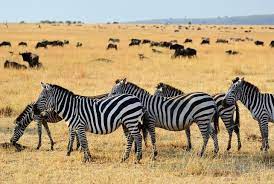
Good sanctuary management balances wildlife protection with practical responsibilities involving habitat maintenance, law enforcement, monitoring, community relations, visitor control, ecological research, and sustainable resource management.
1. Habitat Management: Managers maintain vegetation, water sources, breeding habitats, shelters, feeding areas, and natural ecological conditions while controlling activities that could degrade essential wildlife habitats.
2. Wildlife Monitoring: Regular surveys help managers track species abundance, movement, reproduction, mortality, disease, habitat use, and changes that may require immediate conservation responses.
3. Law Enforcement: Rangers and relevant authorities help prevent poaching, illegal logging, unauthorized settlement, habitat destruction, wildlife trafficking, and other activities that threaten sanctuary objectives.
4. Community Participation: Managers can involve surrounding communities through conservation education, consultation, sustainable livelihood programmes, local monitoring, and other approaches that reduce conflict.
5. Visitor Management: Tourism and recreation require clear rules, designated routes, controlled access, waste management, and visitor education so human presence does not disturb wildlife unnecessarily.
6. Environmental Planning: Sanctuary management benefits from clear objectives, mapped boundaries, monitoring schedules, emergency responses, funding plans, and periodic reviews of conservation performance.
Sound management requires practical environmental resource management principles so managers can coordinate land, water, vegetation, wildlife, budgets, institutions, and community interests effectively.
Managers also need systematic environmental monitoring programmes because changing habitat conditions, population trends, and pollution levels can reveal emerging threats before they become severe.
Threats to Wildlife Sanctuaries
Protected status alone cannot guarantee successful conservation. Wildlife sanctuaries can still experience environmental pressures that weaken habitats, reduce animal populations, increase conflict, and undermine long-term ecological stability.
1. Habitat Destruction: Farming, road construction, settlements, logging, mining, and infrastructure expansion can remove vegetation, fragment habitats, disturb wildlife, and reduce available living space.
2. Poaching: Illegal hunting can remove breeding adults and valuable species from populations, potentially reducing reproductive capacity and creating serious ecological imbalance within protected habitats.
3. Pollution: Waste, chemicals, contaminated water, plastics, smoke, and other pollutants can damage habitats and expose wildlife to harmful environmental conditions.
4. Invasive Species: Introduced organisms can compete with native species, alter habitats, consume resources, transmit diseases, and disrupt ecological relationships that developed naturally within the sanctuary.
5. Climate Change: Changing temperatures, rainfall patterns, drought, extreme weather, and shifting seasons can affect food availability, breeding cycles, migration patterns, habitats, and species distributions.
Deforestation represents a major habitat threat because clearing natural vegetation can remove shelter and feeding areas. The causes and consequences described in deforestation studies remain relevant to wildlife protection.
Pollution requires equally serious attention because water pollution can affect animals through contaminated habitats, toxic substances, reduced food availability, and changes in aquatic ecological conditions.
Waste management also matters because poorly handled waste can introduce plastics, chemicals, smoke, and other materials into protected environments. Waste generation and environmental impacts should therefore form part of sanctuary planning.
Read Also: On-site Municipal Wastewaters Treatment
Role of Wildlife Sanctuaries in Biodiversity Conservation

Wildlife sanctuaries contribute to biodiversity conservation by protecting species within habitats where natural ecological interactions can continue. This approach supports populations rather than isolated individual organisms.
Conserving natural habitats also protects food chains, predator-prey relationships, pollination, seed dispersal, nutrient cycling, breeding areas, shelter, migration routes, and other ecological processes.
1. In-Situ Conservation: Sanctuaries conserve organisms within their natural environments, allowing wildlife to maintain ecological relationships and interact with natural habitat conditions throughout their life cycles.
2. Species Recovery: Protected habitats can support threatened populations while conservation managers monitor reproduction, population trends, habitat requirements, disease, and other factors affecting species recovery.
3. Genetic Conservation: Maintaining viable wildlife populations preserves genetic diversity that can improve resilience, adaptation, reproduction, and long-term survival under changing environmental conditions.
4. Ecosystem Protection: Sanctuaries preserve ecological communities rather than focusing exclusively on single species, helping maintain interactions and environmental processes that support broader biodiversity.
5. Conservation Support: Sanctuary protection can complement seed banks, zoos, botanical gardens, gene banks, captive breeding, tissue culture, and other ex-situ conservation measures.
In-situ protection remains central to biological sustainability and animal survival because long-term conservation depends on healthy habitats and functioning ecological relationships.
Sanctuaries also connect with physical habitat and biological assessment because managers need reliable information about habitat conditions and biological responses when evaluating conservation effectiveness.
Climate considerations should also shape conservation planning because climate change affects biodiversity and natural resources through changing temperatures, rainfall, species distributions, and ecological conditions.
Wildlife Sanctuaries and Conservation in Nigeria
Nigeria contains diverse ecological regions that support many wild species, including forests, wetlands, savannahs, mangroves, coastal environments, and other habitats requiring conservation attention.
Wildlife sanctuaries and other protected areas can help Nigeria conserve biological resources while supporting environmental education, research, tourism, ecological monitoring, and responsible resource management.
1. Wildlife Protection: Protected areas can provide refuge for species facing pressures from habitat destruction, illegal hunting, agricultural expansion, settlement growth, pollution, and unsustainable exploitation.
2. Habitat Conservation: Conserving forests, wetlands, grasslands, and other habitats supports wildlife populations while preserving water resources, vegetation, ecological processes, and natural environmental functions.
3. Community Cooperation: Conservation authorities can improve long-term outcomes by involving surrounding communities in planning, awareness programmes, sustainable livelihoods, monitoring, and conflict reduction.
4. Tourism and Education: Carefully managed wildlife tourism can create educational and economic opportunities while encouraging greater public appreciation for Nigeria’s natural heritage and biodiversity.
5. Research and Monitoring: Scientific studies can provide information about population trends, habitat conditions, species distribution, human impacts, and management priorities within protected areas.
Effective Nigerian wildlife conservation should also consider the importance of forests and rangelands because these landscapes provide habitat, ecological functions, and resources that support many species.
Conservation authorities must address environmental pollution as well. Pollution from different environmental sources can degrade habitats and weaken the ecological conditions necessary for wildlife survival.
Community concerns also deserve attention because conflicts can arise when conservation restrictions affect livelihoods. Lessons from resource conservation and community conflicts show why participation and communication matter.
Finally, responsible conservation requires strong environmental institutions and practical enforcement. Effective environmental management practices can support better coordination among authorities, communities, researchers, and conservation organizations.
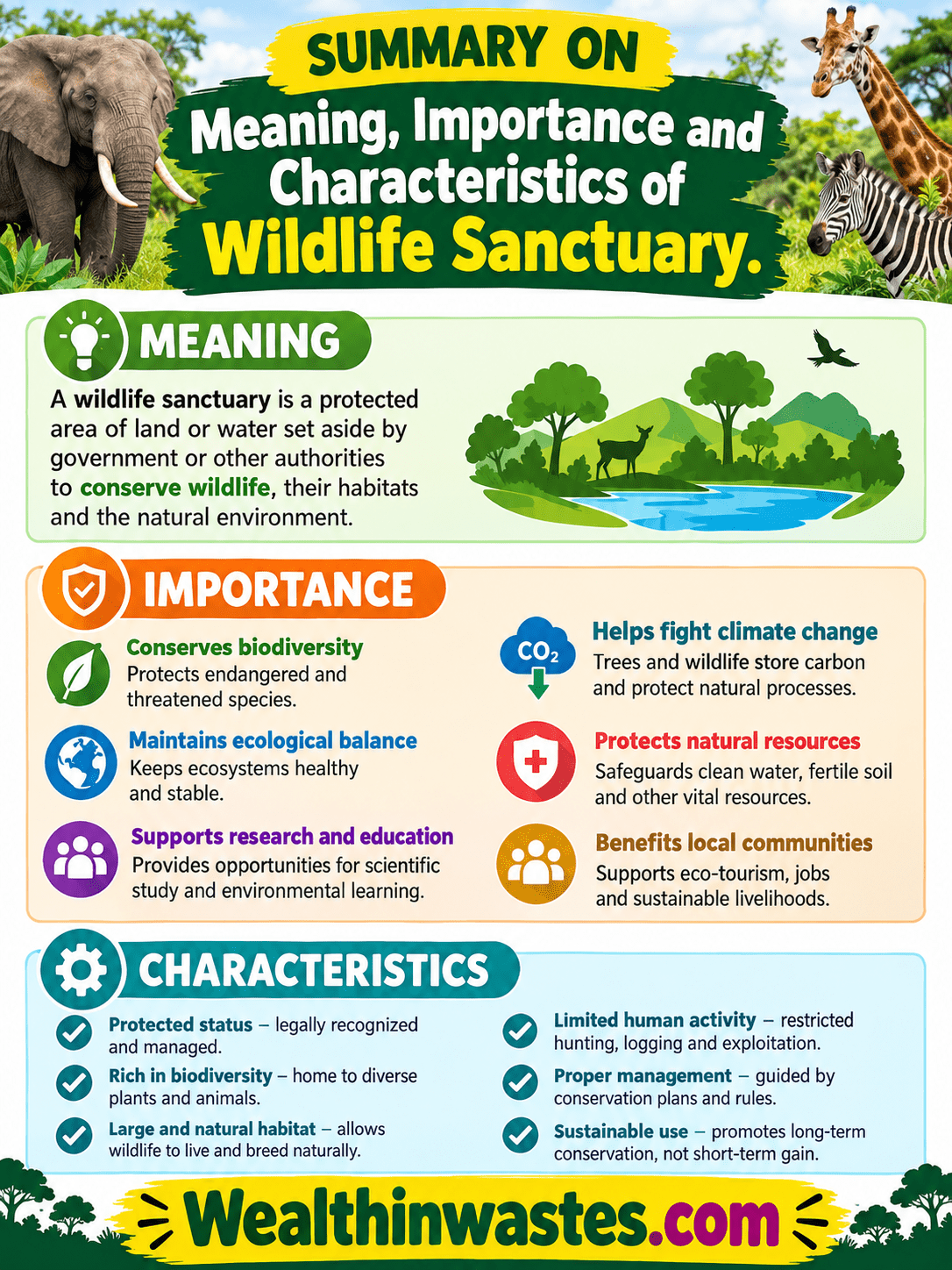
Summary on Meaning, Importance and Characteristics of Wildlife Sanctuary
| Aspect | Summary |
|---|---|
| Wildlife sanctuary | A protected area established mainly to conserve wildlife, habitats, ecological communities, or important natural features. |
| Key characteristic | It provides legal or administrative protection while allowing only compatible activities where applicable. |
| Habitat protection | It safeguards food, water, shelter, breeding grounds, vegetation, and other conditions required by wildlife. |
| Importance | It supports wildlife protection, biodiversity conservation, research, education, tourism, and ecological stability. |
| Management | Successful management involves habitat care, monitoring, law enforcement, community participation, planning, and visitor regulation. |
| Main threats | Major threats include habitat destruction, poaching, pollution, invasive species, climate change, and unsustainable resource use. |
| Conservation role | Sanctuaries support in-situ conservation while complementing ex-situ methods and broader protected-area systems. |
| Nigeria | Protected wildlife areas can support biodiversity, research, tourism, education, ecological services, and sustainable resource management. |
Frequently Asked Questions About Wildlife Sanctuary: Key Characteristics and Importance
1. What is a wildlife sanctuary?
A wildlife sanctuary is a protected area created mainly to conserve wild animals, plants, habitats, ecological communities, or important natural features.
2. What is the main purpose of a wildlife sanctuary?
Its main purpose is to protect wildlife and habitats from activities that can cause serious ecological damage while maintaining suitable conditions for survival.
3. What are the characteristics of a wildlife sanctuary?
Important characteristics include legal protection, wildlife-focused management, habitat conservation, regulated human activities, ecological monitoring, research, education, and community participation.
4. Can people enter a wildlife sanctuary?
Access depends on the sanctuary and applicable regulations. Some sanctuaries allow controlled visitation, research, tourism, or other activities that support conservation objectives.
5. What is the difference between a wildlife sanctuary and a national park?
A national park generally protects larger natural ecosystems under stronger restrictions, while a sanctuary may allow certain regulated activities when conservation objectives remain protected.
6. Why are wildlife sanctuaries important?
They protect wildlife, conserve habitats, support biodiversity, encourage research, provide educational opportunities, strengthen conservation awareness, and contribute to ecological stability.
7. What threats affect wildlife sanctuaries?
Major threats include habitat destruction, poaching, pollution, invasive species, climate change, infrastructure development, and unsustainable resource exploitation.
8. How do wildlife sanctuaries support biodiversity conservation?
They conserve species within natural habitats, helping maintain populations, genetic diversity, food webs, ecological interactions, breeding areas, and natural ecological processes.
9. Why is community participation important?
Community participation can improve cooperation, reduce conflicts, support local monitoring, encourage sustainable livelihoods, and strengthen long-term acceptance of conservation objectives.
10. How can wildlife sanctuaries become more effective?
Effectiveness improves through clear laws, adequate funding, strong enforcement, scientific monitoring, habitat restoration, community involvement, effective planning, and responsible visitor management.
Do you have any questions, suggestions, or contributions? If so, please feel free to use the comment box below to share your thoughts. We also encourage you to kindly share this information with others who might benefit from it. Since we can’t reach everyone at once, we truly appreciate your help in spreading the word. Thank you very much for your support and for sharing!
Read Also: Concepts of Wildlife and Wildlife Management