


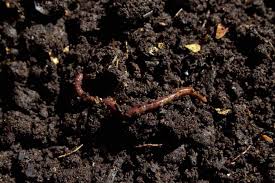
Vermicomposting is a biological method of treating biodegradable organic waste by combining earthworms with microorganisms to produce vermicompost, a stable material also called worm castings, for improving soils in gardens, farms, and other growing systems.
Unlike ordinary composting, vermicomposting depends on earthworm feeding, digestion, and casting production alongside microbial decomposition, creating conditions that accelerate the stabilization of suitable organic materials when feed materials are properly prepared.
Microorganisms begin breaking down complex organic matter through extracellular enzymes, while earthworms fragment, ingest, grind, and process partially decomposed materials before microorganisms continue transforming them into stable, nutrient-rich castings suitable for agriculture.
Earthworm guts contain diverse microorganisms, including bacteria, fungi, and other microscopic organisms, which participate in digestion and transformation after waste particles have been mechanically reduced within the worm’s gizzard during feeding.
Successful vermicomposting therefore depends on a balanced interaction among organic feedstock, microorganisms, earthworms, moisture, temperature, oxygen, particle size, and the degree of prior decomposition throughout the process from beginning to completion.
Vermicomposting Process and Principles
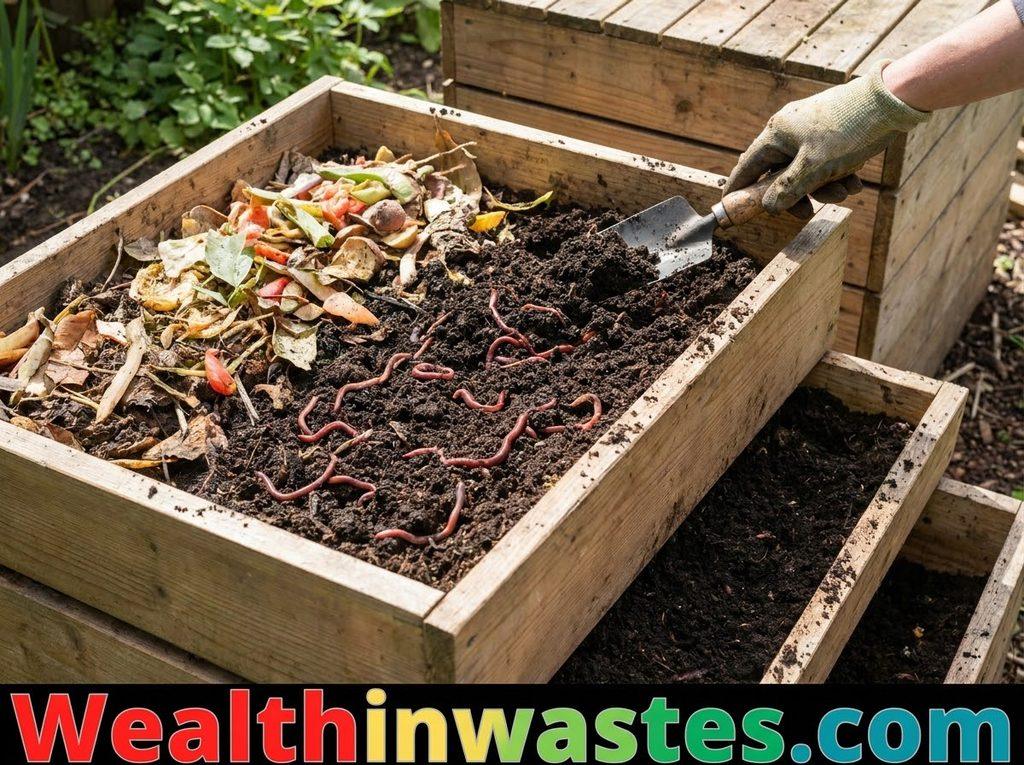
Vermicomposting begins with the selection of suitable biodegradable materials such as vegetable residues, fruit wastes, leaves, crop residues, and appropriately prepared animal manure that can safely support earthworm activity.
Fresh organic materials may undergo rapid microbial fermentation and generate excessive heat or acidic compounds, so partially decomposing the feedstock before adding worms helps create a safer environment for sustained feeding.
Earthworms consume softened organic materials and mechanically reduce particle size within their digestive system, while microorganisms associated with the feedstock and worm gut continue breaking down complex organic compounds into simpler substances.
The resulting castings contain transformed organic matter and nutrients that can contribute to soil fertility, structure, moisture management, and biological activity when properly matured, handled, and applied to agricultural soils.
Successful systems require adequate oxygen because earthworms and many beneficial microorganisms perform poorly when the composting environment becomes persistently anaerobic, waterlogged, compacted, or contaminated with harmful substances.
Moisture must remain sufficient to prevent drying while avoiding saturation, because excessive water can fill pore spaces, restrict oxygen movement, create unfavorable anaerobic conditions, and reduce earthworm activity.
Temperature is equally important because excessive heat generated during rapid decomposition can stress or kill earthworms, whereas moderately favorable temperatures encourage feeding, movement, microbial activity, and continued organic matter stabilization.
The process can be carried out successfully when feedstock preparation, moisture control, aeration, temperature monitoring, and regular observation are coordinated carefully according to the local climate and the chosen earthworm species.
For broader understanding of organic waste treatment, readers can review converting organic waste into useful compost for agriculture before establishing a vermicomposting unit.
Understanding ordinary composting first can help operators recognize why worms require partially stabilized feedstock, especially because intense fermentation and high temperatures may reduce worm survival and compromise the efficiency of vermicomposting systems.
Read Also: Household Level Composting (Manure Pit)
Earthworm Species and Suitable Feedstock
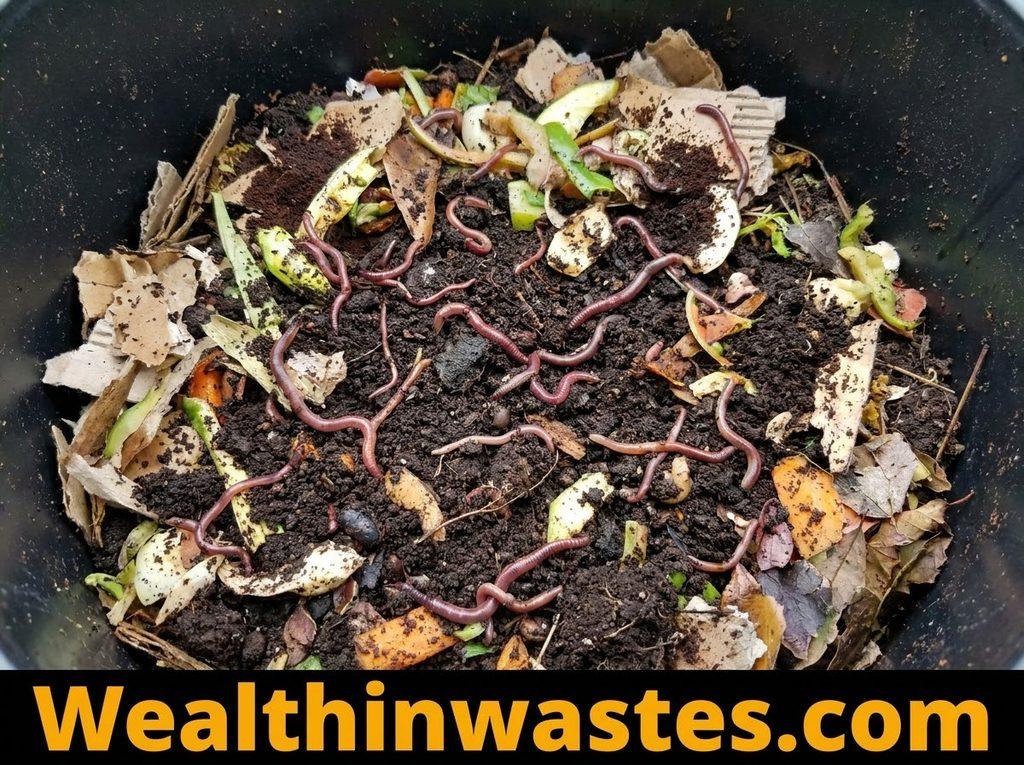
Several earthworm species are used in vermicomposting, with Eisenia fetida, Eudrilus eugeniae, and Lampito mauritii among the species commonly discussed for organic waste processing under managed environmental conditions.
Eisenia fetida is widely used because it adapts well to decomposing organic materials and can reproduce efficiently under favorable conditions, while Eudrilus eugeniae is also valued in warmer tropical environments.
Lampito mauritii is an indigenous species in parts of South Asia and may be considered where locally adapted earthworms are readily available, provided they tolerate the chosen waste and environmental conditions.
Local earthworms adapted to regional conditions may offer practical advantages, but species identification, temperature tolerance, feeding behavior, reproduction, and waste suitability should be considered before commercial or community-scale use.
Suitable feedstocks commonly include vegetable scraps, fruit residues, crop wastes, leaves, aged animal manure, and other biodegradable materials that are free from toxic chemicals and excessive concentrations of unsuitable contaminants.
Materials should preferably be chopped or physically reduced before processing because smaller particles provide greater surface area for microbial action and generally make decomposition and earthworm feeding more efficient.
Potentially toxic materials, persistent chemicals, heavily contaminated wastes, and substances containing compounds harmful to earthworms should be excluded because they may reduce worm activity, cause mortality, or contaminate finished vermicompost.
Agricultural residues can provide valuable feedstock because many agricultural wastes are renewable organic resources suitable for recovery and reuse rather than immediate disposal.
Additional information on waste resources can be found through proper management approaches for agricultural wastes, especially when farms generate large quantities of crop residues, manure, or other biodegradable materials.
Feedstock selection ultimately determines much of the quality, safety, nutrient composition, decomposition rate, and handling characteristics of vermicompost, making careful material preparation one of the most important management decisions.
Environmental Conditions Required for Vermicomposting
Moisture is essential because earthworms require a moist environment for respiration through their skin, movement, feeding, and physiological functions, although saturated conditions can restrict oxygen availability and create harmful anaerobic conditions.
Maintaining moderate moisture is therefore more important than keeping the material excessively wet, with practical management involving regular observation and careful addition of water whenever bedding becomes noticeably dry.
Temperature should also remain within a range tolerated by the selected earthworm species, because extreme heat can cause stress, migration, reduced feeding, or mortality, particularly during rapid decomposition of fresh feedstock.
Adequate aeration supports aerobic microorganisms and prevents compacted conditions from restricting oxygen movement through the composting bed, while proper bedding structure helps maintain suitable air-filled spaces around organic materials.
Particle size influences both microbial activity and worm access because finely reduced materials decompose rapidly, whereas excessively coarse materials may remain difficult for earthworms and microorganisms to process effectively.
The degree of decomposition before worm introduction also matters because partially stabilized materials generally produce less heat and fewer harmful fermentation products than freshly collected, rapidly fermenting organic waste.
Monitoring should include visual inspection of worm behavior, moisture, temperature, odor, bedding condition, and feed consumption so that unfavorable changes are detected early and corrected before substantial losses occur.
Good environmental control also supports conventional composting, where moisture, temperature, microorganisms, and the carbon-to-nitrogen ratio influence decomposition and determine how effectively organic materials are stabilized.
Where aerobic composting is used before vermicomposting, operators should avoid excessive heat and allow the preprocessed material to cool sufficiently before introducing earthworms into the prepared bedding.
Proper environmental management reduces unpleasant odors, improves decomposition efficiency, protects earthworm populations, and helps produce a more uniform vermicompost suitable for soil amendment and nutrient management.
Advantages of Vermicomposting
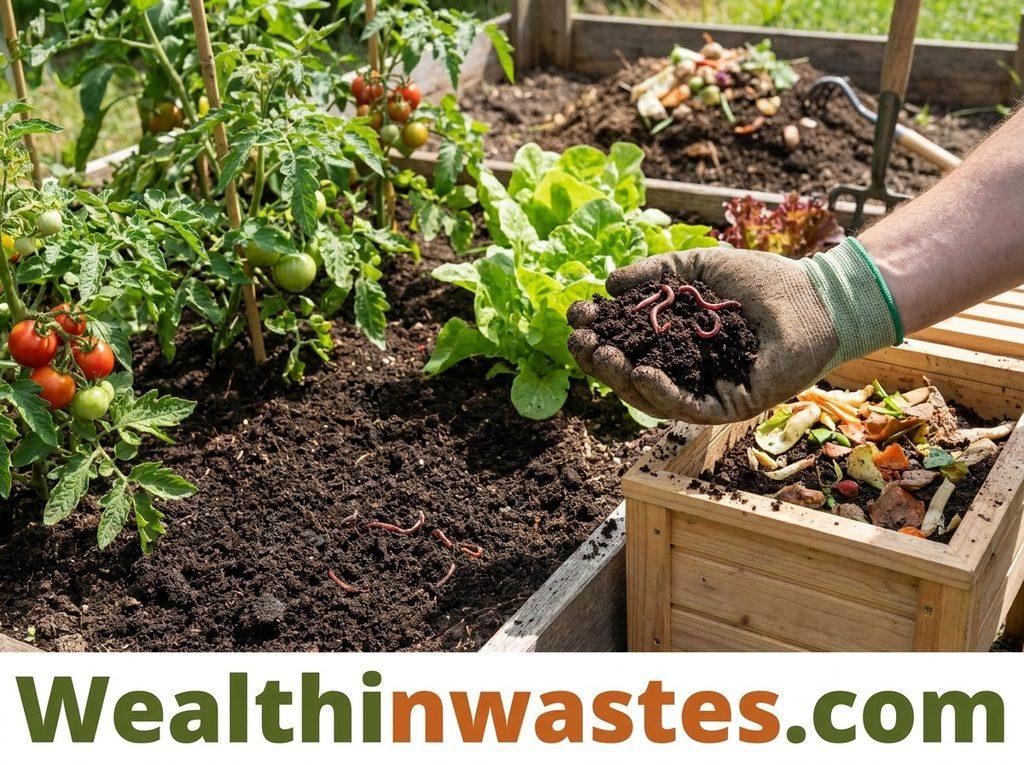
1. Organic waste recovery: Vermicomposting converts biodegradable wastes such as food residues, leaves, crop materials, and suitable animal manure into useful organic amendments instead of leaving them as unmanaged environmental burdens.
2. Nutrient-rich amendment: Properly produced vermicompost contains organic matter and plant nutrients that can support soil fertility, although nutrient concentrations vary according to feedstock composition and processing conditions.
3. Improved soil condition: Adding mature vermicompost can contribute organic matter that supports aggregation, moisture retention, aeration, and microbial activity, especially where soils have low organic matter content.
4. Reduced waste volume: Vermicomposting provides a practical pathway for diverting suitable biodegradable materials from disposal streams, reducing the quantity of organic waste requiring transportation, dumping, or landfill space.
5. Odor management: Well-managed systems can operate with limited offensive odors because appropriate moisture, aeration, feedstock preparation, and regular monitoring discourage prolonged anaerobic decomposition and excessive fermentation.
6. Small-space suitability: Vermicomposting systems can be established in household containers, beds, tanks, sheds, or community facilities, making the technology adaptable to different scales and available land conditions.
7. Resource efficiency: Vermicomposting supports circular use of organic materials by converting discarded biomass into a valuable soil amendment, potentially reducing dependence on purchased soil conditioners and improving resource recovery.
8. Economic opportunities: Properly managed vermicomposting can support income-generating activities through the sale of vermicompost and related services, especially where agricultural waste is abundant and local demand exists.
Organic waste recovery can also support broader agricultural enterprises because agricultural wastes can become income-generating resources through composting, vermicomposting, and related recovery activities when properly managed.
For farms seeking additional outlets for recovered materials, converting organic waste into fertilizer products demonstrates how waste streams can be transformed into useful agricultural inputs.
Applicability and Methods of Vermicomposting
Vermicomposting is applicable at household, institutional, community, farm, and small commercial levels, provided suitable feedstock, adequate management skills, proper containers, and favorable environmental conditions are available.
At household level, simple beds or covered containers can process kitchen scraps and selected garden materials, allowing families to recover organic resources while producing useful material for home gardens.
Community systems can handle greater quantities of biodegradable waste when households collectively separate organic materials and deliver them to a managed processing location designed for controlled treatment and storage.
Commercial operations generally require better site planning, reliable feedstock supply, labor, drainage, storage, harvesting arrangements, product quality control, and markets capable of absorbing the resulting vermicompost consistently.
1. Vermicomposting beds: Prepared beds can contain bedding and preprocessed organic matter, with suitable earthworm populations introduced after temperatures decline and feedstock conditions become safe for active feeding.
2. Vermicomposting tanks: Tanks provide defined spaces for handling organic materials and can be adapted to household or institutional settings where better containment and easier management are preferred.
3. Sheds and protected units: Covered structures can help protect worms from direct sunlight, heavy rainfall, excessive heating, predators, and other environmental disturbances that interfere with consistent vermicomposting operations.
Site selection should consider drainage, shade, accessibility, water availability, ventilation, protection from flooding, and distance from contaminants so that the system remains manageable throughout production and harvesting cycles.
For community operations, lessons from community-level organic waste treatment systems can help planners understand site access, waste collection, space requirements, storage, and sequential processing arrangements.
Where space is limited, household waste minimization and organic recovery practices can reduce the quantity of material requiring treatment while making vermicomposting easier to manage effectively.
Applicability ultimately depends on the quantity and quality of available organic material, available labor, environmental conditions, management capacity, intended use of vermicompost, and the economic practicality of maintaining the operation.
Advantages of Composting
Composting converts biodegradable organic materials into a more stable soil amendment through controlled biological decomposition, providing an important waste management option for households, farms, institutions, and communities.
Proper decomposition helps transform food residues, leaves, crop materials, and animal manures into useful organic matter, thereby reducing the amount of biodegradable waste sent for uncontrolled dumping or disposal.
Aerobic composting can generate heat during active decomposition, helping reduce certain pathogens and weed seeds when sufficient temperatures are maintained throughout the appropriate stages of the process.
Composting can also improve sanitation by reducing accumulations of exposed biodegradable waste that may provide food, moisture, and breeding opportunities for flies, rodents, and other nuisance organisms.
When mature compost is incorporated into agricultural soils, the added organic matter can support improved structure, moisture retention, aeration, and biological activity, depending on soil type and management practices.
Good composting practice therefore contributes to resource recovery because materials once considered waste become agricultural inputs, reinforcing the principle that waste can be redirected into productive and economically useful applications.
Composting systems may use pits, heaps, tanks, windrows, or other suitable structures, with method selection influenced by climate, rainfall, available space, waste quantity, labor, and desired processing scale.
Readers can explore different waste management methods and composting approaches to understand how composting fits within wider integrated waste management systems.
Organic waste composting also has environmental value because proper biodegradable waste management includes composting and other recovery methods that reduce uncontrolled decomposition and improve material utilization.
For larger agricultural systems, agricultural wastes can be processed into compost and other useful products, strengthening resource recovery while reducing the environmental burden associated with unmanaged residues.
Factors Affecting Composting and Vermicomposting Efficiency
The carbon-to-nitrogen ratio is important because microorganisms require carbon primarily as an energy source and nitrogen for protein synthesis, while an imbalance can slow decomposition or cause excessive nitrogen losses.
Moisture strongly influences microbial metabolism and earthworm activity because microorganisms require water for biochemical functions, while earthworms depend on moist surroundings for respiration and movement through the processing material.
Too little moisture can restrict microbial activity and cause materials to dry, whereas excessive moisture may displace air, encourage anaerobic conditions, produce odors, and interfere with normal earthworm performance.
Temperature also determines decomposition speed because microbial activity changes as the composting mass warms, while excessive temperatures can damage organisms that are necessary for successful vermicomposting.
During conventional aerobic composting, temperatures around 50–60°C are commonly associated with active decomposition, while excessively high temperatures may suppress beneficial organisms and reduce overall process efficiency.
Aeration must therefore be maintained through suitable particle structure, turning where appropriate, adequate drainage, and avoidance of excessive compaction that blocks air movement through the composting mass.
If oxygen becomes severely limited, aerobic organisms decline and anaerobic microorganisms may become dominant, slowing decomposition and potentially producing unpleasant odors and gases associated with oxygen-deficient conditions.
Turning or loosening compost can improve aeration, but vermicomposting beds should be managed carefully because excessive disturbance can disrupt earthworms, bedding structure, feeding zones, and developing populations.
Other important considerations include feedstock particle size, acidity, contaminants, loading rate, worm density, harvesting frequency, drainage, and protection from predators, all of which can influence final vermicompost quality.
More information on biological treatment is available through biological approaches to waste management and organic fertilizer production, which place composting within broader resource-recovery technologies.
Read Also: Community Level Composting (Manure Pit)
Importance of Proper Waste Preparation and Management
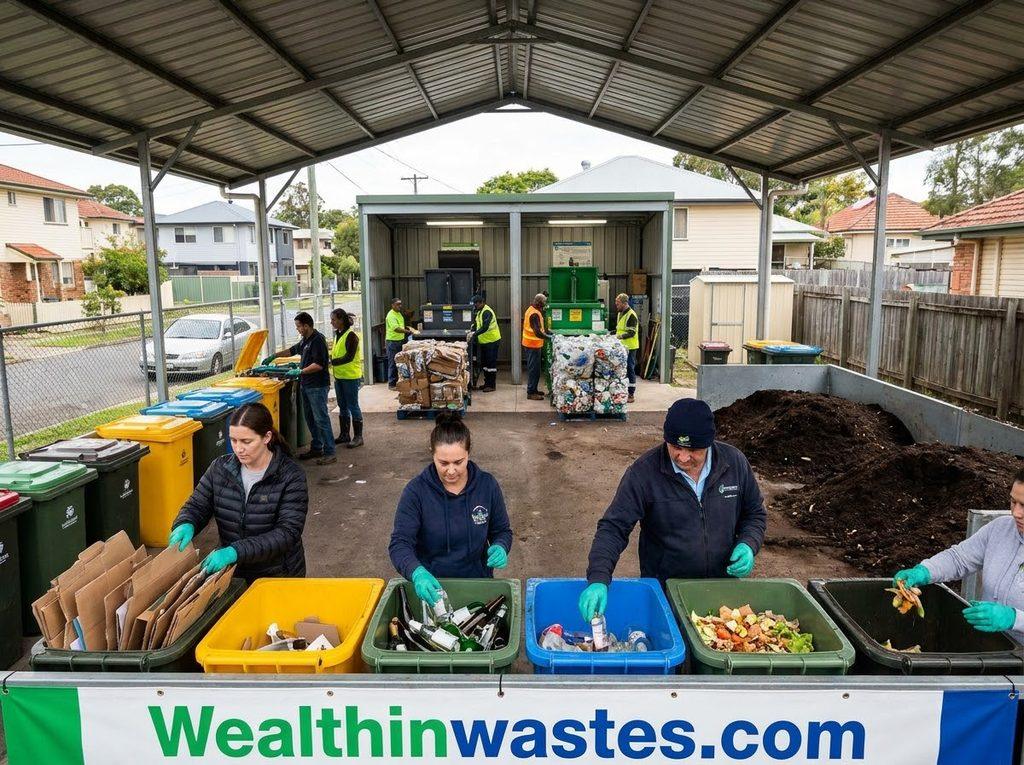
Proper waste preparation begins with source separation so that biodegradable materials are kept apart from plastics, metals, glass, chemicals, and other contaminants that could reduce process safety.
Organic materials should be inspected before processing because hazardous substances can harm microorganisms and earthworms, contaminate the finished product, and create environmental or agricultural risks during later application.
Large materials can be chopped or shredded to improve decomposition, while extremely wet materials may require blending with drier carbon-rich materials to restore better structure and airflow.
Fresh manure and other rapidly fermenting wastes should be allowed to stabilize sufficiently before earthworm introduction because excessive heating can create unfavorable conditions that reduce survival and feeding activity.
Operators should establish routine monitoring schedules covering temperature, moisture, odor, worm behavior, feed consumption, drainage, and visible contamination so that management problems can be corrected promptly.
Harvesting should occur only when the material has become sufficiently processed and earthworms can be separated from the finished vermicompost without causing excessive stress or unnecessary product contamination.
Finished vermicompost should be stored under clean, protected conditions that preserve product quality and reduce exposure to excessive rain, direct sunlight, contaminants, and unnecessary moisture loss.
Integrated planning can also reduce the quantity of waste requiring treatment because waste reduction practices can prevent unnecessary organic material from entering disposal systems in the first place.
These practices support the wider objective of sustainable waste management by combining reduction, reuse, biological treatment, recovery, and responsible final handling rather than relying on disposal alone.
Effective vermicomposting is therefore not simply a matter of adding worms to waste; it requires deliberate preparation, suitable environmental conditions, continuous observation, responsible harvesting, and appropriate use of the finished material.
Summary on Vermi Composting (Manure Pit)
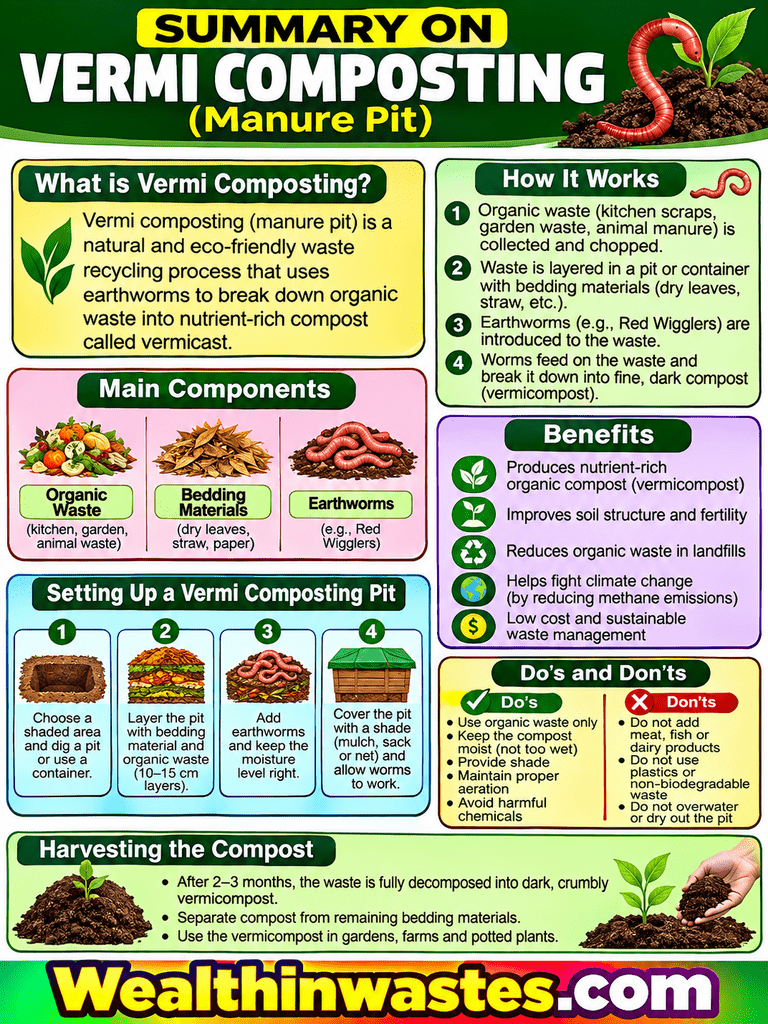
| Aspect | Summary |
|---|---|
| Definition | Vermicomposting is the biological stabilization of suitable organic waste through the combined activities of earthworms and microorganisms. |
| Main organisms | Earthworms and decomposer microorganisms work together to fragment, digest, transform, and stabilize organic materials. |
| Common worm species | Eisenia fetida, Eudrilus eugeniae, and Lampito mauritii are commonly associated with vermicomposting systems. |
| Suitable materials | Vegetable residues, fruit wastes, leaves, crop residues, aged manure, and other suitable biodegradable organic materials can be used. |
| Preprocessing | Fresh, rapidly fermenting waste should generally be stabilized before worms are introduced to reduce heat and harmful fermentation effects. |
| Important conditions | Moisture, temperature, aeration, particle size, feedstock quality, and degree of decomposition strongly affect performance. |
| Major benefits | Vermicomposting supports organic waste recovery, soil improvement, resource conservation, and potential income generation. |
| Applications | The method can be used at household, institutional, community, farm, and small commercial scales. |
| Management principle | Successful systems require proper feed preparation, environmental monitoring, contamination control, and appropriate harvesting and storage practices. |
Frequently Asked Questions About Vermicomposting
1. What is vermicomposting, and how does it differ from conventional composting when biodegradable organic waste is processed under controlled environmental conditions?
Vermicomposting combines earthworm activity with microbial decomposition, while conventional composting mainly relies on managed microbial activity without intentionally using earthworms as the primary biological processors.
2. Why should freshly collected organic waste usually be partially decomposed before introducing earthworms into a vermicomposting system for processing?
Fresh wastes can ferment rapidly, generating excessive heat, acidity, and other unfavorable conditions that may stress or kill earthworms and reduce overall vermicomposting efficiency.
3. Which earthworm species are commonly used for vermicomposting, and why are species selection and local adaptation important?
Commonly used species include Eisenia fetida, Eudrilus eugeniae, and Lampito mauritii, but suitability depends on local temperature, feedstock characteristics, moisture conditions, and species performance.
4. What types of biodegradable organic materials are generally suitable for vermicomposting when they are properly prepared and free from harmful contaminants?
Suitable materials include vegetable scraps, fruit residues, leaves, crop residues, and aged animal manure, provided they are properly prepared and free from toxic substances and excessive contaminants.
5. Why are moisture and aeration considered essential environmental requirements for successful vermicomposting operations?
Earthworms require moisture for respiration and movement, while adequate aeration supports aerobic microorganisms and prevents oxygen deficiency that can encourage odors and unfavorable anaerobic conditions.
6. Can vermicomposting be practiced at household level, or is it mainly suitable for farms and commercial agricultural operations?
Vermicomposting can be practiced at household, institutional, community, farm, and small commercial levels, provided the chosen system matches available space, feedstock quantity, labor, and management capacity.
7. What are the major agricultural benefits of applying properly processed vermicompost to suitable soils?
Vermicompost adds organic matter and nutrients while potentially improving soil structure, moisture retention, aeration, microbial activity, and nutrient availability, depending on its quality and application practices.
8. What can happen when vermicomposting conditions become excessively wet, hot, compacted, contaminated, or poorly aerated?
Unfavorable conditions can reduce earthworm feeding, encourage odors, slow decomposition, increase stress, cause mortality, and lower the quality and consistency of the final vermicompost product.
9. How can farmers and households improve the reliability and quality of their vermicomposting systems over time?
They should separate waste correctly, prepare feedstock, maintain suitable moisture and temperature, provide aeration, monitor worm behavior, remove contaminants, and harvest and store finished vermicompost properly.
Do you have any questions, suggestions, or contributions? If so, please feel free to use the comment box below to share your thoughts. We also encourage you to kindly share this information with others who might benefit from it. Since we can’t reach everyone at once, we truly appreciate your help in spreading the word. Thank you very much for your support and for sharing!
Read Also: Farm Waste Management