



Environmental information helps people understand pollution, conservation, natural resources, climate concerns, waste management, and sustainable development while guiding decisions that affect communities and surrounding ecosystems.
The value of environmental information depends greatly on how effectively people receive, understand, discuss, and apply it. Good information therefore requires suitable communication channels that reach specific audiences.
The internet has expanded environmental communication by making information available across geographical boundaries through websites, social platforms, email, online publications, videos, databases, and other digital resources.
Mass media remains equally important because newspapers, magazines, radio, television, and audiovisual programmes can reach large populations while shaping public awareness, opinions, attitudes, and environmental behaviour.
However, effective environmental communication should not rely on one channel alone. Combining digital tools, traditional media, educational resources, community networks, and interpersonal communication can improve understanding and participation.
Ours is still a society where information spreads through personal encounter and by word of mouth. The audio-visual media have certain limitations but media provide use and views for the community leaders.
Internet Tools For Environmental Information
The internet has become one of the most flexible tools used for dissemination of environmental information because organizations can publish reports, educational materials, news, research findings, and guidance instantly.
Environmental websites can present detailed information through articles, downloadable documents, photographs, videos, charts, maps, and interactive resources, allowing users to investigate environmental subjects according to their needs.
Websites can also support environmental monitoring information by presenting observations, measurements, trends, and explanations that help readers understand changes affecting air, water, soil, ecosystems, and communities.
Online resources also strengthen waste minimization knowledge by explaining practical methods for reducing waste generation, improving resource efficiency, encouraging reuse, and supporting responsible material management.
Digital communication also makes environmental information easier to update when regulations, scientific findings, environmental conditions, or recommended practices change, helping audiences access more current educational material.
Read Also: Methods of Dissemination of Environmental Information
Mass Media And Environmental Communication
Mass media remains a powerful environmental communication tool because it can deliver messages to large audiences through established channels that many households already use regularly for news and education.
Newspapers and magazines can provide detailed environmental stories, interviews, editorials, investigations, photographs, and explanatory articles that encourage readers to understand environmental concerns beyond brief announcements.
Television can combine spoken explanations, images, demonstrations, interviews, animations, documentaries, and field reports, making complex environmental subjects easier for audiences to visualize and discuss.
Radio can reach communities where internet access remains limited, particularly when broadcasters present local environmental issues using familiar languages, practical examples, interviews, and repeated public awareness messages.
Mass communication can also highlight different sources of environmental pollution, helping audiences recognize activities that contribute to air, water, soil, and broader environmental degradation.
Similarly, media coverage can explain the consequences of water pollution and encourage citizens, industries, institutions, and authorities to support pollution prevention and responsible environmental practices.
Print Tools That Support Environmental Awareness
Print materials remain useful tools for environmental information dissemination because audiences can read them repeatedly, keep them for reference, distribute them physically, and use them during educational activities.
1. Newspapers: Newspapers provide environmental news, editorials, reports, interviews, and public notices that can inform large literate audiences about pollution, conservation initiatives, environmental regulations, and community challenges.
2. Magazines: Environmental magazines can provide more detailed features about climate change, biodiversity, waste management, resource conservation, environmental technology, and sustainable development through photographs and carefully developed explanatory articles.
3. Posters And Leaflets: Posters and leaflets communicate short, practical environmental messages through simple language, illustrations, instructions, warnings, and reminders that communities can display or distribute in schools, markets, offices, and public spaces.
4. Reports And Brochures: Reports and brochures can communicate research findings, environmental policies, project outcomes, monitoring results, and management recommendations to decision-makers, professionals, institutions, community organizations, and interested members of the public.
Digital Media For Wider Environmental Reach

Digital media extends environmental communication beyond conventional websites by allowing users to create, share, comment on, discuss, and redistribute information through multiple online platforms simultaneously.
Social media platforms can circulate environmental messages rapidly through posts, short videos, photographs, live broadcasts, discussions, infographics, and links, creating opportunities for immediate audience interaction.
Organizations can use digital campaigns to explain strategies for reducing water pollution, promote community participation, announce environmental programmes, and encourage individuals to adopt responsible environmental practices.
Online communication can also promote recycling and reuse practices by explaining their environmental importance, economic opportunities, resource benefits, and practical applications for households, businesses, institutions, and communities.
Digital tools also support environmental education by connecting learners with experts, educational resources, research publications, environmental campaigns, interactive courses, and practical demonstrations from different geographical locations.
However, digital dissemination requires careful attention to accuracy because misleading environmental claims can spread rapidly. Reliable sources, clear evidence, responsible editing, and transparent references therefore remain essential for credibility.
Community Tools For Environmental Information
Community communication remains important because environmental problems often affect people locally. Direct engagement can therefore make information more relevant, understandable, practical, and responsive to community experiences.
1. Community Meetings: Community meetings provide opportunities for environmental officers, researchers, leaders, residents, and organizations to discuss pollution, waste, sanitation, conservation, resource use, and proposed environmental solutions.
2. Workshops: Workshops allow participants to learn through demonstrations, practical exercises, discussions, presentations, and question sessions, making them useful for communicating specific environmental management skills and procedures.
3. Community Leaders: Traditional leaders, religious leaders, youth representatives, and other respected voices can reinforce environmental messages because residents may trust familiar figures who understand local concerns.
4. Word Of Mouth: Personal communication can spread environmental information among relatives, neighbours, colleagues, farmers, traders, and community groups, especially where formal communication channels have limited reach.
Community communication can also strengthen understanding of public responses to environmental pollution by creating spaces where residents share experiences and discuss practical responses.
Educational Tools For Environmental Dissemination

Educational institutions provide structured environments for environmental information dissemination because teachers can introduce concepts systematically, encourage discussion, organize activities, and connect classroom knowledge with environmental situations.
Schools can use textbooks, lesson notes, posters, laboratory activities, documentaries, field visits, environmental clubs, seminars, debates, exhibitions, and assignments to strengthen environmental awareness among learners.
Environmental education can explain practical subjects such as solid waste management, helping students understand collection, transport, processing, recycling, disposal, public health, and environmental protection.
Educational materials can also promote integrated waste management principles by demonstrating how prevention, reuse, recycling, recovery, treatment, and disposal fit into broader environmental management systems.
Adult education programmes remain valuable because many environmental decisions occur outside formal schools. Agricultural workers, business owners, household managers, and community members may require practical information for daily activities.
Environmental Information Through Audio And Visual Media
Audio and visual materials can communicate environmental information effectively because people often understand practical processes more easily when they hear explanations while seeing examples, demonstrations, locations, and environmental conditions.
Documentaries can present environmental problems through interviews, field observations, photographs, maps, historical records, and scientific explanations that connect environmental changes with human activities and management decisions.
Videos can demonstrate practical activities such as recycling, waste separation, composting, pollution prevention, water conservation, and environmentally responsible production methods more clearly than text alone.
Environmental documentaries can also explain the effects of agricultural waste, showing how poor disposal practices can affect air quality, ecosystems, soil, water resources, animals, and people.
Visual communication can further explain oil pollution and its environmental effects by displaying affected ecosystems, pollution sources, response activities, restoration measures, and community experiences.
Scientific And Institutional Dissemination Tools

Researchers, government agencies, universities, environmental organizations, industries, and development institutions use specialized tools to communicate technical environmental information to professional and decision-making audiences.
Scientific journals provide detailed findings that allow researchers and specialists to examine environmental evidence, methods, results, limitations, and recommendations while contributing to broader knowledge development.
Environmental agencies may publish regulations, technical guidelines, monitoring reports, environmental assessments, public notices, and policy documents that support informed environmental governance and institutional decision-making.
Technical communication can draw attention to environmental management systems, helping organizations understand structured approaches for identifying environmental aspects, setting objectives, monitoring performance, and improving environmental practices.
Institutional reports may also present information about economic losses resulting from pollution, helping decision-makers understand how environmental degradation can create financial and social consequences.
Read Also: Proper Waste Reduction Process
Best Practices For Environmental Information Dissemination

Choosing appropriate dissemination tools requires consideration of audience characteristics, communication objectives, available resources, language, literacy levels, location, technological access, environmental urgency, and the complexity of the message.
Environmental communicators should use simple language when addressing general audiences while retaining sufficient technical accuracy. Visual examples, local experiences, demonstrations, and practical recommendations can improve understanding significantly.
Information should also encourage responsible action rather than merely describe environmental problems. For example, communication about proper waste treatment and disposal should explain practical actions alongside environmental risks.
Messages about household waste reduction should similarly provide realistic steps that individuals can apply without creating unnecessary complexity, expense, or confusion.
Environmental information should remain credible, timely, inclusive, culturally appropriate, and easy to access. Combining several communication tools can improve reach while allowing the same message to reach audiences through different channels.
The effectiveness of dissemination should also be reviewed through feedback, participation levels, audience responses, behavioural changes, and evidence showing whether people understood and applied the information communicated.
The combination of communication channels becomes especially useful when audiences face different environmental challenges, such as water pollution from different sources that require clear, locally relevant information.
Summary on Tools Used for Dissemination of Environmental Information
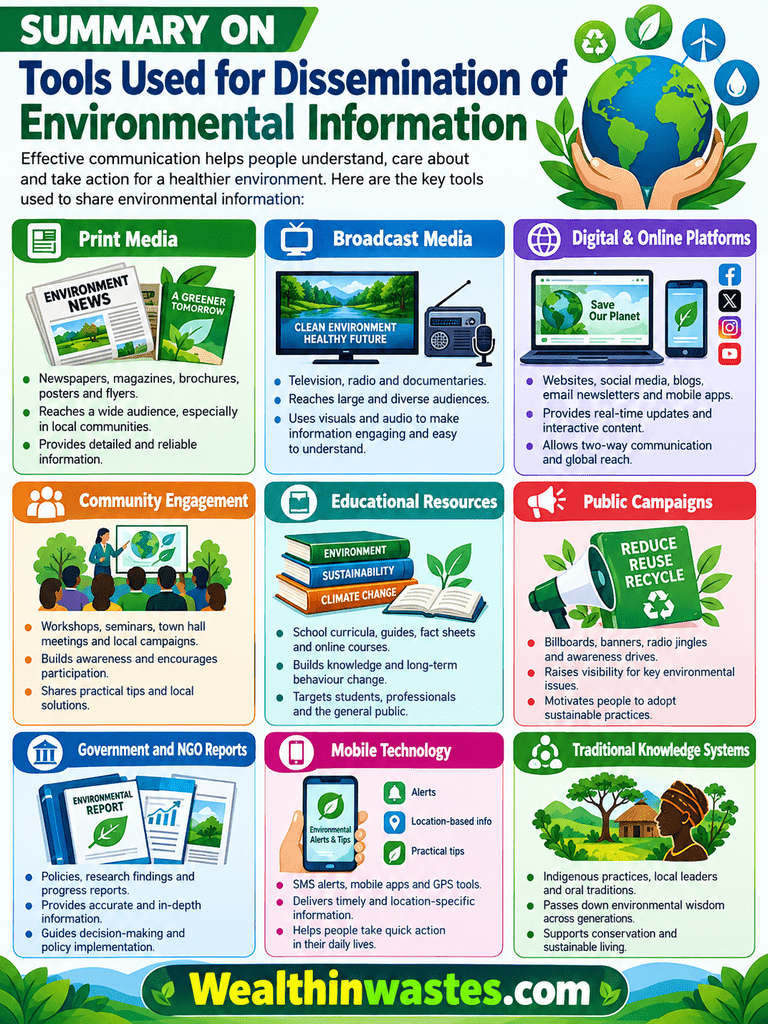
| Tool | Main Use | Key Advantage |
|---|---|---|
| Internet | Websites, online articles, digital resources, and social platforms | Rapid and wide geographical reach |
| Mass Media | Radio, television, newspapers, and magazines | Reaches large and diverse audiences |
| Print Media | Posters, leaflets, brochures, and reports | Easy to preserve and revisit |
| Community Communication | Meetings, workshops, leaders, and word of mouth | Builds local participation and trust |
| Educational Tools | Textbooks, lessons, clubs, seminars, and field activities | Supports structured learning |
| Audio-Visual Media | Videos, documentaries, demonstrations, and broadcasts | Makes complex issues easier to understand |
| Scientific And Institutional Tools | Reports, journals, technical guidelines, and policy documents | Provides evidence for professional decisions |
Frequently Asked Questions About Tools Used for Dissemination of Environmental Information
1. What are the major tools used for environmental information dissemination?
The major tools include the internet, mass media, print materials, community communication, educational resources, audio-visual media, and scientific or institutional communication channels.
2. Why is the internet important for environmental information?
The internet provides rapid access to environmental information through websites, social media, digital publications, videos, databases, online courses, and interactive resources available across geographical boundaries.
3. How does mass media support environmental awareness?
Mass media reaches large populations through radio, television, newspapers, and magazines while providing environmental news, education, interviews, documentaries, public notices, and awareness campaigns.
4. Why is community communication important?
Community communication makes environmental messages locally relevant and encourages residents, leaders, organizations, and other stakeholders to discuss problems and participate in practical environmental solutions.
5. What role do schools play in environmental information dissemination?
Schools provide structured opportunities for environmental education through lessons, textbooks, field activities, clubs, debates, demonstrations, seminars, assignments, and other learning activities that develop environmental understanding.
6. What are the benefits of audio-visual environmental communication?
Audio-visual materials combine sound and images to demonstrate environmental conditions, processes, problems, and solutions, making complex information more understandable, memorable, and engaging for audiences.
7. Why should different dissemination tools be combined?
Combining communication tools increases audience reach, accommodates different literacy and technology levels, reinforces messages through repetition, and improves opportunities for people to understand and apply environmental information.
8. What makes environmental information effective?
Effective environmental information should remain accurate, timely, understandable, relevant, accessible, credible, culturally appropriate, and connected to practical actions that audiences can realistically adopt.
Do you have any questions, suggestions, or contributions? If so, please feel free to use the comment box below to share your thoughts. We also encourage you to kindly share this information with others who might benefit from it. Since we can’t reach everyone at once, we truly appreciate your help in spreading the word. Thank you very much for your support and for sharing!
Read Also: Conservation and Management of Natural Resources in Agriculture