


Soil occurs in many environments, and its properties change with climate, organisms, relief, parent material, and time. Understanding these differences helps explain why soils vary across continents and landscapes worldwide.
In this article, the major soil types of the world follow a genetic grouping that divides soils into zonal, intra-zonal, and azonal categories. Each group reflects different influences during soil formation.
Zonal soils closely reflect climate and vegetation, while intra-zonal soils respond more strongly to special relief or parent material conditions. Azonal soils remain weakly developed because youth limits profile development.
This classification provides a useful way to compare soils from cold polar margins, temperate grasslands, tropical regions, waterlogged environments, saline landscapes, coastal areas, and recently deposited surfaces around the world.
Knowing these broad soil groups also helps farmers, students, planners, and environmental professionals connect soil characteristics with drainage, fertility, crop production, conservation needs, and responsible land management practices across diverse landscapes worldwide.
Understanding Major Soil Types of the World
The genetic approach groups soils according to the major factors controlling their formation and development. In this framework, climate, vegetation, relief, parent material, water, and soil age interact differently across landscapes.
The three broad groups include zonal, intra-zonal, and azonal soils, although each broad group contains several more specific soil types with different characteristics, distributions, formation processes, and agricultural uses worldwide.
A useful soil science perspective considers how soils form and how people use them, making broad classification valuable for environmental study, farming, planning, conservation, land-use decisions, education, research, and communication.
The original classification also emphasizes that climate strongly influences zonal soils, while special parent materials, relief conditions, water regimes, or recent deposits can dominate development in other soil groups and landscapes.
Consequently, the major soil types of the world should not be treated as identical textures or colors. They represent broad genetic relationships that help explain important soil differences across landscapes and environments worldwide.
Soil classification also becomes clearer when readers understand soil constituents, because mineral matter, organic matter, soil air, and soil water influence development, behavior, fertility, and biological activity within soil systems.
These broad groups therefore provide a practical starting point for studying soil distribution before examining individual examples such as tundra, podsols, chernozems, tropical soils, saline soils, peat, alluvial, marine, and volcanic soils.
For a broader view, soil properties help explain why particular soil groups respond differently to water, cultivation, pollutants, plant roots, and natural soil-forming processes over time in agricultural fields worldwide.
Read ALso: The Four (4) Forms of Complex Processes of Soil Formation
Zonal Soils And Their Main Examples
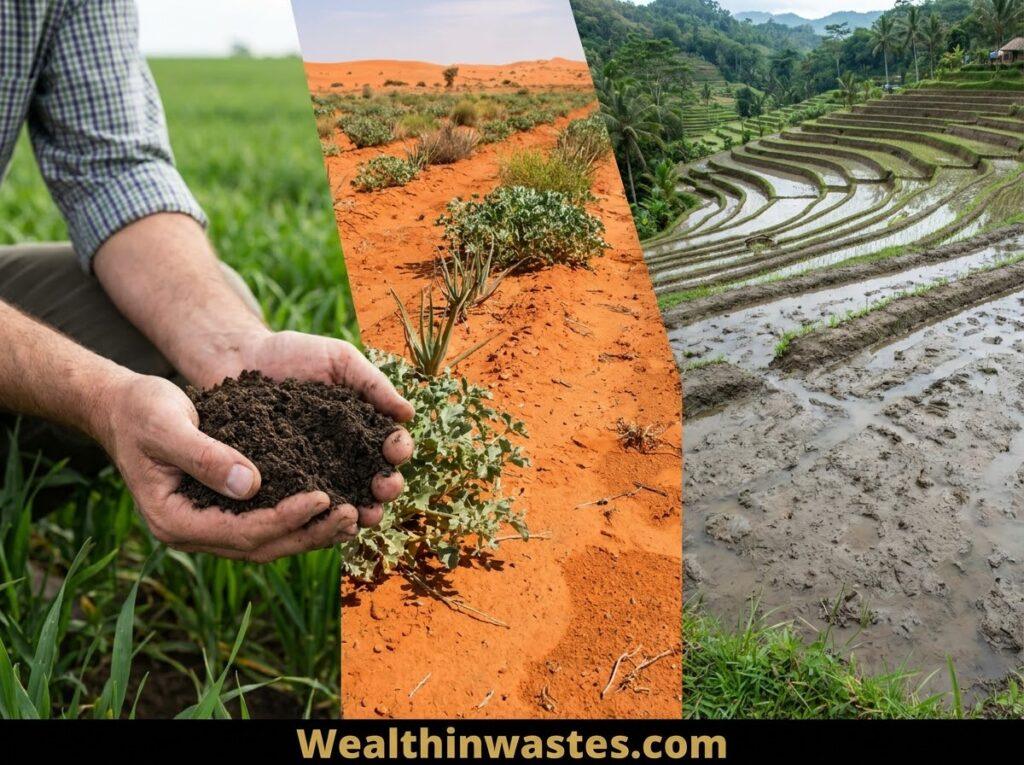
Zonal soils develop where climate exerts the strongest long-term influence and where relief, drainage, and parent material do not dominate formation. They commonly occur across broad climatic regions around the world.
1. Tundra Soils: Tundra soils occur near polar margins where very low temperatures restrict soil development. Permafrost occurs beneath the active layer, while summer thaw supports limited vegetation such as mosses and lichens.
2. Podsol Soils: Podsols commonly develop beneath coniferous forests in cooler humid regions of Eurasia and North America. Their soil formation processes involve strong leaching, slow decomposition, and acidic conditions.
3. Chernozem Soils: Chernozems commonly occur beneath temperate grasslands and contain abundant organic matter and humus. Their dark surface horizons support productive agriculture, especially grain production, across major temperate farming regions.
4. Tropical Soils: Tropical soils develop under warm conditions where intense weathering and leaching can produce deep profiles. Major examples include ferralitic, ferruginous, ferrisol, and vertisol groups described within tropical environments.
5. Ferralitic And Ferruginous Soils: Ferralitic soils are deeply weathered, leached, red, porous, and commonly old. Ferruginous soils often occur in savannas, where grass residues contribute organic matter and fertility.
7. Vertisols: Vertisols commonly develop in depressions containing fine clay sediments. Their expansive clays respond strongly to soil moisture, swelling and shrinking while creating cracks, drainage challenges, and cultivation difficulties.
Intra-zonal Soil Types And Key Features
Intra-zonal soils develop where special conditions of parent material, relief, drainage, or water influence soil formation more strongly than surrounding climate and vegetation conditions in particular local environments and landscapes.
1. Saline Soils: Saline soils contain substantial soluble salts and commonly occur where evaporation exceeds effective rainfall. Salinization processes may create surface crusts and restrict normal plant water uptake in fields.
2. Solonchak Soils: Solonchaks represent typical saline soils where strong salt accumulation occurs. Capillary movement can bring dissolved salts upward, leaving visible surface deposits when moisture evaporates under dry environmental conditions.
3. Solonetz Soils: Solonetz soils can develop where somewhat greater rainfall leaches surface salts but concentrates sodium-rich conditions deeper within the profile. Their properties can create management challenges for agriculture.
4. Peat Soils: Peat soils form under prolonged waterlogging where limited oxygen slows microbial decomposition. Organic materials accumulate because reducing conditions restrict the rapid breakdown that normally occurs in well-aerated soils.
5. Fen, Meadow And Bog Peat: Fen, meadow, and bog peat represent wetland settings where vegetation accumulates and decomposes slowly because saturation limits oxygen and microbial breakdown under persistent waterlogged conditions.
6. Calcareous Soils: Calcareous soils develop from limestone or chalk parent materials and contain significant calcium carbonate. Their chemical behavior can be considered alongside toxicant mobility in affected agricultural soils.
Azonal Soil Types And Their Distribution

Azonal soils lack strongly developed profile characteristics because they remain relatively young or because parent material and relief conditions interrupt the development of mature soil horizons across changing landscapes and depositional settings.
1. Alluvial And Floodplain Soils: Alluvial soils form from sand, silt, clay, and other sediments deposited by running water. Their land suitability can support intensive cultivation and dense rural settlement.
2. Marine Soils: Marine soils develop from materials deposited along low-lying coasts, including mud, sand, and other sediments. Their properties reflect coastal environments, sediment movement, drainage conditions, and reclamation activities.
3. Polder Soils: Polder soils occur where low-lying coastal areas receive drainage through human intervention, including dykes and related systems. Such management can make marine clay landscapes suitable for cultivation.
4. Volcanic Soils: Volcanic soils develop from lava, ash, and other volcanic deposits. Their weathered materials can support high productivity, while soil infiltration affects water movement, drainage, and moisture availability.
5. Young Soil Materials: Azonal soils commonly retain strong signatures of recent deposition because limited time prevents mature horizon development. Their properties can vary substantially over short distances where sediments differ.
6. Parent-Material Effects: Parent material can strongly influence azonal soils because recently deposited sediments retain inherited mineral characteristics. This explains why texture, drainage, fertility, and color can vary between nearby landscapes.
Factors That Shape Major Soil Types
The major soil types of the world emerge from several interacting soil-forming factors. No single factor acts alone because climate, organisms, relief, parent material, and time continually interact across landscapes and seasons.
Climate influences temperature, rainfall, evaporation, weathering intensity, biological activity, leaching, and vegetation. Its broad regional control explains why zonal soils often follow recognizable climatic belts around the world and across continents.
Parent material supplies minerals and strongly influences texture, chemistry, color, and drainage. Recently deposited materials can preserve these inherited properties, especially where soil development has not progressed very far within young landscapes.
Relief controls drainage, runoff, erosion, deposition, and exposure. Gently undulating landscapes can support stronger horizon development, while steep slopes may repeatedly lose surface materials before mature profiles develop through time.
Vegetation and organisms contribute organic residues, recycle nutrients, alter pore spaces, and influence decomposition. Their activities interact closely with climate and water availability, helping determine the developing soil environment within different ecosystems.
Time allows weathering, leaching, translocation, accumulation, and horizon differentiation to proceed. Young soils therefore commonly show weaker profile development than landscapes where soil-forming processes have continued for many years under stable conditions.
Soil physical properties matter because texture, structure, depth, profile, color, and temperature affect water movement, aeration, root growth, and the practical behavior of different soil groups in agriculture. See soil environmental media for added context.
A detailed discussion of soil physical properties helps explain why two soils formed under similar climates can still behave differently when texture, structure, depth, or porosity changes significantly across locations.
Water is another essential control because infiltration governs moisture recharge and runoff. The study of water resources connects rainfall, irrigation, soil moisture, drainage, and agricultural production across farming systems while reducing avoidable water losses.
Agricultural Importance Of Major Soil Types
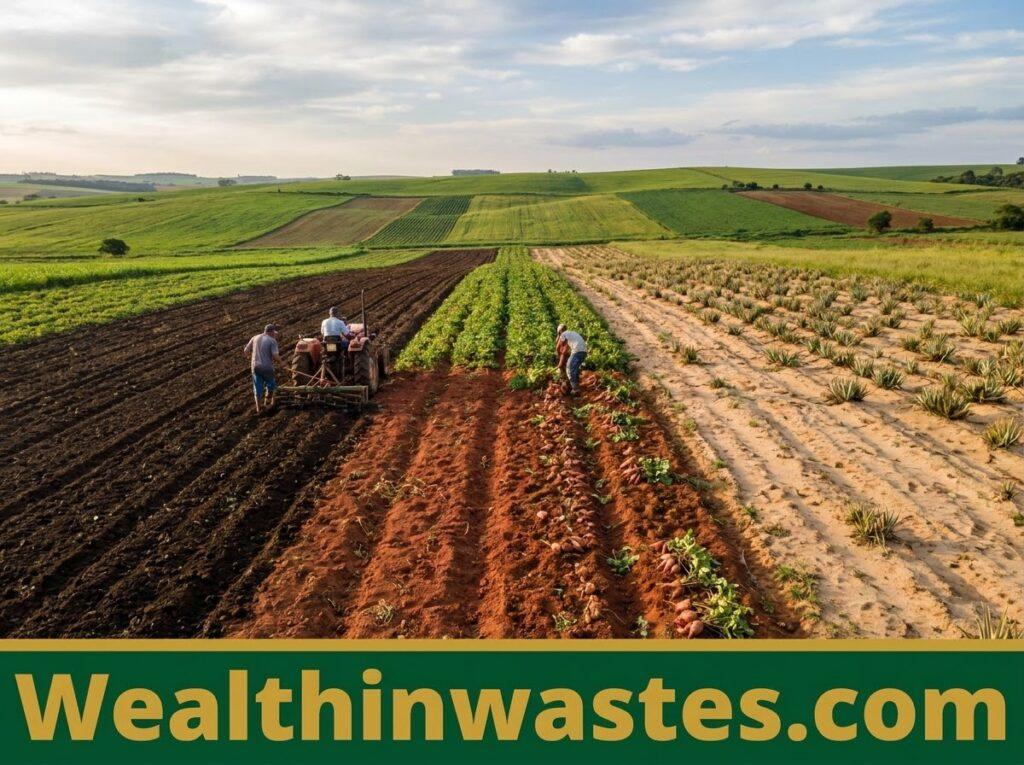
Soil classification matters to agriculture because different soil groups provide different combinations of fertility, drainage, water storage, rooting conditions, nutrient supply, and management requirements for successful crop production across different regions.
1. Crop Selection: Soil characteristics influence which crops can establish and perform well. Farmers should consider texture, moisture, fertility, drainage, and rooting depth before selecting suitable crops for particular fields.
2. Fertility Management: Nutrient availability differs among soils because weathering, organic matter, leaching, and clay properties vary. Appropriate amendments and nutrient management should therefore respond to the specific soil condition.
3. Water Management: Sandy, clayey, saline, peat, volcanic, and alluvial soils differ in water movement and storage. Farmers need irrigation and drainage strategies that match these contrasting soil behaviors under local conditions.
4. Erosion Control: Soil structure, slope, vegetation cover, rainfall, and cultivation practices affect erosion risk. Conservation measures help protect productive topsoil and maintain essential soil functions under repeated agricultural use.
5. Land Suitability: Understanding soil groups improves land-use planning because crop production depends on soil depth, fertility, drainage, texture, and limitations. Proper classification supports better matching between land and intended uses.
6. Organic Matter Management: Adding suitable organic materials can improve aggregation, nutrient cycling, moisture retention, and biological activity. Information on composting organic waste can support practical soil improvement on farms.
7. Conservation Planning: Sustainable management should protect soil against erosion, compaction, nutrient depletion, salinity, and other forms of degradation. Effective conservation begins with recognizing each soil group’s strengths and limitations.
8. Productive Investment: Farmers can improve long-term results by understanding how soil conditions affect inputs, crop response, and risks. Research on soil resource management strengthens responsible farm planning and investment decisions.
Major Soil Types And Soil Management
Good soil management begins with recognizing the limitations and opportunities associated with each major soil group. Management should protect soil structure, regulate water, conserve nutrients, and reduce degradation over time.
1. Improve Soil Cover: Vegetative cover protects soil from raindrop impact, runoff, wind, and temperature extremes. Crop residues, cover crops, and appropriate vegetation can therefore reduce erosion and maintain better soil conditions.
2. Manage Organic Inputs: Organic matter supports aggregation, nutrient cycling, moisture retention, and biological activity. Compost, crop residues, and other suitable organic materials can improve soil condition when managed correctly.
3. Control Salinity: Saline soils require careful irrigation, adequate drainage, and monitoring of salt accumulation. Preventing persistent waterlogging can reduce the upward movement and concentration of dissolved salts in fields.
4. Reduce Erosion: Contour practices, reduced tillage, vegetation, terraces, and other conservation measures can reduce soil loss. Detailed guidance on soil conservation explains these approaches more fully for farmers and land managers.
5. Avoid Soil Pollution: Heavy metals, pesticides, hydrocarbons, salts, and other contaminants can damage soil functions. The risks become clearer when understanding soil pollution and soil properties in affected environments.
6. Manage Agricultural Chemicals: Soil texture, moisture, organic matter, pH, and permeability influence pesticide movement. Information on pesticide mobility in soil supports safer chemical management practices on farms and fields.
7. Limit Land Degradation: Deforestation, overgrazing, intensive cultivation, and poor land use can degrade soil resources. Reviewing agricultural land degradation helps connect soil management with long-term farm productivity and resilience.
Why Major Soil Types Matter Worldwide
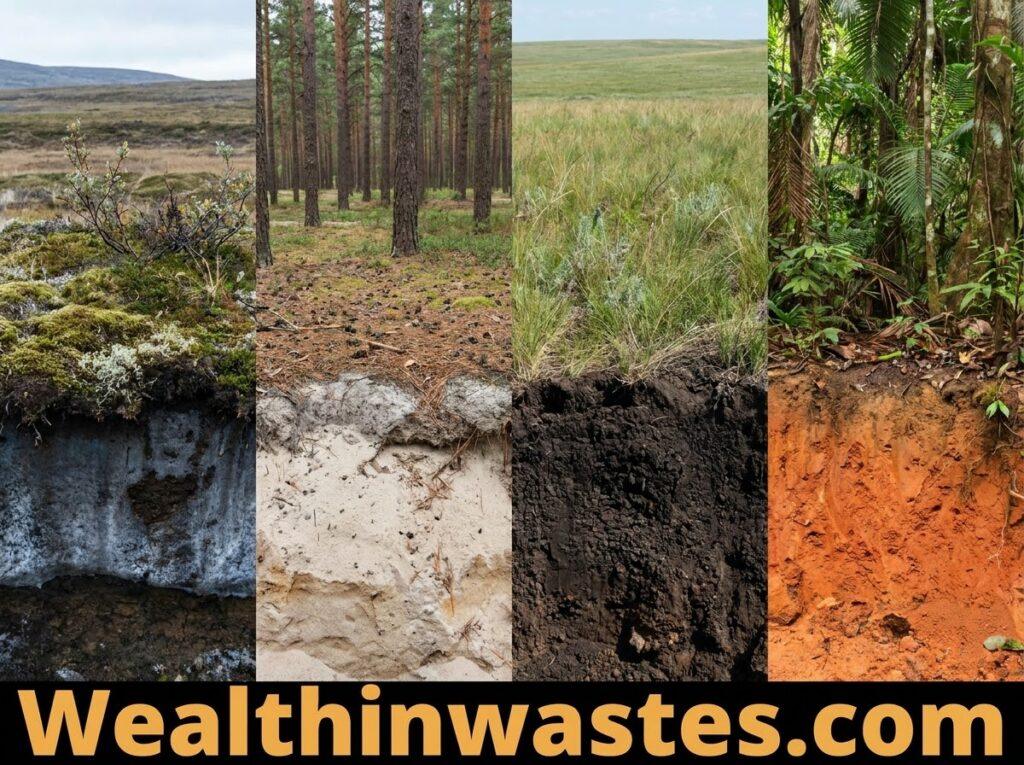
The major soil types of the world provide a broad genetic framework for studying soils worldwide. Their distribution reflects climate, parent material, relief, organisms, water, and the length of soil development.
Zonal soils demonstrate the powerful regional influence of climate, especially where vegetation and drainage remain comparatively stable. Tundra, podsol, chernozem, and tropical soils illustrate these climatic relationships across broad regions.
Intra-zonal soils demonstrate how special conditions can override broad climatic influence. Saline, peat, and calcareous soils form where water regime, parent material, or local environmental conditions become dominant controls within particular landscapes.
Azonal soils emphasize the importance of youth and recent deposition. Alluvial, marine, and volcanic soils may retain strong parent-material influences because erosion, deposition, and landscape change interrupt mature profile development.
These distinctions support better decisions about agriculture, conservation, drainage, irrigation, pollution prevention, land suitability, and soil monitoring. They also help students interpret soil patterns across continents and ecological regions with greater confidence.
The broader principle remains simple: soil properties result from interacting processes rather than one isolated cause. Good classification therefore improves understanding while supporting appropriate management and sustainable land use across varied environments.
Readers can also connect soil patterns with wider environmental pressures through human impacts on natural environments and land pollution affecting land resources worldwide in different ways and locations across farming landscapes.
Finally, soil knowledge extends beyond agriculture because soil stores water, supports organisms, recycles nutrients, anchors vegetation, and interacts with contaminants across human and natural landscapes. These links strengthen sustainable waste management and environmental planning.
Read Also: The Four (4) Forms of Complex Processes of Soil Formation
Summary on Major Soil Types of the World
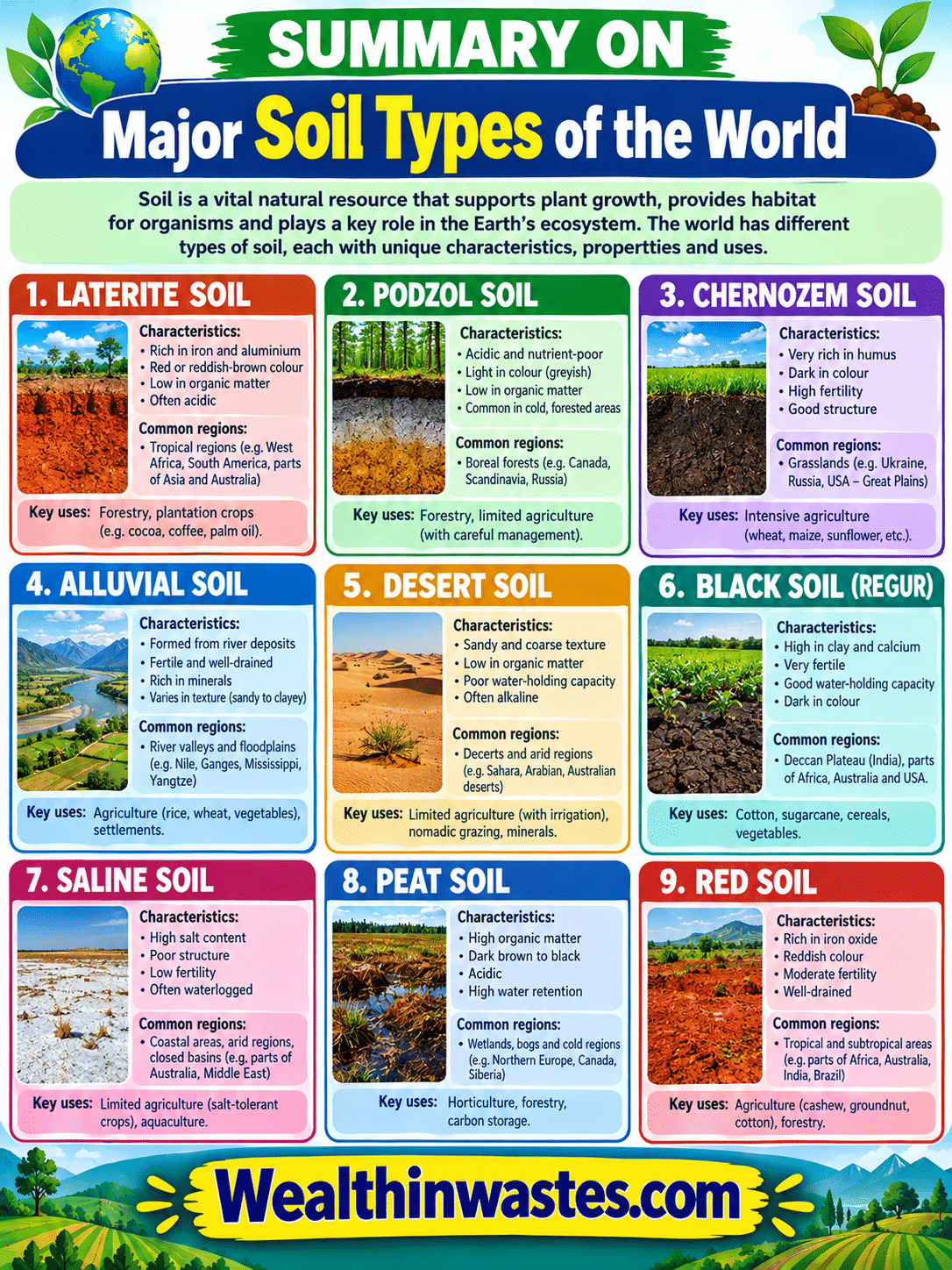
| Major Group | Main Influence | Examples | Key Feature |
|---|---|---|---|
| Zonal | Climate and vegetation | Tundra, podsol, chernozem, tropical soils | Strong climatic relationship |
| Intra-zonal | Relief, parent material, water | Saline, peat, calcareous soils | Local conditions dominate |
| Azonal | Youth and recent deposits | Alluvial, marine, volcanic soils | Weak profile development |
| Agricultural relevance | Soil properties and management | All groups | Guides land use and conservation |
The three major soil groups provide a broad genetic framework for studying soils worldwide. Zonal soils reflect climate strongly, intra-zonal soils respond to special local controls, and azonal soils remain comparatively young or weakly developed.
Frequently Asked Questions About Major Soil Types of the World: 3 Broad Soil Groups
1. What are the three major soil types of the world?
The three broad genetic groups are zonal, intra-zonal, and azonal soils, each reflecting different dominant influences during soil formation.
2. What controls the formation of zonal soils most strongly?
Climate usually exerts the strongest influence, especially through temperature, rainfall, vegetation, weathering, leaching, and biological activity across broad regions.
3. Which soils belong to the intra-zonal group?
Common examples include saline soils, peat soils, and calcareous soils, where local water conditions, relief, or parent material strongly affect development.
4. Why are azonal soils considered weakly developed?
They often form from recent deposits or under relief conditions that prevent enough time or stability for distinct soil horizons to develop.
5. Are zonal soils found in specific climatic regions?
Yes. Their distribution commonly follows broad climatic belts, including cold polar margins, temperate regions, grasslands, forests, and tropical environments.
6. Which major soil types can support agriculture effectively?
Many soils can support agriculture when their limitations receive suitable management, although alluvial, chernozem, and some volcanic soils can be particularly productive.
7. What is the main importance of soil classification?
Classification helps people compare soils, understand their formation, predict behavior, select appropriate land uses, and design better conservation and management practices.
Do you have any questions, suggestions, or contributions? If so, please feel free to use the comment box below to share your thoughts. We also encourage you to kindly share this information with others who might benefit from it. Since we can’t reach everyone at once, we truly appreciate your help in spreading the word. Thank you very much for your support and for sharing!
Read Also: Management of Nigerian Soils in Agriculture