


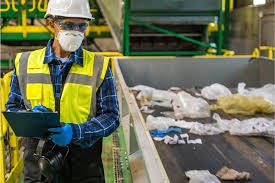
Every modern business produces waste in one form or another. From office paper and packaging materials to plastics, metals, and electronics, these leftovers often pile up faster than expected. What many companies fail to realize is that this waste is not just something to discard but a hidden resource waiting to be transformed.
This is where structured recycling support becomes essential. Through professional systems designed for collection, sorting, and reuse, organizations can shift from careless disposal to responsible recovery of materials. This approach not only protects the environment but also improves efficiency, reduces expenses, and strengthens long term business stability.
At the center of this transformation are business waste recycling services, which help companies manage waste in a smarter and more structured way. Instead of sending materials to landfills, these services ensure that valuable resources are recovered and reintroduced into production cycles.
Businesses today are also under increasing pressure from customers, governments, and global sustainability goals. This makes responsible waste handling not just a moral choice but a competitive advantage.
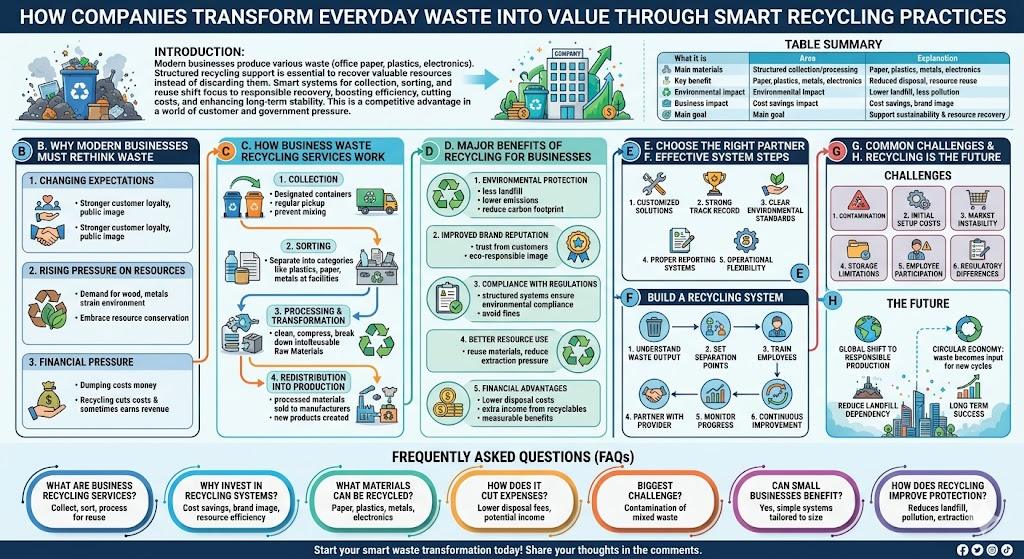
Table Summary on How Companies Transform Everyday Waste Into Value Through Smart Recycling Practices
| Area | Explanation |
|---|---|
| What it is | Structured systems for collecting and processing business waste |
| Main materials | Paper, cardboard, plastics, metals, electronics |
| Key benefit | Reduced waste disposal and improved resource use |
| Environmental impact | Lower landfill dependency and reduced pollution |
| Business impact | Cost savings and improved brand reputation |
| Main goal | Support sustainability and resource recovery |
Read Also: Waste Management
B. Why Modern Businesses Must Rethink Waste
1. Changing expectations from society
Customers today pay attention to how companies treat the environment. A business that ignores sustainability risks losing trust. On the other hand, those that adopt sustainability practices often gain stronger loyalty and better market positioning.
Waste is no longer just a disposal problem. It is part of a company’s public image and long term responsibility.
2. Rising pressure on natural resources
Industries depend heavily on raw materials such as wood, metals, and petroleum based products. When these are used without recycling, demand for virgin resources increases, leading to environmental strain.
By embracing resource conservation, companies help reduce unnecessary extraction and support a more balanced use of the planet’s materials.
3. Financial pressure on operations
Waste disposal is not free. Transporting, handling, and dumping materials costs money. Over time, these expenses grow significantly. Recycling helps reduce these costs while sometimes creating additional revenue streams.
This is where cost savings become a major advantage for businesses of all sizes.
C. How Business Waste Recycling Services Work
Understanding how recycling systems operate helps businesses make better decisions.
1. Waste collection process
Companies place waste in designated containers based on type. These are then collected regularly by recycling providers. The goal is to prevent mixing materials that could reduce recycling quality.
2. Sorting and separation
At recycling facilities, waste is sorted into categories such as plastics, paper, metals, and organic materials. Proper separation improves efficiency and increases the chance of reuse.
3. Processing and transformation
After sorting, materials are cleaned, compressed, or broken down. They are then converted into reusable raw materials that can be used in manufacturing or production.
This stage is where recyclable materials regain value instead of becoming landfill waste.
4. Redistribution into production
The processed materials are sold or delivered to manufacturers who use them to create new products. This closes the loop of what is known as a circular system.
D. Major Benefits of Recycling for Businesses
1. Environmental protection
One of the strongest benefits is the reduction of harmful environmental impact. Less waste in landfills means less pollution, lower greenhouse emissions, and healthier ecosystems.
Companies actively reduce their carbon footprint by participating in recycling systems that limit unnecessary waste accumulation.
2. Improved brand reputation
Businesses that show commitment to responsible practices stand out. Customers are more likely to trust and support companies that care about environmental impact.
This improves brand image and can even attract partnerships with other eco responsible organizations.
3. Compliance with regulations
Many regions have strict rules about waste disposal. Companies that ignore these rules risk penalties or legal issues.
Using structured systems ensures environmental compliance, helping businesses avoid fines while maintaining smooth operations.
4. Better use of resources
Recycling ensures that materials are not wasted but reused. This reduces pressure on raw material extraction and supports long term environmental balance.
Through resource conservation, businesses help maintain a healthier production cycle.
5. Financial advantages
Waste reduction often leads to lower disposal costs. Some recyclable materials can also be sold, adding extra income. Over time, this creates measurable financial benefits.
E. How to Choose the Right Recycling Partner
Not all service providers offer the same quality. Selecting the right partner is essential for success.
1. Customized waste solutions
Every business produces different types of waste. A good provider should offer tailored systems that match specific operational needs instead of a general one size approach.
2. Strong track record
Experience matters. Companies should look for providers with proven reliability, consistent service delivery, and positive client feedback.
3. Clear environmental standards
A responsible provider should follow safe and efficient recycling methods that genuinely support environmental protection.
4. Proper reporting systems
Data tracking is important for monitoring progress. Businesses should be able to see how much waste is recycled and how much impact is reduced over time.
5. Operational flexibility
The provider should be able to adapt to business size, industry type, and waste volume changes without disrupting operations.
Read Also: Strategies for Effective Pharmaceutical Waste Disposal
F. Steps to Build an Effective Recycling System
1. Understand your waste output
Before starting, companies must identify what types of waste they generate. This includes measuring quantity and understanding frequency.
2. Set up clear separation points
Employees should have access to labeled containers for different waste categories. Clear instructions improve participation and reduce contamination.
3. Train employees properly
Staff involvement is crucial. When employees understand the importance of recycling, participation improves significantly.
4. Partner with a reliable service provider
A professional recycling company ensures smooth collection, processing, and reporting.
5. Monitor progress regularly
Tracking results helps businesses see improvements and identify areas that need adjustment.
6. Encourage continuous improvement
Over time, companies can refine their systems to improve efficiency and reduce waste further.
G. Common Challenges in Waste Recycling Systems
1. Contamination issues
One of the biggest problems is mixing recyclable and non recyclable waste. This reduces efficiency and increases processing difficulty.
2. Initial setup costs
Starting a recycling program may require investment in bins, training, and logistics.
3. Market instability
Demand for recycled materials can fluctuate, affecting profitability and consistency.
4. Storage limitations
Some businesses struggle with space required to store waste before collection.
5. Employee participation
Without proper training, staff may ignore sorting rules, reducing system effectiveness.
6. Regulatory differences
Different regions may have different waste rules, making compliance more complex for large organizations.
H. Why Recycling Is the Future of Business Operations
Modern businesses cannot ignore environmental responsibility anymore. Waste is no longer just something to throw away. It is a resource that can be recovered, reused, and reintegrated into production systems.
By adopting waste management strategies that focus on recycling, companies become part of a global shift toward responsible production. This approach reduces landfill dependency, protects natural ecosystems, and supports long term economic stability.
The concept of a circular economy continues to grow worldwide. In this system, waste becomes input for new production cycles instead of being discarded. Businesses that adapt early position themselves for long term success.
Frequently Asked Questions on How Companies Transform Waste Through Recycling Systems
1. What are business waste recycling services?
They are structured systems that help companies collect, sort, and process waste materials so they can be reused instead of being sent to landfills. These services support environmental protection and resource recovery.
2. Why should companies invest in recycling systems?
Companies benefit from reduced disposal costs, improved brand image, regulatory compliance, and better resource efficiency. It also supports long term environmental responsibility.
3. What types of waste can be recycled in businesses?
Common materials include paper, cardboard, plastics, metals, glass, and certain electronic components. The exact types depend on the industry and local recycling facilities.
4. How does recycling help reduce business expenses?
Recycling lowers waste disposal fees and can sometimes generate income from reusable materials. It also improves operational efficiency over time.
5. What is the biggest challenge in business recycling?
The most common challenge is contamination, which happens when recyclable and non recyclable materials are mixed together, making processing more difficult.
6. Can small businesses benefit from recycling services?
Yes, small businesses can significantly reduce costs and improve efficiency by adopting simple recycling systems tailored to their size and waste output.
7. How does recycling improve environmental protection?
It reduces landfill waste, lowers pollution levels, and decreases the need for raw material extraction, helping protect natural ecosystems.
Business waste recycling is no longer an optional activity. It has become a core part of responsible modern operations. Companies that adopt structured systems for managing waste are not only protecting the environment but also improving efficiency and profitability.
By embracing business waste recycling services, organizations contribute to cleaner cities, healthier ecosystems, and stronger economies. The shift toward sustainability is already underway, and businesses that take action now will benefit the most in the long run.
Do you have any questions, suggestions, or contributions? If so, please feel free to use the comment box below to share your thoughts. We also encourage you to kindly share this information with others who might benefit from it. Since we can’t reach everyone at once, we truly appreciate your help in spreading the word. Thank you very much for your support and for sharing!
Read Also: What You Need to Know About Osteospermum