


The history of biodiversity explains how living organisms changed, diversified, adapted, and disappeared across Earth’s long geological history. Scientists rely on several forms of evidence to reconstruct these biological changes.
Among the most important sources of biodiversity record are fossils and molecular evidence. Each source reveals different aspects of biological history, while their combined use produces stronger evolutionary interpretations.
Fossils preserve physical traces of organisms that lived during earlier geological periods. They can reveal structures, distributions, appearances, disappearances, environmental associations, and major biological changes that shaped ancient ecosystems.
However, fossils do not provide a complete catalogue of past biodiversity because preservation depends heavily on organism characteristics, environmental conditions, geological processes, burial patterns, exposure, discovery, and scientific investigation.
Molecular evidence provides another important perspective by comparing genetic information among living organisms. Scientists can use these comparisons to estimate relationships, evolutionary divergence, ancestry, and approximate timing of biological events.
Understanding both sources is essential because present biodiversity represents only one stage in Earth’s biological history. Earlier life forms provide valuable context for understanding adaptation, extinction, diversification, conservation, and ecosystem development.
What Are Sources of Biodiversity Record?
The sources of biodiversity record are forms of evidence that allow scientists to reconstruct biological diversity across time. They include preserved remains, genetic information, geological evidence, and observations of living organisms.
Fossil evidence remains one of the most direct sources because it preserves physical remains, impressions, footprints, shells, bones, teeth, pollen, and other traces associated with ancient organisms and environments.
Molecular evidence complements fossils by allowing researchers to compare DNA, RNA, proteins, and other biological molecules. These comparisons help identify relationships that physical characteristics alone may not clearly demonstrate.
The study of biodiversity also benefits from understanding how organisms interact with their surroundings. Knowledge of natural resource classification provides useful environmental context for interpreting changes in species and ecosystems.
Researchers may also compare modern biodiversity patterns with historical evidence to identify changes in species richness, geographic distribution, extinction, environmental pressure, and ecosystem structure across different periods.
These sources do not provide identical information, so scientists interpret them together. Their combined strengths make it possible to develop more reliable explanations of biodiversity change through geological time.
Read Also: On-site Municipal Wastewaters Treatment
Fossil Record As Biodiversity Evidence

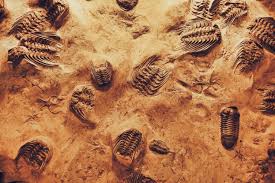
1. Preserved Organisms: Fossils provide physical evidence of organisms that lived in the past, preserving bones, shells, teeth, wood, leaves, impressions, footprints, and other biological structures under suitable geological conditions.
2. Geological Distribution: Fossil occurrences across different rocks and regions help scientists determine where organisms lived, when populations appeared, and how biodiversity changed across geological periods and environments.
3. Biological Change: Fossils reveal structural changes among organisms and document important patterns of appearance, diversification, extinction, adaptation, and replacement within ancient biological communities across successive geological periods.
4. Environmental Context: Fossils occur within geological settings that provide information about ancient environments. Sediments, rock formations, and associated remains can help researchers interpret past habitats and ecological conditions.
Much of our knowledge about ancient biodiversity comes from examining fossils within rocks. Scientific interpretation becomes stronger when fossil information connects with soil and mineral evidence associated with geological environments.
Fossils also help researchers identify major extinction events and periods of rapid diversification. Changes in fossil abundance and distribution can provide clues about how biological communities responded to environmental changes.
Hard-bodied organisms often leave better fossil evidence than soft-bodied organisms. Consequently, the fossil record provides a stronger representation of organisms with durable structures than organisms whose bodies decay rapidly.
Forest and wildlife conservation knowledge also helps readers appreciate why historical biodiversity records matter, because ancient evidence provides context for understanding present species, habitats, extinction pressures, and conservation priorities.
Fossil Record Strengths And Limits
1. Historical Directness: Fossils offer direct physical evidence of ancient organisms, making them especially valuable for confirming that particular biological forms existed during specific geological periods and environments.
2. Preservation Bias: Fossil preservation strongly favors abundant, widespread, long-lived, and hard-bodied organisms. Soft-bodied organisms usually leave fewer recognizable remains, creating uneven representation within biodiversity records.
3. Geological Loss: Erosion, uplift, burial, weathering, tectonic activity, and geological recycling can destroy fossils or keep them inaccessible. These processes create gaps that scientists must consider carefully.
4. Geographic Bias: Some environments preserve fossils more effectively than others. Marine deposits often provide extensive records, whereas terrestrial ecosystems may leave fewer fossils because preservation conditions differ substantially.
The fossil record therefore represents an incomplete sample rather than a perfect history. Researchers must avoid assuming that the absence of fossils automatically proves an organism did not exist previously.
For example, soft-bodied organisms can disappear without leaving recognizable fossils, while organisms with shells, bones, or durable structures have much better preservation opportunities and therefore stronger historical representation.
The quality of the fossil record also differs between geological periods and geographic locations. Researchers must consider these differences when comparing biodiversity patterns across regions and long periods.
Understanding the ecological value of forests and wildlife reinforces this limitation because many modern terrestrial organisms occupy environments that rarely produce complete fossil records under ordinary conditions.
Molecular Evidence For Biodiversity History
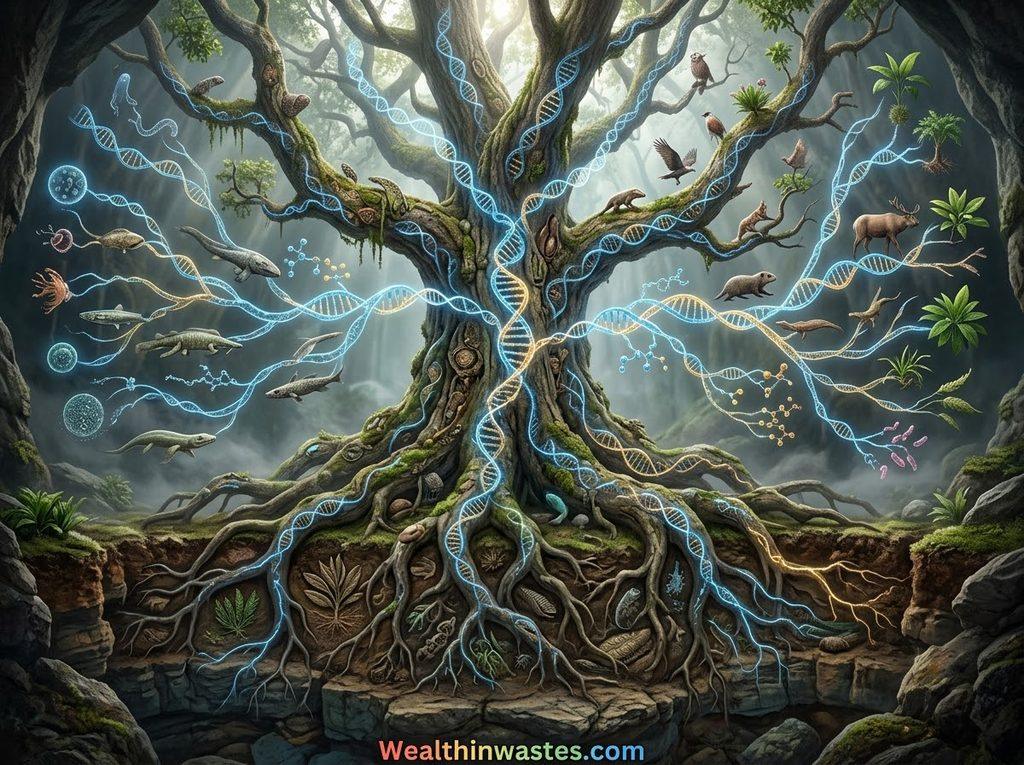
1. Genetic Comparisons: Molecular studies compare DNA, RNA, proteins, and other biological molecules among organisms. These comparisons help researchers identify similarities, differences, ancestry, and evolutionary relationships among different lineages.
2. Evolutionary Relationships: Closely related organisms generally share greater molecular similarity than distantly related organisms. Scientists use these patterns to construct phylogenetic trees that represent proposed evolutionary relationships.
3. Hidden History: Molecular evidence can reveal relationships that fossils or visible structures cannot clearly establish. It may also suggest that some lineages originated much earlier than their oldest known fossils.
4. Modern Analysis: Advances in genetic science have expanded biodiversity research considerably. The principles of biotechnology and genetic analysis provide important foundations for studying biological information.
Molecular evidence helps scientists investigate biodiversity beyond what preserved physical remains can show. Genetic sequences contain historical information that can clarify relationships among organisms sharing common evolutionary ancestry.
Researchers can compare molecular changes among species to identify branching patterns in evolutionary history. These patterns often complement morphological information obtained from living organisms and fossil specimens.
Genetic evidence also helps address uncertainty created by incomplete fossil preservation. When early members of a lineage left no recognizable remains, molecular comparisons can provide additional clues about their evolutionary history.
Environmental conditions remain important when interpreting molecular history because organisms evolve within ecosystems. Studies of physical habitat and biological relationships can therefore strengthen interpretation of biodiversity patterns.
Phylogenetic Relationships From Molecular Data
Phylogenetics examines relationships among organisms by comparing inherited characteristics. Molecular sequences often provide detailed evidence for reconstructing branches, common ancestry, divergence, and relationships among related biological groups.
Scientists organize molecular similarities into phylogenetic trees. These trees represent hypotheses about evolutionary relationships rather than simple timelines, because researchers must interpret sequence differences alongside fossil, anatomical, and ecological evidence.
Taxonomic and phylogenetic diversity can also support biodiversity assessment by showing how organisms differ and how closely their evolutionary histories connect across biological groups and geographic regions.
The study of species diversity and richness complements phylogenetic analysis because biodiversity includes not only the number of species but also their abundance and evolutionary relationships.
Molecular relationships can also challenge older classifications based primarily on appearance. Two organisms may look similar because of adaptation to similar environments, while molecular data reveal that their evolutionary histories differ substantially.
Conversely, organisms that appear different may share a relatively recent common ancestor. Molecular evidence can identify such relationships and improve scientific understanding of diversification, adaptation, and evolutionary history.
Researchers therefore avoid interpreting molecular similarity in isolation. Fossils, morphology, geography, ecology, and molecular sequences work together to produce stronger and more defensible phylogenetic conclusions.
Molecular Clocks And Evolutionary Timing
A molecular clock is an approach that estimates the timing of evolutionary divergence using differences accumulated within genetic sequences. It provides useful estimates when suitable evolutionary assumptions support the analysis.
Scientists compare molecular differences between related organisms and use calibrated rates of sequence change to estimate when their evolutionary lineages may have separated from shared ancestral populations.
Fossils often help calibrate molecular clocks because fossil ages can provide minimum estimates for the presence of particular lineages. Geological evidence therefore remains important even during molecular dating studies.
Molecular-clock estimates contain uncertainty because sequence changes do not always accumulate at identical rates. Researchers must consider mutation rates, selection, generation times, calibration points, and evolutionary variation.
Environmental history can also influence interpretation because major climatic changes may alter population sizes, distributions, and evolutionary pressures. The study of climatic change and resource conservation provides useful environmental context.
Fossil and molecular dates may therefore differ for particular groups. A molecular analysis may suggest an older origin than the oldest known fossil because early representatives may have left no preserved remains.
The reverse can also occur when assumptions or calibration choices affect molecular estimates. Scientists consequently treat molecular-clock results as evidence that requires comparison with other independent sources.
When interpreted carefully, molecular clocks extend biodiversity history beyond the visible fossil record and help researchers estimate the broad timing of evolutionary diversification and lineage separation.
Read Als: Wastewater Treatment and Guideline Standards
Combining Fossil And Molecular Evidence

1. Cross-Checking Evidence: Scientists compare molecular findings with fossil evidence to determine whether independent lines of evidence support similar evolutionary histories, divergence patterns, or estimates for major biological events.
2. Filling Historical Gaps: Molecular data can provide information where fossils are absent, while fossils can anchor molecular interpretations to geological time and physical evidence from ancient organisms.
3. Environmental Interpretation: Biodiversity changes become easier to understand when evolutionary evidence is combined with information about climate, habitats, geological conditions, and environmental disturbances across different periods.
4. Stronger Conclusions: Combining independent evidence reduces dependence on a single source and helps researchers develop more reliable explanations of biodiversity history, evolutionary relationships, extinction, and diversification.
The combined approach recognizes that no individual source can explain the entire history of biodiversity. Fossils provide physical records, while molecular evidence supplies information about ancestry and evolutionary relationships.
Environmental conditions also influence both preservation and evolution. Studies of climate change and land resources can help explain why biodiversity records vary across locations and geological periods.
Scientists may also use evidence from biodiversity monitoring, ecological studies, and modern species distributions. These sources provide present-day comparisons that help interpret patterns identified within ancient records.
Modern environmental monitoring practices demonstrate how systematic observations can establish biodiversity conditions, identify trends, and provide measurements that complement historical evidence from fossils and molecular studies.
Why Biodiversity Records Matter Today
Biodiversity records provide historical context for understanding present ecosystems. They show that species composition changes naturally through time, while also helping scientists identify human influences that accelerate biodiversity loss.
Historical evidence can reveal how organisms responded to environmental pressures, climatic shifts, habitat changes, disease, competition, and other disturbances. Such knowledge supports better predictions about future ecosystem responses.
Fossil evidence can also identify previous extinction events and recovery periods. These records help scientists recognize that biodiversity changes can involve both rapid losses and long periods of biological recovery.
Modern conservation planning benefits from this historical perspective. Information from resource conservation and biodiversity management helps connect historical understanding with present decisions about habitats and natural resources.
Habitat destruction remains a major concern because reducing available habitat can decrease populations and increase extinction risk. Historical biodiversity records can help identify which changes represent natural variation or unusual losses.
Human activities such as deforestation, pollution, land conversion, and resource exploitation can alter ecosystems rapidly. Understanding deforestation and biodiversity loss therefore becomes important when evaluating modern environmental trends.
Pollution can also influence biodiversity records by changing habitats and reducing the survival of sensitive species. Studies of polluted water ecosystems demonstrate how environmental disturbances can affect biological communities.
Similarly, industrial activities can introduce pollutants that disrupt ecological systems. Research concerning industrial waste impacts highlights why environmental pressures must remain part of biodiversity assessment and interpretation.
Good biodiversity records therefore support scientific research, conservation planning, environmental education, policy development, and sustainable resource management. They help society understand where biodiversity came from and how it may change.
Effective environmental governance also benefits from reliable biological information. pollution control institutions and environmental programmes require evidence to evaluate ecological conditions and guide appropriate management responses.
Understanding the wider environment and its interacting components strengthens biodiversity interpretation because organisms respond continuously to relationships among climate, soil, water, habitats, and other environmental conditions.
These records also demonstrate why biodiversity conservation remains important. Long-term evidence shows that biological communities are dynamic, but species losses can permanently remove evolutionary lineages from future ecosystems.
Human activities can intensify these losses through habitat destruction, pollution, unsustainable extraction, and environmental degradation. Pollution sources and environmental pressures should therefore receive careful attention.
Finally, biodiversity records contribute to sustainability because ecosystems support resources, services, and processes that human societies depend upon. Long-term biological knowledge encourages informed decisions that protect ecological resilience.
The principles of biological sustainability and ecosystem survival further emphasize the importance of maintaining species, habitats, and ecological processes so that biodiversity can continue supporting natural systems.
Summary on Sources of Biodiversity Record
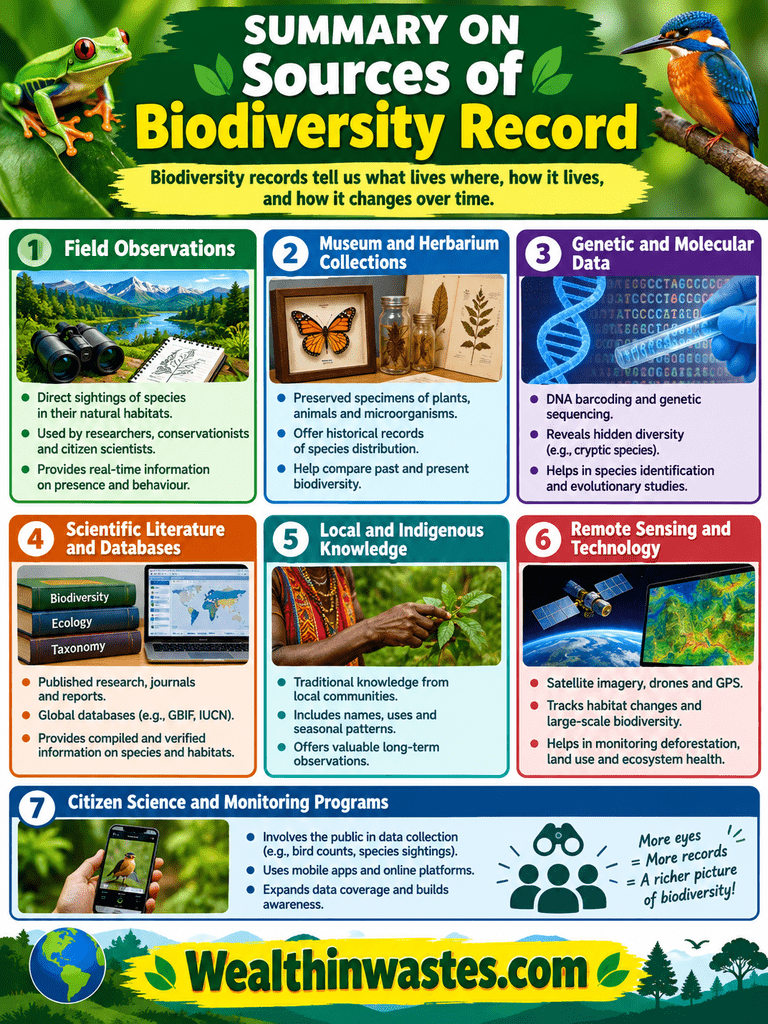
| Aspect | Summary |
|---|---|
| Primary Sources | The main sources include fossil evidence and molecular data, supported by geological, ecological, and biodiversity observations. |
| Fossil Evidence | Fossils preserve physical evidence of ancient organisms and reveal appearances, distributions, environmental associations, diversification, and extinction. |
| Fossil Limitations | Fossils are incomplete because preservation favors certain organisms, environments, geological conditions, and accessible locations. |
| Molecular Evidence | Genetic comparisons reveal evolutionary relationships, ancestry, divergence, and possible timing of biological events. |
| Phylogenetics | Molecular similarities help researchers construct phylogenetic trees and examine relationships among species and broader biological groups. |
| Molecular Clocks | Molecular-clock methods estimate evolutionary divergence dates but depend on assumptions, calibration, and appropriate interpretation of molecular change. |
| Combined Evidence | Fossils and molecular data complement one another, producing stronger interpretations of biodiversity history than either source alone. |
| Modern Importance | Biodiversity records support conservation, environmental management, scientific research, ecological monitoring, and sustainable resource decisions. |
Frequently Asked Questions About Sources of Biodiversity Record: Fossils And Molecular Data
1. What are the main sources of biodiversity record?
The main sources are fossil evidence and molecular data. Scientists also use geological, ecological, anatomical, and modern biodiversity observations to interpret changes in organisms, ecosystems, distributions, relationships, and diversity.
2. Why is the fossil record important for biodiversity history?
The fossil record provides physical evidence of ancient organisms. It helps researchers identify past biological forms, distributions, appearances, disappearances, environmental associations, diversification patterns, and major extinction events through geological time.
3. Why is the fossil record incomplete?
The fossil record is incomplete because preservation favors certain organisms and environments. Geological processes, decay, erosion, burial, limited exposure, and incomplete discovery also remove fossils from the available historical evidence.
4. Why are soft-bodied organisms poorly represented in fossils?
Soft-bodied organisms usually decay quickly and lack durable structures that survive burial and geological processes. Consequently, organisms with shells, bones, teeth, or other hard structures often receive stronger fossil representation.
5. How does molecular evidence contribute to biodiversity history?
Molecular evidence compares genetic sequences among organisms. These comparisons help scientists infer evolutionary relationships, common ancestry, divergence, and historical patterns that may remain unclear from fossils or visible physical features.
6. What is a molecular clock?
A molecular clock estimates evolutionary divergence timing using accumulated differences in genetic sequences. Scientists calibrate molecular changes with suitable evidence, including fossils, while accounting for uncertainty in evolutionary rates.
7. Why can fossil and molecular dates differ?
Fossils may fail to preserve the earliest members of a lineage, while molecular estimates depend on assumptions about sequence change, calibration, mutation rates, and evolutionary patterns through geological time.
8. Why should scientists combine fossil and molecular evidence?
Combining both sources provides complementary evidence. Fossils supply physical and geological information, while molecular data clarify genetic relationships and divergence, producing a broader and more reliable understanding of biodiversity history.
Do you have any questions, suggestions, or contributions? If so, please feel free to use the comment box below to share your thoughts. We also encourage you to kindly share this information with others who might benefit from it. Since we can’t reach everyone at once, we truly appreciate your help in spreading the word. Thank you very much for your support and for sharing!
Read Also: Measures of Biodiversity Conservation