



The social environment describes the network of human relationships, institutions, cultural expectations, and shared practices through which people organise daily life and interact with the natural world around them over time.
People depend on their surroundings for food, water, shelter, energy, and other necessities. Their decisions, however, also reflect family relationships, cultural traditions, economic activities, government policies, and community expectations.
The social environment connects individuals through different relationships and institutions. These connections influence resource distribution, population patterns, production methods, environmental awareness, and the collective responsibility people demonstrate towards their surroundings.
Understanding this structure helps explain why environmental problems rarely result from individual actions alone. Social organisation, infrastructure, technology, cultural values, and institutional decisions often determine how communities use resources.
This article examines the social environment structure of the environment, including its major components, primary and secondary groups, cultural influences, institutional responsibilities, and practical contributions to environmental protection and sustainable development.
Meaning and Scope of the Social Environment
The social environment refers to the combined arrangement of human relationships and interactions within a community. It includes families, friends, organisations, businesses, governments, cultural practices, and institutions that influence people’s behaviour.
Unlike the natural environment, which includes physical and biological surroundings, the social environment focuses on relationships, social rules, collective decisions, and organised human activities. However, both environments constantly influence one another.
For example, responsible environmental use depends on community behaviour, access to resources, effective institutions, and shared responsibility. These social conditions can either encourage conservation or contribute to environmental degradation.
Similarly, ecosystem diversity responds to human settlement, agricultural expansion, industrial development, and conservation decisions. Understanding these connections helps explain how social relationships influence ecological conditions across different communities.
Environmental problems such as pollution also demonstrate this relationship. The effects of environmental pollutants may extend beyond individual properties, affecting neighbouring communities, public health, wildlife, and shared water resources.
Read Also: Biosphere and its Dependent Links to the other Spheres
Main Components of Social Environment Structure
1. Constraint Environment: The constraint environment includes the physical, biological, and chemical conditions that limit or enable human activities, including climate, soil, water availability, organisms, natural hazards, and environmental resource availability.
2. Infrastructure: Infrastructure comprises the systems and facilities that support social and economic activities, including roads, electricity, water supplies, communication networks, healthcare facilities, schools, and transportation services connecting people with resources.
3. Mode of Production: The mode of production describes the technologies, labour arrangements, and practices used to create goods and services. These choices influence resource consumption, employment, land use, and pollution levels.
4. Mode of Reproduction: The mode of reproduction concerns the practices and institutions that influence population size and continuity, including family life, healthcare, education, and reproductive choices that shape future resource demand.
5. Social Structure: Social structure refers to the relationships and bonds connecting individuals within communities. Family networks, friendship groups, professional associations, and formal organisations influence cooperation, authority, responsibilities, and social expectations.
6. Superstructure: Superstructure includes cultural expressions and mental influences such as art, music, literature, rituals, values, emotions, traditions, and beliefs. These influences shape environmental attitudes, resource-use practices, and collective decisions.
These components operate together rather than independently. For example, biodiversity information can support conservation decisions, while knowledge of soil properties helps communities understand the consequences of agricultural practices and waste disposal.
Population pressures and infrastructure also influence resource availability. Consequently, climate change and sustainability require coordinated responses involving households, businesses, public institutions, and communities rather than isolated individual efforts.
Primary and Secondary Social Groups

Social groups form an important part of the social environment because they organise relationships, communicate expectations, and coordinate collective activities. Sociologists commonly distinguish primary groups from secondary groups according to their relationships and purposes.
Primary Group Structure
Primary groups include family members, close friends, neighbours, community networks, and voluntary associations whose members often develop intimate relationships. These groups encourage belonging, cooperation, trust, socialisation, and shared values.
Environmental education initiatives can use these familiar relationships to encourage responsible waste disposal, water conservation, tree planting, and respect for natural resources through regular discussions and practical community activities.
Families and close communities also influence socialisation, basic production, domestic discipline, and decisions about family life. Their everyday examples can establish lasting habits that influence how children and adults treat the environment.
Secondary Group Structure

Secondary groups include government agencies, political parties, businesses, industries, military and police organisations, media institutions, non-governmental organisations, professional associations, and labour unions whose members cooperate around defined purposes.
These organisations often operate through formal procedures, established leadership, and administrative systems. They regulate production, coordinate services, support education, influence population-related policies, and establish standards for responsible environmental management.
Both group types contribute to environmental protection. Environmental learning programmes become more effective when families reinforce lessons taught by schools, while organisations provide information and resources that communities need.
Public communication also connects these groups. Accessible environmental information channels help distribute practical guidance through meetings, radio, television, community notices, educational materials, and digital platforms.
How Social Structure Shapes Environmental Behaviour
Social relationships influence environmental behaviour by shaping what people consider acceptable, necessary, affordable, or socially responsible. These influences appear in household routines, production systems, consumption patterns, and community responses to environmental challenges.
1. Social Learning: People learn environmental habits by observing relatives, friends, teachers, and community leaders. Responsible examples can encourage conservation, sanitation, and recycling, while harmful practices may spread through imitation and acceptance.
2. Resource Consumption: Household income, employment, social expectations, and access to infrastructure influence how people consume water, energy, food, and materials. These choices determine resource demand and the quantity of waste generated.
3. Community Cooperation: Communities can organise sanitation exercises, protect shared resources, restore habitats, and improve waste collection. Such cooperation supports biological sustainability when activities protect organisms and maintain essential ecological relationships.
4. Production and Waste Practices: Businesses, households, and farmers influence environmental quality through production methods and disposal choices. Responsible waste recycling practices can recover useful materials and reduce pressure on disposal facilities.
5. Attitudes Towards Environmental Change: Shared beliefs and access to information affect how communities respond to environmental risks. Public understanding of global warming and climatic change can strengthen support for conservation and adaptation measures.
Social Institutions and Environmental Governance

Environmental governance depends on institutions that establish rules, coordinate responsibilities, enforce standards, and help communities manage shared resources. Effective governance connects public participation with accountability, scientific information, and practical environmental policies.
1. Government Institutions: Governments establish environmental standards, develop regulations, provide public infrastructure, and monitor compliance. Effective pollution control policies can protect public health while guiding businesses and communities towards responsible practices.
2. Regulatory Instruments: Authorities use permits, inspections, economic incentives, penalties, and other measures to influence environmental behaviour. Appropriate environmental protection instruments encourage compliance and help prevent pollution before it damages ecosystems.
3. Environmental Organisations: Dedicated institutions collect information, coordinate environmental services, educate the public, and support enforcement. Strong pollution control institutions require trained personnel, adequate funding, reliable equipment, and clear responsibilities to operate effectively.
Culture, Values, and Environmental Choices
Culture and values form the superstructure of society, influencing how people interpret nature, understand responsibilities, and decide which activities deserve protection or priority. Their influence can encourage conservation or contribute to environmental degradation.
1. Cultural Superstructure: Art, music, dance, literature, rituals, sports, games, and scientific activities communicate collective ideas about nature and human responsibilities. Cultural expressions can promote environmental awareness and support community conservation campaigns.
2. Mental Superstructure: Values, emotions, beliefs, memories, traditions, and conscious or unconscious motives influence human decisions. These influences may determine whether people protect habitats, conserve resources, or accept environmentally damaging behaviour as normal.
3. Historical and Traditional Knowledge: Earlier experiences, community customs, and traditional resource-management practices can guide current environmental decisions. Studying the historical development of resource sustainability helps explain how social attitudes towards nature have changed.
4. Conservation Ethics: Ethical values encourage people to consider wildlife, ecological stability, and future generations when making decisions. Understanding renewable and non-renewable resource conservation supports responsible choices about extraction, use, and long-term availability.
Shared environmental values can also strengthen public support for biodiversity protection. Recognising the value of biodiversity helps communities appreciate the ecological, economic, cultural, and practical benefits that healthy ecosystems provide.
Ways to Strengthen Social Environment for Sustainability

Strengthening the social environment requires cooperation between households, community groups, educational institutions, businesses, and governments. These actors can improve environmental outcomes by sharing responsibilities and creating opportunities for informed participation.
Environmental education should communicate clearly with different audiences and translate knowledge into practical action. Better environmental information dissemination helps communities understand environmental risks and identify suitable responses.
Governments and community leaders should create inclusive decision-making processes that consider local knowledge, resource needs, cultural practices, and the concerns of vulnerable groups. Fair participation builds trust and improves cooperation.
Communities can also support responsible development by respecting wildlife, protecting habitats, reducing waste, and adopting environmentally sound practices. Effective wildlife policies and laws provide additional guidance for protecting biological resources.
Ultimately, lasting progress requires institutions that enforce appropriate rules, organisations that communicate accurate information, and individuals who practise environmental responsibility. Together, these efforts can create healthier communities and more sustainable relationships with nature.
Read Also: Resource Conservation and Management
Summary on The structure of Social Environment
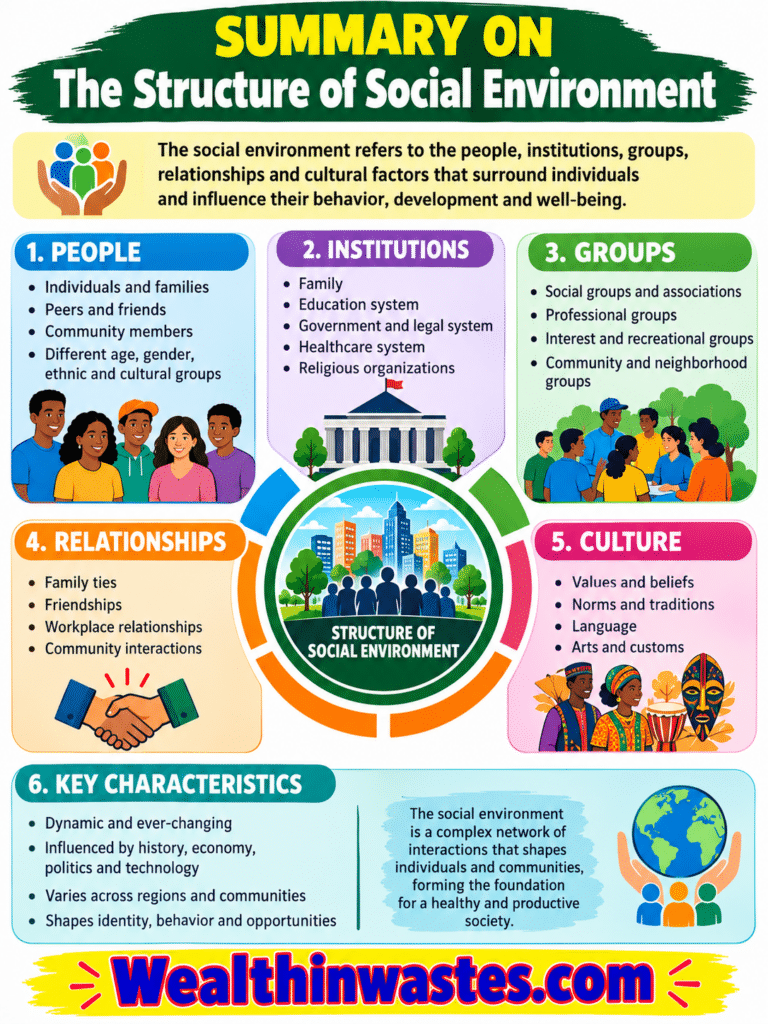
| Component | Description | Environmental Importance |
|---|---|---|
| Constraint Environment | Physical, biological, and chemical conditions affecting human activities. | Determines environmental limits and resource availability. |
| Infrastructure | Facilities and systems supporting social and economic activities. | Influences access to services, resources, and environmental management. |
| Mode of Production | Technologies and practices used to produce goods and services. | Shapes resource consumption, employment, land use, and pollution. |
| Mode of Reproduction | Practices and institutions influencing population size and continuity. | Affects population patterns and demand for environmental resources. |
| Primary Groups | Families, friends, neighbours, and close community networks. | Encourages socialisation, shared values, and environmental responsibility. |
| Secondary Groups | Governments, industries, professional bodies, and formal organisations. | Supports environmental policies, regulation, education, and collective action. |
| Cultural Superstructure | Art, music, literature, rituals, traditions, and shared expressions. | Communicates social beliefs and influences environmental attitudes. |
| Mental Superstructure | Values, emotions, beliefs, customs, and motives affecting behaviour. | Shapes individual choices and collective responses to environmental problems. |
Frequently Asked Questions About The Social Environment Structure of the Environment
1. What Is the Social Environment?
The social environment consists of human relationships, cultural practices, institutions, and social expectations that influence behaviour, resource use, community organisation, and interactions with the natural environment.
2. What Are Its Main Components?
Its components include the constraint environment, infrastructure, production and reproduction systems, social structures, and superstructure, comprising cultural expressions, values, beliefs, and traditions that influence behaviour.
3. What Are Primary Social Groups?
Primary social groups include families, close friends, neighbours, and community networks whose intimate relationships encourage cooperation, socialisation, shared values, and responsible environmental habits through everyday interactions.
4. How Do Secondary Groups Help?
Secondary groups include governments, businesses, industries, and formal organisations. They coordinate environmental programmes, establish regulations, communicate information, and support pollution control and conservation activities.
5. How Does Culture Influence the Environment?
Culture influences beliefs about nature, resource use, and conservation. Traditions and shared values can encourage environmental protection, although some social practices may contribute to unsustainable resource exploitation.
6. Why Is Environmental Education Important?
Environmental education develops awareness, practical knowledge, and responsible habits. It helps individuals and communities recognise environmental problems, evaluate solutions, and participate effectively in conservation and sustainable development.
7. How Can Communities Protect the Environment?
Communities can protect the environment by reducing waste, conserving water, planting trees, protecting habitats, sharing reliable information, participating in local decisions, and supporting responsible environmental policies.
[Do you have any questions, suggestions, or contributions? If so, please feel free to use the comment box below to share your thoughts. We also encourage you to kindly share this information with others who might benefit from it. Since we can’t reach everyone at once, we truly appreciate your help in spreading the word. Thank you very much for your support and for sharing!]
Read Also: Complete Agricultural Extension Guide for Farmer Education
“`