


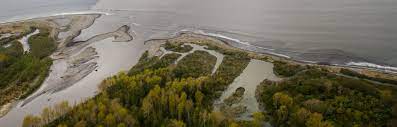
Sediment deposition occurs when moving water, wind, ice, or gravity loses enough energy to drop the particles it carries. This natural process continually reshapes river channels, floodplains, lakes, reservoirs, and coastlines.
In rivers, deposition often begins as water velocity decreases, allowing transported particles to settle. The size, shape, density, and weight of these particles influence where and when sediment accumulates.
Although sediment deposition forms important natural landforms and fertile soils, excessive accumulation can create environmental, agricultural, and economic challenges. These problems become serious when human activities accelerate erosion and sediment transport.
Understanding sediment deposition helps farmers, environmental managers, construction professionals, and communities recognize how sediment affects water bodies. It also provides a foundation for developing effective prevention, monitoring, and management strategies.
Responsible sediment management focuses on reducing soil erosion, protecting aquatic ecosystems, maintaining drainage capacity, and preventing pollutants from entering waterways. These measures support sustainable land use and improve the long-term health of water resources.
Sediment Deposition and Its Formation
Deposition starts when flow loses enough energy that a particle settles instead of remaining in motion. In watercourses, this usually happens as water velocity drops below the particle’s settling velocity in that water.
Particle size strongly influences settling speed: larger sand and gravel usually fall first, while finer silt and clay can travel farther before settling. Density, shape, and water turbulence also affect how long grains remain suspended.
As flow slows, coarse material settles near the channel or an obstruction, while finer particles often remain suspended. This sorting influences sediment patterns and the way managers approach responsible water planning.
When water spills beyond riverbanks during floods, it loses speed and deposits suspended particles across the floodplain. This process can build fertile soils and illustrates broader water movement through natural systems.
Lateral channel migration also encourages deposition. As a river erodes one bank and deposits material along another, it can build point bars, gradually changing the channel’s shape and its surrounding landscape.
Floodplains store sediment as rivers move material through drainage basins. Their deposits influence channel boundaries, soil characteristics, vegetation, and other components of the connected natural resource system.
Deposition patterns vary with rainfall, topography, channel shape, particle characteristics, and changing flow conditions. Understanding these relationships helps managers distinguish beneficial natural accumulation from sediment buildup that threatens ecosystems or infrastructure.
Read Also: How to Reduce the Amount of Wastes Produced
Impacts of Sediment Deposition
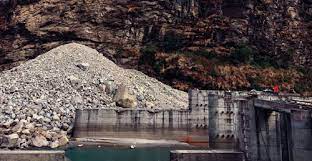
Excessive sediment accumulation affects aquatic habitats, water quality, drainage systems, and human activities. Understanding these effects helps communities strengthen measures that protect water quality and limit environmental damage.
1. Aquatic Habitat Destruction: Fine sediment can cover gravel beds and other habitats that fish, mussels, and bottom-dwelling invertebrates need for feeding, breeding, shelter, and successful reproduction in rivers and streams.
2. Increased Water Turbidity: Suspended particles make water cloudy and reduce light penetration. Lower light availability can restrict photosynthesis, limit aquatic plant growth, and disturb ecological relationships within affected freshwater environments.
3. Reduced Channel Capacity: Sediment accumulation can make river channels, drains, and reservoirs shallower. When available water-storage or flow capacity decreases, the surrounding area may experience greater flooding or more frequent drainage problems.
4. Transport of Contaminants: Sediment particles can carry attached pesticides, nutrients, and certain metals downstream. Consequently, sediment pollution may contribute to wider water resource contamination problems and aquatic ecosystem deterioration.
5. Recreational and Aesthetic Damage: Muddy water, shallow waterways, and accumulated deposits can reduce the attractiveness of rivers and lakes. These conditions may affect fishing, boating, swimming, tourism, and other recreational activities.
Sources and Transport of Sediment
Sediment originates from the weathering of rocks, soil erosion, bank collapse, construction, dredging, and poorly managed agricultural land. Human disturbance can increase the quantity of loose material available for transport.
Rainfall can dislodge exposed soil particles and carry them downhill as surface runoff. Poorly managed land contributes to land degradation and environmental pollution when loose soil reaches nearby waterways.
Farming practices influence erosion rates because cultivation can expose bare soil, weaken soil structure, and increase runoff. Appropriate soil conservation approaches help maintain protective vegetation and reduce the movement of sediment from fields.
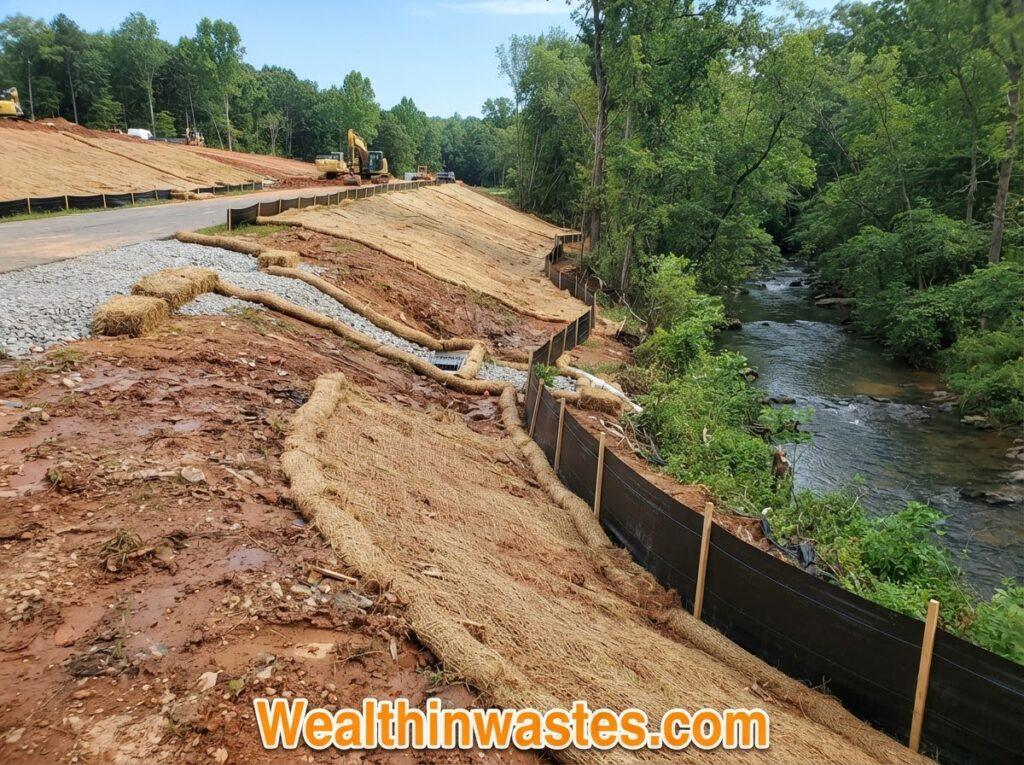
Construction activities can also generate sediment when workers clear vegetation, excavate soil, or reshape land. Unprotected stockpiles and poorly designed drainage channels allow rainfall to transport loose particles into streams and rivers.
Rivers transport sediment through suspension, rolling, sliding, and bouncing along the bed. Strong currents generally carry larger quantities of material, while slower currents encourage particles to settle and accumulate.
Wind can move dry, exposed soil across agricultural fields and construction areas, while glaciers transport rock fragments over long distances. Eventually, these materials accumulate wherever the transporting force loses sufficient energy.
The drainage basin connects many sediment sources to a common water body. Integrated watershed protection practices therefore help managers control erosion across entire catchment areas rather than addressing individual sites alone.
Preventive Sediment Control Measures
Preventive sediment control aims to keep eroded soil away from waterways before deposits develop. Effective programmes combine erosion reduction, suitable land management, drainage maintenance, vegetation protection, and regular inspection of vulnerable areas.
1. Maintain Protective Vegetation: Planting grasses, cover crops, and suitable trees protects exposed soil from raindrop impact. Their roots strengthen the soil structure and reduce runoff, making it harder for sediment to reach nearby waterways.
2. Establish Riparian Buffers: Vegetated strips beside streams, rivers, and lakes slow surface runoff and trap moving soil particles. These buffers also protect aquatic habitats and reduce the amount of sediment entering water bodies.
3. Improve Drainage Management: Well-maintained drains and carefully planned water channels direct runoff safely without encouraging excessive soil erosion. Appropriate drainage practices also help prevent irrigation-related soil and water problems.
4. Stabilize Construction Sites: Construction teams should cover exposed ground, protect soil stockpiles, install suitable sediment barriers, and manage site runoff. These actions reduce the amount of loose material that storms can carry into streams.
5. Apply Sustainable Land Use: Farmers, developers, and local authorities should match land activities with environmental conditions. Responsible land-use planning decisions help protect vulnerable slopes, drainage pathways, and naturally sensitive areas.
Remedial Methods for Sediment Removal
Remedial sediment control addresses deposits that have already accumulated in rivers, reservoirs, drainage channels, and retention facilities. Managers should select suitable methods after evaluating sediment quantity, environmental risks, cost, and disposal requirements.
1. Construct Settling Basins: Settling basins slow incoming water and allow suspended particles to settle before the water moves downstream. Operators must remove accumulated material periodically to preserve storage capacity and treatment efficiency.
2. Develop Detention Reservoirs: Detention reservoirs temporarily store runoff, reduce flow velocity, and encourage sediment settlement. Proper design and maintenance help control downstream sediment movement, although managers must account for storage limits and ecological effects.
3. Remove Sediment Through Dredging: Dredging removes deposited material from waterways, ports, and reservoirs where accumulation interferes with navigation or storage. Managers must assess contamination risks and identify suitable disposal or beneficial reuse options before excavation.
4. Restore Natural Storage Areas: Side-channel basins and suitable flood-retention areas can temporarily hold floodwater and encourage sediment settlement. Such projects require careful planning to protect neighbouring properties, maintain ecological functions, and support wider water resource protection efforts.
5. Maintain Existing Infrastructure: Regular inspections help identify sediment buildup in drains, culverts, detention structures, and reservoir inlets. Timely maintenance preserves their intended functions and reduces the risk of expensive repairs or disruptive flooding.
Agricultural and Economic Effects of Sediment
Sediment deposition affects agriculture when eroded soil removes valuable topsoil and carries nutrients away from cultivated land. Farmers may experience reduced crop productivity, greater input costs, and declining income when erosion continues unchecked.
Deposits can bury seedlings, obstruct drainage ditches, and change field surfaces. These problems make planting and irrigation more difficult, especially where intense rainfall repeatedly moves soil from sloping fields into lower areas.
Excess sediment also transports nutrients that may encourage excessive algae growth in receiving waters. Sustainable production systems must therefore protect both soil fertility and water quality through careful resource management and pollution prevention.
Environmental degradation can increase the cost of water treatment because highly turbid water often requires additional treatment attention. Communities may need better filtration, improved monitoring, and stronger pollution prevention to maintain dependable drinking-water supplies.
Sediment can reduce reservoir storage and increase maintenance demands for drainage infrastructure. These problems create financial pressure for households, farmers, industries, and public agencies that depend on reliable water supply and functioning waterways.
Long-term resource conservation helps protect productive landscapes and essential ecosystems. Responsible practices that preserve renewable resources can also maintain the natural resources communities depend on for agriculture, recreation, and economic development.
Protecting freshwater sources also safeguards fisheries, livestock production, irrigation, and household activities. Sustainable freshwater management practices help communities reduce pollution risks and maintain dependable supplies for present and future generations.
Watershed Practices for Sediment Management
Watershed management reduces sediment problems by coordinating land use, vegetation protection, drainage, and water quality activities across a catchment. Its success depends on practical measures that match local conditions and involve affected communities.
1. Protect Stream Banks: Avoid unnecessary clearing, excavation, and heavy disturbance near watercourses. Suitable vegetation, controlled access, and stable bank protection help reduce erosion while preserving habitats and the natural movement of water.
2. Improve Farm Soil Cover: Mulching, cover crops, crop rotation, and suitable conservation tillage protect agricultural soil from intense rainfall. These practices also support soil structure and improve the retention of useful moisture and nutrients.
3. Manage Organic Materials Responsibly: Properly prepared compost can improve soil structure and support vegetation establishment. Suitable organic waste recovery methods can also return useful materials to gardens and farms instead of sending them unnecessarily to disposal sites.
4. Recycle Appropriate Agricultural Residues: Farmers can use suitable crop residues and finished compost to improve soil cover and organic matter. Learning about organic material conversion techniques supports practical soil improvement and resource recovery.
5. Coordinate Community Action: Farmers, construction companies, regulators, and residents should cooperate on sediment prevention. Shared inspections, environmental education, and clear maintenance responsibilities help address erosion sources that cross property or administrative boundaries.
Sediment Monitoring and Water Quality
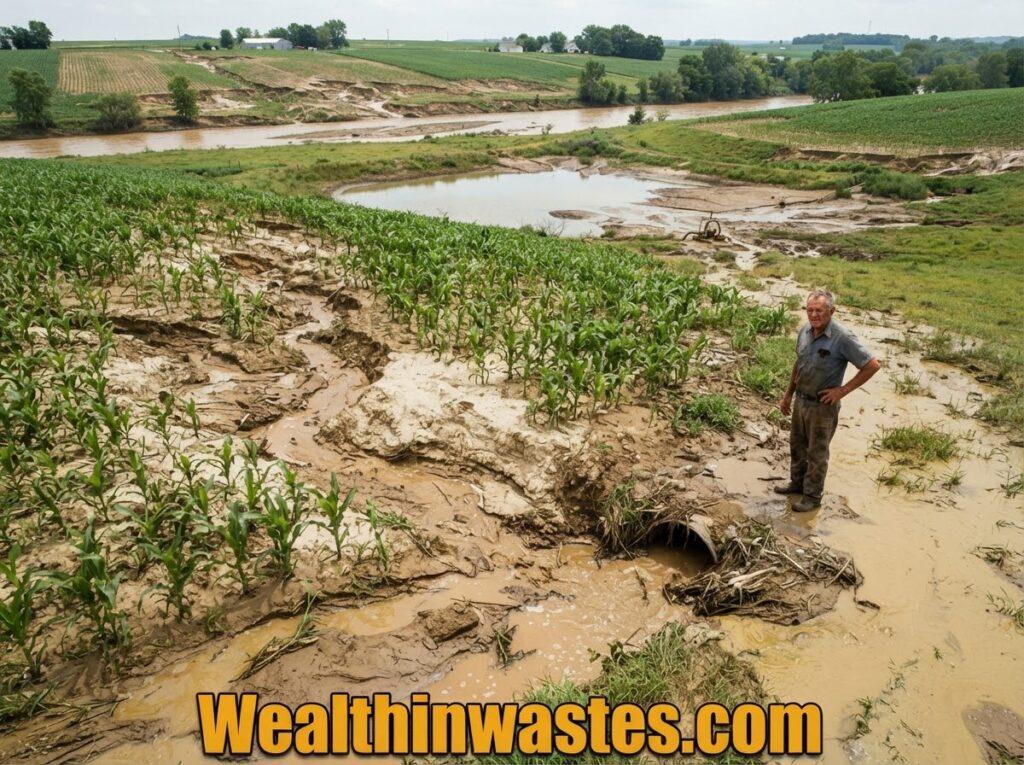
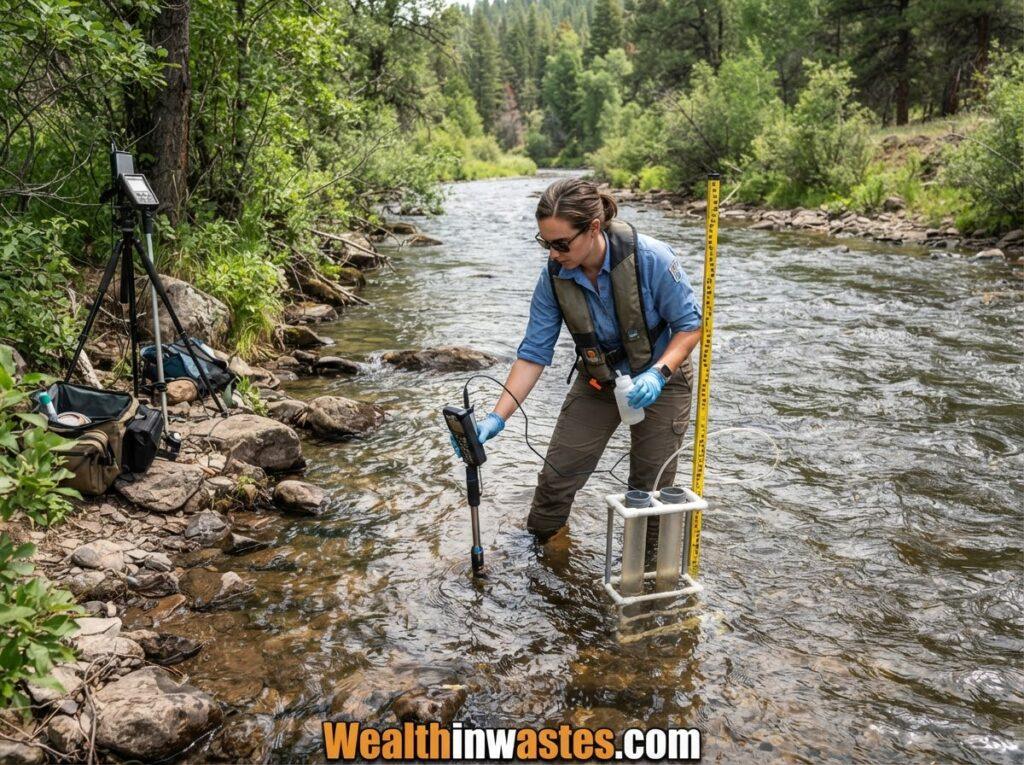
Monitoring helps environmental managers identify sediment sources, measure accumulation, and evaluate whether control measures work. Useful observations include water turbidity, channel depth, sediment deposits, bank condition, and changes following heavy rainfall.
Water sampling can reveal suspended solids and potential contaminants associated with sediment. Consistent measurements help distinguish ordinary seasonal changes from unusual pollution events that require investigation, additional control measures, or corrective action.
Inspections should cover upstream erosion sources, vulnerable construction areas, agricultural drainage outlets, and downstream receiving waters. This approach helps managers identify where soil enters the system and prioritize interventions with the greatest potential benefit.
Monitoring can also reveal how erosion affects agricultural productivity and land condition. Understanding agricultural land degradation and recovery helps farmers choose suitable conservation practices and track improvements in soil protection.
Effective sediment management requires cooperation between landowners, researchers, local authorities, water suppliers, and environmental agencies. Their combined information can strengthen long-term water resource planning and support better decisions about infrastructure, conservation, and ecosystem protection.
Managers should review monitoring results regularly and adjust control measures when conditions change. This continuous process helps communities respond to erosion, protect aquatic habitats, maintain drainage capacity, and reduce unnecessary sediment-related expenses.
Ultimately, successful sediment control combines prevention, appropriate removal, ongoing monitoring, and responsible watershed management. These measures protect land productivity, improve water quality, and preserve the ecological functions of rivers, lakes, and reservoirs.
Read Also: Factors Influencing Soil Moisture
Summary on Sediment Deposition, Impacts of Sediment and Sediment Control
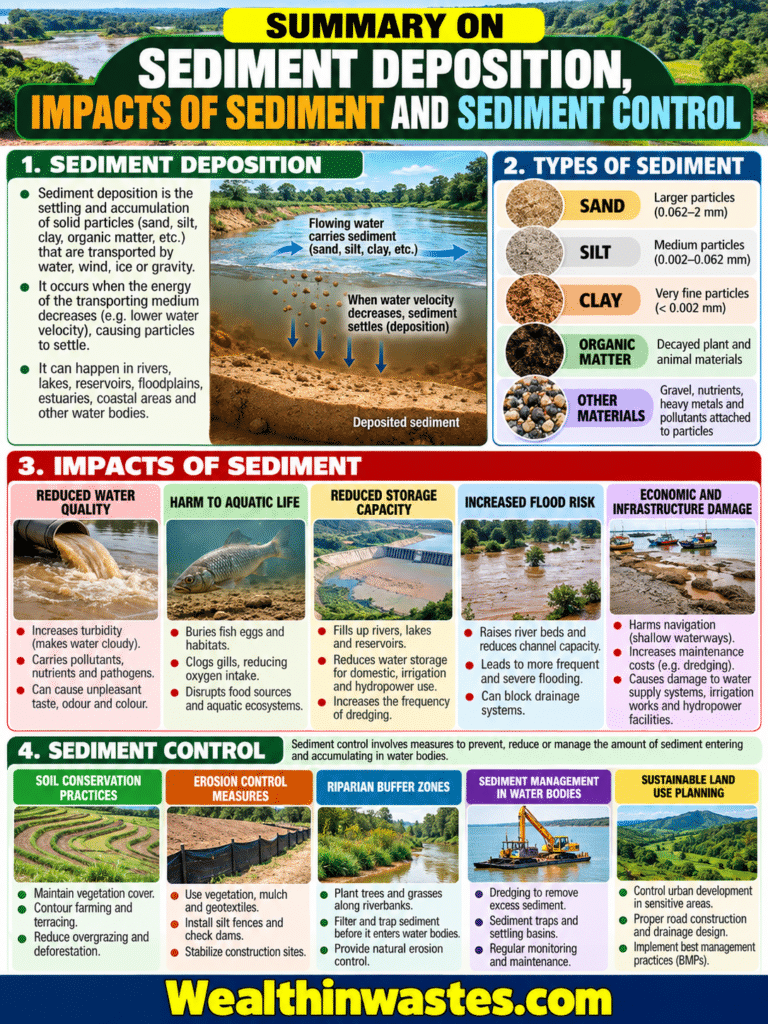
| Topic | Key Information | Importance |
|---|---|---|
| Sediment Deposition | Particles settle when transporting forces lose sufficient energy. | Explains the formation of river deposits, floodplains, and other landforms. |
| Major Impacts | Excessive deposits affect habitats, water clarity, drainage, and storage capacity. | Helps identify environmental and infrastructure risks. |
| Sediment Sources | Erosion, construction, bank collapse, agriculture, wind, and glaciers supply sediment. | Identifies areas where prevention can reduce sediment loads. |
| Preventive Control | Vegetation, riparian buffers, stable construction sites, and improved drainage limit erosion. | Reduces sediment movement before deposits develop. |
| Remedial Control | Settling basins, detention reservoirs, dredging, and maintenance address existing deposits. | Restores useful storage and drainage capacity when properly managed. |
| Agricultural Effects | Soil loss, buried seedlings, blocked drains, and nutrient movement reduce productivity. | Protects farm income, soil health, and water quality. |
| Watershed Management | Coordinated land use, soil conservation, and community participation reduce erosion. | Supports long-term protection of connected land and water systems. |
| Monitoring | Water sampling, turbidity checks, and sediment inspections track changing conditions. | Guides timely interventions and evaluates control effectiveness. |
Frequently Asked Questions About Sediment Deposition: Impacts, Risks, and Control Methods
1. What Is Sediment Deposition?
Sediment deposition occurs when transported particles settle after the water, wind, or other transporting force loses energy.
2. What Causes Sediment Deposition?
Reduced flow velocity, low turbulence, changing topography, and obstacles encourage sediment particles to settle and accumulate.
3. How Does Sediment Deposition Affect Water Quality?
Suspended sediment increases turbidity, reduces light penetration, and can transport attached nutrients, pesticides, and certain metals.
4. What Are the Main Sources of Sediment?
Common sources include eroding farmland, exposed construction sites, unstable riverbanks, disturbed landscapes, and weathered rocks.
5. What Is Sediment Control?
Sediment control uses practices and structures that keep eroded soil from entering and polluting nearby water bodies.
6. How Can Farmers Reduce Sediment Deposition?
Farmers can maintain vegetation cover, use mulch, practice conservation tillage, establish buffers, and manage runoff carefully.
7. What Is the Difference Between Preventive and Remedial Control?
Preventive control reduces erosion before sediment reaches waterways, while remedial control removes or manages deposits already present.
8. Why Is Sediment Monitoring Important?
Monitoring identifies pollution sources, tracks sediment accumulation, evaluates control measures, and supports informed environmental management decisions.
Do you have any questions, suggestions, or contributions? If so, please feel free to use the comment box below to share your thoughts. We also encourage you to kindly share this information with others who might benefit from it. Since we can’t reach everyone at once, we truly appreciate your help in spreading the word. Thank you very much for your support and for sharing!
Read Also: Soil and Water Conservation in Agriculture