


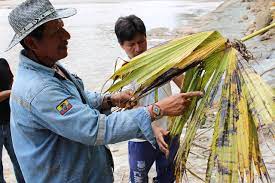
Oil tagging provides a scientific method for distinguishing petroleum sources when several crude oils or petroleum residues occur within the same environment after spills, leakage, discharge, transportation accidents, or industrial activities.
Biomarkers make source comparison possible because many petroleum biomarkers retain distinctive molecular structures after burial and petroleum generation, preserving chemical information about biological precursors, source rocks, depositional conditions, and thermal history.
These molecular fossils help investigators compare contaminated environmental samples with suspected source oils, determine likely relationships between residues, and evaluate how petroleum changed while moving through water, soil, sediment, and biological systems.
Consequently, oil tagging combines environmental sampling, petroleum geochemistry, chromatography, biomarker interpretation, and site information to strengthen pollution investigations where ordinary measurements cannot clearly distinguish competing petroleum sources.
Biomarkers are complex organic compounds occurring naturally in crude oil, source rocks, sediments, and other geological materials. Their structures can retain recognizable relationships to biological precursor molecules despite geological transformation.
During diagenesis and later petroleum generation, some biomarker structures remain sufficiently preserved for analytical use, although not every biomarker remains unchanged. Weathering, biodegradation, maturity, and other processes can modify distributions.
Researchers therefore describe many useful biomarkers as molecular fossils because their carbon frameworks preserve clues about ancient biological inputs and geological conditions that existed before petroleum accumulated within reservoirs.
Biomarker evidence can reveal source characteristics, depositional environment, maturity, and post-generation alteration. However, analysts should interpret patterns collectively because one compound rarely provides enough evidence for confident oil-source attribution.
Understanding Oil Tagging and Biomarkers
Oil tagging refers to the characterization of petroleum using chemical features that allow investigators to compare an unknown oil residue with known or suspected petroleum sources.
The approach becomes especially useful when several wells, pipelines, storage facilities, vessels, refineries, or natural seepages could plausibly contribute hydrocarbons to one contaminated location.
Crude oils differ in composition because their biological precursors, source rocks, depositional settings, geological histories, and degrees of thermal maturity differ from one petroleum system to another.
The geological origin of crude oil helps explain why petroleum composition varies between fields, since source materials and geological conditions influence the hydrocarbons eventually generated.
Biomarkers are particularly valuable because their structures can survive many petroleum-forming reactions better than numerous lighter hydrocarbons that readily evaporate, dissolve, or undergo environmental degradation.
The different petroleum fractions and hydrocarbon components provide useful background because petroleum contains compounds with different physical and chemical behaviours during refining and environmental release.
Modern oil tagging therefore looks beyond visible colour, smell, or general hydrocarbon concentration and examines detailed molecular fingerprints that provide stronger evidence about petroleum identity and possible source.
When investigators combine chemical fingerprints with reliable field information, oil tagging becomes a practical forensic tool for environmental assessment, contamination tracing, spill response, and source attribution.
Read Also: Oil pollution Monitoring and Control
Why Biomarkers Matter for Oil Source Identification

Biomarkers matter because they preserve molecular information that conventional measurements such as total petroleum hydrocarbons may not provide when several petroleum sources have contaminated the same environment.
Hopanes commonly originate from hopanoid precursors associated with microorganisms, while steranes derive from sterols and related biological compounds. Their persistence supports forensic comparisons of petroleum residues.
Recent research confirms that hopane and sterane chromatographic patterns can remain sufficiently stable in water and sediment to support oil-source identification, although some compounds may change within biological matrices.
Source identification becomes stronger when several compounds display matching relationships because a complete molecular pattern is less likely to arise independently in unrelated petroleum samples.
The processes governing petroleum migration and occurrence also matter because movement through geological formations can influence the chemical characteristics that investigators later observe.
Biomarkers may additionally indicate depositional environments by reflecting contributions from marine organisms, terrestrial plants, freshwater systems, or microorganisms associated with particular geological settings.
Oleanane, for example, can indicate significant higher-plant input and provides useful geological context in some petroleum systems, particularly when interpreted alongside other biomarker characteristics and maturity indicators.
Therefore, the strongest interpretation comes from biomarker distributions, diagnostic ratios, petroleum composition, geological information, and site evidence considered together rather than from one isolated compound.
Oil Tagging in Petroleum Pollution Monitoring
1. Source Comparison: Oil tagging compares biomarker profiles from polluted soil, sediment, water, or residue with reference oils collected from suspected petroleum sources near the affected environment.
2. Spill Attribution: Investigators can determine whether petroleum recovered from a contaminated location resembles oil from a particular field, well, storage facility, pipeline, vessel, or industrial operation.
3. Contamination Tracking: Biomarker patterns can help trace petroleum movement across connected environmental compartments and distinguish source characteristics from changes produced during transport.
4. Weathering Assessment: Stable biomarker compounds can remain detectable after some lighter hydrocarbons disappear, allowing investigators to compare weathered petroleum with possible original sources.
5. Pollution History: Persistent biomarker signatures can support investigations involving old petroleum residues where visible evidence has disappeared and routine hydrocarbons have already undergone extensive weathering.
6. Monitoring Support: Oil tagging complements conventional environmental measurements by providing source-related information that helps scientists interpret contamination patterns and design more effective monitoring programmes.
The fate and environmental mobility of petroleum contamination provide important context because released oil can move between land, water, sediments, and biological systems.
Likewise, environmental pollutant monitoring methods show why laboratory measurements and systematic sampling remain essential parts of a complete pollution investigation.
Oil tagging does not replace measurements such as total petroleum hydrocarbons, oil and grease, or other environmental parameters. Instead, it provides source-specific information that these measurements may lack.
This integrated approach allows investigators to evaluate both the amount of contamination and the probable petroleum source responsible for the environmental problem.
Common Biomarkers Used in Oil Tagging
Several biomarker families contribute to oil tagging because each group provides different information about biological source materials, depositional conditions, maturity, and petroleum transformation.
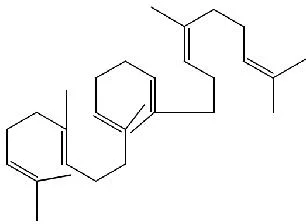
1. Squalene: Squalene is a triterpenoid precursor associated with biological systems and can undergo geological transformation into more stable molecular products that later help investigators interpret petroleum source characteristics.
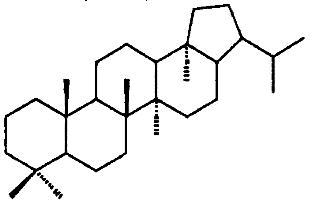
2. Hopanes: Hopanes are pentacyclic compounds derived from hopanoid precursors and are widely used because many members of this family resist environmental alteration better than numerous conventional petroleum hydrocarbons.
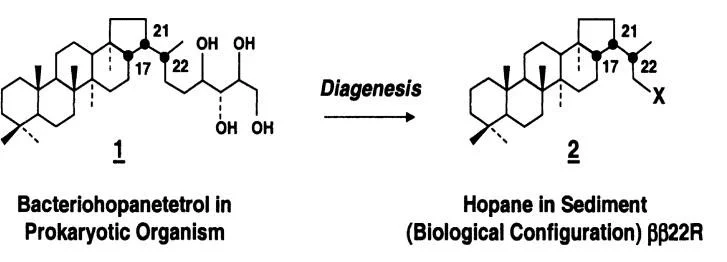
3. Source Indicators: Diagnostic biomarker compounds within polluted environmental samples can indicate whether the petroleum resembles a particular reference source and can reveal effects of subsequent biogeochemical alteration.
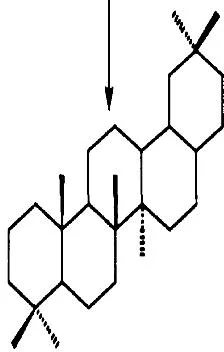
4. Oleanane: Oleanane is associated with higher-plant input and can provide useful information about source material and geological age when analysts interpret its abundance with other biomarkers.
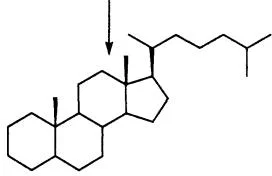
5. Steranes: Steranes occur widely in petroleum and geological extracts, while their distributions can provide information about biological contributions such as marine algal and other organic inputs.
6. Dinosteranes: Dinosteranes can indicate contributions associated with dinoflagellates, making their distribution useful when investigators examine biological source characteristics within petroleum systems.
7. Propylcholestanes: Certain propyl-substituted steranes can provide additional evidence concerning source-organism contributions and depositional environments, especially when analysts evaluate complete biomarker distributions rather than isolated compounds.
The composition and distribution of petroleum compounds help analysts understand why heavy, persistent molecules can remain after lighter petroleum components have weathered from contaminated environments.
These biomarker families should not receive identical interpretation in every petroleum system because their usefulness depends on source geology, maturity, environmental alteration, and the quality of reference samples.
Biomarker Ratios for Oil Tagging Accuracy
Biomarker ratios compare the relative abundance of selected compounds and often provide stronger information than simply recording whether one biomarker occurs within an oil sample.
Hopane and sterane relationships can help differentiate petroleum families because their distributions reflect variations in source materials and depositional settings across different petroleum systems.
Oleanane-to-hopane relationships can provide information about higher-plant contributions, while selected sterane distributions can assist interpretation of biological source inputs and depositional environments.
Researchers also use maturity-related ratios because geological heating can cause predictable molecular transformations while retaining enough structural information for comparison between oils.
Recent studies have shown that several hopane and sterane diagnostic ratios can remain useful during short-term aquatic exposure, although biological matrices may introduce changes in particular compounds.
The movement and management of groundwater contamination are relevant because dissolved petroleum components may migrate away from their release point and alter the spatial distribution of contamination.
Ratio interpretation requires caution when multiple petroleum sources have mixed because the resulting molecular pattern may represent combined inputs rather than one original oil source.
Consequently, investigators should compare several diagnostic ratios alongside chromatographic fingerprints, conventional petroleum measurements, geological information, and environmental observations.
Sampling and Laboratory Analysis for Oil Tagging

Reliable oil tagging begins with representative sampling because laboratory instruments cannot correct conclusions created by poorly selected, contaminated, insufficient, or improperly preserved environmental samples.
1. Sampling Plan: Investigators should define sampling objectives, suspected sources, environmental compartments, sampling locations, sample numbers, and analytical requirements before field collection begins.
2. Representative Samples: Samples should represent the contamination being investigated, whether the study involves surface water, groundwater, soil, sediment, source oil, vegetation, or another environmental medium.
3. Clean Equipment: Sampling equipment and containers should remain free from petroleum residues and other contaminants that could introduce false chemical signals into laboratory analyses.
4. Sample Preservation: Appropriate containers, handling, preservation, storage, labelling, transportation, and documentation protect sample integrity between collection and laboratory preparation.
5. Laboratory Analysis: Gas chromatography and gas chromatography-mass spectrometry can provide detailed petroleum profiles and identify biomarker distributions used for forensic comparison.
6. Quality Assurance: Blanks, duplicates, calibration checks, documented sample handling, and laboratory controls improve confidence in analytical results and strengthen technical conclusions.
The principles of representative environmental sampling emphasize that inappropriate sample selection can introduce errors that laboratory analysis cannot subsequently remove.
The different pollution source pathways also help investigators decide where to sample when contamination may originate from point sources or diffuse environmental transport.
A sound field strategy should therefore collect both suspected source materials and affected environmental samples whenever possible, because comparison requires a suitable reference for interpreting the molecular fingerprint.
Careful documentation also records sampling location, date, environmental conditions, sample type, handling procedures, and other observations that can later explain unusual analytical results.
Environmental Factors That Affect Biomarker Evidence
Petroleum does not remain chemically static after entering the environment. Physical transport, evaporation, dissolution, biodegradation, photochemical reactions, and sediment interactions can change contaminant composition over time.
Lighter hydrocarbons often disappear more rapidly than larger and more persistent molecular compounds, causing the remaining petroleum residue to differ from the original released oil.
Microbial activity can selectively degrade some compounds, while oxygen availability, temperature, sediment characteristics, and water chemistry influence the rate and direction of petroleum transformation.
The biological characteristics of polluted aquatic environments demonstrate how ecological and chemical conditions can influence contaminant behaviour after pollutants enter water systems.
Oil can also bind strongly to fine sediment and organic matter, creating persistent contamination reservoirs that may remain within an environment long after the original spill has occurred.
The relationship between soil resources and petroleum contamination is important because soil properties can influence contaminant retention, movement, persistence, and exposure.
Similarly, the composition and behaviour of land pollution provide useful context when petroleum residues accumulate within terrestrial environments.
Because weathering changes chemical composition, investigators should compare diagnostic biomarker patterns rather than expecting every concentration in a contaminated sample to match the original source oil exactly.
Recent experimental work supports this caution because biomarker fingerprints showed strong stability in water and sediment, while some transformations occurred within plants and fish during exposure.
Read Also: Roles of Producers and Corporations in Waste Management
Applications and Limitations of Oil Tagging

1. Spill Source Investigation: Oil tagging can support forensic investigations by comparing environmental residues with petroleum samples from suspected sources and identifying the closest molecular relationship.
2. Pipeline Monitoring: Biomarker fingerprints can assist investigations of suspected pipeline leaks by comparing petroleum residues collected at different locations along affected areas.
3. Industrial Pollution: Refineries, petrochemical facilities, storage terminals, and other petroleum operations can benefit from source characterization when several hydrocarbon inputs occur around industrial sites.
4. Remediation Planning: Source information can help environmental managers understand contamination patterns and design monitoring programmes that target the areas requiring investigation or cleanup.
5. Legal Investigations: Carefully generated biomarker evidence may contribute to environmental disputes, liability assessments, compensation cases, and regulatory investigations when supported by broader analytical information.
6. Long-Term Monitoring: Persistent biomarkers can support follow-up assessments by showing whether petroleum residues remain chemically related to previously identified sources after environmental alteration.
The environmental impacts associated with industrial waste provide important background because petroleum facilities can generate several contaminant streams beyond crude oil itself.
The broader environmental effects of waste discharges also show why contamination assessments should examine impacts across water, soil, ecosystems, and human activities.
However, oil tagging has limitations because different petroleum sources can share similar biomarker characteristics, while weathering and mixing can modify the patterns investigators observe.
The classification and sources of hazardous waste reinforce the need to consider industrial mixtures and associated contaminants instead of interpreting petroleum biomarkers without wider site context.
In addition, incomplete reference samples can weaken attribution, especially when investigators lack representative source oils from every plausible facility, field, pipeline, or historical release.
The fundamental concept of environmental pollution supports a broader interpretation in which chemical findings remain connected to the environmental conditions and activities producing contamination.
Oil tagging therefore works best as one part of an integrated investigation rather than as an isolated test used without environmental, geological, analytical, and historical evidence.
Oil Tagging and Environmental Management Decisions
Oil tagging can influence environmental management by helping decision-makers distinguish contamination sources, prioritize monitoring locations, evaluate pollution pathways, and select appropriate follow-up investigations.
For industrial sites, source characterization can complement routine monitoring by showing whether detected petroleum residues resemble current operations, historical contamination, or unrelated background inputs.
The principles of environmental management systems show how monitoring, documentation, corrective action, and continuous improvement can work together within organized environmental programmes.
Where petroleum contamination enters wastewater streams, source characterization can complement treatment monitoring by separating petroleum-source information from general indicators such as oil, grease, and organic load.
The industrial wastewater treatment process is relevant because petroleum and petrochemical facilities may handle wastewater containing oil, grease, organic compounds, and other contaminants.
The procedures used for industrial wastewater treatment provide further context for managing contaminated effluents before discharge, recycling, or other approved handling methods.
Treatment and monitoring should remain connected because identifying a pollution source without controlling the release does not provide a complete environmental management solution.
Similarly, available wastewater treatment approaches show that treatment selection depends on contaminant characteristics, effluent requirements, technical constraints, and the intended final water quality.
Where petroleum contamination affects wider drainage areas, investigators may need catchment-scale monitoring and repeated sampling because water movement can carry residues beyond the original release location.
The management of pollution across watersheds illustrates why source identification, regular monitoring, and pollution-control measures must operate together within interconnected environmental systems.
Biological treatment can also contribute to petroleum waste management in suitable circumstances, although treatment performance depends on the compounds present and the environmental conditions supporting microbial activity.
The use of biotechnology in waste management provides additional context for biological processes that can contribute to the breakdown of selected hydrocarbon-containing wastes.
Effective environmental management therefore combines source identification, pollution prevention, monitoring, treatment, remediation, documentation, and long-term evaluation rather than relying on one analytical technique alone.
R=H; CH3; C2H5; C3H7
Oil tagging is most reliable when investigators interpret diagnostic biomarker patterns alongside conventional petroleum chemistry, environmental observations, geological information, representative sampling, and suitable reference materials.
Its value lies in helping connect petroleum residues with probable sources while accounting for the transformations that occur after oil enters environmental systems.
Because no single biomarker proves every source relationship, professional interpretation should compare multiple molecular indicators and acknowledge uncertainty whenever source characteristics overlap.
When applied carefully, biomarker fingerprinting provides a useful scientific foundation for oil pollution monitoring, environmental investigations, remediation planning, and improved understanding of petroleum contamination.
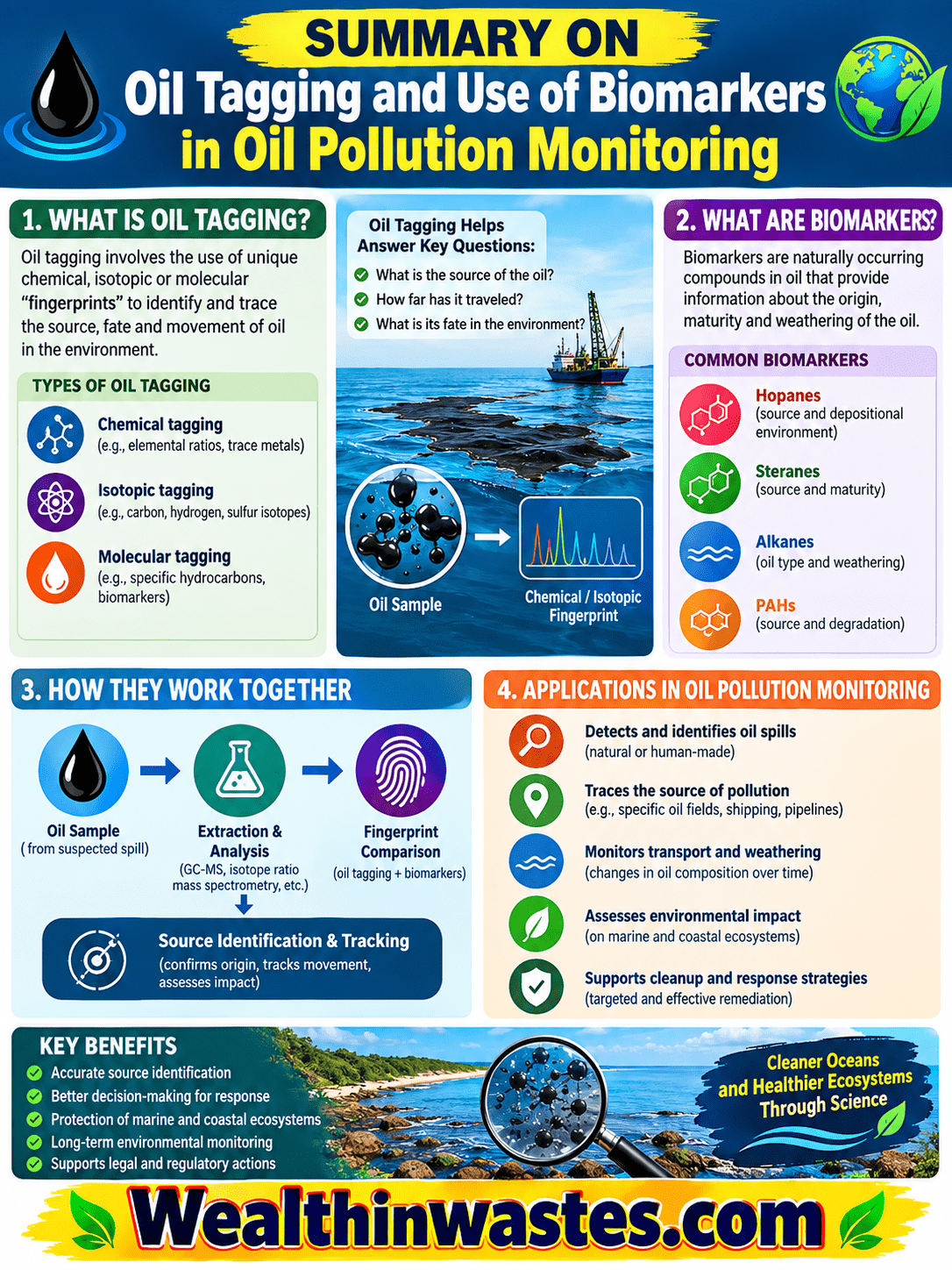
Summary on Oil Tagging and Biomarkers for Oil Pollution Monitoring
| Aspect | Key Point |
|---|---|
| Oil Tagging | A forensic approach that compares petroleum chemistry to identify probable sources of contamination. |
| Biomarkers | Persistent molecular compounds that retain useful information about petroleum source materials and geological history. |
| Hopanes | Pentacyclic biomarkers derived from hopanoid precursors and widely useful for petroleum fingerprinting. |
| Steranes | Biomarkers derived from sterols that provide information about biological source inputs and petroleum relationships. |
| Oleanane | A biomarker associated with higher-plant input and useful for source and geological interpretation. |
| Diagnostic Ratios | Relative molecular abundances that strengthen source, depositional-environment, and maturity interpretation. |
| Sampling | Representative, clean, well-preserved samples are essential for reliable oil-tagging results. |
| Environmental Changes | Weathering, biodegradation, evaporation, dissolution, transport, and sediment interactions can modify petroleum signatures. |
| Limitations | Similar sources, mixed contamination, altered biomarkers, and incomplete reference data can reduce attribution confidence. |
| Best Practice | Combine biomarker fingerprints with petroleum chemistry, site information, geological evidence, and quality-controlled sampling. |
Frequently Asked Questions About Oil Tagging and Biomarkers for Oil Pollution Monitoring
1. What is oil tagging?
Oil tagging is the comparison of petroleum chemical fingerprints to determine whether an environmental oil residue is related to a known or suspected petroleum source.
2. Why are biomarkers useful in oil tagging?
Many biomarkers remain relatively persistent and retain molecular patterns that can help distinguish petroleum sources after environmental weathering and other changes.
3. Which biomarkers are commonly used for oil identification?
Common petroleum biomarkers include hopanes, steranes, oleanane, and related compounds used together to evaluate source characteristics and molecular relationships.
4. Can oil tagging identify an oil spill source?
It can help identify a probable source when contaminated samples closely match suitable reference oils across multiple biomarker patterns and supporting chemical evidence.
5. Does weathering affect biomarkers?
Yes. Weathering, biodegradation, dissolution, evaporation, and biological activity can change some biomarker concentrations and ratios, so analysts must interpret results carefully.
6. Why do analysts use biomarker ratios?
Ratios compare related compounds and can reveal source, depositional, or maturity differences that may not become clear from the presence of one compound alone.
7. What samples can investigators analyze?
Investigators can analyze source oils and contaminated environmental materials such as soil, sediment, water, and selected biological samples, depending on the study objectives.
8. Is one biomarker enough to prove an oil source?
No. Reliable attribution normally requires several biomarkers, diagnostic ratios, chromatographic patterns, reference samples, and independent environmental or geological evidence.
9. Why is representative sampling important?
A poorly selected or contaminated sample can produce misleading results, and laboratory analysis cannot completely correct an error introduced during field sampling.
10. What is the main advantage of oil tagging?
Its main advantage is that it can provide source-related information that general petroleum concentration measurements cannot provide when different oils contaminate the same environment.
Do you have any questions, suggestions, or contributions? If so, please feel free to use the comment box below to share your thoughts. We also encourage you to kindly share this information with others who might benefit from it. Since we can’t reach everyone at once, we truly appreciate your help in spreading the word. Thank you very much for your support and for sharing!
Read Also: Water and Land Pollution in Agriculture