


Urban environmental degradation occurs when rapid population growth, construction, transport, industry, waste generation, and resource consumption place pressure on air, water, soil, vegetation, and other components of the urban environment.
Cities need housing, roads, energy, industries, markets, drainage systems, and public services, yet poorly planned expansion can increase pollution, flooding, erosion, heat, waste accumulation, habitat loss, and pressure on limited resources.
Effective management therefore requires more than cleaning polluted locations after damage occurs. Urban authorities must prevent environmental harm, control risky activities, restore damaged areas, and involve residents in everyday environmental protection.
Good management combines land-use planning, pollution control, efficient waste systems, water protection, green infrastructure, environmental regulation, community education, monitoring, emergency preparedness, and investments that support healthier and more resilient urban settlements.
This article explains practical approaches for managing urban environmental degradation, while showing how government agencies, businesses, communities, planners, and households can coordinate their responsibilities to protect urban resources and improve quality of life.
Read Also: How to Reduce the Amount of Wastes Produced
Urban Environmental Degradation Explained
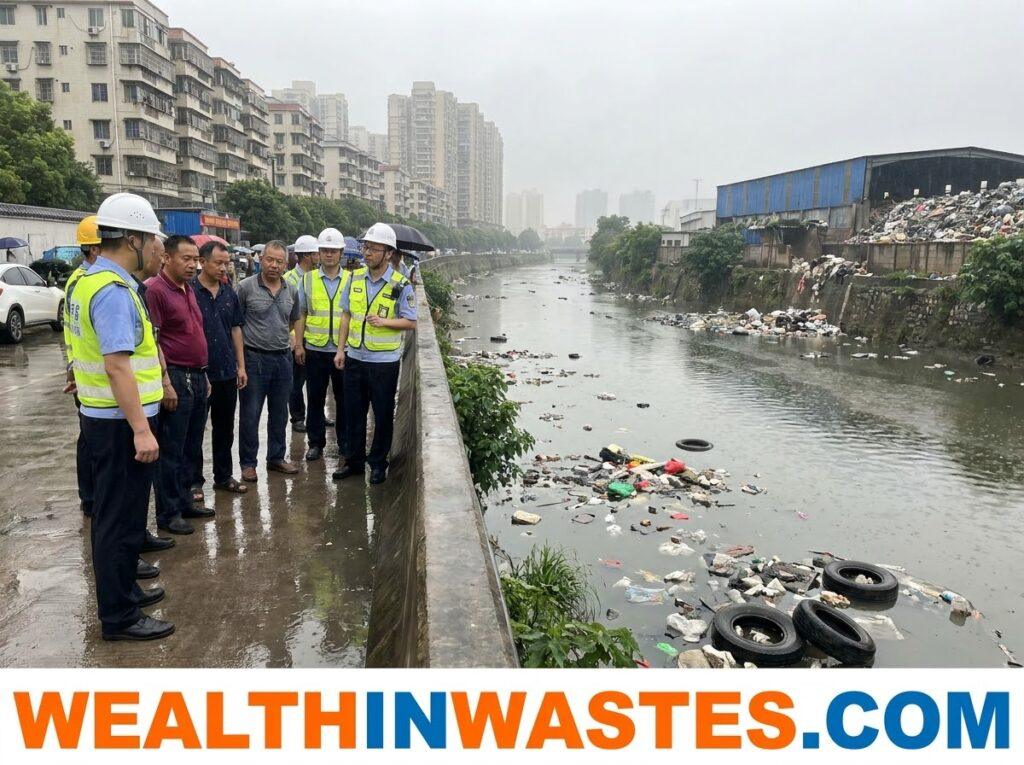
Urban environmental degradation begins with changes that exceed the carrying capacity of city systems. Population growth, construction, traffic, industry, and poor sanitation can gradually weaken environmental quality across residential, commercial, and industrial districts.
Cities experience degradation through several connected forms, including polluted air, contaminated water, damaged land, excessive noise, flooding, heat accumulation, vegetation loss, and poorly managed waste. Understanding these connected urban degradation types helps authorities select suitable responses.
Urban planners should first identify local environmental pressures and their causes. A useful overview of urban environmental pressures can help decision makers connect population growth, land conversion, infrastructure expansion, and pollution sources.
Authorities also need to examine how different problems interact. For example, blocked drains can worsen flooding, unmanaged waste can pollute waterways, and vegetation removal can intensify erosion, heat, runoff, and habitat loss.
Assessing urban environmental effects and their likely consequences provides a stronger foundation for action. Cities can then prioritize threats according to public health effects, ecological damage, economic losses, affected populations, and urgency.
Urban Environmental Degradation and Land Use
1. Land-use zoning: Cities should separate incompatible activities through clear zoning, keeping heavy industries, waste facilities, floodplains, wetlands, and hazardous operations away from sensitive residential areas, schools, and ecological zones.
2. Environmental screening: Planners should evaluate proposed developments before construction begins, considering drainage, traffic, vegetation, waste, emissions, water demand, and likely impacts before approval on surrounding communities and ecosystems alike.
3. Site assessment: Reliable information from environmental analysis tools can reveal soil contamination, water-quality problems, air pollution, erosion risks, and other conditions across selected sites that should influence urban development decisions.
4. Hazard mapping: Authorities should map flood-prone zones, unstable slopes, polluted areas, industrial risks, and drainage channels, then use those maps to guide building permits, infrastructure investment, and emergency planning.
5. Green space protection: Urban plans should preserve parks, wetlands, river corridors, tree cover, and drainage buffers because these areas absorb rainfall, moderate temperatures, support biodiversity, and provide recreational benefits for residents.
6. Planning coordination: Effective institutional coordination for pollution control requires clear responsibilities among planning departments, environmental agencies, utility providers, communities, and emergency services, with shared standards and dependable communication during emergencies.
Urban Environmental Degradation: Air And Climate

1. Emission control: Cities should reduce smoke, dust, nitrogen oxides, sulfur compounds, and other harmful emissions by enforcing vehicle standards, cleaner industrial processes, efficient fuels, and regular pollution inspections consistently.
2. Cleaner transport: Better public transport, walking routes, cycling infrastructure, traffic management, and cleaner vehicles can reduce congestion, fuel consumption, roadside pollution, and the environmental burden associated with unnecessary private journeys.
3. Industrial safeguards: Industries should install suitable emission controls, maintain equipment, monitor releases, and respond quickly to leaks. Strong compliance programs also discourage facilities from transferring pollution from one environmental medium into another.
4. Safe chemical handling: Understanding the nature and behavior of hazardous substances helps urban facilities prevent accidental releases, choose appropriate storage systems, prepare emergency responses, and protect workers, residents, and nearby ecosystems.
5. Energy efficiency: Buildings and public services can lower emissions through efficient lighting, cooling, insulation, appliances, and renewable energy systems, while urban authorities should support low-carbon technologies wherever practical and affordable.
6. Exposure prevention: Proper sanitation practices and safe pesticide handling principles can reduce unnecessary exposure to hazardous chemicals, especially around homes, markets, gardens, drainage channels, storage areas, and public facilities.
Urban Environmental Degradation: Water Protection
1. Source protection: Cities should protect rivers, streams, wells, reservoirs, wetlands, and groundwater recharge areas by controlling dumping, maintaining sanitation, and limiting risky activities near important water sources near vulnerable communities whenever possible.
2. Wastewater treatment: Domestic and industrial wastewater should receive suitable treatment before discharge or reuse. Physical, chemical, and biological processes can reduce solids, nutrients, toxic substances, pathogens, and other contaminants.
3. Pollution planning: A practical water pollution control framework helps authorities identify contamination sources, establish objectives, prioritize affected locations, assign responsibilities, and monitor whether selected interventions actually improve water quality.
4. Runoff management: Drainage systems should combine gutters, channels, retention areas, permeable surfaces, and maintained waterways. These measures reduce polluted runoff, standing water, flooding, erosion, and pressure on downstream ecosystems.
5. Community prevention: Households, businesses, and industries should follow effective water pollution prevention practices by controlling waste, reducing harmful discharges, protecting drains, conserving water, and reporting contamination promptly to authorities.
6. Water quality monitoring: Applying water pollution reduction strategies alongside broader water-quality management guidance allows cities to detect contamination trends, protect drinking-water sources, strengthen enforcement, and guide timely corrective action.
Urban Environmental Degradation: Waste Management
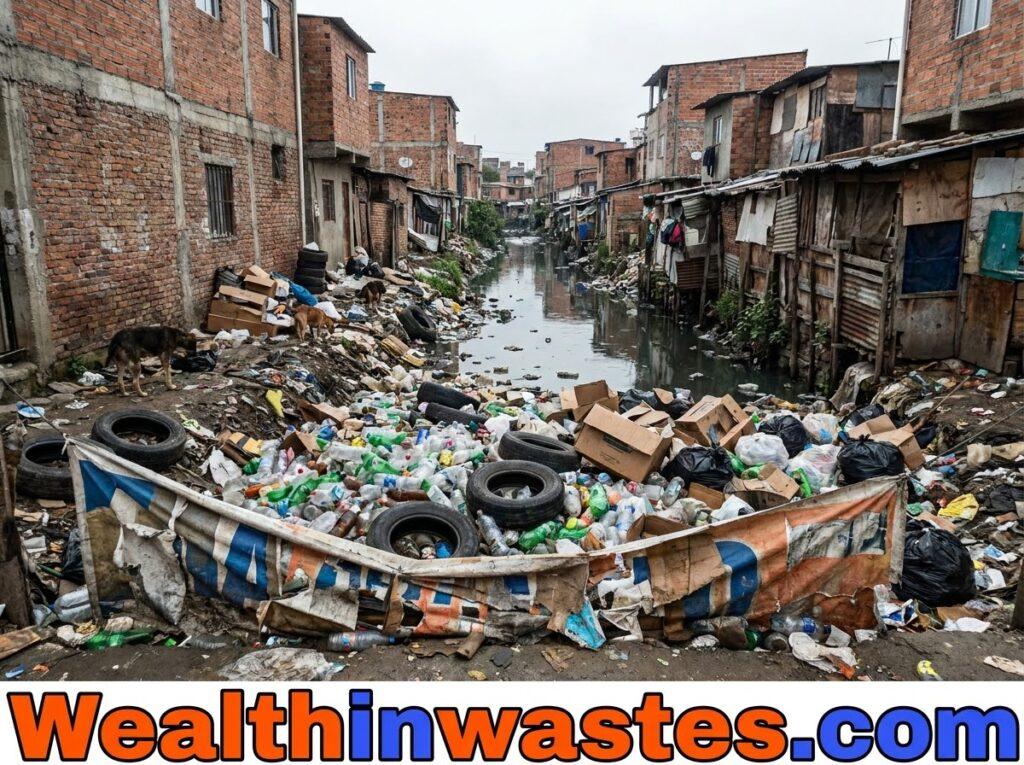
1. Reliable collection: City sanitation authorities should establish dependable collection routes, transfer points, transport schedules, and disposal arrangements. Reliable services prevent illegal dumping, blocked drains, odors, pests, and unsightly streets.
2. Waste reduction: Municipal programs should follow urban solid waste management objectives by reducing waste generation, improving collection, increasing recovery, protecting workers, and ensuring safe final disposal of unavoidable residues.
3. Integrated systems: The integrated waste management approach encourages cities to combine prevention, reuse, recycling, composting, treatment, energy recovery, and controlled disposal according to local waste characteristics and available infrastructure.
4. Source separation: Households, markets, offices, and businesses should separate organic materials, recyclables, hazardous items, and residual waste where systems exist. Separation improves recovery, protects workers, and supports efficient processing.
5. Circular value: Cities can create jobs and reduce resource pressure by supporting reuse, recycling, composting, repair enterprises, and markets that convert discarded materials into useful products instead of immediate disposal.
6. Safe disposal: Residual waste should reach properly designed disposal facilities rather than waterways, roadsides, vacant land, or open drains. Facilities should control leachate, gases, fires, odors, pests, and unauthorized access.
Urban Land, Green Space, And Biodiversity
Urban land degradation often increases when vegetation disappears, construction strips soil, waste accumulates, and drainage concentrates runoff. Protecting soil and vegetation therefore forms an essential part of urban environmental management.
Authorities should prevent unnecessary clearing during construction and require erosion controls such as mulching, drainage diversion, sediment barriers, stabilized surfaces, and prompt revegetation of disturbed sites after major earthworks are completed properly.
Tree planting, urban forests, community gardens, parks, and vegetated corridors can improve shade, reduce heat, stabilize soil, absorb rainfall, and create habitats. These measures also make densely populated districts more pleasant.
Land restoration should prioritize native or well-adapted plants, especially around waterways and degraded public spaces. Healthy vegetation can support ecological functions while reducing maintenance costs and improving the appearance of neighborhoods.
Resource recovery also protects land because the benefits of integrated waste management include keeping useful materials away from disposal sites, conserving resources, creating economic opportunities, and reducing the pressure associated with uncontrolled dumping.
Likewise, proper waste recycling processes can divert paper, plastics, metals, glass, and suitable organic materials from disposal. Effective recovery reduces litter, conserves raw materials, and supports cleaner urban surroundings across residential and commercial areas.
Governance For Urban Environmental Degradation
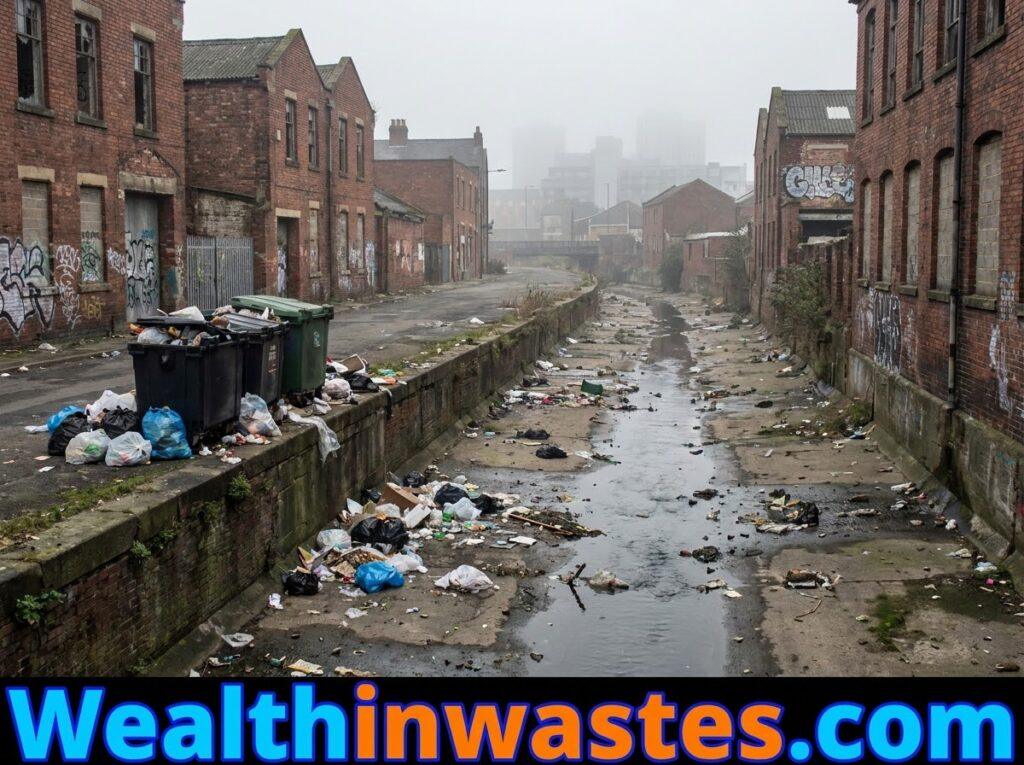
1. Strong regulation: Environmental authorities need clear standards, realistic permits, inspection powers, transparent penalties, and adequate funding so that urban environmental rules move beyond written policies into consistent daily enforcement.
2. Environmental impact assessment: Major projects should undergo credible impact assessment before approval. EIA findings should examine pollution, biodiversity, traffic, drainage, waste, resource use, community health, and feasible mitigation measures.
3. Hazardous materials control: Facilities should identify dangerous waste streams and follow hazardous waste management principles covering segregation, labeling, secure storage, transportation, treatment, emergency response, and environmentally sound final disposal.
4. Waste classification: Proper hazardous waste classification helps facilities distinguish ordinary waste from materials requiring special controls. Accurate identification reduces unsafe mixing, accidental exposure, inappropriate disposal, and contamination during handling.
5. Community participation: Residents should receive environmental information, reporting channels, sanitation education, and opportunities to participate in neighborhood planning. Local knowledge can reveal recurring drainage, waste, pollution, and nuisance problems.
6. Polluter responsibility: The polluter pays principle can encourage prevention when responsible parties bear appropriate costs for cleanup, remediation, monitoring, and compliance. Enforcement should remain fair, transparent, and supported by reliable evidence.
Monitoring Urban Environmental Degradation
Urban environmental management needs continuous monitoring because conditions change with population growth, new industries, construction, climate pressures, and shifting consumption patterns. Authorities should track environmental indicators regularly rather than rely on occasional observations.
Monitoring programs should measure relevant air, water, soil, waste, vegetation, noise, drainage, and public-health indicators. Data should remain accessible to planners, regulators, researchers, community organizations, and other legitimate users consistently.
Environmental records should support practical decisions. For example, waste determination methods can improve identification of hazardous materials, while monitoring results can reveal whether pollution controls, sanitation programs, and restoration projects deliver measurable improvements.
Health protection should remain central because environmental degradation can create exposure pathways through air, water, food, soil, chemicals, and contaminated surroundings. Risk assessment helps authorities identify vulnerable groups and prioritize preventive action.
Chemical exposures require particular care because human health risk assessment for pesticide exposure illustrates how toxicity, dose, exposure pathways, duration, and uncertainty should inform decisions about environmental protection and public health.
Finally, cities should review plans periodically, finance maintenance, strengthen emergency preparedness, and update regulations as evidence changes. Long-term success depends on sustained leadership, reliable institutions, public participation, and consistent investment.
Read Also: Guiding Principles of Integrated Waste Management
Summary on Management of Urban Environmental Degradation Strategies
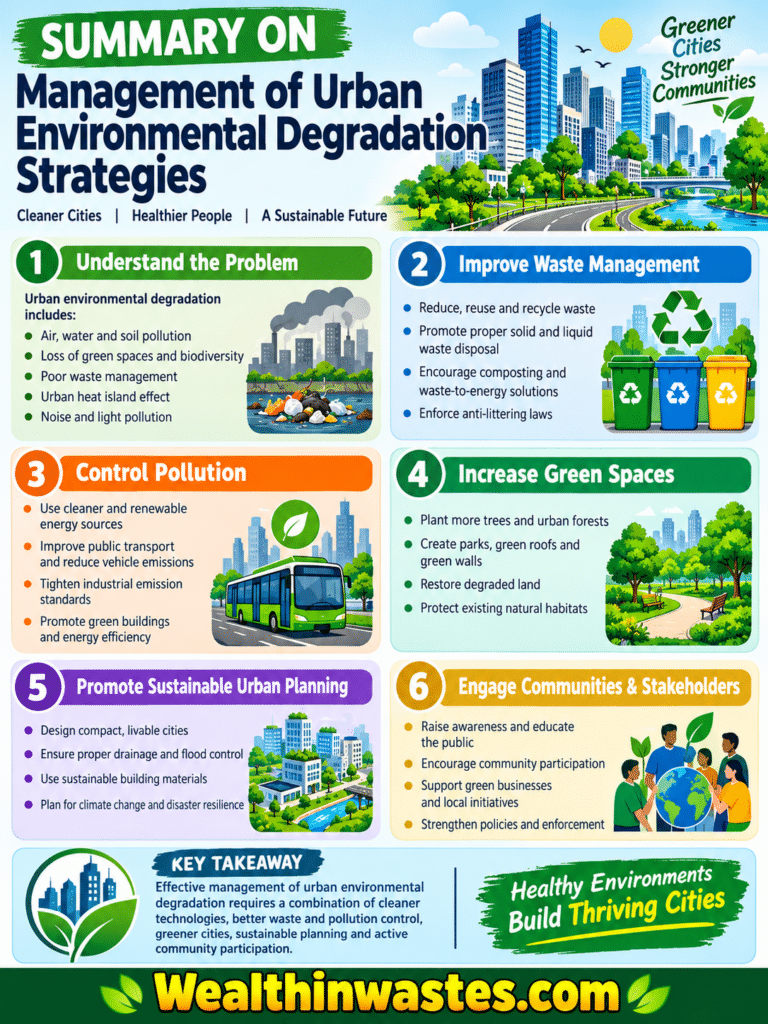
| Management Area | Key Action | Main Benefit |
|---|---|---|
| Land Use | Apply zoning, screening, hazard mapping, and coordinated planning. | Reduces exposure and prevents unsuitable development. |
| Air And Climate | Control emissions, improve transport, increase energy efficiency. | Improves air quality and lowers environmental pressure. |
| Water Protection | Protect sources, treat wastewater, control runoff, monitor quality. | Safeguards water resources and public health. |
| Waste Management | Reduce, separate, recycle, recover, treat, and safely dispose. | Limits pollution while conserving resources. |
| Land And Biodiversity | Protect vegetation, restore degraded land, and expand green spaces. | Reduces heat, erosion, runoff, and habitat loss. |
| Governance | Strengthen regulation, EIA, hazardous waste control, and participation. | Improves compliance and environmental accountability. |
| Monitoring | Collect data, assess risks, review plans, and maintain infrastructure. | Supports timely decisions and long-term urban resilience. |
Frequently Asked Questions About Management of Urban Environmental Degradation Strategies
1. What is urban environmental degradation?
It is the deterioration of urban air, water, soil, vegetation, ecosystems, and living conditions caused by natural pressures and human activities.
2. What is the main goal of managing urban environmental degradation?
The main goal is to prevent environmental damage, reduce pollution, protect resources, restore degraded areas, and create healthy, resilient cities.
3. How does urban planning help control environmental degradation?
Urban planning guides land uses, protects sensitive areas, controls risky development, preserves green spaces, improves drainage, and reduces exposure to environmental hazards.
4. How can cities reduce air pollution?
Cities can reduce emissions through cleaner transport, industrial controls, energy efficiency, fuel improvements, regular inspections, and stronger enforcement of environmental standards.
5. How can urban water pollution be controlled?
Water pollution control requires source protection, wastewater treatment, runoff management, proper waste disposal, pollution monitoring, and enforcement against harmful discharges.
6. Why is waste management important in urban areas?
Effective waste management prevents illegal dumping, blocked drains, pollution, disease risks, unpleasant surroundings, and unnecessary loss of valuable recyclable and organic materials.
7. What role does environmental impact assessment play?
EIA helps identify likely environmental impacts before major projects begin and provides opportunities to avoid, reduce, control, or compensate for those impacts.
8. How can communities help manage urban environmental degradation?
Communities can reduce littering, separate waste, protect drainage channels, conserve water, maintain green spaces, report pollution, and participate in environmental planning.
9. Why is environmental monitoring necessary?
Monitoring provides evidence about changing environmental conditions and helps authorities identify problems early, evaluate interventions, enforce standards, and improve future decisions.
10. Can urban environmental degradation be completely eliminated?
Complete elimination is unlikely, but strong planning, prevention, enforcement, restoration, monitoring, and public participation can substantially reduce environmental degradation and its consequences.
Do you have any questions, suggestions, or contributions? If so, please feel free to use the comment box below to share your thoughts. We also encourage you to kindly share this information with others who might benefit from it. Since we can’t reach everyone at once, we truly appreciate your help in spreading the word. Thank you very much for your support and for sharing!
Read Also: Proper Farm Waste Management Guide