


The Earth’s water is never truly static. It continually shifts among the atmosphere, land, oceans, soils, rocks, plants, animals, and underground reservoirs through interconnected movements called hydrologic processes operating continuously.
These processes form the physical foundation of the hydrologic cycle, moving water between different parts of Earth while changing its location, storage condition, temperature, and sometimes physical state across environmental systems.
Water reaches the atmosphere through evaporation and transpiration, returns through precipitation, enters soils through infiltration, moves underground through percolation, and travels across landscapes as runoff toward rivers, lakes, wetlands, and oceans.
The biosphere depends on these movements because organisms require water for metabolism, growth, reproduction, nutrient transport, temperature regulation, and habitat maintenance. Healthy water movement therefore supports ecological stability throughout terrestrial and aquatic environments.
Understanding hydrologic processes helps explain floods, droughts, groundwater recharge, soil moisture, streamflow, ecosystem productivity, and water availability. It also supports responsible planning for agriculture, settlements, industry, and environmental conservation for human communities.
Meaning and Scope of Hydrologic Processes
The scientific study of water is represented by hydrologic science and its scope, which examines where water occurs, how it moves, and how it interacts with Earth materials and living organisms.
Water can exist as liquid, solid ice, or atmospheric vapor, allowing it to move through different environmental compartments. The same water may pass through several stages before returning to another reservoir.
Students and environmental managers can understand groundwater resources and their formation by connecting rainfall, infiltration, storage, recharge, and discharge across catchments and larger drainage systems within local aquifers for local planning.
Hydrologic processes also explain why some locations experience persistent flooding while others suffer water shortages. Differences in vegetation, soil, slope, geology, climate, and land use strongly influence water movement under different environmental conditions.
Water quality remains important because contaminants can travel through connected pathways. Learning about major water pollutants and their pathways therefore strengthens understanding of hydrologic systems and better pollution prevention decisions.
Read Also: Casella Waste Services Complete Guide
Evaporation And Transpiration In The Water Cycle
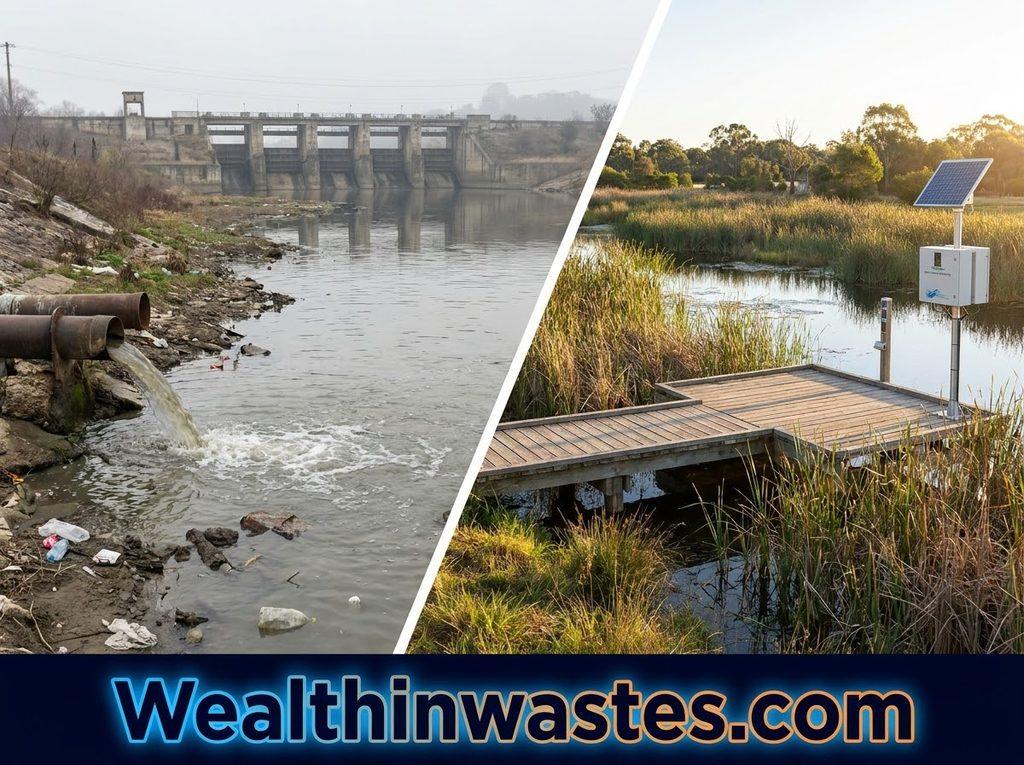
1. Evaporation: Evaporation changes liquid water into vapor when surfaces receive energy. Oceans supply most atmospheric moisture, while lakes, rivers, wet soils, reservoirs, and other exposed surfaces contribute additional water. Water conservation limits avoidable losses.
2. Transpiration: Transpiration occurs when plants release water vapor through microscopic leaf openings. Roots absorb soil moisture, transport it through plant tissues, and return water to the atmosphere. Pollution reduction protects water pathways.
3. Evapotranspiration: Evaporation and transpiration combine as evapotranspiration, linking the water cycle and vegetation. Its rate varies with temperature, sunlight, humidity, wind, soil moisture, plant type, and available surface water.
Condensation And Precipitation Return Water
1. Condensation: Condensation begins when rising water vapor cools and changes into droplets or ice particles. These particles gather around atmospheric nuclei and eventually form clouds that can produce precipitation. Water treatment processes protect supplies.
2. Precipitation: Precipitation returns atmospheric moisture to Earth as rain, snow, sleet, or hail. In tropical regions, rainfall usually provides the dominant freshwater input supporting terrestrial ecosystems, rivers, wetlands, crops, and forests.
3. Rainfall Distribution: The amount and timing of precipitation influence rainfall patterns and water availability. Heavy storms can overwhelm infiltration, whereas prolonged dry periods reduce soil moisture, recharge, streamflow, and productivity. Pollution monitoring supports protection.
Infiltration Percolation And Groundwater Movement

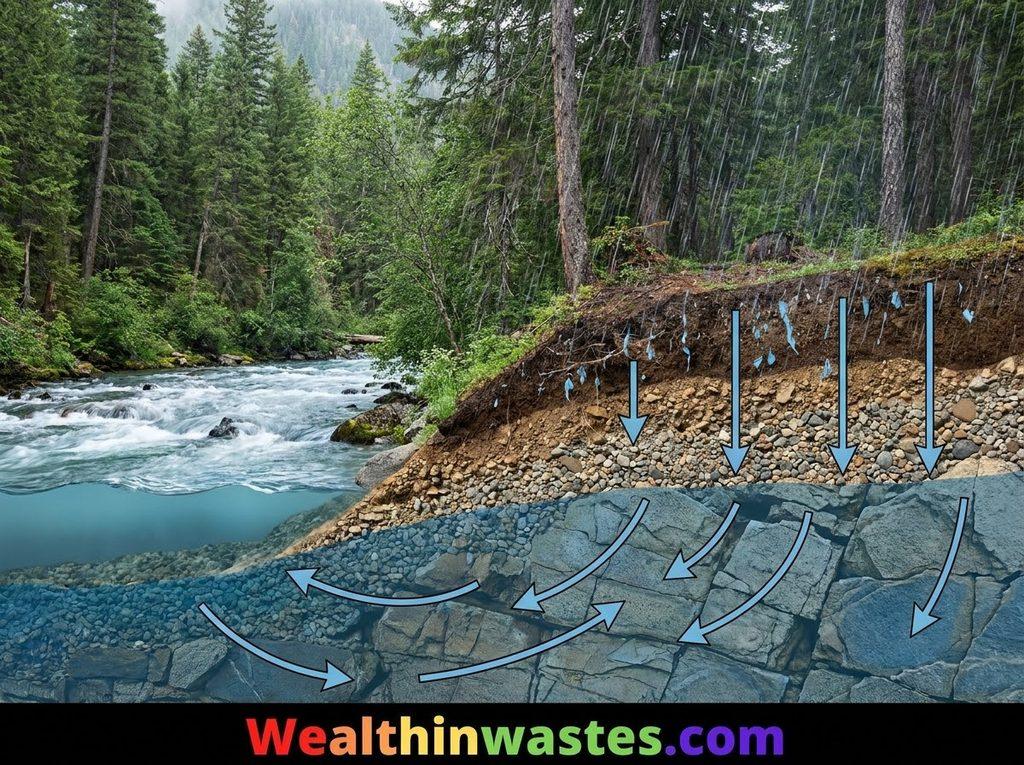
Infiltration occurs when water at the land surface enters the soil. The infiltration rate depends on soil texture, structure, vegetation cover, antecedent moisture, surface condition, rainfall intensity, and land management.
After entering the soil, some water remains within pores as soil moisture, while some moves downward through percolation. Deeper percolation can replenish groundwater and maintain subsurface stores beneath landscapes for use by ecosystems and communities.
The movement of water through waste materials can also create leachate, making hydrology at disposal sites important for protecting groundwater and nearby surface waters and downstream aquatic ecosystems and healthy wetlands.
Leachate from poorly managed solid waste can carry dissolved substances into soils and underground water. Proper controls therefore help reduce contamination risks within connected hydrologic pathways and nearby aquatic habitats.
Groundwater movement also depends on geology, hydraulic gradients, pore spaces, fractures, and permeability. Good soil and mineral resource management can support infiltration and reduce harmful land degradation and protect groundwater quality.
Runoff And Streamflow Across Landscapes
1. Surface Runoff: Surface runoff develops when rainfall reaches the ground faster than the surface can absorb it, or when soils become saturated. Runoff then moves downslope under gravity toward channels and water bodies.
2. Runoff Generation: Runoff depends on rainfall intensity, soil permeability, slope, vegetation, land cover, surface storage, and soil moisture. Urban surfaces such as roads and roofs often increase rapid runoff and flood peaks.
3. Streamflow Response: Streamflow combines water entering channels from direct runoff, shallow subsurface movement, and groundwater contributions. Measuring these components helps scientists interpret drainage and stream responses after rainfall events and storms.
Water Storage Across Earth Systems
Water remains temporarily stored in oceans, glaciers, groundwater, lakes, rivers, wetlands, soils, the atmosphere, and living organisms. Each reservoir has different storage capacity and residence times within the hydrologic system.
Oceans contain the largest share of Earth’s water, while much freshwater remains locked in ice or stored underground. Surface water represents only a small portion of the planet’s total supply.
Soil moisture provides water directly to plants, while groundwater can remain underground for years, centuries, or longer depending on recharge conditions and geological settings. These stores buffer changes in water availability.
Natural resource planning benefits from conservation of renewable and non-renewable resources, because protecting soils, water stores, and vegetation further strengthens long-term environmental resilience for communities and ecosystems.
Hydrologic Processes And The Biosphere
The biosphere includes living organisms and the environments that support them. Water connects plants, animals, microorganisms, and habitats by supplying a resource required for cellular functions and ecological interactions in every region.
Plants absorb water through roots and use it in photosynthesis, nutrient transport, cooling, and growth. Vegetation also alters hydrologic processes by intercepting rainfall, improving infiltration, reducing runoff, and strengthening soil structure.
Healthy ecosystems benefit from compost that improves soil water retention, because better soil structure can support moisture storage, infiltration, plant growth, and microbial activity within terrestrial habitats and farming systems.
Animals depend on surface and groundwater for drinking, feeding habitats, reproduction, and temperature regulation. Aquatic ecosystems rely especially on suitable flow, depth, temperature, oxygen, and water quality conditions for survival.
Good environmental management practices help protect water-dependent habitats while reducing pressures that could disrupt ecological relationships between land, water, and living organisms across connected ecosystems over time and across landscapes.
Read Also: Proper Waste Control Complete Guide
Human Impacts and Sustainable Hydrologic Management

1. Land-Use Change: Deforestation, urban expansion, mining, drainage, intensive farming, waste disposal, and excessive groundwater abstraction can change infiltration, runoff, recharge, storage, and water quality across catchments and surrounding ecosystems.
2. Pollution Control: Pollutants can move with runoff, infiltrating water, groundwater, and streamflow. Preventing contaminants from entering drainage pathways protects people and downstream ecosystems, while wastewater source control limits pollution. Understanding flow characteristics supports pollution control.
3. Sustainable Management: Sustainable management should protect catchments, maintain vegetation, reduce unnecessary losses, and prevent contamination. Industrial waste impacts show why responsible discharge controls matter, while safe wastewater reuse can conserve freshwater.
4. Farm Water Efficiency: Farmers can improve water efficiency through soil conservation, irrigation, mulching, rainwater harvesting, and practices that increase organic matter, retain moisture, and reduce erosive runoff. Effective water waste management supports water efficiency.
5. Ecosystem Protection: Communities should protect wetlands, recharge areas, streams, and floodplains because these environments store, filter, convey, and release water. Water quality standards also help safeguard connected ecosystems and downstream users.
Summary on Hydrologic Processes and the Biosphere
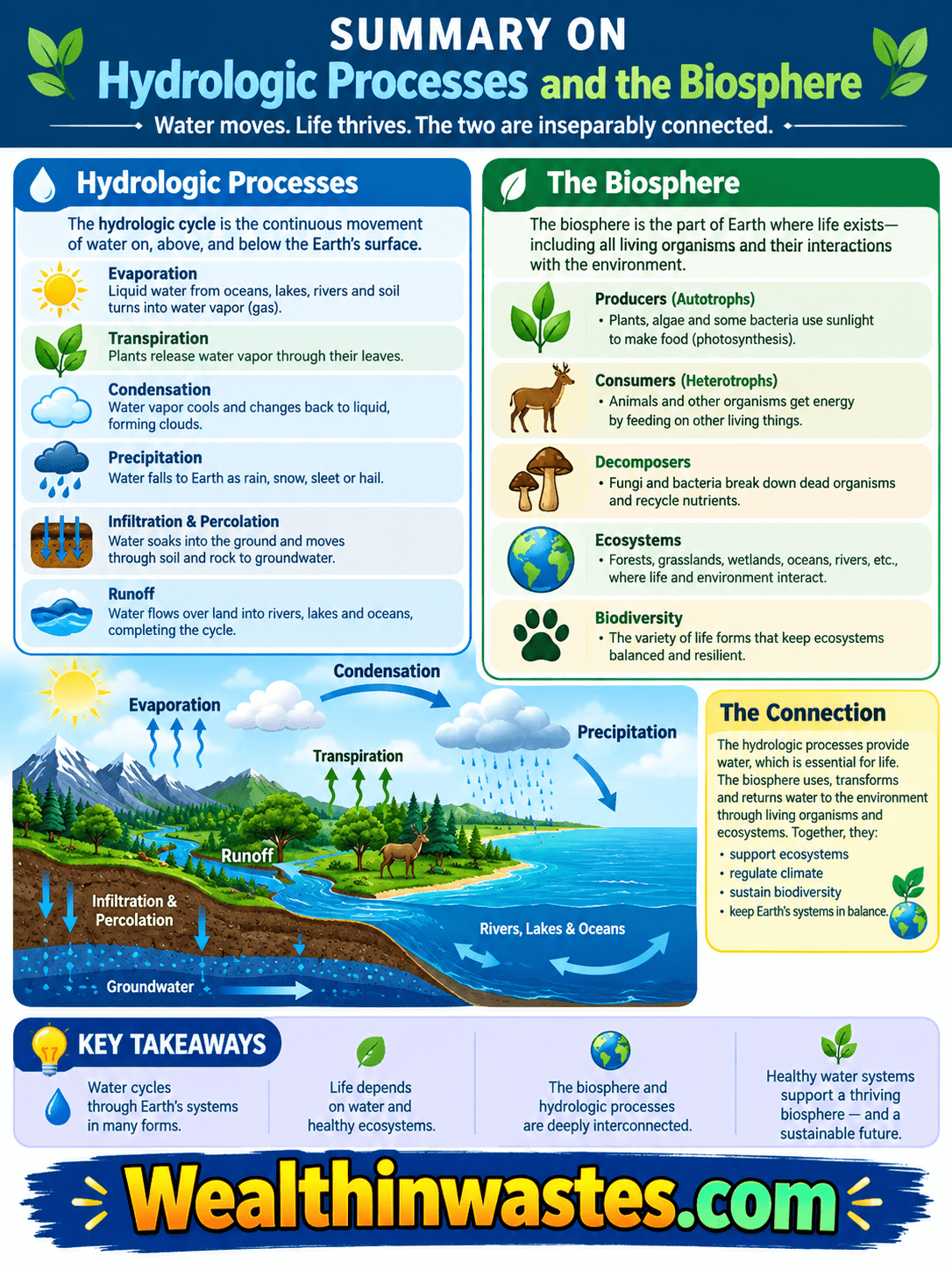
| Topic | Summary |
|---|---|
| Hydrologic Processes | Natural movements and transformations that circulate water through Earth’s atmosphere, land, oceans, soils, rocks, and living organisms. |
| Evaporation | Changes liquid water into atmospheric vapor using energy supplied mainly by the Sun. |
| Transpiration | Plants release absorbed soil water into the atmosphere through leaf openings. |
| Condensation | Cooling water vapor forms droplets or ice particles that contribute to cloud formation. |
| Precipitation | Returns atmospheric moisture to Earth as rain, snow, sleet, or hail. |
| Infiltration | Allows surface water to enter soil and support soil moisture and groundwater recharge. |
| Groundwater | Stores water below the surface and can sustain wells, springs, wetlands, rivers, and vegetation. |
| Runoff | Moves excess surface water downslope toward streams, rivers, lakes, wetlands, and oceans. |
| Biosphere | Depends on water for metabolism, growth, reproduction, habitat maintenance, and ecological stability. |
| Sustainable Management | Protects water quality, recharge areas, wetlands, soils, streams, and other components of connected hydrologic systems. |
Frequently Asked Questions About Hydrologic Processes: How Water Sustains the Biosphere
1. What are hydrologic processes?
Hydrologic processes are natural movements and transformations that circulate water between the atmosphere, land, oceans, underground reservoirs, soils, and living organisms.
2. Why are hydrologic processes important?
They regulate water availability, soil moisture, groundwater recharge, streamflow, ecosystem productivity, flood formation, drought conditions, and the continued functioning of life-supporting environments.
3. What is the role of evaporation?
Evaporation transfers liquid water from oceans, rivers, lakes, soils, and other surfaces into the atmosphere, where the vapor can later condense and return through precipitation.
4. How does groundwater form?
Groundwater develops when infiltrated water moves downward through soil and permeable geological materials, eventually reaching saturated zones where underground water accumulates and moves through aquifers.
5. How does runoff affect the environment?
Runoff transports water, sediments, nutrients, and pollutants across landscapes. Excessive runoff can increase flooding, erosion, water pollution, and habitat disturbance when natural drainage capacity becomes overwhelmed.
6. How do hydrologic processes support the biosphere?
They provide plants and animals with water for growth, metabolism, reproduction, cooling, nutrient movement, habitat maintenance, and ecological interactions across terrestrial and aquatic environments.
Do you have any questions, suggestions, or contributions? If so, please feel free to use the comment box below to share your thoughts. We also encourage you to kindly share this information with others who might benefit from it. Since we can’t reach everyone at once, we truly appreciate your help in spreading the word. Thank you very much for your support and for sharing!
Read Also: Hydrologic Cycle and Its Importance in Agricultural Water Management