


The relationship between people and the environment reaches into every aspect of human existence. Humans depend on land, water, air, forests, minerals, plants, animals, and ecological processes for survival and development.
From early settlements to modern cities, people have modified natural surroundings to obtain food, shelter, security, transport, energy, and economic opportunities. This long interaction explains why environmental resources remain central to human progress.
Some natural conditions support easy settlement, while others create serious challenges. Wetlands, steep mountains, dense forests, arid zones, and flood-prone areas can restrict development, yet people repeatedly find ways to adapt or transform them.
Human adaptation can produce useful changes, but excessive transformation can weaken the systems that support society. Draining wetlands, clearing forests, extracting minerals, and consuming water beyond renewal can gradually reduce environmental resilience.
Each person requires food, water, shelter, clothing, energy, healthcare, and other materials. These needs connect humans to the lithosphere and biosphere, while used materials eventually return to environmental systems as wastes.
Human linkage to environmental resource describes more than simple consumption. It explains the relationship between human needs, natural resource use, environmental impacts, technological responses, and responsibility for protecting ecological systems.

Human Dependence on Environmental Resources
Human societies draw essential materials and services from nature every day. Food comes from biological resources, water supports life, land supports settlement and farming, while energy and minerals support transportation, industry, communication, and construction.
Air also functions as a fundamental environmental resource because humans require breathable atmospheric conditions. Forests, wetlands, rivers, soils, and oceans provide ecological services that support climate regulation, water movement, nutrient cycling, habitat, and livelihoods.
Modern development often hides these connections because people obtain resources through markets, infrastructure, and technology. Nevertheless, every product ultimately depends on materials, energy, land, water, or ecological processes originating within environmental systems.
This dependence becomes clearer through forest resources and their ecological importance, which extend beyond timber. Forests support biodiversity, carbon storage, water regulation, soil protection, recreation, and many rural livelihoods locally.
Water illustrates the same linkage especially clearly. Water pollution pathways can connect household, industrial, agricultural, and urban activities with rivers, lakes, groundwater, fisheries, and communities that depend on clean supplies.
The relationship also includes limits. People cannot continually extract resources, occupy sensitive land, or release wastes without affecting ecological processes. Environmental sustainability therefore encourages choices that satisfy needs without destroying future resource capacity.
Read Also: Methods of Disposal of Waste Pesticide Containers
Human Actions That Shape Environmental Resources

1. Agriculture: Farming converts land, uses water, modifies soils, and depends on biodiversity. When cultivation expands without conservation, erosion, nutrient depletion, pesticide movement, and habitat loss can weaken resources that agriculture itself requires for productivity.
2. Urban Development: Roads, housing, industries, and public facilities transform land surfaces and drainage patterns. Poor planning can destroy wetlands, increase runoff, reduce vegetation, and intensify waste generation, while thoughtful planning can conserve open spaces.
3. Resource Extraction: Mining, logging, quarrying, fishing, and fossil-fuel production provide materials and energy for society. However, excessive extraction can degrade landscapes, reduce biodiversity, pollute water, and diminish the natural capital available to future communities.
4. Industrial Production: Factories convert raw materials into useful products but also consume water and energy while generating emissions and waste. Clean technology approaches can reduce resource losses and pollution by improving production efficiency.
5. Household Consumption: Daily purchases influence resource demand through food, clothing, transport, electricity, packaging, and household products. Waste classification helps identify suitable handling, while prevention, reuse, recovery, recycling, and responsible disposal limit environmental pressure.
Environmental Resource Use and Waste
Resource use creates an unavoidable material flow. People take water, biomass, minerals, fuels, and other materials from environmental systems, transform them into useful goods, consume them, and eventually return residues to land, water, or air.
This connection means waste cannot remain separate from resource management. The concept of solid waste shows how discarded materials arise from ordinary human activities, including household consumption, agriculture, commerce, and industry.
Some wastes retain value when societies recover useful materials. Waste minimization reduces unnecessary material losses before disposal becomes necessary, while reuse and recycling keep valuable resources within productive cycles for longer periods.
Pollution appears when discharged substances exceed the capacity of environmental systems to dilute, transform, retain, or safely absorb them. Environmental pollution can affect air, water, soil, organisms, and human settlements.
Water provides an example because pollutants can move between land and aquatic systems. Agricultural runoff, sewage, industrial discharge, and urban drainage may transport contaminants into waterways, reducing their value for drinking, farming, fisheries, and ecosystems.
Effective management therefore requires people to consider the complete pathway of materials. Preventing unnecessary consumption, reducing waste generation, protecting sinks, and recovering useful materials can weaken the harmful connection between human demand and environmental degradation.
Population Growth and Environmental Resource Pressure

1. Rising Resource Demand: Population growth increases demand for food, housing, water, energy, transport, and materials. Without efficient planning, growing consumption can place heavier pressure on land, forests, freshwater supplies, minerals, and biological resources.
2. Expanding Settlements: More people require additional homes, roads, schools, markets, industries, and services. Expansion may replace vegetation and productive land, especially when settlements spread into wetlands, floodplains, forest margins, or other environmentally sensitive areas.
3. Greater Waste Generation: Larger populations generally create more household, commercial, agricultural, and industrial waste. Effective waste management becomes necessary to protect public health, recover resources, and reduce pollution as communities grow.
4. Pressure on Water Resources: Population growth can increase domestic, agricultural, and industrial water demand. Where supplies remain limited, overuse may lower groundwater levels, reduce flows, and intensify competition among households, farmers, industries, and systems.
5. Demand for Land Resources: A growing population can encourage cultivation, construction, mining, roads, and other land uses. Reducing environmental impact becomes important because careful land use can conserve habitat and productive soils.
Poverty, Policy, and Resource Degradation
1. Poverty and Resource Dependence: Poor households may depend directly on nearby forests, soils, water, and wildlife for fuel, food, income, and shelter. Limited alternatives can encourage rapid resource use where environmental regulation remains weak.
2. Weak Environmental Policies: Governments need policies that balance development with conservation. Pollution control legislation can establish standards, responsibilities, monitoring systems, and enforcement mechanisms that discourage damaging activities and protect shared environmental resources.
3. Institutional Capacity: Environmental rules produce better results when responsible agencies possess reliable data, trained personnel, equipment, funding, and clear mandates. Strong pollution-control institutions can coordinate monitoring, regulation, sanitation, and public environmental programmes.
4. Economic Priorities: Short-term economic gains may encourage intensive extraction, pollution, and land conversion when environmental costs remain outside business decisions. Effective waste policies can align economic activity with cleaner production and responsible resource use.
5. Unequal Environmental Burdens: Environmental damage can affect communities differently because income, location, services, and political influence vary. Fair resource management should protect vulnerable groups while ensuring development decisions account for health and social costs.
Technology and Human Environmental Control
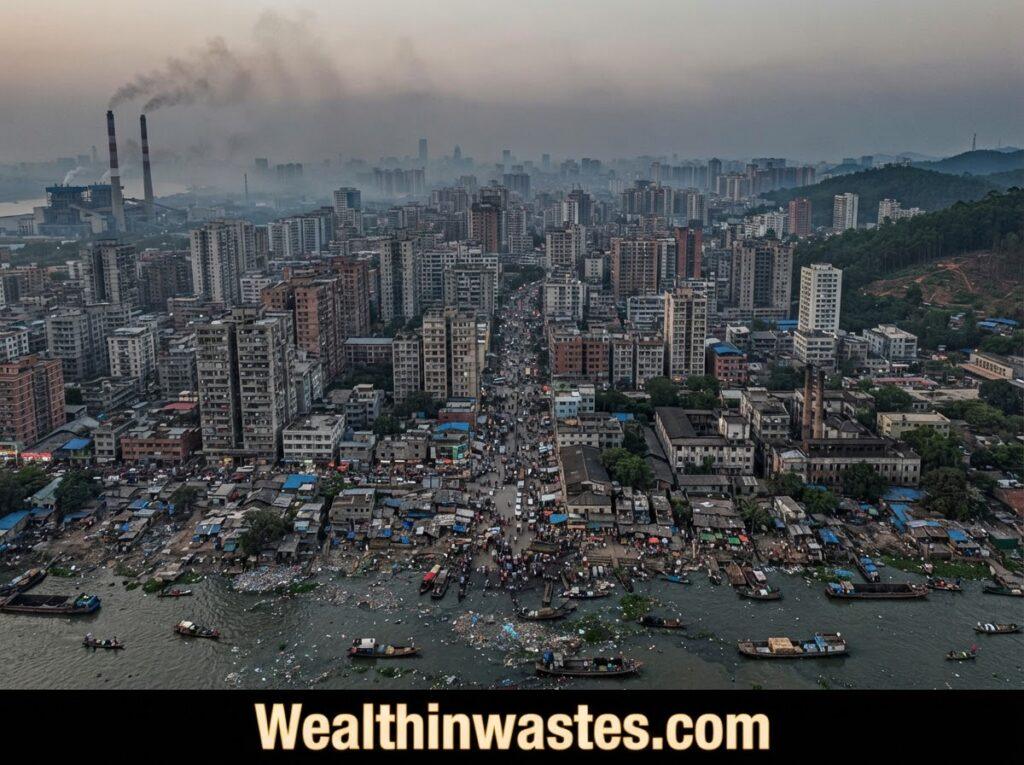
Science and technology give humans powerful tools for changing environmental conditions. Irrigation, drainage, machinery, chemicals, construction methods, transport, energy systems, and digital monitoring can improve livelihoods while also increasing the scale of resource extraction.
Technology itself does not determine environmental outcomes. The result depends on how people design, deploy, regulate, and evaluate technologies. A useful innovation can reduce pressure when it improves efficiency, prevents waste, or protects ecosystems.
Chemical technologies illustrate this complexity. Responsible pesticide application can protect crops, but careless handling can create exposure, residues, runoff, drift, and waste beyond intended treatment areas on surrounding land and water.
Human health also shows why technological decisions require caution. Environmental health risk assessment connects chemical toxicity with realistic exposure pathways, helping decision-makers understand whether particular human activities may create unacceptable risks.
Chlorofluorocarbons illustrate how technological choices can create distant environmental consequences. Their use in earlier industrial systems contributed to stratospheric ozone depletion, showing that apparently useful innovations can disturb protective planetary systems when risks go unrecognized.
However, technological solutions should not become excuses for unlimited exploitation. Prevention often works better than endless correction because ecosystems have thresholds, recovery periods, and complex relationships that machines cannot always reproduce or control.
Environmental Limits and Sustainable Resource Use
Environmental resources have limits, even when technology temporarily expands access. Renewable resources can decline when extraction exceeds regeneration, while non-renewable resources exist in finite quantities and require careful allocation, substitution, recovery, and recycling.
The environment also has limits as a receiving system. Land, water, and air can absorb or transform some wastes, but excessive loads can overwhelm natural processes. Pollution prevention therefore deserves greater attention than cleanup alone.
Proper waste treatment and disposal remain important when prevention cannot eliminate residues. Yet treatment should complement reduction, reuse, recovery, and recycling rather than encourage continued generation of avoidable wastes through better decisions.
Waste minimization processes can reduce material losses at their source. This approach connects production efficiency with environmental protection because fewer wasted materials usually mean less extraction, handling, transportation, treatment, and disposal.
Resource limits also require attention to hazardous materials. Hazardous waste control protects environmental media by reducing the chances that toxic, corrosive, reactive, or ignitable materials will harm ecosystems or people.
Climate change also demonstrates human responsibility. Scientific evidence and public debate show why resource decisions should consider emissions, ecosystem responses, economic interests, uncertainty, and effects that present choices may impose on future generations.
Sustainable resource use ultimately requires a change in values. People must judge development by more than immediate benefits, considering resource renewal, environmental quality, social welfare, intergenerational needs, and the long-term consequences of present choices.
Read Also: The Need for Environmental Sustainability and Its Benefits
Practical Ways to Strengthen Human Environmental Linkage
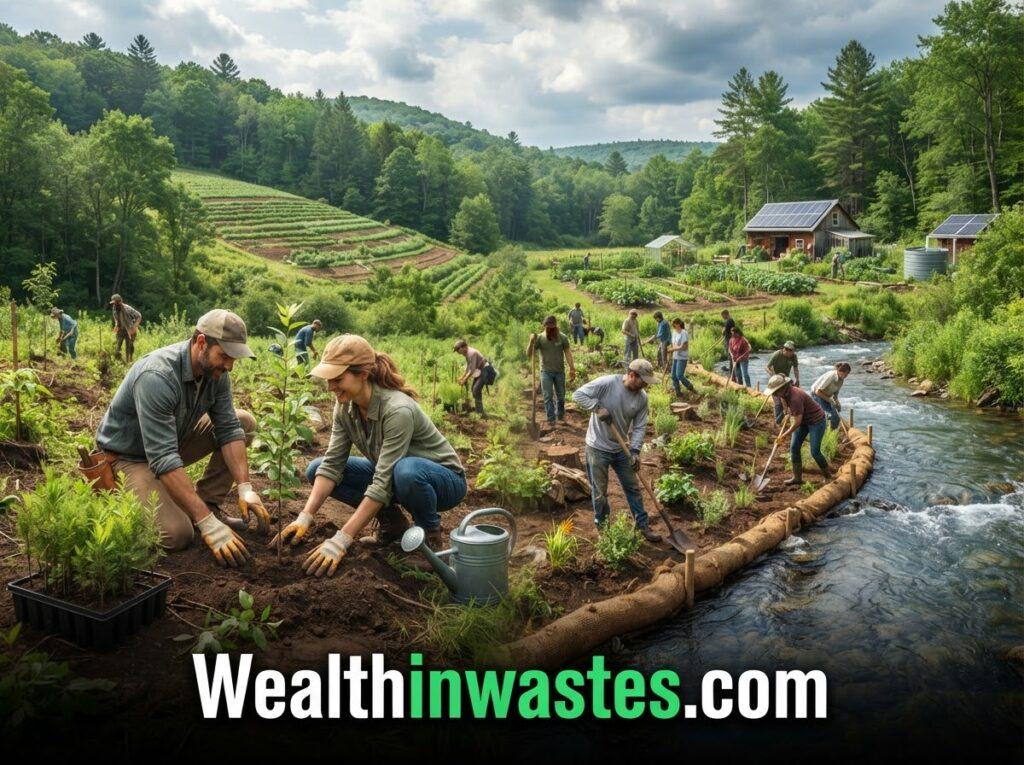
1. Conserve Resources: People can reduce environmental pressure by using water, energy, land, forests, and materials efficiently. Conservation works best when households, farms, businesses, and governments treat resource efficiency as a daily management responsibility.
2. Prevent Waste: Avoiding unnecessary consumption reduces both extraction and disposal needs. Understanding waste sources helps communities identify where waste originates and where prevention, reuse, recovery, or recycling can begin.
3. Protect Sensitive Areas: Wetlands, riverbanks, forests, steep slopes, and groundwater recharge zones require careful land-use decisions. Development should respect ecological functions instead of assuming every landscape can support intensive construction or extraction.
4. Manage Agricultural Chemicals: Farmers should match pesticide use with crop needs, weather, soil conditions, and approved guidance. Mobility management practices can reduce unwanted movement toward groundwater, surface water, and surrounding environments.
5. Strengthen Environmental Responsibility: Citizens and institutions should support monitoring, education, enforcement, cleaner production, and community participation. Sustainable choices become stronger when environmental responsibility guides planning, purchasing, production, waste management, and public decision-making.
Read Also: Water and Land Pollution in Agriculture
Summary on Human Linkage to Environmental Resource: A Complete Guide
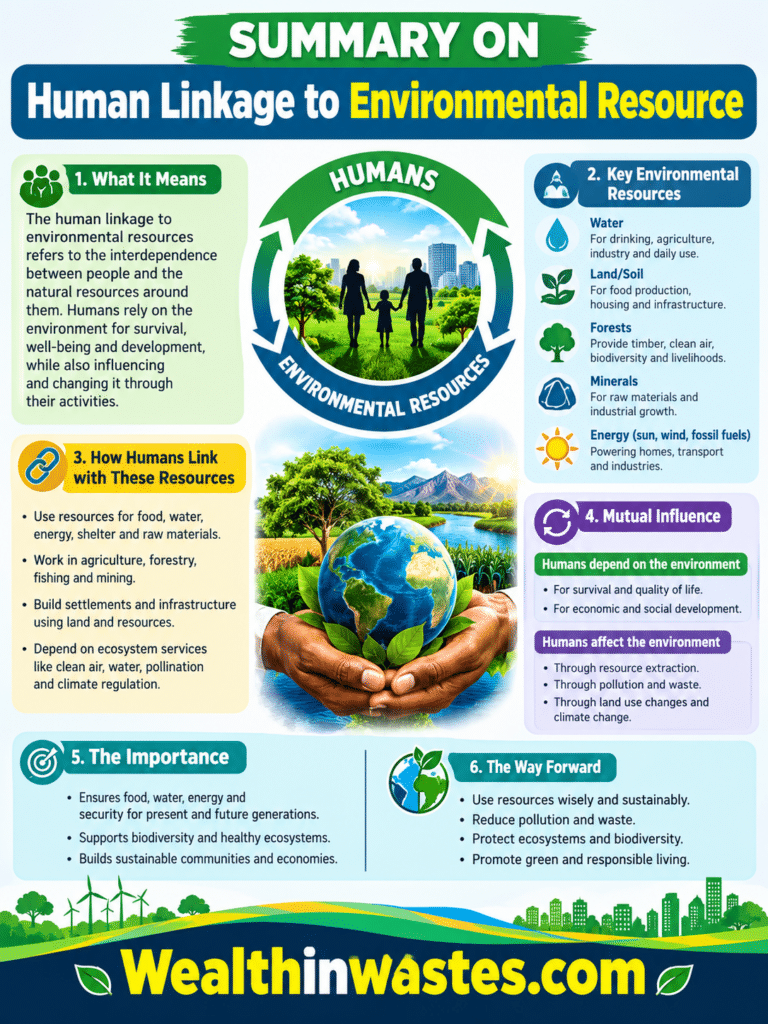
| Aspect | Main Idea | Environmental Effect | Responsible Response |
|---|---|---|---|
| Human Dependence | People require natural materials and ecological services for survival and development. | Continuous demand can pressure environmental systems. | Use resources efficiently and protect ecological functions. |
| Human Activities | Agriculture, settlements, extraction, industry, and consumption reshape nature. | Land degradation, pollution, habitat loss, and resource depletion may increase. | Plan activities around conservation and environmental limits. |
| Waste | Used materials eventually return to land, water, or air. | Excessive waste can overwhelm environmental sinks. | Prevent, reuse, recover, recycle, treat, and dispose responsibly. |
| Population Growth | More people generally increase demand for water, food, land, energy, and materials. | Resource pressure and waste generation may intensify. | Improve planning, infrastructure, conservation, and resource efficiency. |
| Poverty and Policy | Economic hardship and weak institutions can increase environmental pressure. | Communities may experience resource depletion and unequal environmental burdens. | Strengthen policies, institutions, services, and equitable resource access. |
| Technology | Science and technology can improve production while creating new environmental risks. | Technological misuse can create pollution and unintended ecological effects. | Prioritize prevention, risk assessment, monitoring, and cleaner technologies. |
| Environmental Limits | Resources and environmental sinks have physical and ecological limits. | Overuse can reduce regeneration and environmental resilience. | Adopt sustainable consumption and long-term resource planning. |
| Human Responsibility | Daily choices influence environmental quality and future resource availability. | Collective behaviour can either increase or reduce environmental degradation. | Promote conservation, responsible consumption, education, and participation. |
Frequently Asked Questions About Human Linkage to Environmental Resource: A Complete Guide
1. What does human linkage to environmental resource mean?
It describes the continuous relationship between human needs, natural resource use, environmental impacts, technological responses, and responsibilities for maintaining healthy ecological systems.
2. Why do humans depend on environmental resources?
Humans need water, food, air, land, energy, minerals, biological materials, and ecological services for survival, settlement, economic activity, health, and development.
3. How do human activities create environmental resource problems?
Resource extraction, land conversion, pollution, waste generation, overconsumption, poor planning, and harmful technologies can reduce resource quality, availability, and ecological resilience.
4. What role does population growth play?
Population growth can increase demand for land, water, food, housing, energy, infrastructure, and materials, creating additional pressure when planning and resource management remain inadequate.
5. Can technology solve environmental resource problems?
Technology can improve efficiency, monitoring, treatment, recycling, and restoration, but it cannot replace responsible behaviour, prevention, conservation, sound policies, and respect for ecological limits.
6. How can people improve their environmental linkage?
People can conserve resources, prevent waste, protect sensitive ecosystems, reduce pollution, support sustainable practices, participate in environmental programmes, and consider long-term effects when making daily decisions.
Do you have any questions, suggestions, or contributions? If so, please feel free to use the comment box below to share your thoughts. We also encourage you to kindly share this information with others who might benefit from it. Since we can’t reach everyone at once, we truly appreciate your help in spreading the word. Thank you very much for your support and for sharing!