


Forest resources are among the most valuable natural assets on Earth because they support ecological processes, human livelihoods, agricultural systems, wildlife, and industries while supplying materials used in everyday life.
Forests do more than provide trees for timber. They regulate water movement, protect soil, store carbon, moderate local climates, support biodiversity, and create habitats where countless organisms complete their life cycles.
Modern communities depend on forest products ranging from fuelwood and food to medicines, fibres, building materials, and industrial raw materials. These benefits connect forest condition directly with economic and social wellbeing.
Forest loss can weaken these services when trees disappear faster than ecosystems can recover. Deforestation, degradation, uncontrolled harvesting, agricultural expansion, mining, and infrastructure development can place heavy pressure on forest resources.
A clear understanding of the Forest Resource therefore helps communities, farmers, industries, conservation managers, and policymakers recognize forest values and support management approaches that maintain useful resources for present and future generations.
Forest Resource
Forest resources include the trees, vegetation, wildlife, soils, water, genetic materials, and other useful products and ecological functions associated with forest ecosystems across landscapes shaped by climate, geology, and human use.
Understanding natural resource concepts also helps explain why forests belong within broader environmental systems rather than standing as isolated sources of timber, fuel, food, or land and clarifies their place within planning decisions.
The wider nature of natural resources shows that forests interact with land, water, wildlife, atmospheric resources, and human activities within the same environmental system across connected landscapes and communities locally.
1. Timber Resources: Trees supply wood for construction, furniture, poles, packaging, paper, and many other products. Responsible harvesting should maintain regeneration, protect valuable habitats, and prevent unnecessary damage when harvesting follows planned regeneration and protection.
2. Non-Timber Products: Forests provide fruits, nuts, seeds, mushrooms, fibres, resins, medicinal materials, honey, edible leaves, and other products that diversify household income and improve food availability across seasons and changing household needs.
3. Biological Resources: Forest ecosystems contain plants, animals, microorganisms, and genetic materials that support ecological processes, scientific research, breeding programmes, cultural practices, and future resource development while supporting future uses and ecological adaptation.
Read Also: City and Environmental Degradation
Importance of Forest Ecosystems

Forests contribute benefits at local, regional, and global scales. Their importance extends beyond visible trees because forest systems influence soil formation, water regulation, climate processes, biodiversity, and human economies across connected landscapes.
Information on natural resource classification shows that forests interact with water, land, atmospheric, mineral, and biological resources, making integrated management especially important for long-term environmental planning and sustainability across regions.
Urban growth can influence forest conditions when roads, settlements, industries, and other developments expand into natural landscapes. Related city environmental degradation can intensify pressure near forest edges and surrounding rural areas.
1. Biodiversity Support: Forest habitats provide shelter, food, breeding areas, and ecological connections for many species. Protecting these habitats helps maintain biological diversity and the relationships that keep ecosystems functioning over time.
2. Water Regulation: Forest vegetation intercepts rainfall, improves infiltration, slows runoff, and supports watershed functions. These processes can help reduce sudden water flows and support more reliable water availability downstream.
3. Climate Regulation: Trees remove carbon dioxide during photosynthesis and store carbon in biomass and soils. Forest protection therefore forms part of wider efforts to maintain stable climate systems and resilient landscapes.
Forest Resources and Rural Livelihoods
Forest resources support rural economies by supplying materials, foods, energy, medicines, fodder, and income opportunities. Their value becomes especially visible where households depend directly on nearby natural resources throughout the year.
Broader land-resource livelihood relationships show why resource decisions affect household income, land access, employment, food security, and long-term community resilience across rural landscapes and vulnerable households over many seasons in resource-dependent economies.
Forest products are closely linked with wildlife habitats because many useful plants and animals depend on healthy forest ecosystems. Guidance on forest and wildlife conservation explains this connection clearly for sustainable management.
1. Food and Nutrition: Forests provide fruits, nuts, leaves, mushrooms, honey, roots, seeds, and other foods that can supplement cultivated crops and strengthen dietary diversity for households facing seasonal shortages.
2. Household Energy: Fuelwood and charcoal remain important energy sources in many communities. Sustainable supply systems can reduce pressure on natural forests while meeting household cooking and heating needs reliably.
3. Livestock Support: Forest and woodland vegetation can provide fodder, browse, shade, and water-related benefits for livestock. Proper management helps prevent overgrazing and protects regeneration in vulnerable areas throughout dry seasons.
Forest Roles in Soil and Water
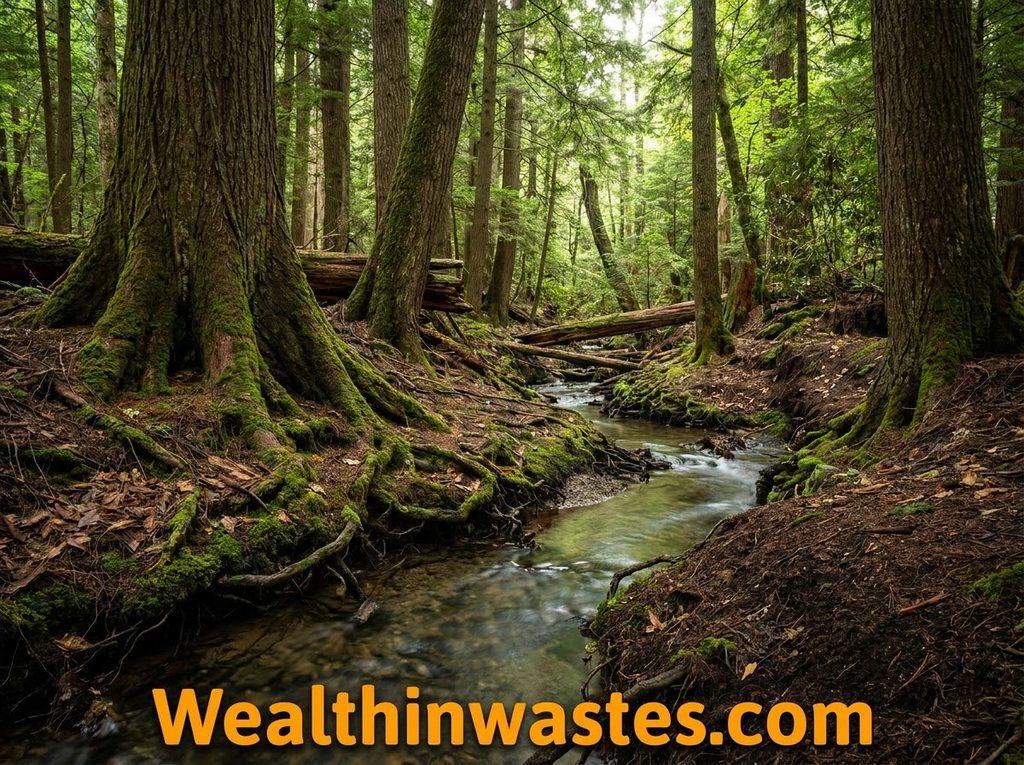
Healthy forests protect soil and water resources through interconnected physical and biological processes. Tree roots stabilize the ground, while litter and canopy cover reduce the force of rainfall reaching exposed soil.
Forest floors contain organic matter that supports soil structure and biological activity. Roots create channels that can improve infiltration, while vegetation slows runoff and reduces the movement of sediment into waterways.
Vegetation cover is central to soil erosion control, because tree roots bind soil particles and canopy cover reduces direct raindrop impact on exposed surfaces while improving ground stability and infiltration capacity.
Forest soils can absorb and temporarily store rainfall, supporting groundwater recharge and reducing rapid surface runoff. This buffering function becomes valuable during intense storms, especially in sloping or vulnerable landscapes.
Forested catchments can help maintain water quality by reducing sediment transport and supporting natural filtration processes. Protecting these areas benefits farms, communities, aquatic systems, and downstream water users over time.
Forest protection should therefore form part of wider land and water planning. Coordinated management becomes especially important where farms, settlements, roads, wetlands, and forest landscapes occupy the same watershed for long periods.
Further guidance on water-resource development reinforces the need to meet human water requirements while protecting environmental systems that sustain water availability, quality, ecological functions, and downstream needs across watersheds and surrounding communities.
Communities also benefit when forest protection is coordinated with freshwater management, because forests, rivers, groundwater, wetlands, and agricultural systems often depend on connected hydrological processes in dry and wet seasons.
Forest Resource and Climate Regulation
Forests participate in climate regulation by absorbing carbon dioxide during photosynthesis and storing carbon in vegetation, roots, deadwood, litter, and soils across different forest ecosystems and landscapes worldwide over long periods.
They also influence temperature, humidity, rainfall movement, and surface conditions, creating environmental effects that can extend beyond the boundaries of individual forest stands and local communities across connected regions and watersheds.
Forest degradation can release stored carbon when vegetation is burned, decomposed, or removed. At the same time, losing tree cover reduces the capacity of landscapes to remove additional atmospheric carbon over time.
Information on climate change sustainability increasingly emphasizes ecosystem protection because forests can provide several benefits at once, including carbon storage, biodiversity support, and water regulation for surrounding communities and economies.
Understanding climate change processes helps explain why forest decisions matter beyond the immediate landscape, particularly where land-use changes affect carbon stocks and ecosystem resilience over longer periods and larger regions.
Protecting forests does not eliminate the need to reduce other greenhouse gas sources, but forest conservation and restoration can complement broader climate and environmental management strategies across multiple sectors and landscapes.
Forests also provide raw materials that can support lower-impact production when harvested sustainably. This makes forest resources relevant to discussions about renewable materials, circular production, and responsible resource use in expanding economies.
Causes of Forest Resource Loss
Forest resource loss can result from several interacting pressures. Recent deforestation causes and effects discussions show that forest loss can carry ecological, economic, and social consequences across affected landscapes over time.
Land conversion also relates closely to land-cover change processes, because forests may be replaced by farms, roads, buildings, extraction sites, or other human uses across expanding landscapes and settlement corridors.
1. Agricultural Expansion: Forests may be cleared to establish cropland, pasture, plantations, or grazing areas. Poor land planning can increase pressure when new farms replace productive or ecologically valuable landscapes.
2. Timber Harvesting: Logging can remove valuable trees and fragment forest habitats. Problems become more serious when harvesting exceeds regeneration, damages residual trees, or occurs without adequate management controls and monitoring.
3. Fuelwood and Charcoal: High demand for household energy can increase tree cutting, especially where alternative energy sources remain costly, unreliable, or unavailable to rural and low-income households during difficult economic periods.
4. Mining and Infrastructure: Roads, mines, pipelines, settlements, and industrial projects can clear vegetation and divide habitats. Associated drainage changes, waste disposal, and vehicle movement can create additional environmental pressure across surrounding forest landscapes.
Sustainable Forest Resource Management
Sustainable forest resource management seeks to maintain forest functions while allowing appropriate use of useful products. It requires planning that recognizes ecological limits, community needs, economic objectives, and regeneration capacity over time.
Integrated resource conservation and management recognizes that forests must be managed alongside agriculture, water, wildlife, energy, and other resources that interact within the same landscape and influence shared environmental outcomes.
Forest and wildlife protection require habitat-focused approaches because species depend on suitable food, shelter, breeding sites, and ecological connections across forest landscapes for long-term survival, reproduction, movement, and ecological stability.
1. Sustainable Harvesting: Forest products should be collected at rates compatible with regeneration. Harvest planning should protect seed trees, young growth, sensitive habitats, waterways, and areas requiring special conservation measures.
2. Forest Restoration: Degraded landscapes can recover through assisted natural regeneration, enrichment planting, reforestation, erosion control, and protection from repeated disturbance and damaging land-use practices over time and across priority areas.
3. Community Participation: Local users can contribute knowledge, monitoring, stewardship, and practical enforcement. Participation becomes stronger when communities have clear rights, responsibilities, incentives, and fair access to benefits over time.
4. Monitoring and Enforcement: Forest managers need reliable inventories, field inspections, remote sensing, harvesting records, and effective enforcement systems to detect illegal clearing and guide timely corrective action across forest areas for responsible resource use.
Forest Resource Challenges
Forest resource conservation faces complex challenges because ecological protection must operate alongside food production, housing, energy needs, employment, trade, and infrastructure development across rapidly changing landscapes and growing communities worldwide.
Competition among different resource users can increase pressure when forest boundaries overlap with farms, settlements, grazing areas, roads, mines, and community lands, especially where land availability remains limited locally and demands continue rising.
Forest governance can become difficult when laws are unclear, monitoring capacity is weak, ownership arrangements overlap, or communities receive limited benefits from nearby conservation programmes and sustainable forest activities over time.
Conservation decisions can also create disagreements when restrictions affect people who depend on forest products for food, energy, income, medicine, or cultural practices, particularly where alternative livelihoods remain limited locally.
Research on resource conservation conflicts illustrates the importance of understanding different resource-use interests when establishing protected areas or changing access to natural resources in communities and surrounding landscapes over time.
Broader ecological sustainability principles support approaches that connect environmental protection with economic activity, social needs, resource governance, and long-term ecosystem health across affected communities and wider regions over time.
Effective conservation should therefore combine science, local knowledge, transparent rules, practical livelihoods, monitoring, enforcement, and long-term financing rather than relying on forest restrictions alone across complex social and ecological landscapes.
Read Also: Land Cover Change and Deforestation
Future of Forest Resource Conservation
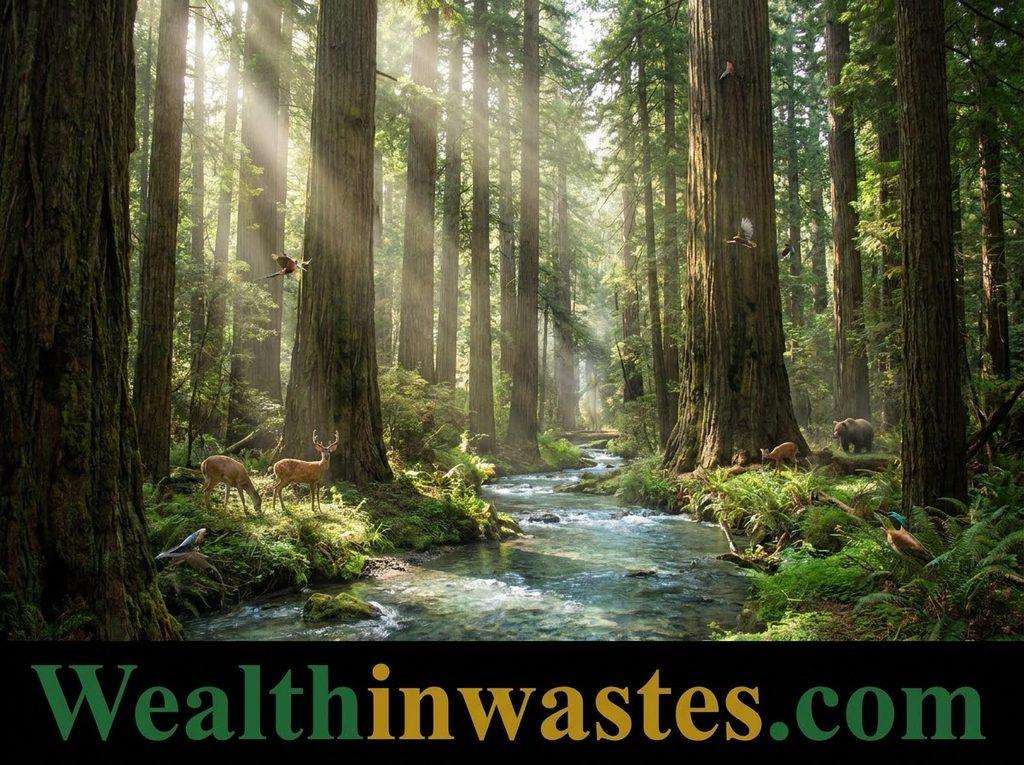
The future of forest resources depends on how societies manage competing demands for land, products, energy, food, and infrastructure while maintaining the ecological functions that forests provide for communities everywhere.
Public awareness can encourage responsible consumption, support restoration programmes, and improve understanding of how forest loss affects soil, water, biodiversity, climate, and rural livelihoods across different regions and seasons worldwide.
Environmental planning can benefit from environmental management best practices that promote efficient resource use, pollution prevention, biodiversity protection, monitoring, community participation, and accountability across development programmes, conservation initiatives, and institutions.
Farmers can also reduce pressure on remaining forests through productive land management. Guidance on agricultural land management shows why maintaining productive soils can reduce incentives for continual expansion into natural areas.
Understanding natural resource relationships helps decision-makers recognize that forests interact continuously with soil, water, wildlife, land, and atmospheric systems across the same landscape and ecological region over time and across communities.
Water planning should remain connected with forest conservation because healthy catchments support water regulation. Related information on water resources and the hydrologic cycle explains this important relationship across watersheds and communities.
Long-term sustainability requires cooperation among governments, communities, farmers, businesses, researchers, and conservation groups so that forest resources remain productive, resilient, and available for future generations while ecosystems retain essential functions.
Summary on Forest Resource and Importance of Forest
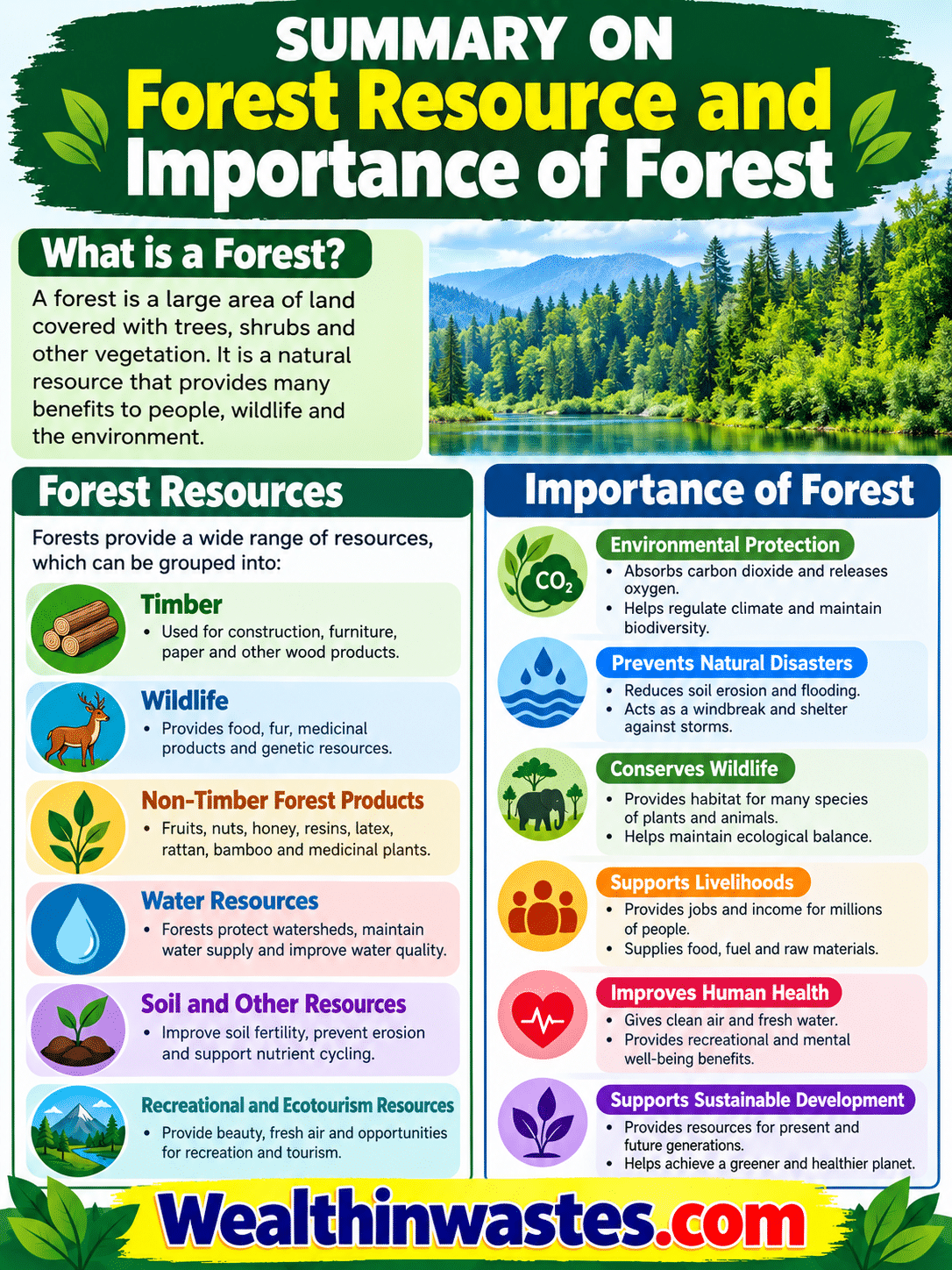
| Section | Main Idea | Why It Matters |
|---|---|---|
| Forest Resource | Forests contain timber, non-timber products, biodiversity, and ecological resources. | They provide useful materials and essential ecosystem functions. |
| Importance of Forest Ecosystems | Forests support biodiversity, water regulation, and climate processes. | These services sustain healthy and productive environments. |
| Rural Livelihoods | Forest products support food, energy, livestock, and income. | They strengthen household resilience and economic diversity. |
| Soil and Water | Vegetation protects soil and regulates water movement. | It helps reduce erosion, runoff, sediment, and water stress. |
| Climate Regulation | Forests absorb carbon dioxide and store carbon. | They support climate regulation and environmental resilience. |
| Forest Resource Loss | Agriculture, logging, energy demand, mining, and infrastructure create pressure. | Unchecked loss reduces ecological and social benefits. |
| Sustainable Management | Harvesting, restoration, participation, monitoring, and enforcement are important. | These measures support long-term forest productivity and conservation. |
| Future Conservation | Forest protection requires integrated planning and cooperation. | Collaboration can maintain resources for future generations. |
Frequently Asked Questions About Forest Resource: Importance, Uses and Conservation
1. What is a forest resource?
A forest resource includes trees, wildlife, vegetation, soils, water, genetic materials, timber, and non-timber products obtained from forest ecosystems.
2. Why are forest resources important?
They provide materials and livelihoods while supporting biodiversity, soil protection, water regulation, carbon storage, climate regulation, and ecological stability.
3. What products come from forests?
Forests provide timber, fuelwood, fruits, nuts, fibres, medicines, fodder, resins, honey, paper materials, and other useful products.
4. How do forests protect soil?
Roots stabilize soil, while canopy cover and forest litter reduce rainfall impact, runoff, sediment movement, and erosion.
5. How do forests support water resources?
Forest vegetation intercepts rainfall, improves infiltration, stores water in soils, reduces runoff, and helps protect watershed water quality.
6. What causes forest resource loss?
Major pressures include agricultural expansion, timber harvesting, fuelwood demand, mining, infrastructure development, settlement growth, and poorly managed land conversion.
7. How can forest resources be managed sustainably?
Management can combine planned harvesting, restoration, community participation, monitoring, enforcement, biodiversity protection, and careful land-use planning.
8. Why should communities participate in forest conservation?
Local communities often depend on forest resources and possess valuable knowledge, so meaningful participation can strengthen stewardship, practical monitoring, and fair resource management.
Do you have any questions, suggestions, or contributions? If so, please feel free to use the comment box below to share your thoughts. We also encourage you to kindly share this information with others who might benefit from it. Since we can’t reach everyone at once, we truly appreciate your help in spreading the word. Thank you very much for your support and for sharing!
Read Also: Basic Principles of Forest Management