


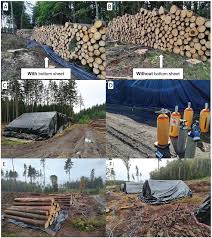
Fumigants are specialized pesticides used as gases or gas-forming products to control pests in enclosed commodities, structures, and soils. Their performance depends strongly on environmental conditions and treatment practices.
Successful fumigation requires more than selecting a suitable product. The gas must reach the target organism at an effective concentration, remain available long enough, and penetrate the material or structure adequately.
Factors that modify fumigant effectiveness include pest species and life stage, temperature, moisture, air movement, sealing quality, commodity characteristics, and the method selected for application.
Poor control may result when any condition prevents the fumigant from reaching a lethal exposure. Understanding each factor helps users interpret label directions and avoid ineffective or unsafe treatment practices.
Because fumigants can present serious inhalation hazards, only trained and authorized personnel should conduct treatments. Product labels, local requirements, monitoring procedures, and re-entry instructions should always guide fumigation work.
Fumigant Effectiveness And Pest Susceptibility
1. Pest Species: Different insect species respond differently to fumigants because their physiology, respiratory structures, protective coverings, and tolerance mechanisms can influence how readily the gas affects them.
2. Life Stage: Eggs, larvae, pupae, nymphs, and adults can differ greatly in susceptibility. Metabolically inactive stages often require more carefully controlled exposure to achieve reliable mortality.
3. Pest Location: A target hidden deep inside grain, wood, packaging, cracks, or other protected areas may receive less fumigant than pests exposed directly to circulating gas.
4. Pest Activity: Metabolic activity can affect fumigant response. Highly active insects may respond differently from dormant or inactive individuals, making biological timing important when planning treatment.
5. Resistance: Repeated exposure to the same fumigant may contribute to resistance within pest populations. Monitoring treatment performance and following approved application requirements helps reduce the risk of control failure.
Read Also: Roles of Producers and Corporations in Waste Management
Temperature And Moisture In Fumigation
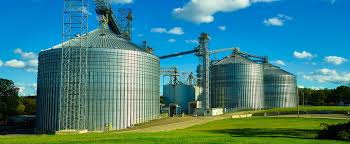
1. Low Temperature: Cold conditions can slow vaporization, diffusion, insect activity, and metabolism. These combined effects may delay mortality and reduce treatment performance compared with suitable operating temperatures.
2. High Temperature: Excessive heat can increase vapor movement and may encourage faster losses when an enclosure leaks. Treatment conditions should therefore remain within the product label specifications.
3. Moisture Level: Some gas-forming products require sufficient moisture to release their active fumigant. Very dry grain or low humidity can slow gas generation and delay effective concentrations.
4. Excessive Moisture: Too much moisture can alter gas distribution or complicate aeration after treatment. Moisture conditions should match the requirements stated on the approved product label.
5. Soil Moisture: Soil fumigation also depends on moisture because extremely dry soil may limit biological activity, while unsuitable wet conditions can change gas movement and complicate treatment uniformity.
Fumigation performance also relates to the wider conditions controlling pesticide persistence in soil, because environmental conditions can alter chemical behaviour, availability, movement, and treatment performance.
Air Movement And Gas Containment
Wind can interfere with fumigation by increasing gas losses through small leaks in structures, covers, doors, joints, vents, and other weak points around the treatment enclosure.
Effective fumigation therefore depends on maintaining a suitable enclosure that limits uncontrolled gas escape throughout the required exposure period. Even a small leak can reduce concentration near vulnerable areas.
Before treatment, operators should inspect seams, openings, drains, vents, doors, windows, and other potential leakage points. Careful preparation improves containment and supports consistent exposure across the treated space.
Gas movement inside the enclosure also matters because tightly packed materials can restrict diffusion. Proper arrangement can help the fumigant reach areas where insects, larvae, or eggs remain concealed.
Understanding pesticide movement and absorption processes can also help explain why chemical distribution differs between materials, especially when physical barriers, surfaces, moisture, or soil conditions influence movement.
Weather conditions should also receive attention during outdoor or soil-related work. Rain, wind, temperature changes, and changing ground conditions can affect containment and treatment consistency significantly.
Structure, Site, and Commodity Conditions

1. Structural Tightness: A tightly sealed structure usually retains fumigant better than a porous or poorly sealed structure. Effective sealing remains one of the most important requirements for successful structural fumigation.
2. Porous Materials: Wood, unfinished masonry, and some building materials can absorb or retain fumigant differently from metal, plastic, or other less porous surfaces.
3. Commodity Arrangement: Dense stacks, tightly packed bags, and compact storage arrangements can slow gas penetration. Adequate spacing and treatment arrangements should follow the approved product directions.
4. Commodity Permeability: The physical structure of grains and stored materials influences gas movement. Kernel size, surface characteristics, seed coats, and packing density can change fumigant distribution.
5. Sorptive Capacity: Commodities may adsorb gas molecules onto surfaces and absorb them within internal spaces. Greater sorption can reduce gas remaining in surrounding air during treatment.
Stored grain conditions deserve particular attention because smaller kernels can present greater surface area relative to volume, potentially affecting gas interactions. These differences reinforce the importance of commodity-specific label directions.
Related soil properties affecting pesticide mobility demonstrate how texture, moisture, organic matter, and other physical characteristics can change the movement and availability of chemicals.
Commodity Properties That Affect Fumigation
Fumigant performance can change according to the type of commodity being treated. Grain, seeds, processed foods, animal feed, timber, soil, and enclosed structures present different physical environments.
Kernel size affects the available surface area, while packing density influences the pathways through which gas can travel. Dust, chaff, broken kernels, and other dockage can also alter treatment conditions.
The sorptive behaviour of grain matters because gas molecules can adhere to external surfaces or move into internal spaces. Greater sorption can reduce the concentration available for pest exposure.
Commodity moisture also influences treatment performance, particularly when products depend on moisture for gas generation. Appropriate storage conditions can therefore contribute to more predictable fumigation results.
Food safety remains another major consideration. Fumigation should not damage the commodity or create unacceptable residues, and users must follow the approved directions for treated foods and agricultural products.
This concern connects with pesticide residue risks in cereals and pulses, where chemical treatment and storage practices can influence residue levels and potential exposure through food.
Similar concerns apply to residue management for fruits and vegetables, although fumigation uses differ across commodities and must always match the products and uses specifically approved by their labels.
Application Methods and Treatment Success

1. Soil Application: Soil fumigants may use approved tarping, injection, or other application systems. The selected method must provide suitable distribution while meeting all label requirements.
2. Space Fumigation: Enclosed structures, storage facilities, vehicles, and other approved spaces may require gas-tight preparation so the fumigant can remain at an effective concentration throughout exposure.
3. Stored Commodity Treatment: Bulk commodities can present different application requirements from bagged products. Operators must follow the product label for placement, exposure, sealing, and subsequent aeration.
4. Application Timing: Weather, temperature, commodity condition, pest life stage, and operational readiness should support the selected treatment. Rushed applications can increase both failure and exposure risks.
5. Monitoring: Appropriate monitoring confirms whether treatment conditions remain within required limits. Reliable detection methods also help determine whether workers can safely remain outside restricted areas.
Application decisions should also consider management practices that influence pesticide movement, especially where soil treatments and environmental conditions can change chemical distribution after application.
For stored produce, an effective approach begins with preparation, sanitation, correct application, controlled exposure, and appropriate aeration. Poor preparation can undermine even an otherwise suitable fumigation product.
Readers can also compare fumigation with broader advantages and disadvantages of fumigation when deciding whether this specialized pest-control method fits a particular situation.
Fumigation Safety And Protective Equipment
Fumigants can cause severe poisoning through inhalation, making worker protection central to every treatment. People should never enter treated areas unless authorized procedures confirm that entry is safe.
Fumigation teams should understand the product label, emergency procedures, restricted areas, detection requirements, ventilation practices, and re-entry conditions before starting any treatment operation.
Personnel should also understand the major routes through which pesticide exposure occurs, including inhalation, skin or eye contact, ingestion, and accidental transfer during handling.
Protective equipment must match the specific product and exposure conditions. Respiratory protection, protective clothing, gloves, eye protection, and other equipment should follow the exact label and safety documentation.
Reliable gas detection is particularly important because fumigant concentrations cannot be judged safely by smell or visible appearance. Workers need suitable instruments and trained personnel for exposure assessment.
Safe storage and disposal also matter after treatment. The recommended storage, handling, and disposal practices for fumigants help reduce accidental exposure, contamination, and improper chemical disposal.
Personnel should report symptoms, accidents, suspected exposure, or equipment failures immediately. Medical evaluation and emergency response should follow the product label, safety data, and applicable occupational requirements.
Environmental Stewardship and Residue Control

Fumigation aims to control pests at a defined site, but poor management can move chemicals beyond their intended location. Environmental stewardship therefore remains important during preparation, application, and cleanup.
Chemical movement through soil, air, and water can create unwanted environmental pathways. Understanding site conditions that affect pesticide mobility helps explain why local environmental conditions require careful consideration.
Water contamination deserves particular attention because pesticides can move from agricultural land into streams, drainage channels, and groundwater. Proper containment and responsible use reduce unnecessary environmental exposure.
The movement of pesticides through surface waters illustrates how dissolved chemicals or particle-associated compounds can travel after reaching water systems and potentially affect organisms outside the original treatment area.
Fumigant-related contamination should also be considered alongside broader effects of hazardous substances on soil and plant life, particularly where repeated chemical use or accidental releases affect agricultural environments.
Where pesticide contamination occurs, appropriate prevention and remediation strategies become important. Integrated pest management can reduce unnecessary pesticide use and reserve fumigation for situations that genuinely require it.
This approach aligns with methods for cleaning up and controlling specific pollutants, including integrated pest management strategies that reduce reliance on chemical controls where safer alternatives can provide sufficient protection.
Additional concerns arise where pesticides reach groundwater or food systems. The broader sources and management of groundwater pollution show why preventing contamination is generally more practical than attempting costly cleanup.
Food-related chemical exposure also deserves careful attention because contaminated agricultural materials can transfer residues into edible products. Proper label compliance, approved commodities, and responsible treatment practices help reduce this risk.
Readers can further understand sources of food contamination and pollution when evaluating how agricultural chemicals can contribute to contamination across production, storage, processing, and distribution systems.
The wider classification of contaminants is also relevant because pollutant characteristics such as persistence, toxicity, and mobility influence the environmental significance of chemicals released into surrounding ecosystems.
Finally, responsible pesticide governance requires awareness of hazardous chemical risks and regulatory concerns. The discussion of hazardous pesticides and regulatory challenges reinforces the need for competent handling and careful compliance.
Read Also: Soil Fumigation, Importance and Types of Fumigation
Practical Factors To Check Before Fumigation
Before treatment begins, operators should confirm that the target pest, commodity, treatment site, product, and application method all match the approved label. This prevents unsuitable treatments and unnecessary chemical exposure.
Temperature and moisture should fall within the product requirements, while wind and other environmental conditions should support containment. Any unusual condition should trigger a careful reassessment.
Structures should receive a thorough inspection for cracks, openings, porous materials, poor seals, and other leakage points. Stored commodities should also receive preparation appropriate to their condition and arrangement.
Workers should establish restricted areas, emergency arrangements, detection procedures, protective equipment, communication systems, and post-treatment aeration requirements before introducing the fumigant.
The broader subject of pesticide behaviour becomes especially useful when assessing treatment failures. Information about pesticide degradation and metabolism helps explain why chemical performance can change as compounds interact with organisms and environmental conditions.
After completing treatment, users should document the conditions, observations, monitoring results, and any problems encountered. Good records can improve future decision-making and support regulatory compliance where records are required.
Where pesticide residues may affect animal products, the related measures for managing pesticide residues in livestock provide useful background on preventing contamination through feed, environments, and chemical exposure.
Waste generated during agricultural chemical use must also receive proper attention. Understanding agricultural waste sources and characteristics helps place chemical containers and related materials within responsible waste-management practices.
A broader understanding of important waste-management terms and environmental concepts can further support communication between fumigators, agricultural workers, regulators, waste managers, and other responsible stakeholders.
When fumigation is necessary, treatment success depends on controlling several factors simultaneously rather than relying on dosage alone. Accurate preparation, monitoring, containment, and strict label compliance remain essential throughout treatment.
Summary on Factors that Modify Fumigant Effectiveness in Fumigation
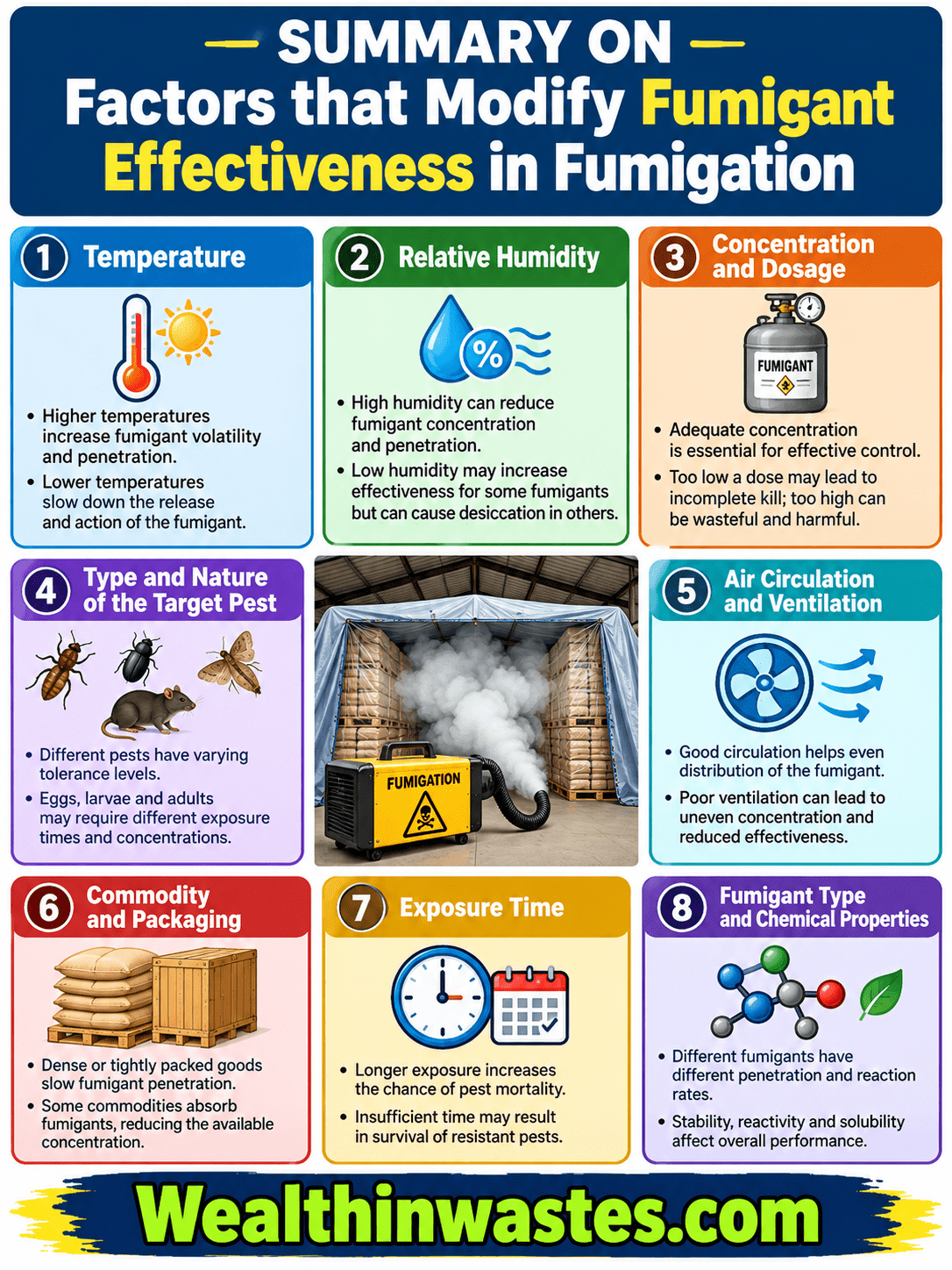
| Factor | How It Modifies Effectiveness |
|---|---|
| Pest Species | Different species and life stages have different susceptibility levels. |
| Temperature | Temperature affects vaporization, diffusion, metabolism, and mortality speed. |
| Moisture | Moisture can influence gas generation, distribution, and soil treatment performance. |
| Air Movement | Wind and leaks can reduce fumigant concentration and exposure time. |
| Structure | Sealing quality and material porosity affect gas retention. |
| Commodity | Kernel size, packing, permeability, dust, and sorption affect gas distribution. |
| Application Method | Placement, timing, monitoring, and treatment technique determine exposure quality. |
| Safety | Detection, protective equipment, restricted access, and aeration protect workers. |
| Environmental Conditions | Soil, water, weather, and chemical behaviour influence movement beyond the target site. |
Frequently Asked Questions About Factors that Modify Fumigant Effectiveness in Fumigation
1. What is fumigant effectiveness?
Fumigant effectiveness describes how successfully a treatment reaches pests and maintains suitable exposure conditions long enough to achieve the intended control.
2. Why does temperature affect fumigation?
Temperature influences fumigant vaporization, diffusion, pest metabolism, and mortality speed, so unsuitable temperatures can reduce treatment performance.
3. How does moisture influence fumigation?
Moisture can affect gas release from certain fumigants and can influence distribution, soil conditions, exposure, and subsequent aeration.
4. Why is sealing important during fumigation?
Good sealing helps retain the gas and maintain effective concentrations. Leaks can cause rapid losses and result in incomplete pest control.
5. Does commodity type affect fumigant performance?
Yes. Kernel size, permeability, packing density, moisture, dust, and sorptive capacity can change how fumigant gas distributes through stored materials.
6. Why are fumigants dangerous to workers?
Many fumigants are highly toxic, particularly through inhalation. Proper training, detection, restricted access, protective equipment, and label compliance are essential.
7. Can poor application cause fumigation failure?
Yes. Incorrect application, inadequate sealing, unsuitable environmental conditions, poor preparation, or insufficient monitoring can prevent effective pest exposure.
8. How can fumigation risks be reduced?
Use only approved products and sites, follow label directions, employ trained personnel, monitor exposure, control access, and complete required aeration.
Do you have any questions, suggestions, or contributions? If so, please feel free to use the comment box below to share your thoughts. We also encourage you to kindly share this information with others who might benefit from it. Since we can’t reach everyone at once, we truly appreciate your help in spreading the word. Thank you very much for your support and for sharing!
Read Also: Safe Handling of Pesticides in Agriculture