


Pesticides applied to agricultural soils do not remain unchanged indefinitely because several physical, chemical, biological, and environmental processes gradually transform, immobilize, move, or remove their active ingredients.
The length of time a pesticide remains active depends on interactions among soil properties, weather conditions, microbial communities, pesticide chemistry, application practices, and the environmental conditions existing after application.
Understanding these relationships helps farmers, environmental professionals, and land managers predict pesticide persistence, improve application decisions, protect crops, and reduce contamination of groundwater, surface water, and surrounding ecosystems.
A pesticide may degrade rapidly in one field yet persist considerably longer in another field because differences in soil texture, organic matter, moisture, temperature, pH, and microbial activity influence degradation.
Degradation generally occurs through microbial transformation, chemical reactions, and photodegradation, while other dissipation processes such as leaching, volatilization, runoff, and plant uptake can also reduce pesticide concentrations.
What Controls Pesticide Degradation?
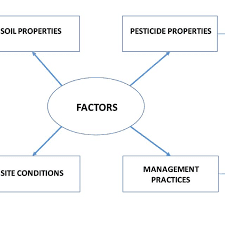
Several broad categories determine how quickly pesticides disappear from soil. Soil conditions control adsorption, biological activity, chemical reactions, and water movement, while weather influences many of these processes.
The chemical structure of each pesticide also determines whether microorganisms can readily attack it, whether hydrolysis occurs, how strongly soil particles retain it, and how easily sunlight changes its molecules.
Farm practices can further change degradation because application rate, timing, irrigation, tillage, crop cover, and repeated pesticide use influence the chemical environment surrounding residues within agricultural soils.
Research on pesticide movement through soil also shows that degradation cannot be considered separately from adsorption, leaching, volatilization, runoff, and uptake by plants.
Consequently, the same pesticide can show different persistence patterns depending on whether it remains strongly adsorbed, dissolves into soil water, reaches microorganisms, or moves outside the treated area.
Understanding these interacting factors is essential because pesticide persistence affects weed control, rotational crop safety, residue levels, environmental contamination, and the overall efficiency of pesticide applications.
Read Also: Soil Fumigation, Importance and Types of Fumigation
How Soil Composition Affects Pesticide Persistence
1. Soil Texture: The relative proportions of sand, silt, and clay determine surface area, permeability, water movement, and the number of locations available for pesticide adsorption and retention.
2. Organic Matter: Organic matter provides numerous binding sites that can retain pesticide molecules, reducing their immediate movement while sometimes limiting their accessibility to microorganisms responsible for biological degradation.
3. Adsorption And Desorption: Soil particles can bind pesticide molecules and later release them into soil water. This reversible relationship affects biological availability, persistence, movement, crop uptake, and carryover.
Fine-textured soils containing substantial clay and organic matter generally possess greater adsorption capacity than coarse sandy soils because they provide more surfaces where pesticide molecules can attach.
Strong adsorption can reduce pesticide availability to microorganisms, slowing biological degradation in some situations, although adsorption does not always increase persistence because other processes may continue simultaneously.
Soil texture also influences drainage. Sandy soils generally permit faster water movement, potentially increasing downward pesticide transport, whereas clay-rich soils usually restrict movement and increase opportunities for pesticide retention.
Organic matter can have a similar dual effect because it may immobilize pesticide residues while improving water retention, microbial habitat, and biological processes that influence eventual transformation.
Information about soil properties affecting pesticide behaviour demonstrates why soil texture, moisture, organic matter, structure, and pH must be considered together when evaluating pesticide persistence.
Soil structure also matters because aggregates, cracks, earthworm channels, and root pathways can create preferential movement routes, allowing pesticide-containing water to bypass portions of the soil profile.
Soil pH And Chemical Breakdown
Soil pH strongly influences the behaviour and degradation of several pesticide groups because acidity or alkalinity can change molecular charge, adsorption, solubility, hydrolysis, and microbial activity.
Some triazine and sulfonylurea herbicides persist longer as soil pH rises because chemical degradation through hydrolysis can become slower under more alkaline conditions.
Soil pH can also change how tightly pesticides bind to soil colloids. A change in adsorption may increase or decrease the fraction available to plants, microorganisms, and water moving through the soil.
Acidic conditions can increase adsorption for certain pesticides, reducing immediate biological availability while preserving residues that may later return to the soil solution.
For imidazolinone herbicides such as imazaquin and imazethapyr, lower soil pH can increase adsorption and reduce microbial access, potentially extending persistence and increasing risks to susceptible rotational crops.
The relationship between pH and degradation therefore differs among pesticide families. Farmers should avoid assuming that one pH condition will accelerate or slow every pesticide equally.
Changes in adsorption can also influence degradation by controlling pesticide bioavailability. When microorganisms cannot access strongly bound molecules, biological transformation may proceed more slowly under certain soil conditions.
Studies have reported relationships between pesticide sorption and persistence, although other soil and environmental factors can modify these relationships and make degradation behaviour difficult to predict from pH alone.
Good understanding of soil properties therefore helps farmers interpret pesticide labels and select application strategies that match local soil conditions rather than relying on generalized expectations.
Microbial Activity And Soil Conditions
1. Microbial Population: Bacteria, fungi, protozoans, and other soil organisms can transform pesticide molecules through metabolic reactions, making microbial abundance and community composition important determinants of degradation speed.
2. Soil Moisture: Microbial processes generally need adequate water because microorganisms require moisture for growth, movement, nutrient uptake, and access to pesticide molecules dissolved within soil water.
3. Oxygen Availability: Aerobic and anaerobic microorganisms use different biochemical pathways. Soil saturation can reduce oxygen diffusion and shift pesticide transformation toward microorganisms adapted to oxygen-limited conditions.
4. Nutrient Supply: Microbial populations require suitable carbon, nitrogen, phosphorus, and mineral nutrients for growth. Poor fertility can limit microbial activity and consequently reduce some biological degradation processes.
Microbial degradation often represents one of the most important pesticide breakdown pathways in soil because microorganisms can transform active ingredients into simpler compounds or less biologically active metabolites.
A warm, adequately moist, well-aerated soil with suitable nutrient availability commonly supports active microbial communities, although each pesticide and microbial population responds differently to environmental conditions.
Repeated exposure to the same pesticide can sometimes increase populations of microorganisms capable of using that compound as an energy or carbon source, resulting in faster degradation.
Information on soil moisture conditions is particularly useful because moisture influences microbial activity, pesticide dissolution, water movement, oxygen supply, and the balance between transformation and transport.
Conversely, very dry soil can restrict microbial activity and reduce pesticide transformation, allowing residues to remain longer until rainfall or irrigation restores sufficient moisture for biological processes.
Research concerning effects of hazardous substances on soil organisms also demonstrates that contaminants may alter microbial abundance, diversity, and enzyme activity, potentially changing normal soil decomposition processes.
Climate, Moisture, Temperature, and Sunlight

Weather conditions can significantly alter pesticide degradation because temperature, rainfall, soil moisture, humidity, wind, and sunlight influence biological, chemical, and physical processes affecting pesticide residues.
Higher temperatures often accelerate chemical reactions and microbial activity, allowing susceptible pesticides to degrade more quickly than under cool conditions when biological processes slow considerably.
Moisture also affects degradation because microorganisms generally require water, while dissolved pesticides become more accessible for chemical transformation and movement through the soil profile.
However, excessive moisture can reduce oxygen availability and change microbial communities, meaning saturated conditions may either accelerate or slow degradation depending on the pesticide and dominant biological pathway.
Drought can increase pesticide carryover because dry conditions restrict microbial activity and water-dependent chemical reactions. Residues may remain until subsequent rainfall restores biological and chemical activity.
Rainfall soon after pesticide application can also promote leaching and runoff, reducing surface concentrations while simultaneously increasing environmental exposure beyond the intended treatment area.
Sunlight contributes to photodegradation for some pesticides, especially those remaining on exposed plant surfaces, water, or soil surfaces before rainfall or incorporation protects them from light.
Photolysis tends to play a smaller role for many pesticides once they become incorporated into soil because soil particles shield residues from direct sunlight.
Temperature and weather conditions also influence pesticide movement. Site conditions affecting pesticide mobility include rainfall, groundwater depth, permeability, hydrogeology, wind, and other environmental variables.
Climatic variability therefore affects pesticide persistence indirectly as well as directly because weather determines soil moisture, temperature, plant growth, water movement, microbial activity, and the timing of agricultural operations.
Pesticide Properties And Degradation Rate
1. Water Solubility: Pesticides that dissolve readily in water can become more mobile within soil, potentially increasing their movement while also making some molecules more accessible to degradation processes.
2. Vapour Pressure: Pesticides with greater volatility can transition from liquid or solid phases into gases, increasing dissipation through volatilization rather than degradation within the soil itself.
3. Chemical Structure: Molecular structure determines susceptibility to hydrolysis, oxidation, reduction, microbial attack, photodegradation, and other transformation pathways operating within the soil environment.
4. Half-Life: The pesticide half-life indicates how long a concentration takes to decline by approximately half under specified environmental conditions, providing a useful measure of persistence.
Water solubility strongly affects pesticide behaviour because dissolved molecules can move with soil water, increasing opportunities for leaching, plant uptake, microbial exposure, or transport toward groundwater.
Highly volatile compounds can dissipate quickly from exposed soil, especially when temperature, wind, or other environmental conditions encourage gaseous movement away from the treatment area.
Some pesticide molecules resist biological attack because their structures contain chemical bonds that microorganisms cannot easily break, resulting in slower transformation and potentially longer environmental persistence.
Other compounds, such as some herbicides, contain structures that microorganisms can readily transform when environmental conditions support the growth of suitable degrading organisms.
Certain pesticide families can also undergo chemical hydrolysis in addition to microbial degradation. The reaction rate may depend strongly on soil pH, temperature, moisture, and other environmental conditions.
Research on pesticide degradation and metabolism illustrates how chemical structure determines transformation pathways, metabolites, detoxification reactions, and the overall environmental fate of pesticide compounds.
Leaching, Volatilization, and Persistence

Degradation is only one process that reduces pesticide concentrations in soil. Leaching, volatilization, runoff, plant uptake, erosion, and movement into other environmental compartments can also remove pesticides from their original application site.
Leaching occurs when pesticide molecules dissolved in water move downward through soil pores. The potential for leaching depends on solubility, adsorption, persistence, soil permeability, rainfall, irrigation, and application practices.
Highly soluble pesticides that remain in the environment for long periods can have greater leaching potential, particularly when soils permit rapid water movement and heavy rainfall occurs after application.
Research on pesticide transport in surface waters shows that chemicals reaching water bodies can occur in dissolved or particle-associated forms, with transport controlled by water flow and particle movement.
Volatilization occurs when pesticides move from liquid or solid forms into the atmosphere. Higher vapour pressure generally increases volatility, while heat, wind, and moisture can influence gaseous losses.
Some pesticide formulations therefore require incorporation into soil soon after application to reduce losses through volatilization, improve target-site activity, and limit unintended atmospheric movement.
Runoff can transport pesticides attached to eroded soil particles or dissolved in water. Heavy rainfall and excessive irrigation soon after application can increase this pathway significantly.
Information on pesticide management practices affecting mobility shows that application rate, irrigation timing, treatment method, and label compliance influence environmental movement and contamination risks.
Persistent pesticides may remain available for movement long after application, increasing opportunities for groundwater contamination, crop uptake, environmental exposure, or injury to sensitive rotational crops.
Studies of hazardous pesticides and environmental concerns reinforce the importance of responsible pesticide selection, correct application, appropriate storage, and proper management of remaining products and residues.
Read Also: Roles of Producers and Corporations in Waste Management
Practical Ways To Reduce Pesticide Carryover

1. Match Pesticides To Soil: Consider soil texture, organic matter, drainage, pH, and cropping plans before selecting products with potentially long residual activity or strong adsorption behaviour.
2. Follow Application Rates: Applying only the recommended amount reduces unnecessary residues, protects target organisms, limits environmental losses, and decreases the quantity requiring degradation after treatment.
3. Monitor Weather Conditions: Avoid applications immediately before heavy rainfall when label directions or local conditions indicate increased risks of runoff, leaching, or unintended pesticide movement.
4. Manage Irrigation Carefully: Irrigation should support crop needs without creating excessive water movement that transports pesticides away from treatment zones toward drainage channels or groundwater.
5. Protect Soil Quality: Maintaining good soil structure, organic matter, fertility, and biological activity creates conditions that can support productive microbial communities and healthier soil processes.
Good soil management can reduce pesticide movement while supporting degradation because stable aggregates, vegetation, crop residues, and healthy microbial communities influence water infiltration and biological activity.
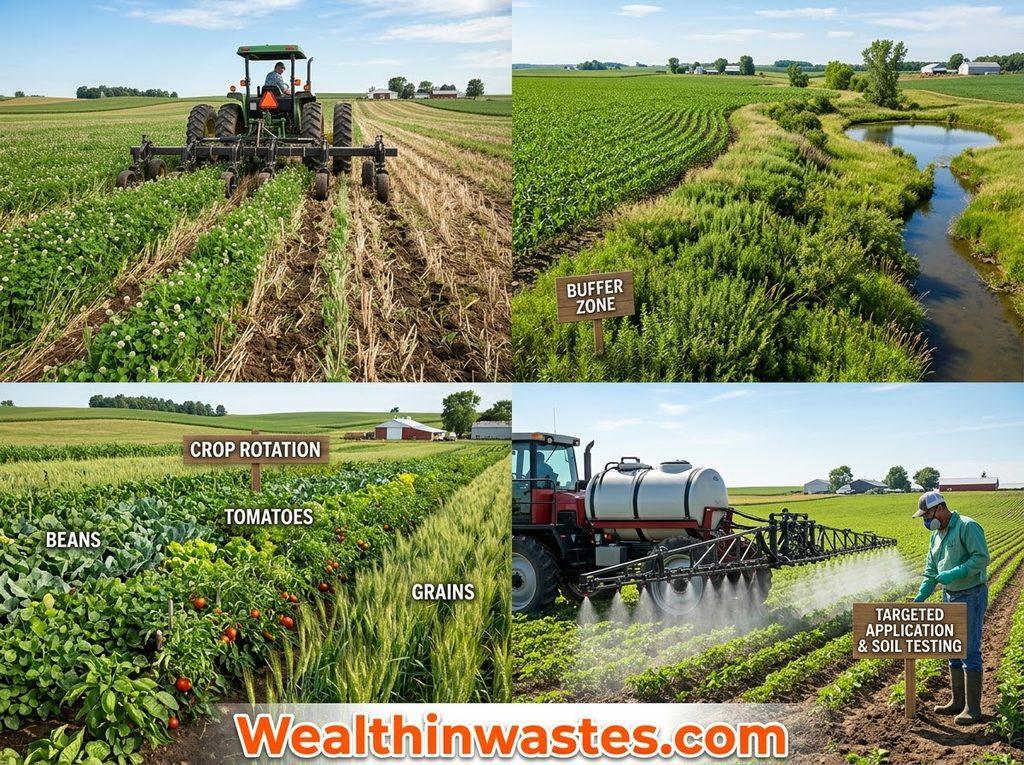
Soil conservation practices such as crop rotation, mulching, cover crops, sensible tillage, and erosion control can help protect soil resources and reduce movement of contaminated particles.
Farmers should also maintain appropriate setbacks from wells, streams, ponds, and drainage channels, especially when applying products that can persist or move readily under local environmental conditions.
Responsible handling matters after field application. Hazardous pesticide waste management prevents unused chemicals and contaminated materials from becoming additional sources of soil and water contamination.
Proper pesticide storage, mixing, container management, equipment cleaning, and disposal also reduce accidental releases that may create localized concentrations far greater than normal agricultural applications.
Where contamination has already occurred, biological remediation of contaminated land may offer useful approaches by supporting microorganisms or organic materials capable of treating certain pesticide-contaminated soils.
Additional environmental protection comes from preventing erosion and runoff. Land pollution prevention measures include reducing harmful agricultural chemical use and encouraging better land management practices.
Reducing pesticide carryover ultimately requires integrated management rather than dependence on one practice because degradation, adsorption, water movement, weather, and pesticide chemistry continually interact.
Farmers should read product labels carefully and consider crop rotation, soil testing, field history, weather forecasts, irrigation schedules, and known pesticide persistence when planning future applications.
Understanding pollution prevention principles can further improve pesticide stewardship by encouraging practices that minimize chemical releases before contamination becomes difficult or expensive to control.
Pesticide residues can also enter food systems when chemicals persist in soil or crops. Pesticide residues in food crops therefore represent another reason to observe correct rates, intervals, and application instructions.
Persistent residues can enter livestock through contaminated feed and environments. Information on managing pesticide residues in livestock highlights the importance of controlling exposure throughout agricultural production systems.
Residues may also transfer through animal products when contaminated plant materials enter feed systems. Sources of pesticide residues in animal products therefore deserve attention during farm management.
Agricultural activities can generate many pesticide-containing materials and residues. Proper handling of agricultural waste streams helps limit accidental release into surrounding soils and water resources.
Soil contamination itself can arise when pesticides accumulate after repeated applications, spills, poor disposal, or inadequate management. Understanding land pollution and soil contamination helps explain these environmental consequences.
Preventing pesticide contamination also protects water resources because chemicals can move from fields into streams, lakes, and groundwater through runoff, leaching, erosion, and drainage.
Water pollution sources and classifications explain why agricultural runoff represents an important nonpoint pollution pathway and why preventing pesticide movement from fields remains environmentally important.
Environmental contamination can involve multiple pollutants simultaneously. Pollution abatement and control approaches provide a broader framework for reducing contaminant releases across land, water, and air.
The fate of organic contaminants also depends on sorption, biodegradation, photolysis, volatilization, transport, and environmental conditions. Organic pollutant fate and mobility provide useful context for understanding these processes.
Overall, pesticide degradation depends on interacting soil factors, climatic conditions, microbial processes, pesticide properties, and management practices rather than one isolated environmental variable.
The most effective approach combines appropriate pesticide selection, accurate application, good soil management, weather monitoring, controlled irrigation, and responsible handling of pesticide residues and wastes.
Summary on Factors Influencing Pesticide Degradation in Soils
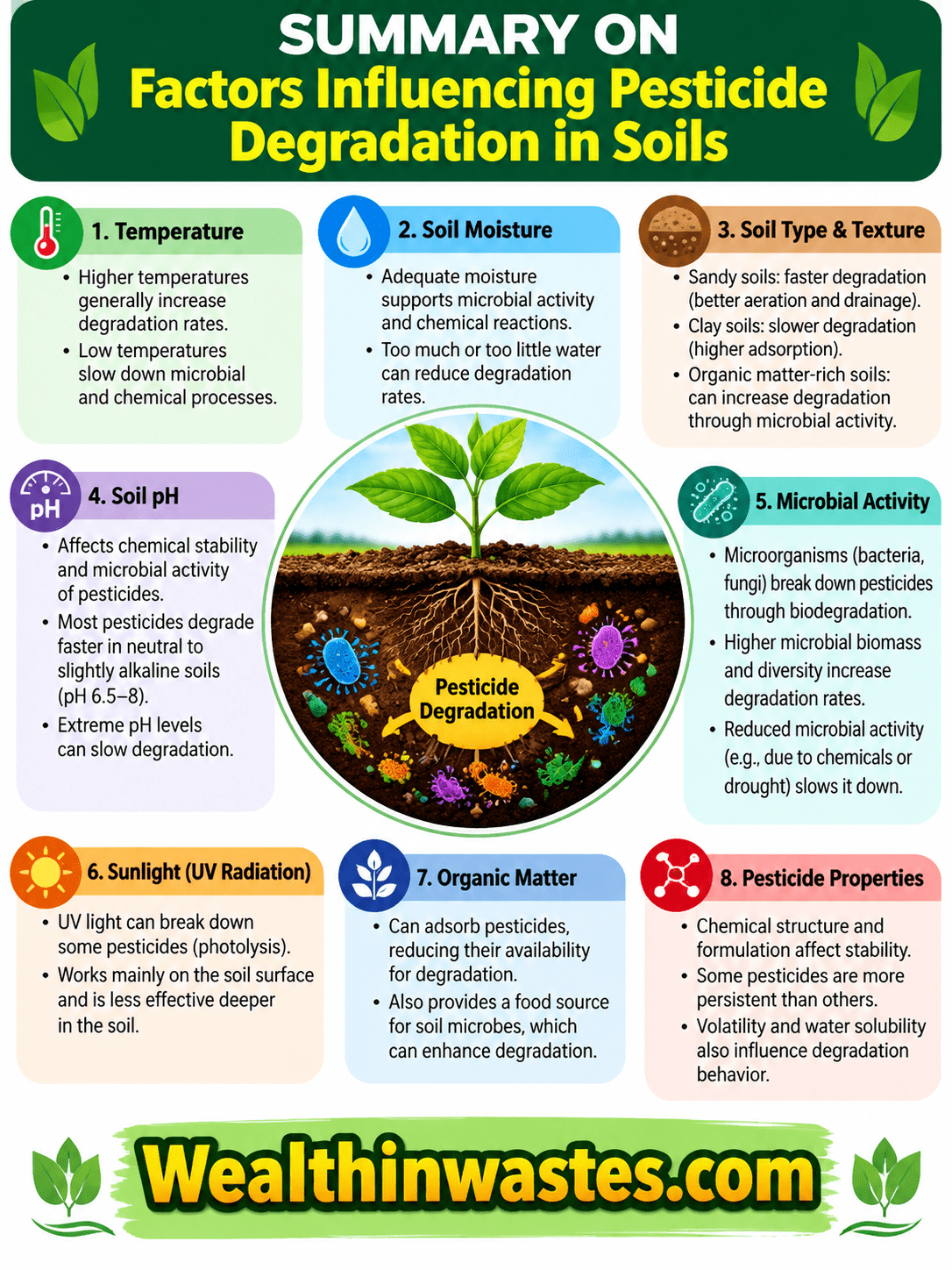
| Factor | Effect On Pesticide Degradation |
|---|---|
| Soil Texture | Controls adsorption, permeability, drainage, and pesticide movement. |
| Organic Matter | Can bind pesticides and alter microbial availability. |
| Soil pH | Changes adsorption, hydrolysis, solubility, and microbial activity. |
| Microorganisms | Transform pesticides through biological degradation pathways. |
| Moisture | Influences microbial activity, dissolution, and chemical reactions. |
| Temperature | Often accelerates chemical and microbial degradation when suitable. |
| Sunlight | Can cause photodegradation of exposed pesticide residues. |
| Pesticide Chemistry | Determines solubility, volatility, stability, and degradation pathways. |
| Rainfall And Irrigation | Influence leaching, runoff, transport, and pesticide availability. |
| Application Practices | Can increase or reduce persistence, movement, and carryover. |
Frequently Asked Questions About Factors Influencing Pesticide Degradation in Soils
1. What are the main factors influencing pesticide degradation?
The major factors include soil texture, organic matter, pH, microorganisms, moisture, temperature, sunlight, pesticide chemistry, rainfall, irrigation, and application practices.
2. Does soil pH affect pesticide persistence?
Yes. Soil pH can change pesticide adsorption, hydrolysis, solubility, microbial activity, and chemical stability, although the effect differs among pesticide groups.
3. Does organic matter increase pesticide persistence?
Organic matter can bind pesticide molecules strongly, reducing immediate availability while sometimes extending the period during which residues remain stored within the soil.
4. How does moisture affect pesticide degradation?
Adequate moisture generally supports microbial activity and chemical reactions, while very dry or excessively saturated conditions can alter degradation pathways and rates.
5. Can temperature affect pesticide breakdown?
Yes. Warmer conditions often increase chemical reaction rates and microbial activity, while cool conditions commonly slow these processes and allow residues to persist longer.
6. Does sunlight degrade pesticides in soil?
Sunlight can degrade some exposed pesticides through photolysis, although this pathway becomes less important after residues become incorporated into or shielded by soil particles.
7. Why can pesticides persist longer in some fields?
Differences in soil properties, climate, microbial communities, pesticide chemistry, moisture, application history, and management practices can produce substantially different persistence periods.
8. How can farmers reduce pesticide carryover?
Farmers can reduce carryover by choosing suitable products, following label rates, monitoring weather, managing irrigation, maintaining healthy soils, and observing crop rotation restrictions.
Do you have any questions, suggestions, or contributions? If so, please feel free to use the comment box below to share your thoughts. We also encourage you to kindly share this information with others who might benefit from it. Since we can’t reach everyone at once, we truly appreciate your help in spreading the word. Thank you very much for your support and for sharing!
Read Also: Chemical Methods of Weed Control Guide